At a glance
Micro data centres, once a single server rack with its own cooling, now include AI sites of up to 20MW placed near users and spare grid capacity.
Anthropic and OpenAI are seeking 20-30MW deals overseas, and Crusoe is building 1MW data centres in a Colorado factory at a target of 100 a year.
Running trained AI models for users, known as inference, can be split across small sites, and JLL says inference could overtake training in 2027.
Australia's draft grid standards tighten at 30MW, and Climate Change and Energy Minister Chris Bowen wants every connection of 5MW or more on a public register.
Queensland is best placed for micro data centres, with little data centre load on its grid, spread-out cities and a public map of network capacity.
The AI labs that sign for gigawatts are now shopping small. Anthropic and OpenAI, which have signed for campuses of hundreds of megawatts and gigawatts, are seeking sites of 20-30MW, CNBC reported.
Sites that size suit running finished AI models for users, work known as inference that can be split across smaller buildings with power already connected. The demand has revived an idea Telstra pitched in 2020, when it planned to turn 650 of its telephone exchanges into small computing sites close to users. A micro data centre then meant one server rack. It now means up to 20MW.
Smaller data centres are a growing part of the market, built alongside the giant campuses that AI training still needs, and Queensland is the Australian state best placed to host them. Australia's draft grid rules are already drawing lines at 5MW and 30MW that will decide how they are treated.
Micro data centres now range from one rack to 20MW
Equipment maker Vertiv defines a micro data centre as one rack carrying "critical loads of no more than 100-150 kilowatts". AI buyers now apply the idea to sites more than a hundred times larger.
Size | Example | Source |
|---|---|---|
One rack, up to 150kW | The traditional micro data centre | Vertiv |
About 1MW | Crusoe's container-sized Spark units; NEXTDC's Port Hedland site | Forbes, NEXTDC |
5-20MW | Planned AI sites at US electricity substations | IEEE Spectrum |
20-30MW | Smaller deals Anthropic and OpenAI are seeking | CNBC |
Source: Vertiv; Forbes, 12 March 2026; NEXTDC; IEEE Spectrum, 12 May 2026; CNBC, 18 September 2026.
NVIDIA and the Electric Power Research Institute, a US utility research body, plan about 25 data centres of 5 to 20MW beside substations, sized to the spare power a typical substation holds, IEEE Spectrum reported. Crusoe, the US developer behind the Texas campus OpenAI uses, builds 1MW units in a Colorado factory targeting 100 a year, according to Forbes. It raised US$3.9 billion on 17 September 2026 to build both the units and large campuses, which co-founder Cully Cavness calls "a barbell strategy".
Inference is pushing AI labs toward 20-30MW sites
Training an AI model takes thousands of chips working together in one building. Inference, running the finished model to answer users, can be split across smaller clusters, and real estate firm JLL expects it could overtake training in 2027.
Anthropic has sounded out 20-30MW agreements in the United Kingdom and the Nordics, and OpenAI has explored deals of that size in the Nordics, CNBC reported on 18 September 2026. "Securing a few megawatts at an existing powered site can be more practical than waiting for a much larger block in one location," Jabez Tan, head of research at Structure Research, told CNBC.
Alexandre Roussas, chief executive of European data centre developer Pure Core, wrote on LinkedIn that "for years 20 MW sat in an awkward spot. Too big for enterprise colocation, too small to interest a hyperscaler." The labs are now paying for "months saved", he wrote.
Customers want connected small sites and giant campuses together
Labs training models still want one giant campus. Labs serving users can spread across connected sites, where "a collection of smaller deployments can add up to substantial capacity," Tan said. "Training bought time. Inference will reward location," Samarth Maira, founder of US developer Blueprint Data Centers, wrote in DCD. The same labs shopping at 20-30MW hold far larger commitments: Anthropic has agreed to rent about 460MW from British provider Nscale in West Virginia, two people familiar with the matter told CNBC, and OpenAI has committed to a further 3GW in Georgia and 8GW in Ohio.
Cloud providers already run connected sites at larger scale. Each AWS availability zone is "one or more discrete data centers", with zones placed up to about 100km apart so one fire or power failure cannot take out a region. Spreading out adds buildings to run, backup equipment at each one and fibre between them.
Businesses and government agencies renting space mostly stay on large established campuses, where network connections and engineers are concentrated, and use small sites for local needs. NEXTDC's Port Hedland site was built with BHP, Vocus and Microsoft to serve the Pilbara.
Carriers are offering their buildings again, after an Omdia analyst wrote in 2025 that distributed computing of that kind had not taken off. Verizon chief executive Dan Schulman said on 10 September 2026 the carrier is now "already signing up deals" to turn "decommissioned central offices" into inference sites.
Big campuses run leaner, and small sites can use spare power and heat
Large campuses still run more efficiently. In an Uptime Institute survey published in October 2025, 67% of facilities drawing more than 20MW used less than 1.5 watts in total for every watt reaching the computers. Only 37% of facilities under 1MW did.
Small sites can use power a campus cannot reach. The national grid switched off 7.2TWh of wind and solar output in 2025 because lines were full or prices fell below zero, RenewEconomy calculated, and a modular unit can sit beside a wind or solar farm to use it. Small sites can also give their heat away. Deep Green's unit at Exmouth in England keeps a public pool at 30°C for 60% of the time through pipes three metres long, CIBSE Journal reported.
Australia has almost no district heating networks, so heat reuse here depends on a single neighbour such as a pool or a greenhouse. A liquid-cooled unit on surplus renewables with a heat customer next door can outperform a campus on a coal-heavy grid, while an air-cooled small room running half empty falls behind a modern campus.
Micro data centre readiness by state: Queensland ranks first
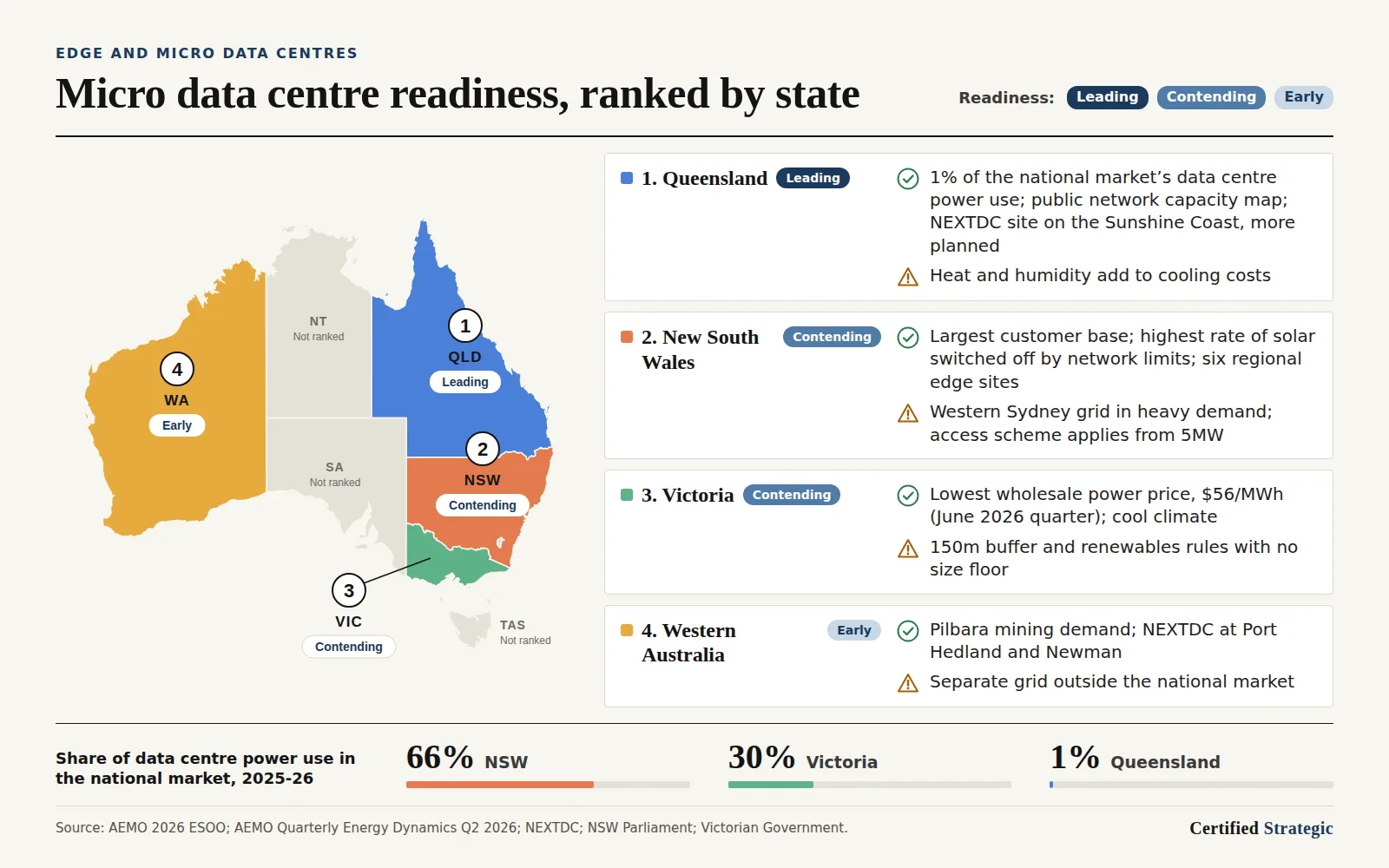
Queensland is the state best placed for micro data centres: data centres use little of its grid, its population is spread across several large cities, and NEXTDC already runs an edge site there with more planned. Each state is placed in one of three readiness bands, from early through contending to leading, the same scale as the state-by-state ranking of Australia's data centre build. Most AI models Australians use are trained overseas, so much of the AI data centre capacity built here will run inference, and the operating data centres in Australia already hold the grid connections a small site needs.
State | Readiness | Why |
|---|---|---|
1. Queensland | Leading | 1% of the national market's data centre power use, a public capacity map and spread-out cities; heat and humidity add to cooling costs |
2. NSW | Contending, in the regions | Largest customer base and most network curtailment; western Sydney grid in heavy demand and an access scheme from 5MW |
3. Victoria | Contending, held back by rules | Lowest wholesale price, $56/MWh in the June 2026 quarter, and a cool climate; 150m buffer and renewables rules with no size floor |
4. Western Australia | Early, a mining niche | Pilbara mining demand and NEXTDC sites at Port Hedland and Newman; separate grid outside the national market |
Source: AEMO; RenewEconomy; NEXTDC; Leading Edge Data Centres; NSW Parliament via PV Tech; Victorian Government via ABC News, September 2026.
1. Queensland: leading. Queensland's data centre market accounted for 1% of data centre electricity use in the national market in 2025-26, against 66% for NSW and 30% for Victoria, AEMO's 2026 forecasting overview shows. Its population is spread across the Gold Coast, the Sunshine Coast, Townsville and Cairns as well as Brisbane, and its networks, Energex and Ergon, publish a network load capacity map. NEXTDC runs a 1MW site at Maroochydore, where the Japan-Guam-Australia South subsea cable comes ashore, and lists 6MW sites in planning for the Sunshine Coast and the Gold Coast. Wholesale power averaged $67/MWh in the June 2026 quarter, against $75/MWh in NSW, AEMO reported.
2. NSW: contending, in the regions. The state has the largest customer base and the highest rate of solar switched off by network limits. Leading Edge Data Centres runs six regional sites from Newcastle to Wagga Wagga, and GreenSquareDC signed Sharon AI on 21 September 2026 as the first customer for a 15MW first stage at Norwest. The state's large load access bill, introduced on 5 August 2026, covers connections from 5MW.
3. Victoria: contending, held back by rules. The state had the lowest wholesale price in the national market in the June 2026 quarter, at $56/MWh, and a cool climate that cuts cooling costs. NEXTDC began building a 4.4MW site in Geelong in April 2026, DCD reported. The 150m residential buffer and renewables requirement announced on 22 September 2026 came with no size floor, so as announced they would apply to regional micro data centres as well as a campus. A size exemption in the final rules would put Victoria ahead of Queensland.
4. Western Australia: early, a mining niche. NEXTDC's 1MW sites at Port Hedland and Newman serve Pilbara mining, and WinDC, which puts containerised computing at wind, solar and battery sites, agreed in March 2026 to deploy 11MW of modular data centres from US maker Armada in Western Australia, New South Wales and other states on the national grid. Western Australia runs its own grid, outside the national market and its rules.
Megaport, the Brisbane company that sells connections between data centres, raised A$827.3 million in June 2026 for a distributed AI inference cloud and plans its first test deployment of graphics processors in the December 2026 quarter, according to its FY26 results. Certified Strategic predicted in its outlook for the rest of 2026 that the next ten large AI data centre announcements in Australia will average under 150MW.
Australia's draft grid rules draw lines at 5MW and 30MW
The Australian Energy Market Commission, which writes the national electricity rules, proposed on 12 March 2026 to apply stricter grid standards to data centres of 30MW or more, with a final determination due on 29 October 2026. Bowen's July 2026 rule change request asks networks to report every connection of 5MW or more. The request says a 5MW threshold "helps manage, and provide insights regarding, boundary effects that could arise if developers seek to avoid regulatory requirements that apply to loads of 30MW or greater."
A 20MW inference site would sit under the stricter line and above the reporting line. The commission advised energy ministers on 5 August 2026 that reforms could be applied so smaller facilities "aren't subject to the same requirements as the largest connections", without naming a size. Finland is drawing its lines lower: a draft law released on 18 September 2026 keeps data centres of up to 1MW in the first-come, first-served queue for grid connections.
What to watch
The commission's final access standards. The 29 October 2026 determination will confirm or move the 30MW line for the stricter grid standards.
Bowen's 5MW register. Submissions on the commission's consultation close on 5 November 2026, with a draft determination due on 1 April 2027.
Megaport's first graphics processors. The half-year result on 18 February 2027 will be the first to cover the December quarter test deployment.
A 20-30MW lab deal in Australia. Neither Anthropic nor OpenAI has named an Australian deployment of that size.