At a glance
The Australian Government will legislate mandatory national standards for large data centres in early 2027, after National Cabinet agreed on 26 August 2026 to develop them with the states. Its consultation paper is open for submissions until 9 October 2026.
Five jurisdictions have a dedicated data centre policy instrument: New South Wales, Victoria, South Australia, Tasmania and the ACT.
Victoria published its Sustainable Data Centre Action Plan on 22 September 2026: new data centres bring their own renewables and storage, pay for their grid upgrades, use recycled or non-drinking water for water-intensive cooling and sit at least 150 metres from homes.
New South Wales published its Data Centre Guidelines on 17 August 2026 and continues to fast-track major projects through its Investment Delivery Authority, with a parliamentary inquiry reporting by 3 November 2026.
South Australia has proposed a Data Centre and AI Infrastructure Act that ties faster approvals to new firmed renewable supply, announced but not yet introduced to parliament.
Queensland, Western Australia and the Northern Territory are attracting investment through broader digital and economic strategies, and Anthropic signed its first Australian data centre lease in Queensland on 16 September 2026.
Which states have a data centre policy
Victoria, South Australia and Tasmania have dedicated data centre policies, and New South Wales published its Data Centre Guidelines on 17 August 2026. The ACT announced a framework of its own on 26 August 2026. Queensland, Western Australia and the Northern Territory are attracting data centre investment through broader digital and economic strategies rather than a standalone plan. Over the top of all of them, the Australian Government published national expectations in March 2026 and is now writing mandatory standards, to be legislated in early 2027.
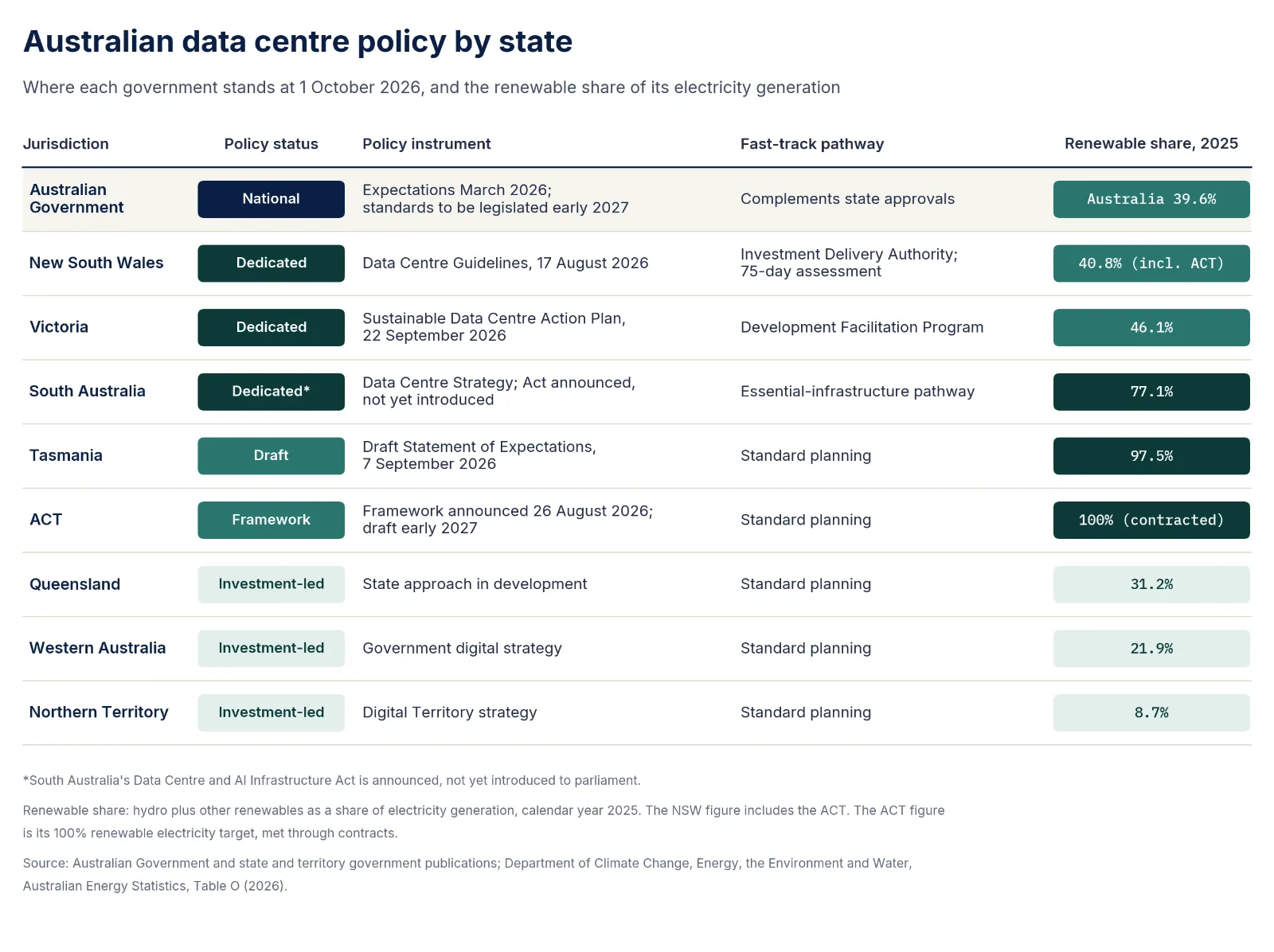
The pattern matters because state and territory governments control the planning approvals that decide where data centres are built. The same investment is choosing Australia as a whole, so the policy lessons each jurisdiction generates on land, grid, water and community consent transfer across borders. The table below summarises where each government stands.
Jurisdiction | Dedicated data centre policy? | What it is |
|---|---|---|
Australian Government | Yes, in development | Expectations published March 2026; mandatory national standards to be legislated early 2027; consultation closes 9 October |
Victoria | Yes | Sustainable Data Centre Action Plan, 22 September 2026: own renewables, grid costs paid, non-drinking water for cooling, 150-metre buffer |
South Australia | Yes, proposed | Announced Data Centre and AI Infrastructure Act, plus an essential-infrastructure planning pathway |
Tasmania | Yes, targeted | Draft Statement of Expectations, 7 September 2026; comment closes 12 October |
New South Wales | Yes | Data Centre Guidelines and Policy Framework, 17 August 2026; inquiry due 3 November |
Queensland | No | Investment through Advance Queensland and digital-economy roadmaps |
Western Australia | No, emerging | Government digital strategy; industry pushing for a dedicated plan; subsea-cable focus |
Northern Territory | No, investment-led | Digital Territory strategy and the Terabit Territory network; Darwin as an Asia gateway |
ACT | Yes | Data centre framework announced 26 August 2026; draft due early 2027 |
Source: Australian Government and state and territory government publications, 2026.
The Australian Government is writing national standards for every state
In March 2026 the Australian Government published its Expectations of data centres and AI infrastructure developers under the National AI Plan. It asks operators to bring new clean energy, pay their full grid-connection and network costs, and run as a flexible load that supports the grid.
On 26 August 2026 National Cabinet agreed that the Commonwealth will work with state and territory governments to develop consistent mandatory standards for data centre energy, water and land use, and legislate them in early 2027. Until the standards are legislated, developers build under the rules each state has in place.
The Department of the Prime Minister and Cabinet released the consultation paper for those standards in September 2026, Getting it right: Building AI infrastructure that works for Australia. It sets out requirements for large data centres under five headings: contributing to the energy transition, minimising water use, imposing no net costs on consumers and communities, engaging with local communities and councils, and building skills. It seeks views on a size threshold, with energy as the likely measure, and says the standards will complement state planning and approvals rather than duplicate them. Submissions close on 9 October 2026.
Energy ministers agreed on 28 July 2026 to progress rules requiring data centres to offset their electricity demand with new renewable generation in the jurisdiction where they operate. Queensland and the Northern Territory were not part of that agreement. Ministers also supported the Commonwealth's commitment to legislate national standards, with states and territories able to build in more stringent local requirements.
Victoria, South Australia and Tasmania lead with dedicated plans
Victoria published its full Sustainable Data Centre Action Plan on 22 September 2026, through the Department of Jobs, Skills, Industry and Regions. New data centres will offset their operating electricity with new renewable generation and storage, and cover their connection and network costs. Planning schemes gain a data centre land use, with a 150-metre buffer from homes, and facilities using water-intensive cooling must use recycled or non-drinking water. Investors get one government contact, the Investment Front Door, and public maps of where power and water capacity is available, as set out in what's in Victoria's plan. The requirements will not apply to planning applications lodged before the plan was released. The state says its data centre plan could unlock up to A$25 billion in private sector projects, and in Geelong NextDC has bought 169 hectares at Lovely Banks beside a transmission line.
South Australia has gone furthest toward dedicated legislation. It has opened an essential-infrastructure planning pathway for data centres and has announced a proposed Data Centre and AI Infrastructure Act, not yet tabled, that would link faster approvals to projects arriving with their own new firmed renewable supply, as we covered in South Australia's clean-power plan to win AI data centres. The pitch is landing capital, with IREN building an 800MW campus at Bundey.
Tasmania published a draft Statement of Expectations for data centres and AI infrastructure on 7 September 2026, open for comment until 12 October. It asks developers to bring new renewable generation into the state and cover their network and connection costs, and it is a non-statutory statement of government policy that creates no new approval step. The AI Factory Zone declared in July 2025 has no published planning instrument giving it legal effect, and both Firmus applications lodged since have gone to councils under the ordinary Tasmanian Planning Scheme. That zone underpins Firmus's Project Southgate, which sits behind a new subsea cable into the mainland network.
New South Wales published its data centre guidelines on 17 August 2026
New South Wales hosts the largest pipeline and finished its policy on 17 August 2026, publishing Data Centre Guidelines that set efficiency and water conditions, an ability to cut grid demand on request, and power purchase agreements of at least ten years signed with generation projects that have not reached a final investment decision. Meeting them is not compulsory: a project that addresses the principles behind them is promised an assessment taking no longer than 75 days in state government hands. They followed the Data Centre consultation paper of March 2026 setting out five principles on energy, water and the long-term interest of households, which we examined in detail, and the state continues to fast-track major projects through an Investment Delivery Authority, as covered in our analysis of how NSW is competing for data centre capital. A separate bill, which passed the Legislative Assembly on 15 September 2026 and is before the Legislative Council, would let the energy minister declare grid access schemes for large loads with connections of 5MW or more, with the cost of the network they need charged to the project. A Legislative Council inquiry is due to report by 3 November 2026.
Queensland, WA and the NT compete on investment, and the ACT sets conditions
The remaining jurisdictions are pursuing the build without a dedicated data centre plan. Queensland attracts investment through its Advance Queensland and digital-economy roadmaps, with projects such as the Supernode complex in Moreton Bay and NextDC's Sunshine Coast expansion proceeding under general planning. On 16 September 2026 Anthropic signed its first Australian data centre lease in Queensland, at Zerra DC's Western Downs Digital Park near Dalby. The state is developing its own approach to data centres, including a social impact assessment and agreements with local councils, covered in our Queensland spotlight.
Western Australia has a government digital strategy and heavy subsea-cable investment, and its own business chamber is urging the state to publish a dedicated data centre strategy. Its planning schemes carry no defined use for a data centre, and the Premier said on 8 September 2026 that developers keep approaching the state about the Mid West and the North West, as covered in where in WA an AI data centre can be built. The Northern Territory runs a Digital Territory strategy and the Terabit Territory network, positioning Darwin as a gateway to South East Asia.
The ACT announced a data centre framework on 26 August 2026. Chief Minister Andrew Barr said data centres will be expected to offset their additional electricity demand through investment in new renewable generation and to demonstrate best-practice water efficiency, and that they cannot be built in residential neighbourhoods. No faster assessment pathway is attached, and the draft framework is due in early 2027.
What to watch
9 October 2026: submissions close on the Australian Government's national standards consultation paper.
12 October 2026: comment closes on Tasmania's draft Statement of Expectations.
29 October 2026: the AEMC's final determination on grid access standards for large loads, including data centres.
3 November 2026: the NSW Legislative Council inquiry into data centres reports.
16 November 2026: the Senate inquiry into artificial intelligence and data centres reports. We read all 54 submissions, summarised in what councils and operators told the Senate.
Early 2027: national standards legislation, and the ACT's draft data centre framework.