At a glance
The South Australian government on 23 June 2026 released a data centre strategy to attract AI infrastructure investment, with government modelling putting a 1GW campus at about A$6.8 billion in capital expenditure, an estimated 500 to 1,000 construction jobs and 200 to 300 ongoing roles.
The centrepiece is a faster, coordinated planning path: the Act would let the Coordinator-General take over decision-making for major projects and give the sector a dedicated pathway. The government frames the strategy around a principle it calls "new energy for new demand".
Mandala research for Data Centres Australia puts members' renewable matching at about 70% of consumption, of which about 1.5 TWh, close to 40% of consumption, comes from operational power purchase agreements. Mandala notes such agreements are typically signed before projects reach financing, so they help underwrite additional renewable capacity.
IREN’s planned 800MW Bundey campus, reported at around A$10 billion, is the working model: a large anchor load that finances new clean energy in a renewable energy zone.
Applications would need SA Water advice on water sufficiency and a Technical Regulator certificate on power-system compliance. The Act has been announced, not yet introduced to state parliament.
AirTrunk welcomed the strategy the same day, highlighting jobs, skills development and long-term regional benefits.
South Australia opens the door to AI data centre investment
Premier Peter Malinauskas released the strategy on 23 June 2026, telling reporters the state needs data centres and intends to win its share of the AI build-out. As reported by the ABC, the government plans to introduce new laws into state parliament to give the sector its own pathway rather than leaving it to existing planning rules. The legislation has been announced, not tabled, so the operative detail will sit in a bill that does not yet exist in public form.
The pitch is built for an Australian audience watching capital chase clean power. South Australia runs the highest wind and solar share of any mainland grid and is targeting 100% net renewable electricity by 2027, which is exactly what a power-hungry AI campus wants. Government modelling cited with the strategy puts a 1GW data centre at about A$6.8 billion in capital expenditure, with an estimated 500 to 1,000 construction jobs and 200 to 300 ongoing roles, and the state has already drawn IREN’s planned 800MW campus at Bundey. The strategy is a move to convert that interest into committed projects.
What the Data Centre and AI Infrastructure Act would offer
The strategy's guiding principle is "new energy for new demand", under which developers match demand growth with new, firmed renewable supply, so each new load is served by generation and firming the developer brings or contracts rather than by existing supply. The strategy says the Act will include measures to match new demand with new supply, though the bill is not yet drafted. In South Australia the binding constraint is firming. South Australia already has the clean generation; the value a large anchor customer adds is the firming, the batteries, transmission and dispatchable capacity that a long-term contract helps finance.
The strategy sets out further expectations alongside it: fit-for-purpose water supply with efficient closed-loop cooling, which it positions around the state's proposed Northern Water project rather than stressed local river systems, support for grid stability with transparent reporting on energy use, and a fair share of network costs. Applications must include SA Water advice on water sufficiency and a Technical Regulator certificate on power-system compliance. Recycled-water cooling, as in AWS's new Melbourne data centre, is one practical answer to the water question. The economics behind the 2026-27 default-offer cuts are the backdrop: data centres are net positive for the system when they fund their own supply, pay their own connection costs, and add flexibility. South Australia is promoting that as the model for building, which is close to how the strongest operators already run.
The grid case for new firmed supply
The opportunity is sharpest where the grid is tightest. When regulated bills fell across most of the country on 1 July 2026, South Australia was the one state where the default offer rose, up 1.4%, on transmission constraints and continued gas dependence, a pattern we detailed in why Australian power bills are falling. Large, creditworthy loads that sign long-term contracts for new firmed renewable supply are one of the few forces that can finance the generation and storage the state needs, and the strategy is designed to channel exactly that.
The national industry already operates this way, and at scale. In Mandala research for Data Centres Australia, members offset about 70% of their electricity consumption with renewables, of which about 1.5 TWh, close to 40% of consumption, comes from operational power purchase agreements. Mandala notes those agreements are typically signed before projects reach financing, so they help underwrite additional renewable capacity. Operators invested A$3.1 billion in grid infrastructure between 2020 and 2025, with a further A$7.2 billion forecast by 2030, A$1.1 billion of it capacity over and above their own needs and available for public use. Data centres are required to fund their own grid connections, including transmission and distribution upgrades where existing capacity is insufficient. South Australia's strategy promotes that practice as its model.
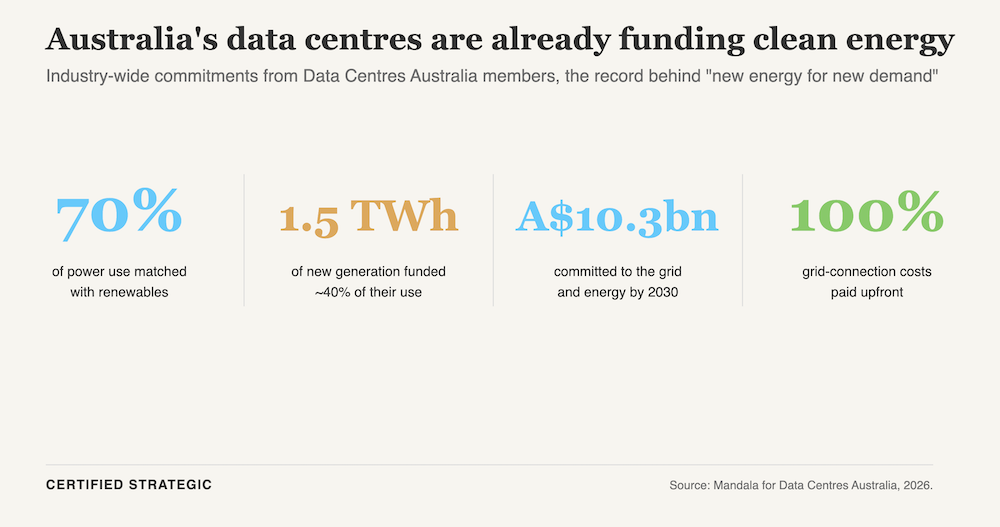
Industry-wide commitments reported by Data Centres Australia.
800MW campus at Bundey
On 3 June 2026, IREN signed a transmission connection agreement for a planned 800MW campus at Bundey, roughly 125km northeast of Adelaide, securing four 330kV feeder exits sized to carry the full load without network upgrades and targeting first power from 2028. IREN cited South Australia’s target of 100% net renewable electricity by 2027, submarine fibre into Singapore, Indonesia, South Korea and Japan, and a state government acting on AI.
Bundey is, in effect, the working model the strategy promotes. The campus anchors to a renewable energy zone, takes a connection sized for its own load, and sits beside the storage and transmission that firm the grid. Reported at around A$10 billion, it shows what a single anchor customer can pull into a region: clean generation, transmission headroom and skilled jobs. The move also broadens a national pipeline that has clustered on the eastern seaboard, the dynamic we examined in the data centre boom as a national opportunity.
Operators welcome the strategy’s community focus
The first operator response came within the hour. AirTrunk, which is building past 630MW in Melbourne, said in a post on the strategy that what stood out was the emphasis on benefits beyond the data centre fence line: jobs, skills development, stronger energy infrastructure and long-term regional growth. The company framed those outcomes under its community-investment approach and said the real opportunity lies in how the investment creates lasting value for local communities. AirTrunk’s response, focused on jobs and community benefit, reads as the sector treating the strategy as an invitation rather than a barrier.
A faster planning path for projects that bring their own power
South Australia is offering a faster, coordinated route to approval. The proposed Act would empower the Coordinator-General to take over decision-making for major projects and set up a dedicated pathway. This builds on 2025 amendments to the Planning, Development and Infrastructure Act, passed in November 2025, that already let qualifying data centres be approved through the state's essential-infrastructure pathway (section 130), with SA Water advice on water sufficiency and a Technical Regulator certificate on power-system compliance required.
The pathway favours building. South Australia is offering certainty and speed, paired with the state's renewable grid as a reason to choose it. Concerns raised about water use and the pace of approvals, including by the Greens, are real, and the strategy's water-efficiency and transparency commitments are the government's answer to them.
How South Australia’s approach compares
South Australia is the first Australian jurisdiction to propose a dedicated data centre Act with its own fast-track planning pathway. Other governments are moving on the same questions by different routes. The Australian Government issued national expectations for data centre and AI developers in March 2026, guidance used to prioritise projects rather than binding law. New South Wales, which hosts about 60% of the national connection pipeline, has consulted on five principles including a requirement that developers fund their own energy and water infrastructure, with a Legislative Council inquiry due to report by 30 September 2026.
Jurisdiction | Main instrument | Energy and supply condition | Planning approach |
South Australia | Proposed Data Centre and AI Infrastructure Act | "New energy for new demand" promoted as principle; named application requirements are water-sufficiency advice and a power-system certificate | Essential-infrastructure status, Coordinator-General fast-track |
New South Wales | Consultation paper, five principles (under review) | Developers to fund their own energy and water infrastructure | State Significant Development, performance-based |
Australian Government | National expectations for developers (guidance) | Expected to underwrite new generation and grid | State-led planning |
Source: Published government documents, June 2026.
What distinguishes South Australia is the dedicated Act: a statutory fast-track and essential-infrastructure status for the sector, paired with the pull of its renewable grid.
What to watch
Three items will shape how much the strategy delivers. The first is the bill itself: the timing of firming matters, because new supply works best for the grid when it lands with the load, and only the legislation will set that out. The second is the connection pipeline. AEMO’s Q1 2026 figures identified 11 large-scale data centre projects representing 5.4GW progressing through the transmission process, the demand the strategy is designed to capture, and we track the queue in our AEMO transmission pipeline analysis. The third is Bundey, and whether South Australia’s flagship moves from a signed connection toward construction as the first proof the model works.