At a glance
AEMO’s newsroom post Digital demand surge: Preparing Australia’s power systems for the rise of data centres discloses 11 large-scale data centre projects (each >5MW) totalling 5.4GW of maximum demand progressing through the National Electricity Market transmission connection process at the end of the March 2026 quarter. About 60% sits in New South Wales and 40% in Victoria.
Seven of the 11 projects, representing 4.1GW, are in the application phase. Four projects, representing 1.3GW, have moved into proponent implementation.
AEMO Group Manager Onboarding and Connections Margarida Pimentel names an approximate two-year target from application to energisation. The typical 5 to 10 year ramp-up of a large data centre is incorporated separately into AEMO’s forward outlooks.
The 2025 Inputs, Assumptions and Scenarios Report projects data centre electricity consumption rising at about 25% a year to around 12TWh (6% of NEM grid-supplied electricity) by FY30, and to around 34TWh (12%) by FY50.
AEMO cites the July 2024 Virginia event, in which roughly 1,500MW of data centre load disconnected after a single 230kV transmission fault, as the international precedent shaping Australia’s approach.
162 data centres are operational nationally, accounting for about 2% of grid-supplied electricity. Western Australia’s South West Interconnected System hosts 15 of them.
Data centres in Australia today use about 2% of the National Electricity Market’s electricity. AEMO projects that share rising to around 6% by FY30 and 12% by FY50. The 5.4GW in the transmission queue is the engineering footprint behind those forecasts, broken out by AEMO as a category for the first time so the build can be tracked transparently.
Data centres pay their own way on the grid. Operators pay 100% of their connection and network-augmentation costs upfront, as documented in Why Australian power bills are falling. The Australian Energy Regulator’s 2026-27 ruling cut residential default offers by up to 7.2% from 1 July 2026. Operator-paid network costs help keep household bills moderate while the data centre build runs.
Australian operators are funding new renewable supply. Members of Data Centres Australia already offset around 70% of their power use with renewable energy they fund themselves through long-term power purchase agreements. They have underwritten 1.5 TWh of new clean generation and committed A$10.3 billion in grid and energy infrastructure investment by 2030.
Supply is comfortably ahead of data centre demand. AEMO records about 72GW of generation and storage installed in the NEM, 67GW of new capacity actively connecting, and more than 345GW publicly announced. Against a 5.4GW transmission queue and an FY30 forecast of around 12 TWh of data centre consumption, the supply build is the larger number by a wide margin.
The grid is greener and cheaper while data centres grow. Renewables supplied 46.5% of NEM electricity in Q1 2026, a new record. Gas-fired output hit its lowest quarterly average since 1999. NEM-wide wholesale spot prices fell 12% year-on-year. Data centre growth is occurring alongside a cleaner, cheaper grid, as we set out in Wholesale prices fall as renewables hit majority share.
What AEMO disclosed
The “Digital demand surge” post is short by AEMO standards. The numbers inside it are not.
For the first time, AEMO’s Quarterly Energy Dynamics (QED) report has carved out data centre connections as a standalone category. The Q1 2026 QED, published in April 2026, recorded 11 large-scale projects (each greater than 5MW) representing 5.4GW of maximum demand progressing through the NEM transmission connection process at the end of the March quarter. Seven of those projects, 4.1GW combined, sit in the application phase. Four, 1.3GW combined, have moved into proponent implementation.
The geographic split is concentrated: around 60% of the disclosed capacity is in New South Wales, around 40% in Victoria. AEMO is working with distribution network service providers to capture distribution-level connections in future reporting. The 5.4GW transmission figure understates the full picture, because mid-scale facilities connect at distribution level and remain outside the current QED count.
5.4GW in transmission: how the projects break down
The numbers map cleanly to the AEMO categorisation:
Phase | Projects | Maximum demand |
Application | 7 | 4.1GW |
Proponent implementation | 4 | 1.3GW |
Total in NEM transmission connection (end-Q1 2026) | 11 | 5.4GW |
Source: AEMO Quarterly Energy Dynamics Q1 2026, as cited in AEMO’s “Digital demand surge” newsroom post.
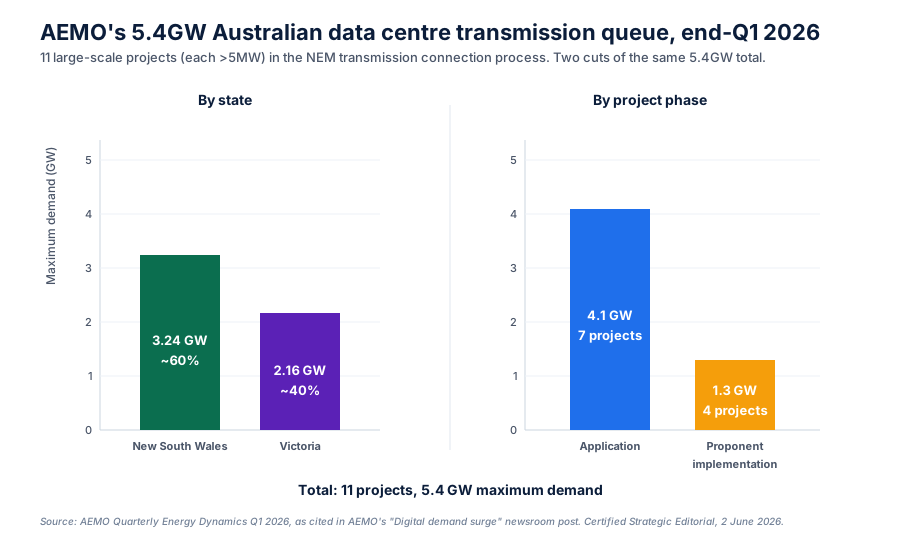
Chart 1. AEMO’s first data-centre transmission-pipeline disclosure
For context, 5.4GW is several times the size of Australia’s current operational data centre electricity draw. The Department of Industry pegs the operational fleet at about 1.5GW today, as we set out in Australia’s 1.5GW data centre fleet, grid-connected and renewable-PPA backed. The 5.4GW figure is the size of the forward order book at the transmission layer, not the installed base.
The 5.4GW figure confirms that the secular demand story embedded in the 2025 Inputs, Assumptions and Scenarios Report has translated into actual transmission applications and implementation work. The forecast and the queue now tell a consistent story.
A two-year connection target, and how Malaysia compares
Pimentel carries a long Australian connections track record (Hydro Tasmania, NEMMCO, VENCorp, AusNet Services, before AEMO). She trained as an electrical and electronics engineer and holds an MBA. When AEMO’s onboarding lead frames the connection conversation in terms of “predictability” and “enabling growth,” it reads as engineering pragmatism.
She describes current experience as “an approximate two-year timeframe from application to energisation, though timelines vary depending on project readiness and system conditions.” The two-year number is the first time AEMO has publicly anchored a target. It sits well below the 600-plus day approval timeframes Australian operators reported through 2023 and 2024, and it is roughly twice the 12-month Green Lane Pathway that Tenaga Nasional Berhad has built in Malaysia. AirTrunk and NEXTDC have together committed close to A$11 billion to Malaysian sites that connect on that 12-month basis.
The two-year Australian target is a credible compromise. It acknowledges the engineering reality of NEM connection, where system strength assessments, voltage stability modelling and Generator Performance Standards equivalents have no Malaysian counterpart. It also acknowledges the commercial reality that the queue is now real and visible, and that the cost of inaction is operators routing capital to jurisdictions that connect faster.
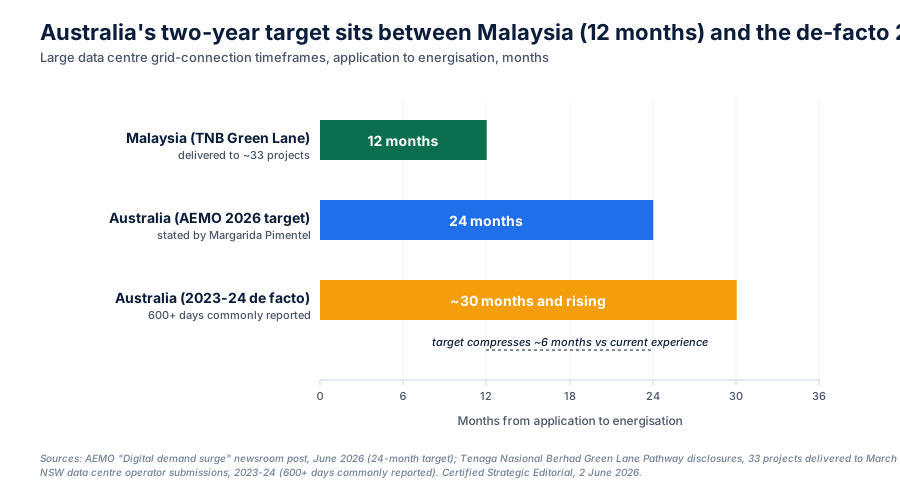
Chart 2. Australian data centre grid-connection timeframes
The AEMC rule change underway, and AEMO’s own draft connection guidelines for inverter-based loads, are the practical instruments for landing the two-year number consistently rather than as a best case.
Why the AEMC inverter-based loads rule exists
On 12 March 2026, the AEMC published a draft determination on access standards for large inverter-based loads, responding to AEMO’s Package 2 rule change request. Stakeholder submissions closed 7 May 2026. A final rule is due mid-to-late 2026.
The headline change is a firm, legally binding 30MW threshold written directly into the National Electricity Rules. The previous informal 5MW guideline never had statutory force. The new rule sets out how large loads such as data centres and hydrogen electrolysers must respond to voltage and frequency disturbances: ride through credible faults, or disconnect in a controlled, predictable manner.
For operators, the trade is more upfront certification work in exchange for shorter, more predictable connection timelines. Predictability is the gating item, and the rule’s direction is consistent with what hyperscalers and neoclouds have asked for in submissions to the NSW data centre consultation.
The Virginia precedent shaping Australia’s approach
The international reference point cited by AEMO is the July 2024 Virginia event. At 7pm on 10 July 2024, a single 230kV lightning-arrestor fault triggered about 60 northern Virginia data centres (roughly 1,500MW of load) to switch to backup UPS within milliseconds. The fault was brief; the sudden loss of 1.5GW left the upstream grid oversupplied. The northern Virginia grid avoided a cascading outage.
AEMO is a founding member of the International System Operator Network. The Virginia incident has been studied through ISON since late 2024, and the AEMC draft rule is the Australian translation of the lessons. The operator community is broadly aligned, because the alternative is unplanned drop-outs that take customer reputation down with grid reliability.
The forecast underneath: 12 TWh by FY30, 34 TWh by FY50
AEMO’s 2025 Inputs, Assumptions and Scenarios Report places Australian data centre electricity consumption at about 4 TWh in FY25, around 2% of NEM grid-supplied electricity. Under the Step Change scenario, that climbs to approximately 12 TWh by FY30 (6%) and to around 34 TWh by FY50 (12%). The implied annual growth rate is 25.1% across the FY25 to FY30 window.
These numbers are now being matched against the 5.4GW transmission queue. A 5.4GW build-out, ramped over five to ten years at typical hyperscale load factors, lands inside the FY30 forecast band, with distribution-level facilities sitting on top.
Where the 5.4GW sits in the Australian operator map
AEMO does not name the proponents behind the 11 transmission applications. The publicly disclosed pipeline across NSW and Victorian transmission-stage projects, however, accounts for considerably more than 5.4GW in aggregate. The 11 are a subset of a deeper bench. Several of these operators also run certified data centres in Australia under the Australian Government's Hosting Certification Framework.
Named projects at planning or implementation stage
These NSW and Victorian projects are at planning, endorsed or implementation stage. None can be individually attributed to AEMO’s 11 without proponent disclosure, but they are the credible cohort:
Microsoft Kemps Creek (NSW): 190MW, US$1.3 billion, two buildings, Building Two completing 2026
NEXTDC S4 Horsley Park (NSW): 350MW campus, in planning
NEXTDC S5 Macquarie Park (NSW): 80MW, in planning
NEXTDC S6 Artarmon (NSW): 13.5MW, Australia’s first purpose-built AI Factory, operating
AirTrunk SYD3 Western Sydney (NSW): 330MW+, hyperscale, the largest single campus in Asia-Pacific outside China
Goodman Eastern Creek Project Atlas (NSW): A$5bn project, Western Sydney
GreenSquareDC SYD1 Stage 2 (NSW): 96MW Western Sydney, endorsed
Macquarie Data Centres IC3 Super West Macquarie Park (NSW): 47MW, AI-ready, coming online 2026
Macquarie Data Centres future 150MW Sydney campus (NSW): planned
DCI SYD02/03 Eastern Creek (NSW): 36MW DA secured, on the existing SYD01 site
NEXTDC M4 Port Melbourne (VIC): 162MW, A$2 billion, DA secured January 2026
AirTrunk MEL2 Melbourne (VIC): 354MW, initial power-on mid-2026
That cohort alone runs well over the 5.4GW figure, which is why AEMO’s 11 is a subset, not a ceiling.
The operators with the largest live NSW and Victorian footprints:
Operator | Selected NSW / Victorian capacity | Status |
NEXTDC | Sydney S1-S6 series (S6 Artarmon = Australia’s first AI Factory, 13.5MW operating; S4 Horsley Park 350MW in planning), Melbourne M1-M3 plus M4 Port Melbourne 162MW A$2bn (DA secured Jan 2026) | Operating + pipeline |
AirTrunk | SYD1 (121MW+), SYD2 (158MW+), SYD3 (330MW+ Western Sydney), MEL1 (276MW+), MEL2 (354MW+, initial power-on mid-2026) | Operating + under construction |
CDC Data Centres | Eastern Creek Sydney, Brooklyn Campus Two Melbourne (200MW operating) | Operating + pipeline |
Equinix | Multiple Sydney sites (SY3 to SY9 series) plus ME1, ME2 Melbourne | Operating |
Macquarie Data Centres | 65MW Macquarie Park campus (IC2, IC3 East, IC3 Super West 47MW coming 2026) plus planned 150MW Sydney campus | Operating + pipeline |
GreenSquareDC | Endorsed | |
SYD01 Eastern Creek (11MW operating) plus SYD02/03 (36MW DA secured) | Operating + pipeline | |
Stack Infrastructure | Melbourne sites (six projects in the Victorian pipeline) | Pipeline |
Goodman Group | Project Atlas Eastern Creek (A$5bn), Western Sydney portfolio of powered shells | Pipeline |
Polaris Data Centre | Pyrmont Sydney | Operating |
Cisco Secure AI Factory at NEXTDC S3 Artarmon (1,024 Blackwell Ultra) plus Sharon AI Supercluster at NEXTDC M3 Melbourne (50MW additional capacity agreed Dec 2025) | Operating + pipeline | |
Six Australian facilities. Sydney: SYD10 + SYD11 Erskine Park (Templar Road, 25MW combined) and SYD12 North Ryde (Waterloo Road). Melbourne: MEL10 + MEL11 + MEL12 Deer Park (Radnor Drive), with land at MEL12 sized for a second-generation expansion. | Operating; 100% renewable-matched (Sydney from January 2024, Melbourne from January 2026 via Origin Energy / Stockyard Hill wind PPA) | |
Microsoft, AWS, Google | Sydney and Melbourne cloud regions | Operating + pipeline |
Source: Certified Strategic Editorial, primary operator disclosures, May 2026. Inclusion in this table does not imply attribution to any specific entry in AEMO’s 5.4GW disclosure.
That list excludes the second tier of Australian neoclouds covered in our neocloud market report, some of which connect at distribution rather than transmission. Firmus, ResetData and IREN sit alongside Sharon AI as the named Nvidia Cloud Partners building in or for Australia. IREN is offshore-domiciled but Sydney-headquartered, with Australian operations targeted from 2028.
What accelerates the pipeline from here
Four levers move the disclosed 5.4GW toward energised capacity faster.
The AEMC final rule. A final inverter-based loads rule by late 2026 ends per-project negotiation on Generator Performance Standards equivalents and substitutes a national standard. May 2026 submissions broadly supported the 30MW threshold.
Location alignment with new transmission. AEMO’s Integrated System Plan identifies Renewable Energy Zones in central-west and New England NSW, western Victoria and South Australia’s Mid-North. Siting near REZs reduces system strength and network augmentation costs that would otherwise sit on consumer bills.
PPA additionality. AirTrunk’s 25MW Riverina solar PPA with Google and OX2 is the working template. The AEMO post itself signals this preference, observing that “data centres are increasingly entering into power purchase agreements, underwriting new generation and storage while securing reliable energy for their operations.”
NSW consultation outcomes. The NSW data centre consultation paper sets five principles for the next decade of facility investment in the state hosting about 60% of the disclosed 5.4GW. Clarity, expected through the second half of 2026, will tell global capital allocators whether Sydney connection timelines are improving.
What to watch
Three dated milestones now sit in the calendar:
AEMC final rule on large inverter-based loads: mid-to-late 2026. The 30MW threshold and the technical performance standards will be locked in.
AEMO QED Q2 2026: publication expected July 2026. Confirms whether the 11 / 5.4GW figure has grown, and whether the NSW-Victoria split is shifting.
NSW consultation outcome: expected late 2026. The single largest jurisdictional variable affecting the 60% NSW share of the disclosed pipeline.
Pimentel’s closing line for the AEMO post is the operative summary: “The opportunity is substantial, but so too is the responsibility to ensure the energy system can support it.” Read alongside Data Centres Australia’s A$10.3 billion grid-investment commitment by 2030, the disclosure is the first public confirmation that the demand side of that equation now has a visible shape.