At a glance
Household power bills fall by up to 7.2% in south-east Queensland, up to 5% across most of New South Wales and Victoria, and 5% to 11% for small businesses, with effect from 1 July 2026, after the Australian Energy Regulator's final 2026-27 ruling on 26 May. The cuts are the deepest since 2022.
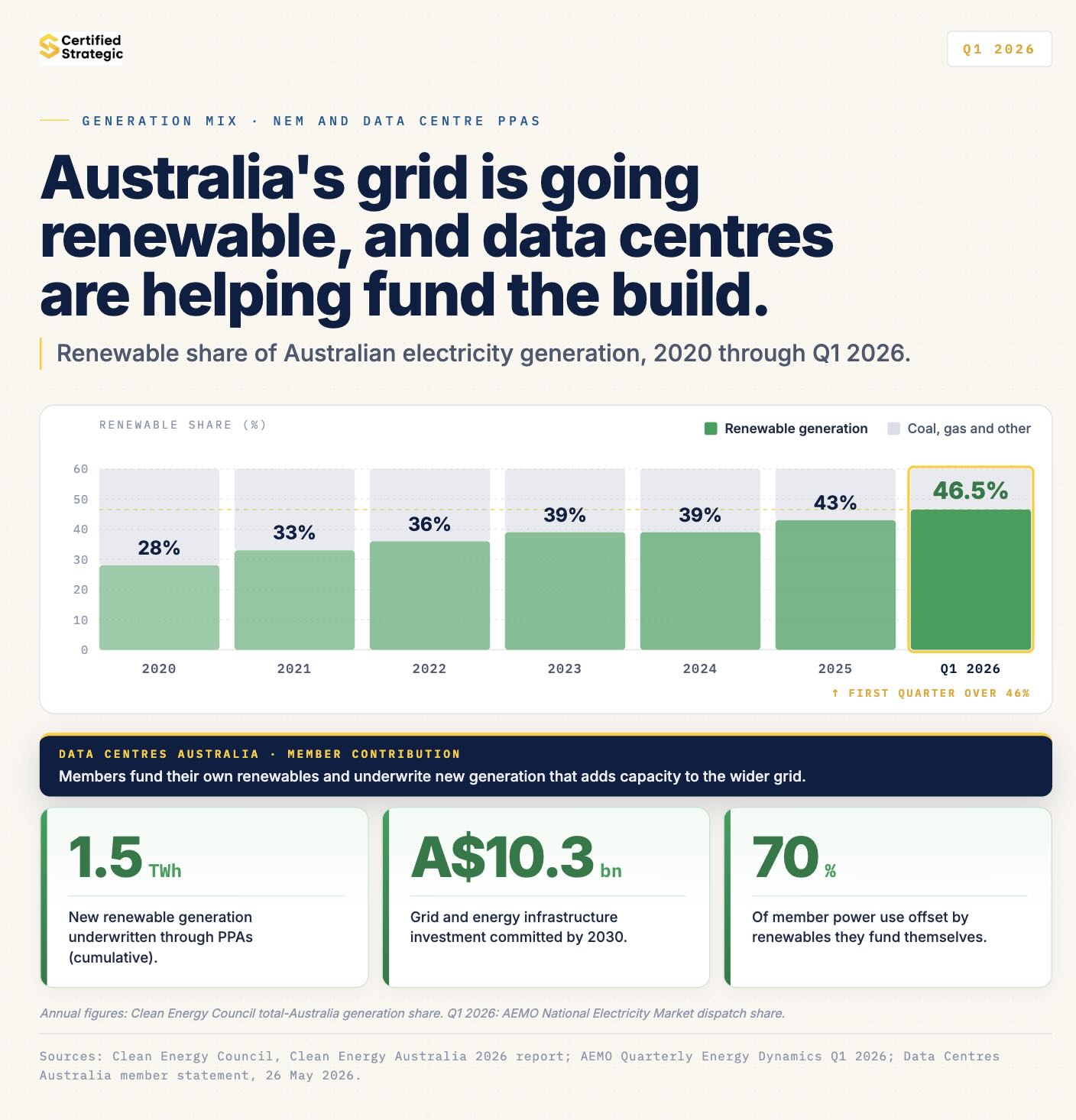
Bills are falling because Australia's grid is now majority renewable for the first time. The Clean Energy Australia 2026 report puts renewables at 43% of national electricity in 2025, up from 39% in 2024, and AEMO's Q1 2026 figures show that share reaching 46.5% in Q1 2026, with gas at its lowest output since 1999 and wholesale prices down 12%.
Australian data centres are helping pay for that build. Data Centres Australia members already offset 70% of their power use with renewables they fund themselves, have underwritten 1.5 TWh of new renewable generation through long-term contracts, and are committed to A$10.3 billion in grid and energy infrastructure investment by 2030.
The AER attributed part of the bill cuts to lower network costs, which make up 40% to 50% of a household electricity bill, and pointed to data centre growth as a contributor. Data centre operators pay 100% of their connection and network augmentation costs upfront, taking a load off ordinary households.
The cuts hold despite the Iran war and the closure of the Strait of Hormuz, which has roughly doubled Australian spot LNG prices. Because the grid burns far less gas than it did five years ago, the shock has not reached Australian electricity prices.
How much will Australian power bills fall on 1 July 2026?
On 26 May 2026, the Australian Energy Regulator finalised the Default Market Offer 2026-27, the cap that protects households on standing electricity plans. Victoria's Essential Services Commission did the same for its state. The cuts are the deepest since 2022.
Where you live | New default annual bill | Change vs last year |
Sydney and Central Coast (Ausgrid) | A$1,899 | Down up to 5% (~A$137) |
Western Sydney, Blue Mountains, South Coast (Endeavour) | A$2,328 | Down up to 5% |
Regional NSW (Essential Energy) | A$2,604 | Down up to 5% |
South-east Queensland (Energex) | A$1,988 | Down 7.2% (~A$155) |
South Australia (SA Power Networks) | A$2,334 | Up 1.4% |
Victorian average (VDO) | A$1,591 | Down 5% (~A$84) |
Source: Australian Energy Regulator and Victorian Essential Services Commission, 26 May 2026.
Small business cuts run deeper, up to A$705 a year on the Ausgrid network and A$445 on Energex. Only South Australia bucks the trend, with a 1.4% rise reflecting transmission constraints and continued local gas dependence.
The cuts also coincide with the federal government winding back its A$75-a-quarter household rebate, announced by Treasurer Jim Chalmers in December 2025. The headline reduction in regulated bills partially replaces what households were receiving as a transfer payment.
Why Australian power bills are really falling: the renewables story
AER chair Clare Savage attributed the cuts to falling wholesale energy costs, lower contract prices and stronger output from wind and battery storage during the evening peak. In plainer language: Australia is now burning much less expensive gas to keep the lights on, and that saving is showing up in your bill.
The Q1 2026 numbers from AEMO:
Renewables supplied 46.5% of National Electricity Market output, a new first-quarter record, up from 42.5% in Q1 2025.
Grid-scale solar averaged a record 2,706MW. Wind averaged a record 3,845MW.
Coal-fired output fell to a new quarterly low of 13,102MW.
Gas-fired generation averaged just 712MW, its lowest quarterly figure since 1999.
Big batteries set the wholesale price in 32% of trading intervals, more often than any other technology.
The national wholesale spot price fell 12% year-on-year to A$73 per megawatt-hour.
Combined with the second half of 2025, renewables and grid batteries have supplied more than half of the NEM's electricity over a rolling six-month window for the first time in the market's history.
How Australian data centres are helping cut power bills
This is the part of the story most coverage of the 26 May ruling is leaving out. The renewables build that is now cutting your bill, and the network build that sits underneath every household bill, are both being part-funded by Australia's data centre and AI infrastructure investment.
Australia's biggest data centre operators are large industrial buyers of electricity. To keep their facilities running on clean power, they sign long-term contracts called power purchase agreements, or PPAs, directly with wind and solar developers. Those contracts underwrite new renewable projects before construction starts. Without that anchor demand, many of the projects would not get financed.
Belinda Dennett, the chief executive of Data Centres Australia, the sector's peak industry body, set out the scale of the industry's contribution this week. Data Centres Australia members already offset 70% of their power use through renewables they procure themselves, have underwritten 1.5 TWh of new renewable generation through PPAs and large-scale generation certificates, and are committed to A$10.3 billion of grid and energy infrastructure investment by 2030. Operators pay 100% of their grid connection and network augmentation costs upfront, rather than passing those costs through to other customers.
AirTrunk has committed to match 100% of its electricity use with renewable energy by 2030. It is part of a long-term 25MW PPA with Google and OX2, announced in December 2023, that is funding a new Riverina solar farm scheduled to begin generating from 2025, an addition to the grid rather than a carve-out of existing supply. Macquarie Data Centres' 47MW IC3 Super West at Macquarie Park in Sydney is being marketed to customers as a sovereign AI hosting platform. CDC Data Centres markets its near-zero water and renewable-matched supply for federal workloads. GreenSquareDC's 96MW SYD1 Stage 2 facility in Western Sydney is being built in a region where new wind and solar are increasingly the marginal addition.
The new wave of Australian neoclouds and AI specialists we covered in our neocloud market report is doing the same. The Blackwell and Vera Rubin-class AI factories described at NVIDIA GTC 2026 consume power on a scale that simply will not work without firm, low-cost renewable contracts. Every gigawatt of data centre capacity that lands in Australia means more new wind and solar capacity has to be built to serve it, and that new capacity also feeds the grid that powers the rest of the country.
AEMO now forecasts data centre electricity consumption rising from around 4 TWh in FY25 to 12 TWh by FY30, an average growth rate of 25.1% a year. The sector is forecast to account for 25% to 30% of all new electricity demand growth on the NEM over the next five years. The CEFC and Baringa project up to 3.2GW of operational data centre capacity by 2035, representing 8% to 11% of national electricity consumption.
That is a substantial pipeline of long-term clean power contracts behind it. The more of that demand that lands in Australia, the more new renewable capacity Australian developers can finance, and the more reliable the cheaper-bill story becomes for households and small businesses.
Long-term renewable PPAs from data centres are timely. Australian wind and solar project investment has slowed sharply over the past year, with new financial commitments at decade-low levels even as renewables have lifted to 43% of generation. Big industrial buyers signing 10 and 15-year contracts are the kind of demand signal that gets new projects out of the planning queue and into construction, which keeps the renewable build, and the bill cuts that flow from it, on track.
How data centres are taking pressure off your network bill
Around 40% to 50% of a typical household electricity bill is not the cost of generation. It is the cost of poles, wires, substations and transmission, the "network" component. The Australian Energy Regulator cited lower network costs as one driver of the 26 May cuts, alongside falling wholesale energy prices.
Data Centres Australia argues that the sector is part of the reason network cost pressure is easing. According to the industry body, operators pay 100% of their connection and grid augmentation costs upfront and absorb the deep network upgrades their loads require. The A$10.3 billion of energy infrastructure investment Data Centres Australia members are committed to by 2030 lands directly in the parts of the network that need reinforcing anyway, transmission corridors, substations and renewable zone connections, without being recovered through household tariffs.
In plain terms, every new hyperscale or AI campus that connects in Western Sydney, the Hunter, Melbourne's west, south-east Queensland or Perth is funding network reinforcement that would otherwise have to be paid for through bills. The structural shift cutting power prices in 2026 sits on top of a network being part-paid for by industrial customers households never see on their bill.
Will the Iran war push up Australian power bills?
The cuts arrive while a serious global energy shock is still playing out. Iran's closure of the Strait of Hormuz on 4 March 2026, in the wake of the US and Israeli military campaign that began on 28 February, has effectively cut off most Qatari LNG exports. Australian spot LNG prices have roughly doubled since the campaign began.
In a country that gets a large share of its power from imported gas, that would be an instant bill shock. In Australia in May 2026, it is not.
The reason is the dispatch mix. With gas-fired generation now running at a fraction of historical levels, Middle East gas prices have less ability to push electricity bills around than they did during the 2022 crisis. The 2023 mandatory gas code keeps a cap on domestic east-coast gas pricing, and a separate federal gas reservation policy is due in 2027. The longer the Hormuz disruption continues, the more those guardrails matter. For now, the renewables-majority grid is the buffer.
Long-term PPAs from Australian data centre operators do two things at once: they finance new wind, solar and battery capacity, and they lock that capacity in at fixed prices for 10 to 15 years. Each additional contract narrows Australia's exposure to global gas price shocks, including any further escalation around Hormuz.