At a glance
Anthropic put at least 1.4GW to the Australian market in a tender reported on 5 July 2026, costed at up to US$15 billion. Queensland has taken the first piece of it.
Anthropic signed a long-term lease on 16 September 2026 at Zerra DC's Western Downs Digital Park near Dalby, thirteen days after Premier David Crisafulli put an offer to the company in California.
Queensland owns Stanwell, CS Energy and CleanCo, and Powerlink, Energex and Ergon. That ownership is what the national data centre standards leave a door open for, and four jurisdictions in the country have it.
A quarter of the landlord consortium is Australian and listed. Dexus owns 85 per cent of Australian Data Centres, which holds 25 per cent alongside Zerra DC and Macquarie Capital.
The filing puts up to 1,400 ongoing jobs at the campus, in a shire of about 34,700 people.
Kogan is one of six Queensland locations already scored against what a campus needs. Ipswich meets all five and carries no gigawatt-scale proposal.
Anthropic signed a campus that was already designed and filed
This is a spotlight on Queensland: what the state has, what it signed, and what it still has to build. As at 17 September 2026 the state holds a signed tenant on a gigawatt-scale campus, five further locations already scored against what a campus needs, three state-owned generators, and a A$31.9 billion project sitting in front of a regional council. In its 2025 planning report, published eleven months earlier, the state's transmission planner forecast 110MW of new industrial demand across southern Queensland and carried no data centre project at all.
Anthropic signed a long-term lease on 16 September 2026 at Zerra DC's Western Downs Digital Park, 37 kilometres north west of Dalby in a shire of about 34,700 people. Premier David Crisafulli described it as "a major win that will deliver more jobs, put more energy into Queensland's grid and drive down power prices for Queenslanders."
Anthropic's tender document, as quoted by the Financial Review's Street Talk, anticipated that a likely outcome was identifying a development partner without a fully developed site and jointly developing one. The tenant priced in a campus built from the ground up. The Kogan site was designed, costed and lodged before the tender closed.
Four conditions were already in place: a campus designed and filed with a council, generation standing beside the transmission connection, state ownership of the generators that supply it, and a published assessment of five further sites. Two are not: no carrier has published a fibre route to Kogan, and the trades to build it are contested statewide. The build runs four to six years.
Kogan takes the first piece of a 1.4GW order
Anthropic has been shopping for Australian capacity since March 2026. A confidential request for proposals reported by the Financial Review's Street Talk on 5 July 2026 put at least 1.4GW in play, costed at up to US$15 billion. Anthropic wanted at least 1GW in use by the end of 2027. It went to CDC Data Centres, AirTrunk, NEXTDC and IREN among others, with Stack Infrastructure on the list and a separate 300 to 500MW process alongside it. At 1.4GW the order approaches the size of the whole Australian operating fleet set out in the directory of Australian data centres.
The first commitment reported since went to Queensland. Kogan is an inference campus, running Claude for existing users rather than training new models. Inference tolerates distance from users far better than training tolerates distance from other training, which is what allows an inland site on contracted power. The application puts four buildings of 360MW at 1.44GW. An engineering report inside the same filing sets out six, which the ABC puts at 2.16GW. Cooling is air based, with no evaporative water use in operation, and Anthropic's lease covers the first stage.
The Australian Government signed Anthropic in March 2026
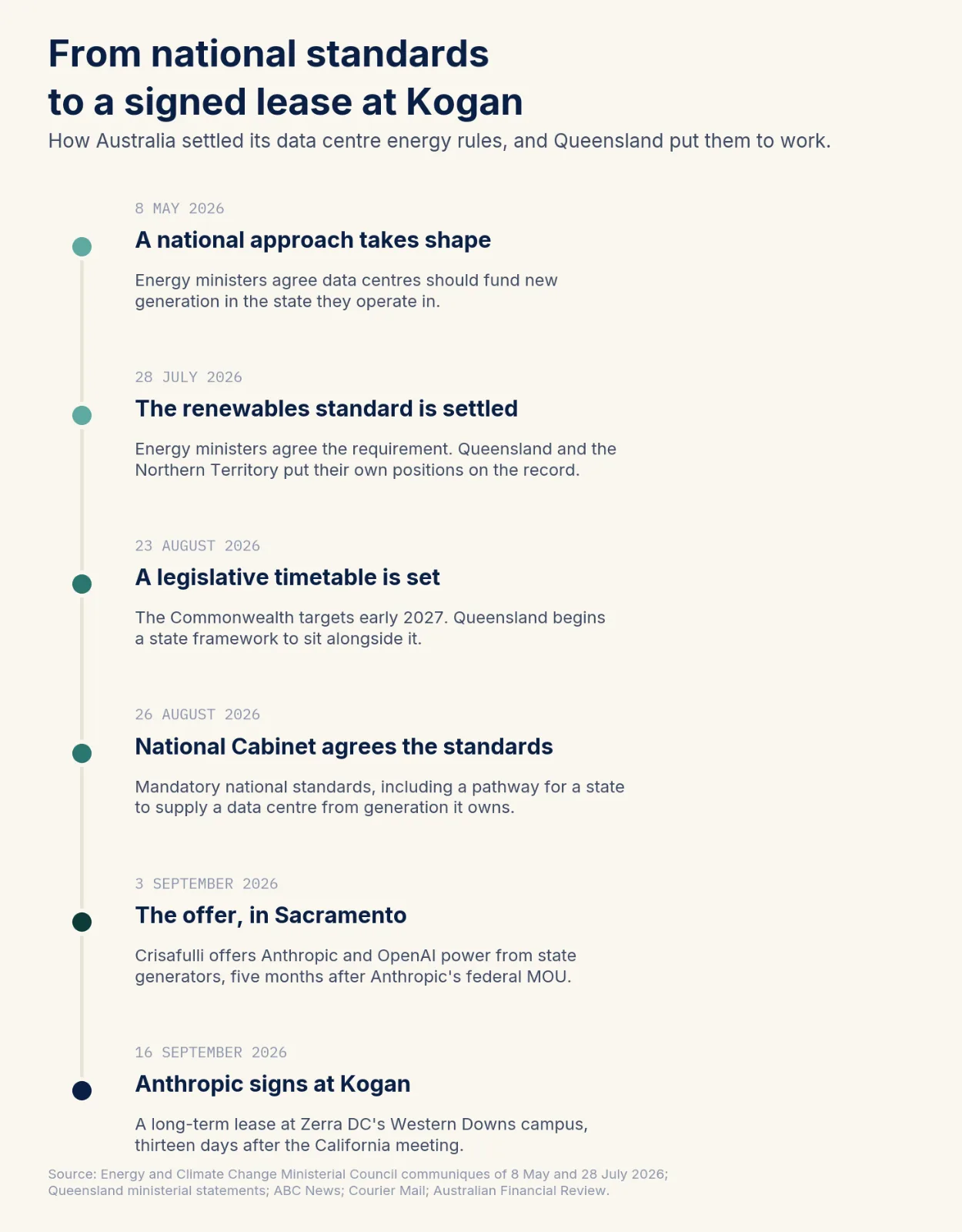
Anthropic signed a memorandum with the Australian Government on 31 March 2026, five months before any state put an offer on the table. Deputy Prime Minister Richard Marles and Assistant Minister Andrew Charlton were in San Francisco on 31 August 2026 meeting Anthropic, OpenAI, Microsoft, Google, Amazon and NVIDIA. The Commonwealth opened the commercial relationship and set the national standards, across four months of 2026.
Date | What happened |
|---|---|
8 May 2026 | Energy ministers agree data centres should fund new generation in the state they operate in |
28 July 2026 | The renewables requirement is agreed. Queensland and the Northern Territory put their own positions on the record |
23 August 2026 | The Commonwealth sets an early 2027 legislative timetable. Queensland begins a state framework to sit alongside it |
26 August 2026 | National Cabinet agrees mandatory national standards, with room for a state to supply from generation it owns |
3 September 2026 | Crisafulli puts an offer of state-owned power to Anthropic and OpenAI in Sacramento |
16 September 2026 | Anthropic signs a long-term lease at Kogan |
Source: Energy and Climate Change Ministerial Council communiqués of 8 May and 28 July 2026; Queensland ministerial statements; ABC News; Courier Mail; Australian Financial Review.
The wording agreed at National Cabinet on 26 August 2026 lets a jurisdiction use state-owned generation, transmission and distribution "where it has clear benefits to grid stability and lower customer prices," as reported by the trade publication The Energy. Climate Change and Energy Minister Chris Bowen set out how it works on 28 August 2026: the standards apply nationally, and "where a state owned government electricity company asserts that they can do it cheaper than renewables, they can apply to the Commonwealth to do that." One national rule, with a pathway for the jurisdictions that still own generation.
Crisafulli called it a win and said why. "Because we own our assets, our distribution and our generation, we are able to control a different mixture of energy right across the board."
Queensland owns Stanwell, CS Energy and CleanCo
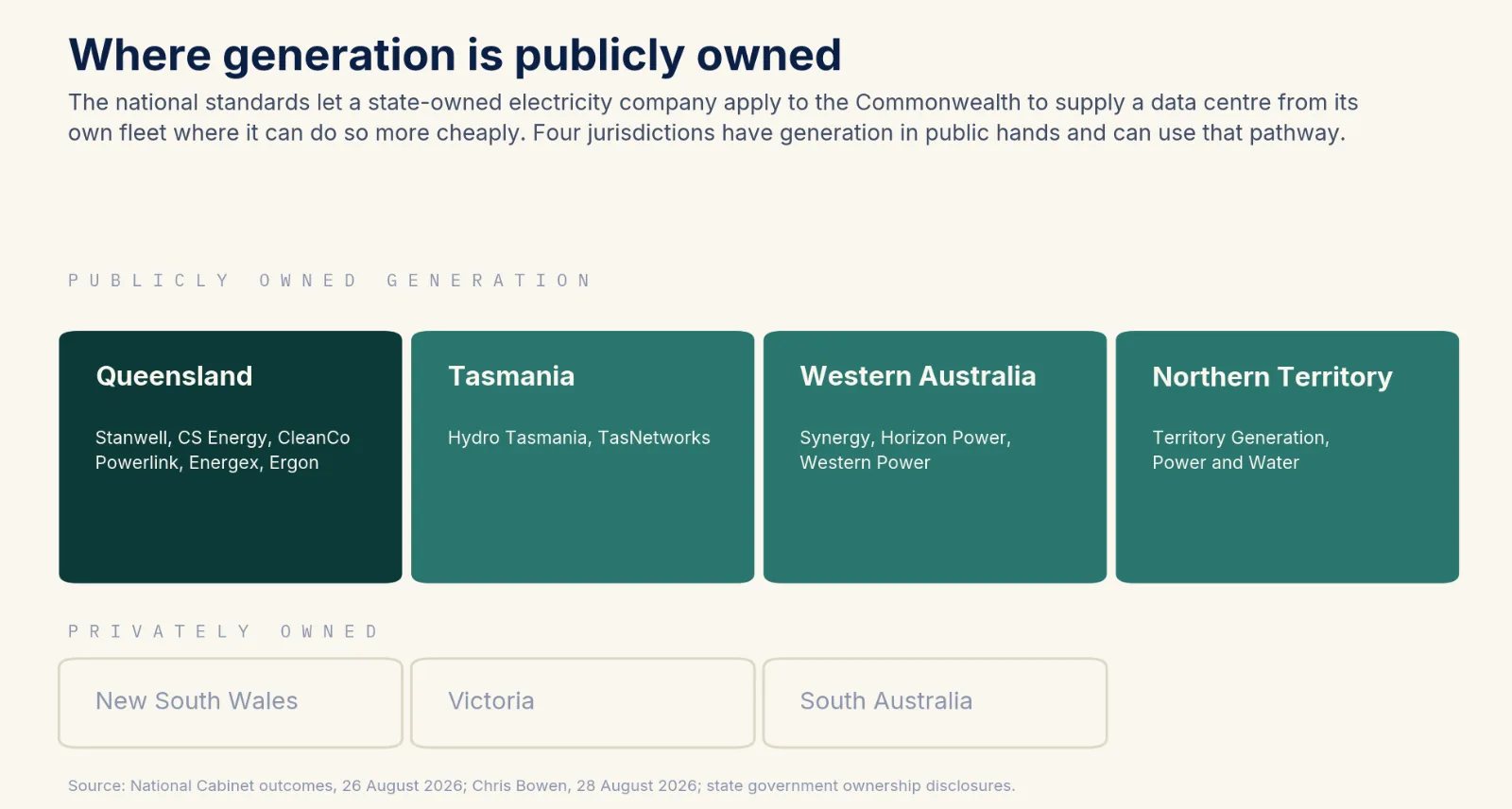
The state holds its three generators, Stanwell, CS Energy and CleanCo, and its three network companies, Powerlink, Energex and Ergon. Tasmania, Western Australia and the Northern Territory also hold generation publicly. In New South Wales, Victoria and South Australia it sits in private hands, which is a different market structure and not a worse one, and those three states have built the deepest data centre markets in the country on it.
Public ownership compresses one step. A state that owns the generator can quote a price directly, apply to supply under the national standards, and retain the developer's payment for new generation within a state-owned balance sheet.
Commonwealth legislation is targeted for early 2027, and Queensland's own framework, a social impact study and a paid council agreement before a project can lodge, is being written alongside it. Both arrive well before this campus is finished, and a project built in Queensland will carry both.
Crisafulli put the offer in Sacramento on 3 September 2026
Crisafulli met OpenAI and Anthropic during a California trade mission, the Courier Mail reported on 3 September 2026, naming OpenAI's vice president of global policy Ann O'Leary and Anthropic's special envoy Jeff Bleich, a former United States ambassador to Australia. Anthropic agreed in a joint communique to work with the state "to explore data centre opportunities in Queensland." It was the second Australian delegation in California that fortnight, following the federal ministers.
The offer carried two conditions. On funding generation, Crisafulli said: "My commitment to Queenslanders is I'll get these guys to pay for the increased generation and maintenance of your assets and that'll drive your power prices down." On siting: "The mistakes that I've seen won't be replicated in Queensland because we just won't allow them to be close to people." Anthropic signed thirteen days later.
Dexus and Macquarie Capital are part-owners of the campus
Dexus told the market on 16 September 2026 that a consortium including its data centre arm had "executed lease documentation" with an Australian subsidiary of Anthropic for the first stage of the campus.
Dexus owns 85 per cent of Australian Data Centres. Australian Data Centres holds 25 per cent of the consortium, alongside Zerra DC and Macquarie Capital, with Macquarie Capital also acting as financial adviser. Australian Data Centres is running a capital raise to bring further investors in.
An ASX-listed landlord and an Australian investment bank are building this campus. The tenant carries the demand risk, and Australian investors get the chance to own a share of the asset. Anthropic separately has a partnership with Macquarie Asset Management and GIC to fund dedicated data centre infrastructure, announced with no sites attached. Macquarie Asset Management and Macquarie Capital are different arms of the same group.
Ipswich meets all five siting conditions
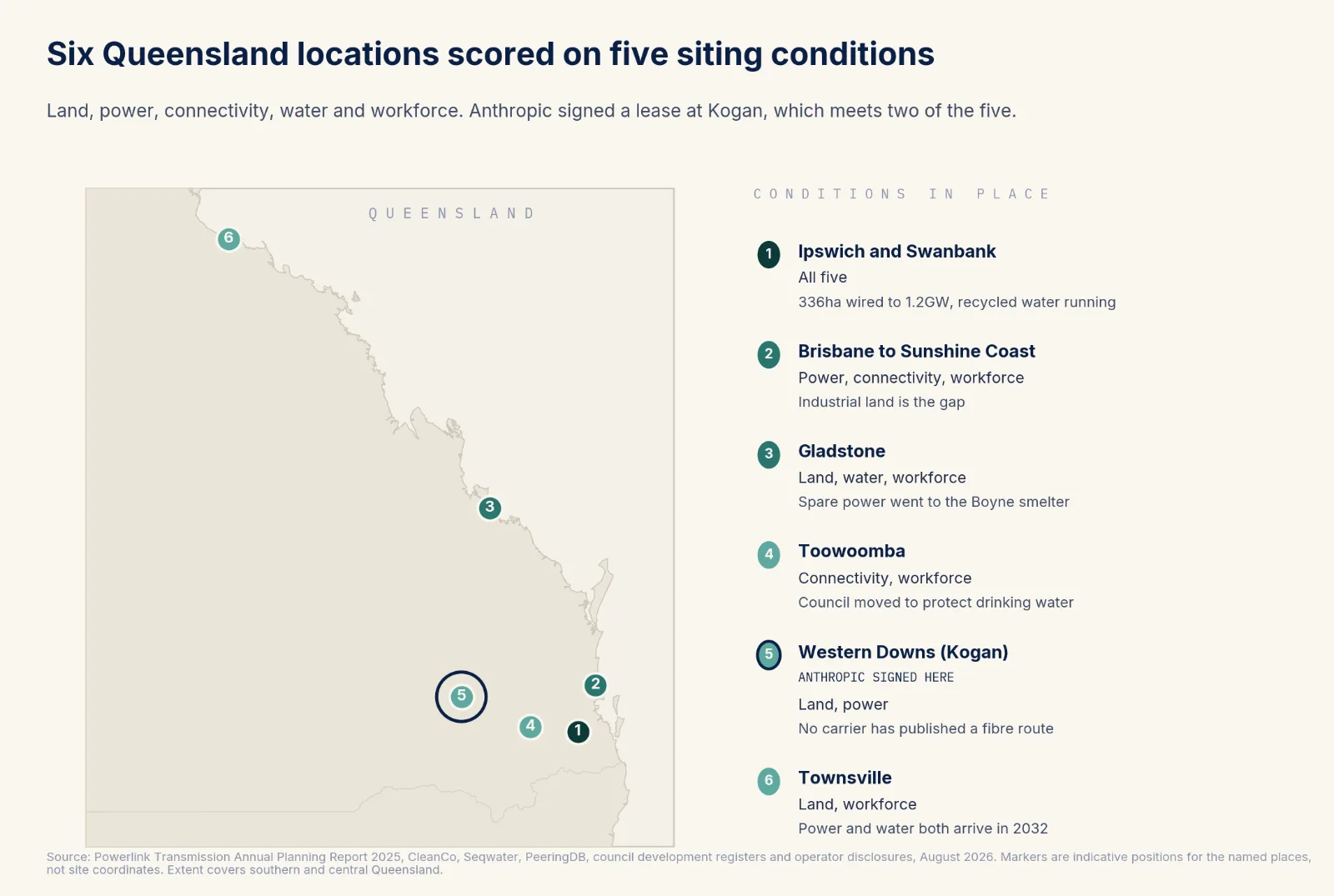
Five further Queensland locations have been assessed against the same siting conditions, and Kogan is the first of the six to secure a tenant.
Location | Conditions in place | Where it stands |
|---|---|---|
Ipswich and Swanbank | All five | Ready to build |
Brisbane to Sunshine Coast | Power, connectivity, workforce | Industrial land to come |
Gladstone | Land, water, workforce | Power to come |
Toowoomba | Connectivity, workforce | Water to come |
Western Downs (Kogan) | Land, power | Anthropic signed, fibre route to come |
Townsville | Land, workforce | Power and water both timed to 2032 |
Source: Powerlink Transmission Annual Planning Report 2025, CleanCo, Seqwater, PeeringDB, council development registers and operator disclosures, August 2026.
The scorecard was built on 31 August 2026 against land, power, connectivity, water and workforce, counting only what a dated public source already showed. Anthropic signed on the location with land and power, the two conditions that have to be in place on day one and the two that take longest to create.
Ipswich satisfies all five conditions and carries no gigawatt-scale proposal. CleanCo says the Swanbank Energy Precinct covers 336 hectares with a grid connection capacity of up to 1.2GW, about 40 kilometres from central Brisbane. A recycled water scheme is already delivering to it, and Springfield Central 15 kilometres away holds a carrier-neutral exchange, a building where any telco can meet any other. A ten-storey data centre was lodged with Ipswich City Council on 4 August 2026. Serviced industrial land at that scale is scarce nationally, on the evidence of the land squeeze across Australian markets.
No carrier has published a fibre route to Kogan. An inference campus depends on that route in a way a training campus does not, which makes it the gating item on the 2027 operating date. QCN Fibre already runs on spare capacity along Powerlink's transmission towers and high-voltage lines cross the Kogan property, so the route follows an existing corridor.
Gladstone holds 26,934 hectares of state-controlled land and Awoonga Dam's 730,500 megalitres. Townsville has 2,200 council-owned hectares at Lansdown zoned for high impact industry, with CopperString's eastern link and the industrial water pipeline both timed to 2032.
Queensland's 2025 grid forecast carried no data centre at all
Every year Powerlink, the state-owned company that owns and operates Queensland's high-voltage transmission network, publishes a planning report setting out how much new industrial electricity demand it expects and where. It is the document generators, investors and government use to decide what to build and when.
The 2025 edition counted about 2,982MW of proposed new industrial demand across Queensland, 110MW of it in the south. On data centres it recorded that the expansions seen in New South Wales and Victoria "have not translated to date in Queensland," and it carried no data centre project in its demand forecast at all.
Kogan was lodged ten months later, on 17 August 2026, at 1.44GW on the plans. The two figures are not a like-for-like comparison, because Powerlink was counting what it had visibility of in 2025 and the application had not been made. What the gap shows is how quickly Queensland became a destination for this class of project. Powerlink's next planning report is the first document that will price that in, and it is the one to read when it lands.
A$31.9bn against what Queensland has built before
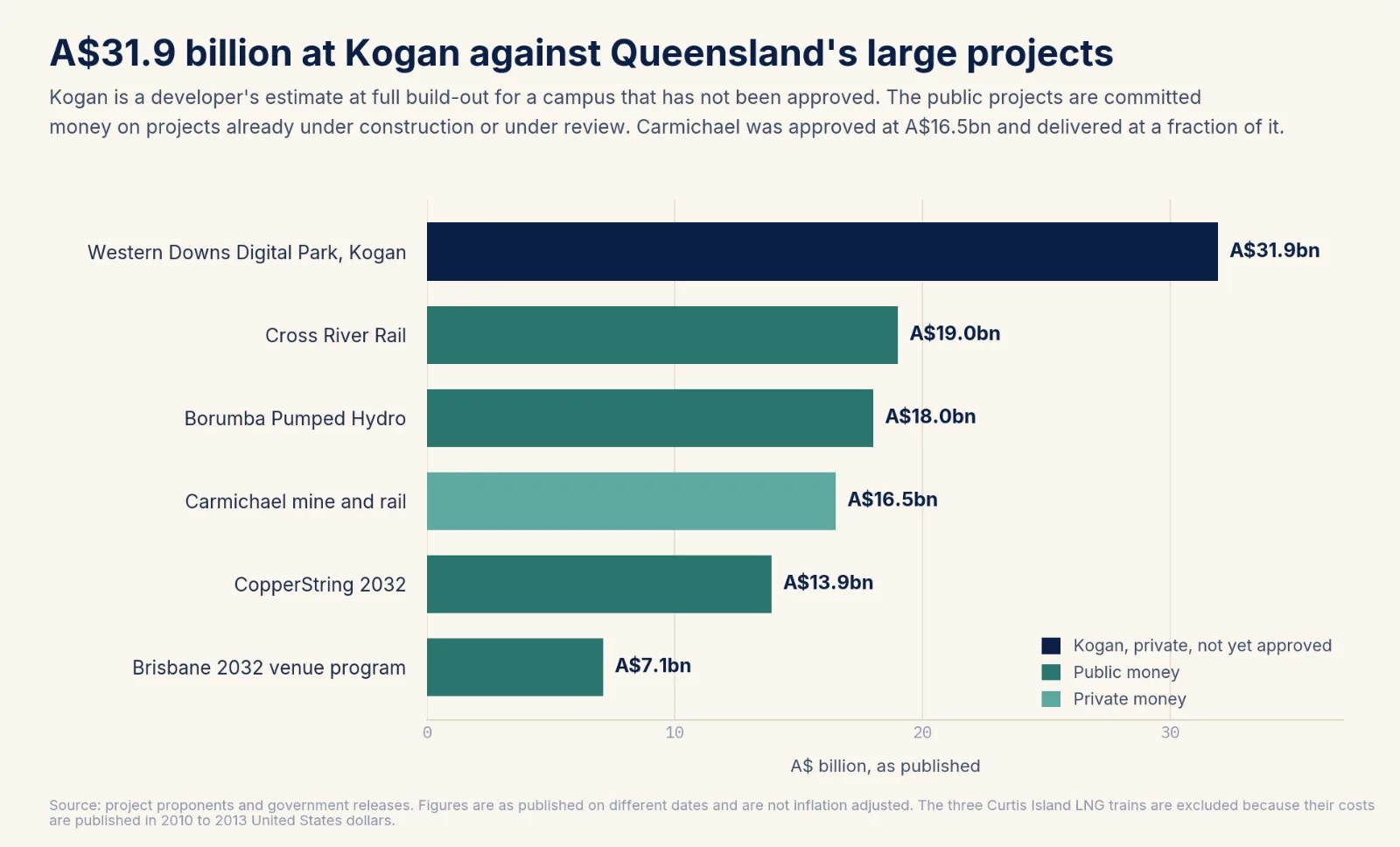
Project | Headline cost | Whose money |
|---|---|---|
Western Downs Digital Park, Kogan | A$31.9bn at full build-out | Private |
Cross River Rail | A$19.0bn | Public |
Borumba Pumped Hydro | Over A$18bn | Public |
Carmichael mine and rail | A$16.5bn at 2017 approval | Private |
CopperString 2032 | A$13.9bn | Public |
Australia Pacific LNG, Curtis Island | US$25bn at final investment decision | Private, 2011 dollars |
Gladstone LNG, Curtis Island | US$18.5bn | Private, 2013 dollars |
Queensland Curtis LNG, Curtis Island | US$15bn | Private, 2010 dollars |
Brisbane 2032 venue program | A$7.1bn funded envelope | Public |
Sources: project proponents and government releases. Figures are as published on different dates and are not inflation adjusted. The Kogan figure is the developer's estimate at full build-out.
The three Curtis Island LNG trains are the closest comparison. Each was a multi-year private build on a remote Queensland site serving an export customer, each drew on a regional labour market, and all three have operated for about a decade.
NEXTDC, Quinbrook and Polaris run Queensland capacity
Queensland's operating fleet is urban and modest by national standards. It is also the state's only source of trained data centre operators, a constraint that bears directly on staffing a campus 250 kilometres inland.
NEXTDC runs B1 in the Brisbane CBD at 2.25MW of IT load, the electricity reaching the servers themselves, and B2 in Fortitude Valley at 12MW, expanded from 6MW. It holds SC1 at Maroochydore at 1MW, attached to the station where the JGA-South subsea cable comes ashore, with SC2 at 6MW in development and GC1 on the Gold Coast at 6MW in planning.
Quinbrook Infrastructure Partners carries the largest published figure in the state. Its Supernode site at Brendale holds three separate high-voltage connections into the South Pine substation, and Quinbrook says the site is capable of hosting up to 2GW.
Pulse DC at Wellcamp, west of Toowoomba, says data reaches Brisbane and returns in about two milliseconds over two physically separate paths. Centuria bought it for A$30 million, settling on 30 January 2026. It runs 2.5MW with room to 7.5MW, and it is the closest operating facility to Kogan.
DigiCo Infrastructure REIT holds BNE1 and BNE2 at Brisbane Airport. Equinix runs BR1 in Fortitude Valley. iseek operates at Brisbane Airport through a completed second stage. Polaris Data Centre, wholly owned by Springfield City Group, runs two meeting rooms for networks at Springfield Central, on separate physical paths, with thirteen networks present in the building.
AirTrunk, CDC and DCI Data Centers all run Australian campuses and none is in Queensland yet. On the corridor scorecard, four locations are waiting on one condition each.
Zerra DC
Zerra DC is the data centre business of AGP Sustainable Real Assets, a Singapore investment manager founded in 2018 that rebranded the unit under the Zerra name in January 2026. Its co-founder and executive director is Kristian Steffensen, and Data Center Dynamics has reported a portfolio of 920MW secured across the United States, India, Japan and Australia.
Kogan is not the company's only Australian project. Zerra lodged a campus on the former Ford plant at Campbellfield in Melbourne in April 2026. The Kogan filing runs to four stages, a temporary village for up to 1,500 construction workers, and A$760 million in estimated annual gross value added. The design is credited to HDR, with Urbis as planning consultant.
Zerra is also negotiating a community payment with Western Downs Regional Council that no Queensland rule requires of a data centre. Wind and solar farms have needed a social impact study and a paid council agreement since 18 July 2025, and batteries of 50MW or more since 12 December 2025. Data centres appear on neither list. The payment is therefore voluntary, and the figure Kogan settles at becomes the reference point for every Queensland council that follows.
Two UQ spinouts sell into the campus economy
A gigawatt campus generates a decade of procurement in power electronics, fibre security, cooling and control systems. How much of that a host state supplies domestically determines whether the build leaves an industry behind it. Queensland's supply base is early-stage and small, and two of the four companies below are University of Queensland spinouts.
Cortisonic, out of the University of Queensland, builds what it calls a sonic processing unit, a chip that computes using sound instead of electricity for very low power AI at the edge of a network. Founded by Dr Glen Harris and Dr Christopher Baker and backed by Main Sequence Ventures, it holds a A$3.2 million strategic partnership involving Lockheed Martin and the Department of Defence.
VeriQuantix, also a University of Queensland spinout, uses quantum photon techniques to detect tampering and eavesdropping on the fibre links running into a data centre. It raised a A$2.4 million seed round on 24 October 2025 led by Uniseed, with UniQuest, PowerHouse Ventures and Lucerne Investment Partners.
Quest Semiconductor at Coolum Beach makes high voltage silicon carbide diodes from 600V to 10,000V, the power electronics that sit between a grid connection and a rack.
PsiQuantum, founded in Palo Alto, is building its quantum computer at Brisbane Airport on a combined A$940 million from the Queensland and Australian governments, with a test lab at Griffith University and an operational target at the end of 2027.
A fibre security product and a low-power processor are both inputs to the campus economy the state is now building, and both are being commercialised in Brisbane, 250 kilometres from the Kogan site. Whether any of them wins work on it is a separate question, and none has announced a contract.
Hutchinson, FDC and Multiplex have built data centres here
HDR has the design and Urbis the planning at Kogan. For every other position, the state already holds firms with Queensland data centre or high-voltage delivery behind them. This is the bench a gigawatt campus draws on, and none of the names below has been appointed to this one.
Position | Queensland pick | The record behind it |
|---|---|---|
Main contractor | Hutchinson Builders | Brisbane headquartered, a data centre portfolio of more than 30 projects nationally |
Data centre builder | FDC | Built NEXTDC's B2 in Fortitude Valley and the iseek facility at Brisbane Airport |
Hyperscale expansion | Multiplex | Delivered the B2 Stage 2 expansion from 6MW to 12MW |
Electrical | Fredon | A A$150 million package of data centre electrical contracts reported in December 2025, including a Brisbane scope |
Mechanical, electrical and plumbing | Aurecon | Engineering consultant on NEXTDC B2 |
Substations and transmission | Zinfra | The Dugald River substation and transmission line in north west Queensland |
Planning | Urbis | Town planner on the Kogan application, and author of the six-location siting framework |
Design | HDR | Architect and engineer on the Kogan application |
Source: firm project disclosures and the Kogan development application, September 2026. Only HDR and Urbis are engaged on the Western Downs campus.
The client-side capability is also local. Powerlink, Energex and Ergon are state-owned and Brisbane-headquartered, placing network engineering and developers in the same city.
The filing puts 1,400 ongoing jobs in a shire of 34,700
The filing puts up to 1,400 people running the campus at full capacity. Western Downs Mayor Andrew Smith has cited around 1,000. On either figure the campus would rank as a substantial ongoing employer in a regional Queensland shire, and the roles are permanent operating positions rather than construction.
Campus | Construction workforce | Permanent roles |
|---|---|---|
Western Downs Digital Park, per the filing | Up to 1,500 | Up to 1,400 |
AirTrunk MEL2, 354MW, Melbourne | Over 4,000 | Over 200 direct |
Meta Richland Parish, 5GW, Louisiana | 7,500 at peak | About 1,000 |
Sources: development application reporting, AirTrunk media release of 24 December 2025, Louisiana Economic Development. AirTrunk's figure is direct roles only, and the campuses are different sizes, so the rows are context and not a ranking.
Kogan's operational figure sits above what comparable campuses have disclosed. Zerra DC has not stated whether the 1,400 applies to the first stage or the full four.
Construction Skills Queensland's Horizon 2032 work, reported on 17 March 2026, puts the statewide construction worker shortfall at a peak of 35,000 in 2027 to 2028, against a pipeline peaking at A$75 billion in the same year. Electrical Trades Union national secretary Michael Wright has said around 10 per cent of the electrical trade workforce is now working on data centre construction, up from none a few years ago.
A four to six year build allows time to train into the roles, and two templates are in operation. Louisiana Delta Community College sits half an hour from Meta's Richland Parish campus. It stood up four-week data centre technician and construction craft laborer courses after the site broke ground, and has put more than 100 graduates through them since January 2026, with a US$5 million Meta scholarship pledge behind it. In Australia the TAFE NSW Datacentre Academy at Meadowbank does the same job with Microsoft. TAFE Queensland and the University of Southern Queensland in Toowoomba have the runway to build a Queensland version.
The Darling Downs built a 40,000-job energy workforce
Between 2010 and 2015 the coal seam gas build supported around 40,000 jobs at its 2014 peak, roughly 18,000 of them across the Dalby, Roma and Moranbah triangle. The region trained, housed and supplied that workforce, and the trades, contractors and accommodation built to do it are still there.
Western Downs Regional Council's own figures record 18,526 jobs against 16,350 employed residents, so about 2,176 positions are already filled by people travelling in. Agriculture, mining and the electricity and gas sector together account for more than a quarter of local employment, which is the trades base a data centre campus draws on.
The gas years are also the region's reference point for what follows construction, and this project compares favourably on that measure. The gas fields retained a maintenance workforce of 8,000 to 9,000 against a peak of 40,000. A data centre campus inverts that ratio, with a smaller construction phase and a substantially larger permanent operation. Western Downs Mayor Andrew Smith told the ABC on 14 September 2026 that the region needs "to be looking ahead at what's going to sustain this region", and called the shire "the energy capital of Queensland" with "a perfect mix of coexistence of ag and energy".
Sydney and Melbourne carry the latency-sensitive work
State | Data centre policy | Owns its generators |
|---|---|---|
New South Wales | Data Centre Guidelines effective 17 August 2026 | No |
Victoria | Sustainable Data Centre Action Plan | No |
Queensland | A framework in preparation | Yes |
State | Wholesale power, Q2 2026 | What it offers |
|---|---|---|
New South Wales | A$75/MWh, down 53 per cent year on year | Depth, customers and a A$50.3bn, 19 project pipeline |
Victoria | A$56/MWh, down 60 per cent year on year | The lowest wholesale price in the mainland market and 840MW permitted |
Queensland | A$67/MWh, down 44 per cent year on year | Firm generation already standing beside the connection, and public ownership of it |
Sources: AEMO Quarterly Energy Dynamics Q2 2026, published 28 July 2026; NSW Government, 17 August 2026.
Sydney and Melbourne carry the latency-sensitive workloads because the customers are there. The western Sydney corridor alone holds more capacity than most states. Queensland competes on a different site class: large inland parcels with firm generation already built beside a transmission connection, under state ownership. The three markets are complementary rather than substitutable.
A state by state comparison records Queensland as drafting rather than publishing, and a state industry body launched in July 2026 to contribute to it. The framework will now be drafted with a signed tenant in the state.
What to watch
What is still to come | Why it decides how far this goes |
|---|---|
The rest of the 1.4GW | Kogan is the first stage of one campus. CDC, AirTrunk, NEXTDC, IREN and Stack were all asked and the balance of the order is still live |
A published fibre route to Kogan | QCN Fibre runs along Powerlink's towers and high-voltage lines cross the site. Whoever announces the route is telling the market about the 2027 date |
Ipswich and Swanbank | 1.2GW of connection capacity, recycled water running, 40km from Brisbane, all five conditions met and no gigawatt campus on it |
The Zerra community benefit figure | Negotiated ahead of any rule requiring it, and it becomes the number every Queensland council opens with |
The Australian Data Centres capital raise | The opening for Australian investors to own a share of the asset |
Powerlink's next planning report | Against the 110MW it counted in southern Queensland in 2025 |
A Queensland training pathway | TAFE Queensland and the University of Southern Queensland have the Louisiana and TAFE NSW models to copy |
Zerra's Campbellfield campus in Melbourne | Filed April 2026, and the second read on how fast this developer moves |
Source: Certified Strategic Editorial, September 2026.
Anthropic has placed the first stage of one campus. The balance of the 1.4GW is still in the market, Ipswich and Swanbank hold 1.2GW of connection capacity 40 kilometres from Brisbane, and Australian Data Centres is raising capital that would widen Australian ownership of the Kogan asset.