At a glance
Singapore developer Zerra DC has filed an A$31.9 billion campus on 725.5 hectares of cattle feedlot near Dalby, which the ABC calls Australia's largest proposed data centre.
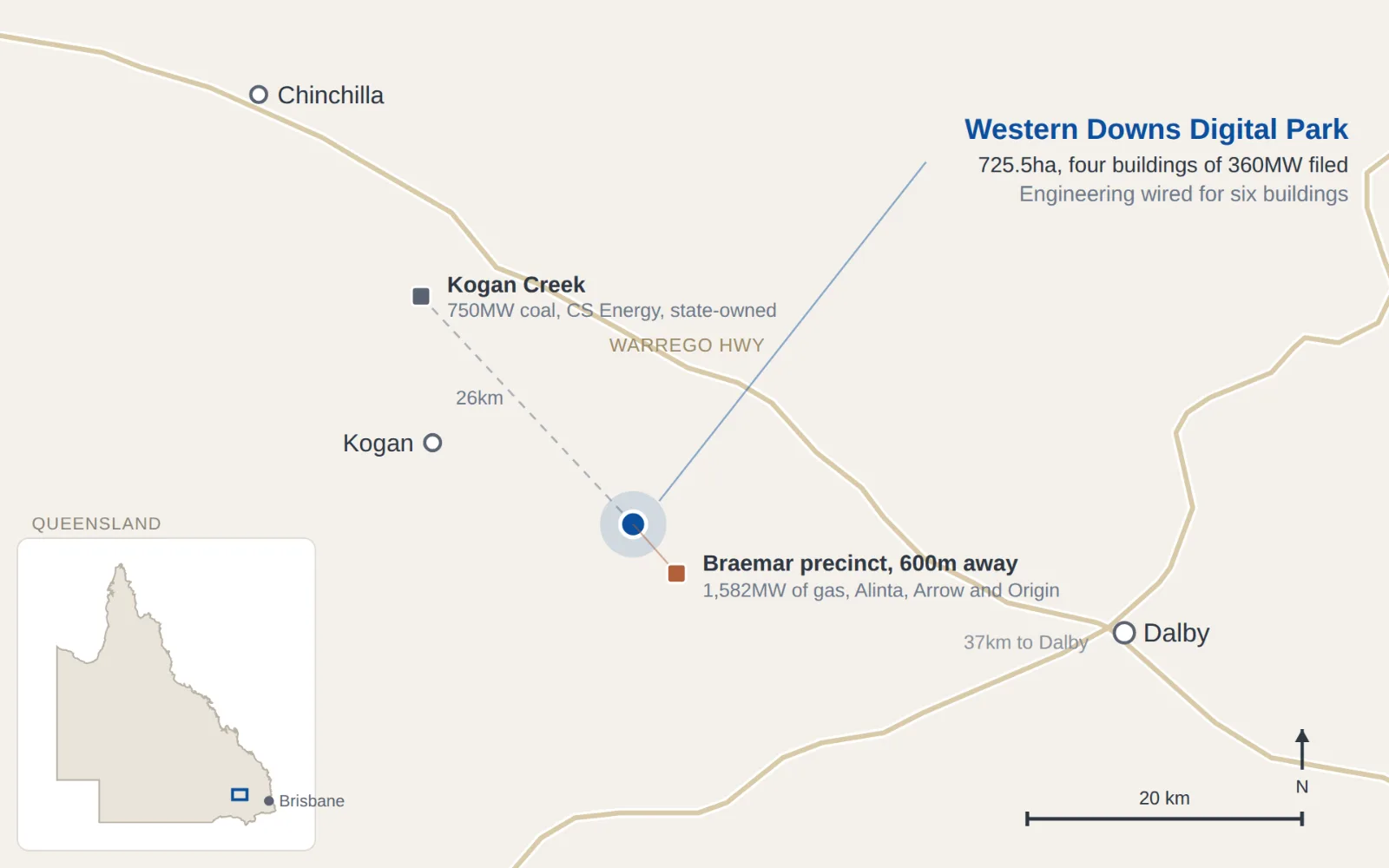
The application seeks four buildings of 360MW on a site 600 metres from a transmission substation and beside 1,582MW of existing gas generation.
Construction runs four stages over four to six years, with up to 1,500 workers on a site the mayor calls the dawn of a new era for the region.
Four buildings at full output come to 34.6 gigawatt-hours a day, below the 47 the ABC reported, which covers either two more buildings or the power cooling adds.
Zerra is negotiating a community payment with the council that no Queensland rule obliges it to make, and the state's benefit list still names only solar, wind and batteries.
A cattle feedlot 250km west of Brisbane would become an A$31.9 billion data centre campus, on a site 600 metres from a transmission substation and surrounded by gas generation. Singapore developer Zerra DC has filed for four buildings of 360MW on 725.5 hectares at Kogan, a project the ABC calls Australia's largest proposed data centre. The engineering behind it is wired for six buildings.
Four stages over four to six years would bring a temporary village for up to 1,500 construction workers into a shire of farms, gas fields and power stations. Western Downs mayor Andrew Smith called it the dawn of a new era for the region, and told the ABC that talks on a community benefit agreement with the developer are already underway. Queensland has required that agreement from wind farms, solar farms and large batteries since 2025. Its list has never reached data centres.
Zerra is negotiating a community payment ahead of any rule requiring one, in a shire whose published rates price only what a project generates. IREN and Goodman named figures of their own a fortnight earlier, and whatever Kogan settles on becomes the number every Queensland council opens with.
The filed project is smaller than the figure in circulation
Zerra filed on 17 August 2026 for a 725.5-hectare site at Kogan, about 37km north west of Dalby and 600 metres from the Braemar transmission substation. It is the developer's second Australian application. The first, for six buildings on the former Ford plant at Campbellfield in Melbourne, went in during April 2026 and carries no published megawatt figure.
The Kogan application seeks approval for four buildings of 360MW, the 1.44GW figure The Urban Developer and Data Center Dynamics both reported in August 2026. An engineering report inside the same application sets out a design for six buildings, and the ABC gave the campus a peak capacity of 2.16GW, the figure six of them reach.
Case | Energy in a day | Against a 170GWh day |
|---|---|---|
Four buildings, 1.44GW, the filed project | 34.6GWh | 20 per cent |
The figure reported on 14 September | 47GWh | 28 per cent |
Six buildings, 2.16GW, the design ceiling | 51.8GWh | 30 per cent |
Source: From ABC News, 14 September 2026, and the capacities reported from Zerra's application in August 2026. The ABC describes the daily figure as about 25 per cent of Queensland's average day; the two figures it publishes divide to 27.6 per cent, and an average day is not a peak one.
The four buildings on the council's desk run to 34.6 gigawatt-hours in a full day, a quarter below the 47 the ABC reported on 14 September. Reaching 47 needs either the two further buildings in the engineering design, which nobody has applied to build, or 360MW counting the servers alone with cooling and conversion on top. The application states neither the utilisation rate nor which capacity the figure uses. A planning approval, a company capacity statement and a grid connection application each measure something different, which is why Australia's 21.6GW data centre pipeline is counted three separate ways.
Zerra would connect at transmission level, beside existing generation
A Zerra spokesperson told the ABC the park would be well positioned among existing energy infrastructure including three gas-fired power stations, and that it would connect directly to the substation rather than relying on Ergon Energy's local distribution to the surrounding towns. The Braemar, Braemar 2, Darling Downs and Daandine plants all sit in the surrounding area, and an Origin Energy spokesperson confirmed to The Energy on 26 August 2026 that Zerra had approached the company about the proposal because its own plant is nearby. Origin owns the Darling Downs gas and solar generators.
Connecting at high voltage keeps the campus off the local network that serves Dalby, Kogan and Chinchilla, and that connection is why Kogan scored on power when the Queensland corridors scorecard tested six locations on 31 August 2026. The works it requires run to hundreds of millions on a campus this size.
Where that supply comes from is being argued across the whole sector, not at this site alone. Climate Energy Finance director Tim Buckley told the ABC the demand has to be matched by investment in new generation, and that gas has an important but small and declining role, predominantly to back up renewable generation. He added on LinkedIn on 14 September 2026 that Australian ratepayers paid for the infrastructure already standing near the site. Andreas Helwig, an associate professor at the University of Southern Queensland, said the project could be a test case for how these facilities get powered, and that getting it wrong affects grid stability and consumer costs.
Premier David Crisafulli argues new generation built alongside these projects can push prices down, a position he took to OpenAI and Anthropic in the United States in September 2026, while Canberra will legislate a renewable supply requirement over Queensland's objection in early 2027.
Queensland's benefit rule names solar farms, wind farms and batteries
Since 18 July 2025 a wind farm of any size and a solar farm of 1MW or more has had to complete a social impact assessment and execute a community benefit agreement with the host council before lodging a development application. Battery storage of 50MW or more joined them on 12 December 2025. The state's own community benefit page lists those three development types and no others.
Every project on that list sells electricity, and the Planning Regulation 2017 reaches them through sections written for generation. Adding a fourth type takes an amendment to that regulation, signed by the Governor in Council, which Parliament can then overturn. Batteries were brought in that way with a day's notice in December 2025, after consultation with councils and industry but with no draft out for public comment. The ABC reported on 24 August 2026 that the Crisafulli government would develop a framework extending the same requirement to data centres, and a draft of one had yet to be published at 14 September 2026, in a state that keeps no dedicated data centre policy on the record.
Western Downs sets its rates by the megawatt generated
The council publishes a minimum contribution for each project type its policy covers, as a floor for negotiation. Few Queensland councils put rates in writing at all, which is why whatever this one settles on with Zerra will travel further than the Western Downs.
Project type, as printed on the policy | Minimum base contribution |
|---|---|
Solar | $850 per MW |
Wind | $1,050 per MW |
Battery Energy Storage System (BESS) | $150 per MWh |
Energy Storage Developments (Hydro) | $850 per MW |
Source: Western Downs Regional Council, Renewable Energy: Community Benefit System Policy, version 4 dated 20 April 2026. The rates apply to agreements executed in the 2025/26 financial year and are adjusted by the Consumer Price Index after that. Batteries are priced per megawatt hour and the rest per megawatt.
Every rate in that policy is a price on output, so the two sides are building a formula for a buyer rather than applying one written for a seller. Smith called the area the energy capital of Queensland and said it has agriculture and energy running side by side.
IREN and Goodman named figures of their own in September
Two developers put numbers on the record in early September 2026. IREN promised $250,000 a year at Bundey in South Australia and Goodman offered $1.1 million at Lane Cove West in Sydney, while Canberra weighs whether to make such payments compulsory. Both were volunteered.
IREN and Goodman named their figures voluntarily, and Zerra is negotiating on the same basis. Liza Balmain, a cotton and grain grower and a spokesperson for the anti-gas group Save Our Darling Downs, told the ABC she was not opposed to data centres but wanted guidelines on the natural resources they would require, and asked what long-term benefit host communities get for the impacts they absorb. That is the question behind the objections at Australian sites now fighting over social licence. At Kogan it is being negotiated four weeks after filing, and years before construction would start.
What to watch
The figure Zerra and the council settle on. It gives every Queensland council a published data centre number to negotiate against. The rate card carries a review date of 21 August 2026, so a newer version may already exist.
An amendment to the Planning Regulation 2017. Under the transitional sections used in July 2025 and December 2025, an application already filed and undecided when the change commenced was taken not to have been properly made. Zerra filed on 17 August 2026 and the council has not decided it.
A second application for buildings five and six. It would take the campus from the 1.44GW being assessed to the 2.16GW the engineering already covers, a difference of about 17 gigawatt-hours a day.
Powerlink's next planning report. It will show whether the Kogan filing moves the 110MW of proposed new industrial demand the transmission owner counted in southern Queensland before the application arrived, a figure smaller than one of Zerra's four buildings.