At a glance
Premier David Crisafulli met OpenAI and Anthropic in Sacramento, the Courier Mail reported on 3 September 2026, and the talks ended with an agreement to "explore" and no signed deal.
The offer has two conditions: developers pay for the extra generation Queensland's state-owned utilities build, and data centres go outside built-up areas.
Canberra's rule, due in legislation in early 2027, also makes a data centre pay for new supply; a state-owned generator can apply to supply from its own fuel mix.
Swanbank, an industrial precinct with 1.2GW of grid connection capacity, and Kogan, where a 1.44GW campus was filed on 17 August 2026, both sit outside towns.
Deputy Prime Minister Richard Marles was in San Francisco the same week to meet Sam Altman and Anthropic on data centre deals tied to a copyright settlement.
Crisafulli pitches state-owned power to OpenAI and Anthropic in Sacramento
Queensland Premier David Crisafulli met OpenAI and Anthropic during a trade mission to California, the Courier Mail reported from Sacramento on 3 September 2026. The paper names OpenAI's vice president of global policy, Ann O'Leary, and Anthropic's special envoy Jeff Bleich, a former United States ambassador to Australia. No agreement was signed. An OpenAI spokeswoman called the talks constructive, and the paper reports Anthropic agreed in a joint communique to work with the state "to explore data centre opportunities in Queensland".
Crisafulli was the second Australian government in California that week. Deputy Prime Minister Richard Marles and Assistant Minister Andrew Charlton flew to the United States on 31 August 2026 to meet Anthropic, OpenAI, Microsoft, Google, Amazon and NVIDIA in San Francisco, and OpenAI confirmed that Sam Altman would meet the delegation. The Financial Review framed that trip as a countdown to signing data centre deals with both companies, tied to a copyright settlement; OpenAI's Sydney campus with NEXTDC has sat as a memorandum of understanding since December 2025.
The meetings followed National Cabinet on 26 August 2026, where the premiers and the Prime Minister agreed the Commonwealth will write mandatory national standards for data centre energy, water and land use. Queensland opposed a renewables-only power rule and came out with wording that lets a state-owned generator apply to supply data centres from its own fleet. Crisafulli told the paper he put two conditions to both companies. Developers pay for the extra generation: "My commitment to Queenslanders is I'll get these guys to pay for the increased generation and maintenance of your assets and that'll drive your power prices down." And they build away from people: "The mistakes that I've seen won't be replicated in Queensland because we just won't allow them to be close to people."
Australia's data centres cluster in and around Sydney and Melbourne, because the companies renting space in them need a fast connection to the city. A campus built to train AI models is the exception: a training run lasts weeks and serves no nearby customer, so its owner can chase cheap, contracted power and open land. Crisafulli is describing a training campus, the class of project Anthropic has put gigawatt figures on in Australia since March 2026. A scorecard of six Queensland locations, published on 1 September 2026, shows which sites fit the second condition.
Queensland would route data centre payments to Stanwell, CS Energy and CleanCo
Canberra's rule, agreed by energy ministers on 28 July 2026, is that a large data centre pays for enough new renewable generation to cover its own demand, with firming behind it. Firming means gas, batteries or hydro for the hours when wind and sun run short. National Cabinet agreed on 26 August that the Commonwealth will legislate standards in early 2027. The trade publication The Energy reported on 26 August that the agreed wording lets a jurisdiction use state-owned generation, transmission and distribution "where it has clear benefits to grid stability and lower customer prices". Climate Change and Energy Minister Chris Bowen said on 28 August 2026 that the standards will apply "with no exceptions and no carve-outs", and that "the only change is that where a state owned government electricity company asserts that they can do it cheaper than renewables, they can apply to the Commonwealth to do that".
Under Crisafulli's version the developer's payment goes to a state generator. Queensland owns its three generators, Stanwell, CS Energy and CleanCo, and its three network companies, Powerlink, Energex and Ergon, so the money for new supply stays with a state company and the state can apply to use whatever fuel it says is cheaper. Tasmania, Western Australia and the Northern Territory also own their power companies, and Queensland is one of the states with no dedicated data centre policy on the record. New South Wales, Victoria and South Australia sold theirs.
Government | What the developer pays for | Status |
|---|---|---|
Commonwealth | New renewable generation to cover its own demand, with firming | Agreed 26 August 2026 to develop mandatory standards; legislation intended early 2027 |
Queensland | Extra generation and maintenance of state-owned assets, with the state applying to use its own fuel mix | Stated to the Courier Mail on 3 September 2026; nothing published |
New South Wales | Renewables to match its load from the fourth year of operation, plus a proposed one-off connection charge of A$200,000 per megawatt between Sydney, Newcastle and Wollongong and A$100,000 elsewhere | Guidelines published 17 August 2026, opt-in; the connection charge is a separate energy department proposal, consultation closes 14 September 2026 |
Source: Energy and Climate Change Ministerial Council communique of 28 July 2026, Prime Minister's statement of 26 August 2026, the Courier Mail of 3 September 2026, NSW Data Centre Guidelines and NSW energy department consultation paper, August 2026.
A data centre that has paid for new supply before it switches on adds generation to the market. A load that runs at the same level around the clock spreads the fixed cost of the wires over more units. Crisafulli's promise to Queensland households holds if the generation is contracted before the load connects and if the developer also pays for the new lines and substations a gigawatt-scale campus needs. His quote covers generation and the maintenance of existing assets; the network works are the open item, and the NSW connection charge exists because that cost is otherwise recovered from every other customer.
Swanbank's 1.2GW precinct and Zerra's Kogan site fit the siting condition
The Queensland proposal on the record is the one the ABC described on 24 August 2026: extending to data centres the social impact assessment and the paid community benefit agreement with the host council that wind, solar and large batteries have required since 2025 before a development application is lodged. The ban on built-up areas had, at 3 September 2026, no definition and no instrument behind it.
The scorecard published on 1 September tested six locations against land, power, connectivity, water and workforce: Ipswich and Swanbank, the Brisbane to Sunshine Coast corridor, Gladstone, Toowoomba, Western Downs and Townsville. Ipswich and Swanbank met all five, on a 336-hectare industrial precinct about 40km south-west of central Brisbane that CleanCo, one of the state's generators, says has grid connection capacity of up to 1.2GW. Western Downs met land and power, on the 725.5-hectare Kogan site where Singapore developer Zerra DC filed a 1.44GW campus with the regional council on 17 August 2026, 600 metres from a substation and about 37km from Dalby. Both places in Queensland with a gigawatt of connection capacity or a gigawatt application appear to meet the Premier's siting condition, and the precinct that scored five out of five belongs to a state-owned generator.
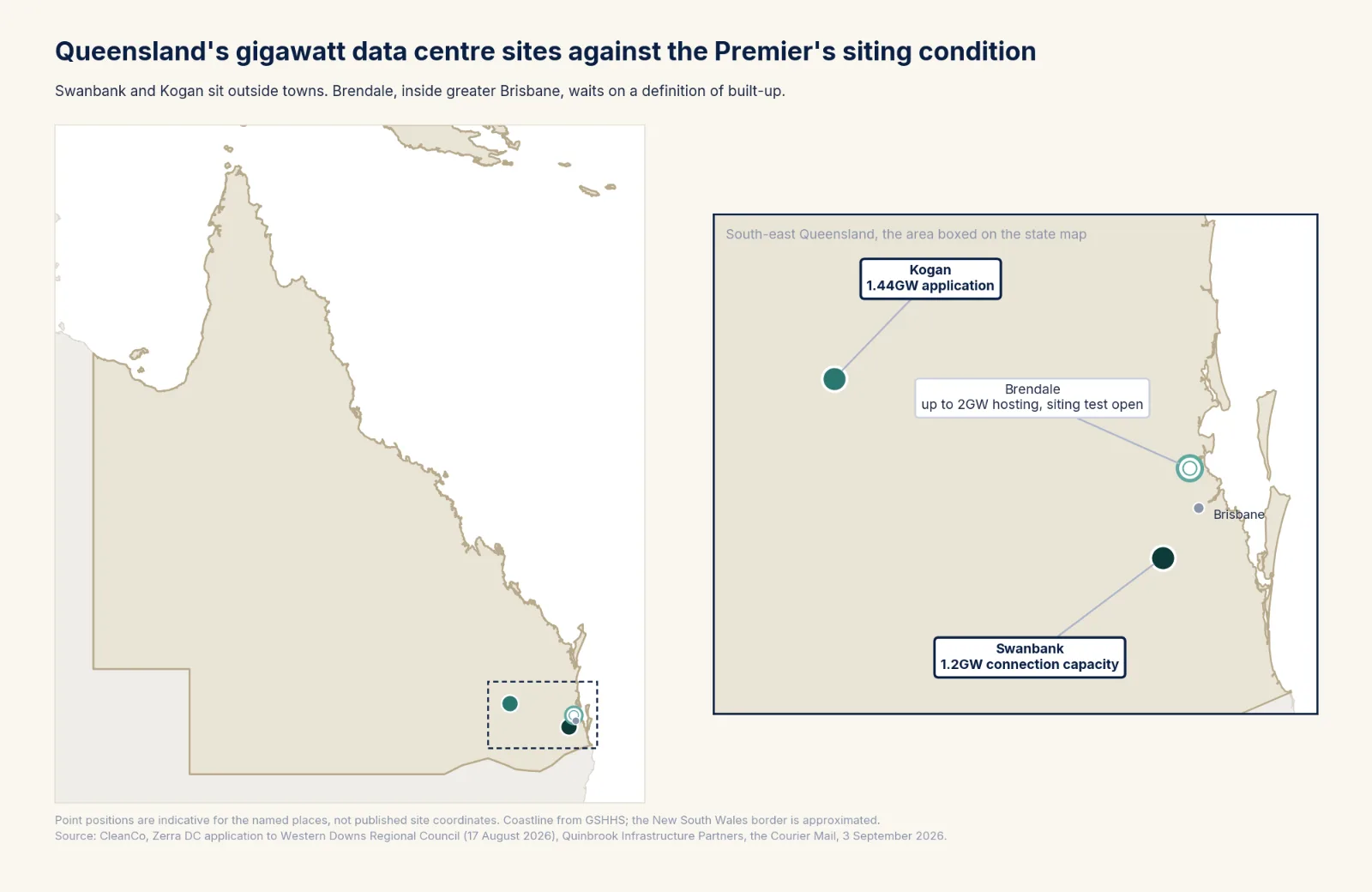
Quinbrook Infrastructure Partners' Supernode site at Brendale, on Brisbane's northern fringe in the Moreton Bay council area, holds three high-voltage connections into the South Pine substation and, Quinbrook says, can host up to 2GW of computing load. Crisafulli's definition, if he publishes one, will have to say whether an industrial estate inside the metropolitan area is built-up. Toowoomba's council resolved in August 2026 to develop a policy keeping data centres out of the city's drinking water supply, and Western Downs Regional Council's decision on the Kogan application was pending at 3 September 2026.
Anthropic and OpenAI have taken their Australian plans to NSW, SA and the NT; Queensland has no project in AEMO's 9GW queue
An Infrastructure NSW email dated 18 March 2026 records Anthropic's chief executive wanting to discuss up to 5GW of AI training capacity in New South Wales, outside Sydney, a figure about three times the roughly 1.6GW of data centres Australia has finished building, and Anthropic signed a non-binding statement of intent with the Australian Government on 31 March 2026. Its confidential tender for at least 1.4GW of Australian capacity closed at the end of March 2026, with the Financial Review reporting CDC Data Centres as front-runner for the largest slice of about 500MW, and The Australian reported in June 2026 that it was in talks with SunCable on Northern Territory solar. OpenAI signed a memorandum of understanding, a non-binding agreement, with South Australia at its San Francisco headquarters on 9 August 2026, the day before that state called an AI royal commission.
The published counts put Queensland near zero. The Australian Energy Market Operator's list of data centre projects seeking a transmission connection stood at 9GW at 30 June 2026, all of it in New South Wales, Victoria and South Australia. Powerlink's planning report, published in 2025 before the Kogan filing, recorded "minimal enquiries or developments progressing beyond preliminary stages", and its forecast holds 110MW of proposed new industrial demand in southern Queensland with no data centre project in it. Commonwealth Bank's A$150 billion estimate of the build to 2030 rests on a different base, about 6GW of proposed capacity, and puts about half of it in New South Wales and about a quarter in Victoria, listing Queensland among the states with growing interest and assigning it no share.
Crisafulli is selling 1.2GW of connection capacity at one precinct, a 1.44GW application lodged at another, a generator fleet the state controls, and a transmission queue that held zero Queensland projects at 30 June 2026. New South Wales holds 52 per cent of AEMO's 9GW and is the state proposing a A$200,000 per megawatt connection charge.
What to watch
The definition of a built-up area. Queensland adds project types to its social impact and community benefit regime by regulation, and a data centre entry there would carry whatever siting test the state settles on.
The Kogan decision. Western Downs Regional Council must publicly notify Zerra's 1.44GW application before it rules, and the ruling can be appealed to the Planning and Environment Court.
Powerlink's next planning report. It will show whether the Kogan filing moves the 110MW of proposed new industrial demand the 2025 report counted in southern Queensland.
The Commonwealth's drafting. Legislation is intended for early 2027, and Queensland's offer depends on how the test for a state-owned supplier that wants to use its own mix is written.
Whether either company names Queensland. Anthropic's tender, its New South Wales approach and its reported Northern Territory talks are on the public record; Queensland's entry is the communique the Courier Mail reported on 3 September 2026.