At a glance
An Infrastructure NSW email says Anthropic's chief executive wanted to discuss locating up to 5GW of AI training capacity in NSW, outside Sydney.
Australia has finished building 1.6GW of data centres, so the figure is about three times the national fleet.
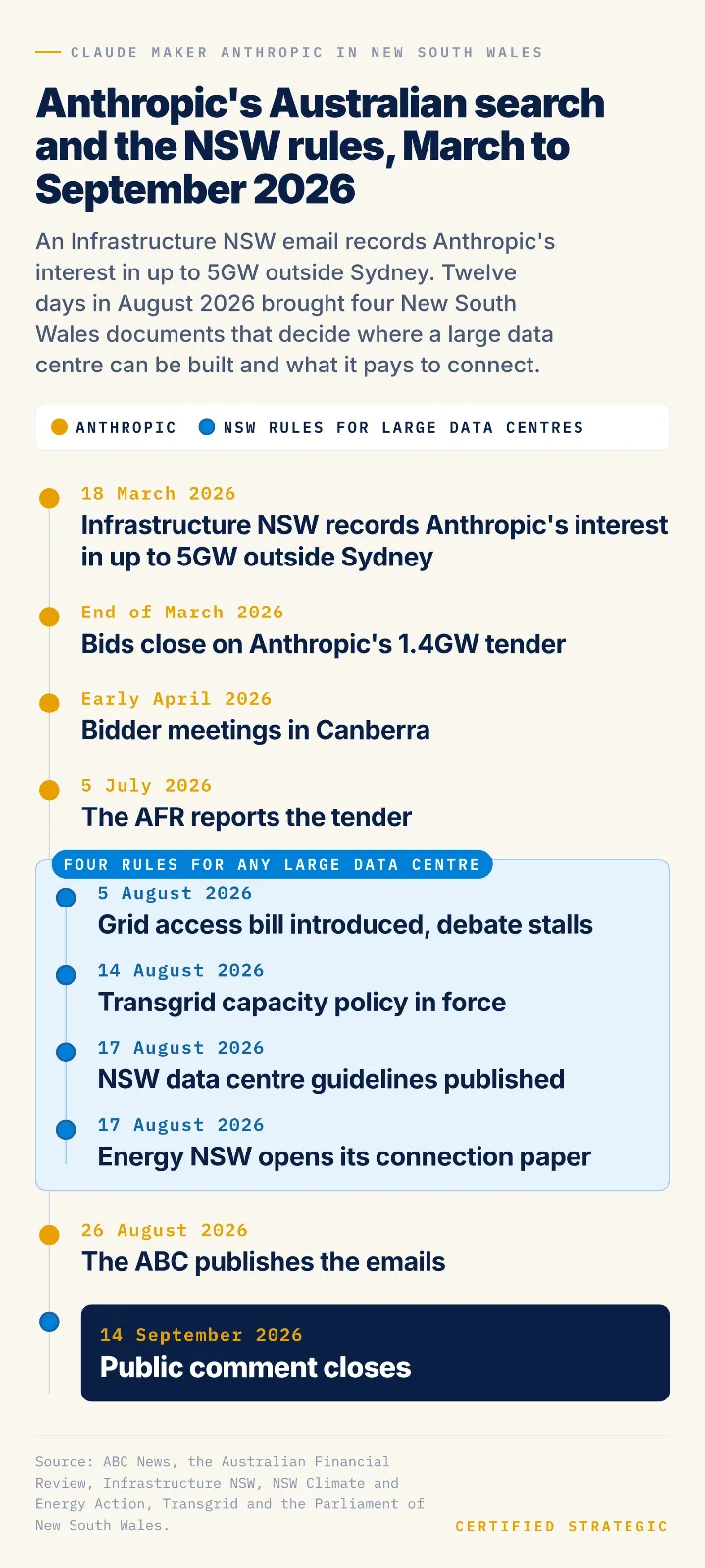
The email is dated 18 March 2026. Bids on Anthropic's confidential Australian tender for at least 1.4GW closed at the end of that month.
Anthropic told bidders it would pick a partner first and find the land with them.
NSW is proposing to charge $200,000 for every megawatt a data centre connects between Sydney, Newcastle and Wollongong, and $100,000 a megawatt everywhere else.
Infrastructure NSW recorded the 5GW figure on 18 March 2026
Dena Jacobs, an executive director at Infrastructure NSW, the state's independent infrastructure adviser, wrote to two senior public servants at Investment NSW, the agency whose job is to bring companies to the state. Her email reads: "The context is that the CEO of Anthropic is visiting Sydney and would like to speak to NSW government about the opportunities to locate up to 5GW of AI training capacity in NSW. i.e. there's an opportunity to locate this outside Sydney."
The NSW parliament ordered the government to release the emails, and the ABC published them on 26 August 2026. The ABC says the email set no timeframe, that the figure reflected initial interest, and that Infrastructure NSW had spoken with several technology companies about their future computing demands. Anthropic and Investment NSW declined to comment. The emails name John Garnaut as an Anthropic adviser; he told the ABC he works with AI firms but "did not put in this particular request". Innovation, Science and Technology Minister Anoulack Chanthivong said his government does not discuss private meetings, and that "the Minns Labor government continues to welcome investment from leading technology companies".
Anthropic was running a confidential Australian tender in the same weeks, which the Australian Financial Review obtained and reported on 5 July 2026. It sought at least 1.4GW of Australian capacity, with at least 1GW of it running by the end of 2027. Bids closed at the end of March 2026, and a handful of companies were invited to meetings in Canberra in early April, when Anthropic chief executive Dario Amodei was in the country to meet Treasurer Jim Chalmers.
The tender asked for land big enough to hold four or more buildings away from houses and schools, and for each bidder's record on making power on site or alongside a private power company. The NSW government decides both of those questions outside Sydney: permission to build, and permission to plug in.
Anthropic asked bidders how they would raise US$15 billion
The AFR reported that the document asked eleven questions, and money came first. Anthropic wanted to know how the company that would own the site and rent it back would raise the US$12 billion to US$15 billion the campus needs, in borrowed money and investors' money, and who would stand behind that funding given the firms that score borrowers treat Anthropic as a risky one to lend to.
Bidders were asked for a one-page summary on every Australian data centre they have built above 200MW, covering timelines, how much power each data hall draws and how it was supplied. Anthropic asked how they had met the energy needs of projects above 300MW, telling them to lead with sites where the power is made on the property or built alongside a private power company, which the document calls "on-premises generation or co-development with independent power producers". It also asked what each bidder could do on security and on dealing with governments.
Anthropic told bidders it expected to pick a partner first and choose the land with them afterwards. The document says "we recognise that a likely outcome is identification of an optimal development partner without a fully developed site", and that in that case "we envision jointly identifying and developing a site that meets our requirements".
The document went to CDC Data Centres, AirTrunk, NEXTDC, IREN and STACK Infrastructure among others, whose Australian sites appear in the directory of Australian data centres. The AFR reported in July that the work could be split across four or five contracts, and estimated CDC would take about 500MW of it.
NSW would charge twice as much to connect near Sydney
The NSW Data Centre Guidelines published on 17 August 2026 commit the government to deciding a building application within 75 days, counting only the days the state itself is working on it, for projects that meet six principles covering energy, water, cost to consumers, community, supply chains and skills. Developers choose whether to follow them.
The tenth test sets who pays for the poles, wires and substations built to serve a data centre. It says a project beyond the ring of high-voltage lines around Sydney should expect a smaller bill, "due to greater grid capacity in many locations".
NSW Climate and Energy Action, the state's energy department, opened its own paper for public comment the same day. Reforming electricity network connection and cost recovery arrangements for data centres in NSW takes written comments until 14 September 2026 and sets out ten changes to what a data centre pays to connect to the grid. The minister can only make any of them if the change to the Electricity Infrastructure Investment Act 2020 now in front of parliament passes.
One is a Major Network Upgrade Fee at "a default rate of $200,000/MW for connections in Sydney-Newcastle-Wollongong and $100,000/MW elsewhere". Another is a deposit of $30,000 for every megawatt a company asks for, which the company loses on a missed deadline, or if the electricity business ends talks over bad faith.
The same paper says companies are seeking up to 28 gigawatts of data centre connections across NSW, around 13GW of that in advanced discussions. It records that Transgrid has told developers there will be no room on the high-voltage lines for new connections in Western Sydney beyond 2033. Transgrid has published a related figure: more than 10GW of data centre enquiries since late 2024, all within 12 kilometres of one substation at Sydney West.
One bidder has already built its Australian plan around that. IREN has announced an 800MW campus at Bundey in South Australia, about 125 kilometres north east of Adelaide. Its June 2026 announcement says the deal secures four high-voltage connection points that can carry 800MW as the network already stands, with power due to start flowing from 2028.
Transgrid reserves grid space when a connection contract is signed
Transgrid's Network Capacity Allocation Policy took effect on 14 August 2026 and decides who gets space on the high-voltage network in New South Wales. It applies to any customer drawing 30MW or more through the electronic gear a data centre uses rather than a spinning generator, which takes in every large campus.
Transgrid pencils in the space when both sides sign a connection contract, and confirms it once the developer passes five tests within three months. First, the state has to have approved the project under the rules NSW uses for its biggest developments, for a site as large as the contract says, with federal sign-off where a foreign owner is involved. The other four tests are land, signed construction contracts, orders placed for the transformers and switchgear that take years to arrive, and money.
The Electricity Infrastructure Investment Act 2020 sets who may plug into the areas NSW has set aside for new wind and solar farms, and so far only power stations and batteries have been let in. A change to that law would give large electricity users the same deal. MPs started debating it in the lower house on 5 August 2026 and have not gone back to it since, according to the parliament's record.
Document | Status as at 26 August 2026 | What it does for a large user |
|---|---|---|
Transgrid Network Capacity Allocation Policy | In force from 14 August 2026 | Reserves grid space on signing a connection contract, confirmed in three months |
NSW Data Centre Guidelines | Published 17 August 2026 | Promises a 75-day state decision to developers who follow them |
Reforming electricity network connection and cost recovery arrangements for data centres in NSW | Open for public comment to 14 September 2026 | Proposes a deposit, two connection charges and a system where large users bid for grid space |
Electricity Infrastructure Investment Amendment Bill 2026 | Introduced 5 August 2026, debate stalled | Would let the minister set up that bidding system for any user drawing 5MW or more |
Source: Transgrid, Infrastructure NSW, NSW Climate and Energy Action and the Parliament of New South Wales.
Anthropic projected a 5GW training site for 2028
The number in the email matches the size Anthropic gives for one of its own future AI data centres. Its United States policy paper "Build AI in America", dated 21 July 2025, says "we project that 2GW and 5GW data centers will be needed to develop single advanced AI models for Anthropic in 2027 and 2028, respectively". The paper puts American demand for training the largest models at 20GW to 25GW by 2028 across the whole industry.
Industry body Data Centres Australia and the advisory firm Mandala published research on 26 August 2026 citing DC Byte figures. Australia has 1.6GW of operating data centre capacity. AEMO's 2026 Electricity Statement of Opportunities counts 67GW of data centre connections proposed at every stage, from early idea to construction. At 30 June 2026, 17 projects totalling 9GW were waiting in its own connection queue.
The NSW guidelines carry the number to read all of that against. They quote Oxford Economics, which prepared AEMO's data centre forecast, estimating that "6 in every 7 megawatts (MW) of data centre connection requests are phantom demand", meaning requests that are not expected to draw power. The guidelines add that consultation with energy utilities suggests one application in five is likely to proceed.
Anthropic signed a statement of intent with the Australian government on 31 March 2026 that binds neither side. On 10 August 2026 it set up a joint venture with Macquarie Asset Management and GIC, Theseus Infrastructure, that will own data centre sites and rent them back to Anthropic, starting in the United States.
Olivia Shen, director of the Strategic Technologies Program at the United States Studies Centre at the University of Sydney, told the ABC the 5GW figure was "a massive amount" and gave three reasons Australia attracts that interest: "One is just that we have lots of land. Another is that we have huge amounts of renewable capacity, particularly solar energy, and the third is that we are a stable democracy."
What to watch
Public comment closes 14 September. The two connection charges, and the plan to make large users bid against each other for grid space, decide what a campus outside Sydney pays and how long it waits.
The change to the 2020 law. Debate stalled in the lower house in August. The connection changes happen only if it passes.
Anthropic's decision. The AFR reported on 5 July 2026 that a decision was at least six weeks away and could be split across four or five providers. Seven weeks on, Anthropic has said nothing.
The premiers meet, 26 August. National Cabinet was due to consider national rules for data centres in Sydney, covering renewable supply, water use, where a facility may be built and how large it may be for its site. State policies differ widely, and the Australian government says it will put a law to parliament in early 2027.