At a glance
AEMO forecasts data centre electricity use tripling from about 5TWh a year to around 15TWh by 2029-30, then reaching about 34TWh by 2035-36.
That is a constant draw of about 3.9GW, which on AEMO's own utilisation band sits behind roughly 8GW of grid connection.
Both years AEMO's retailer obligation tests, 2027-28 and 2029-30, come through its assessment clear.
The network companies that own the electricity wires told AEMO they are fielding 225 data centre projects, and that proposed connection capacity has gone from 38GW to 67GW.
AEMO says that if the proposed framework comes into force, data centre developers may build the extra generation themselves.
AEMO triples the data centre forecast inside four years
The Australian Energy Market Operator published its annual Electricity Statement of Opportunities on 25 August 2026, the outlook that decides whether electricity retailers are put on notice to contract more supply.
AEMO forecasts data centre consumption tripling from around 5TWh in 2025-26 to around 15TWh by 2029-30, and reaching around 34TWh by 2035-36. In the unit an operator plans in, 34TWh is a constant draw of about 3.9GW, and on AEMO's own utilisation band that sits behind roughly 8GW of grid connection, against 2.2GW already connected. The figures come from its Step Change scenario, the central case; its June 2026 system plan put data centres near a tenth of underlying demand by 2050, on a different measure.
AEMO chief executive Daniel Westerman, writing on LinkedIn on 25 August 2026: "The digital economy is a core part of Australia's future, and our energy systems are adapting to support it." The ABC reported that a year earlier AEMO put 34TWh some time after 2050.
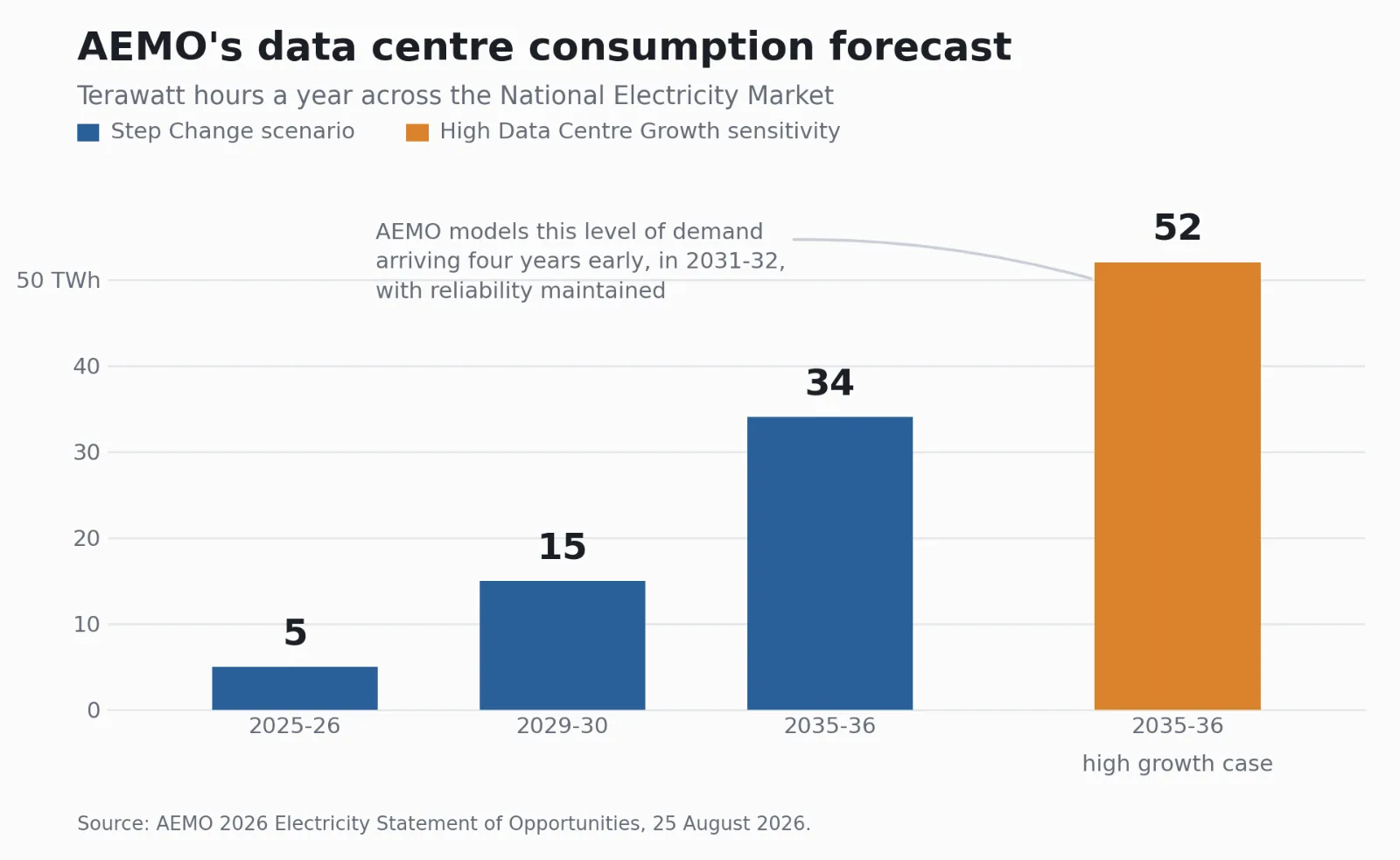
Data centres take 2.8 per cent of what the market supplies in 2025-26, 7.8 per cent by 2029-30 and 13 per cent by 2035-36, after which AEMO expects growth to taper.
New generation and storage in the pipeline hit 40GW
About 9.1GW of new generation and storage came to full output in 2025-26, more than double the capacity connected the year before. Another 24GW of committed and anticipated projects have joined since the 2025 outlook, taking the pipeline to 40GW. AEMO headed its media release "Reliability can be maintained with timely investment as demand grows", and Westerman said the outlook had improved, "supported by record levels of new generation and storage, and a strong pipeline of projects expected over the next decade".
Both years the Retailer Reliability Obligation tests, 2027-28 and 2029-30, come through AEMO's assessment clear, and it requests no instrument from the Australian Energy Regulator. About 26GW of the capacity behind that clean result is anticipated rather than committed, meaning it has cleared fewer delivery milestones. On a committed-only count AEMO would have requested instruments in Queensland and New South Wales for 2029-30, after Gladstone and Eraring close, and the obligation gives no second chance to ask for that year.
AEMO publishes two supply cases
Beyond those years AEMO publishes two cases, both measured against its reliability standard, a threshold of 0.002 per cent of a region's annual demand going unserved.
On the Government Schemes and Actionable Developments case, the more optimistic of the two, AEMO holds New South Wales, South Australia and Victoria inside the standard until 2033-34, Tasmania until 2034-35, and Queensland right through the ten-year outlook. Its Committed and Anticipated Developments case, the reliability forecast proper, counts only projects that have cleared its commitment tests and applies recent commissioning delays. There the standard is exceeded from 2030-31 in New South Wales and Victoria, 2031-32 in South Australia, 2032-33 in Queensland and 2033-34 in Tasmania.
A high-growth case brings 2035-36 demand forward to 2031-32
AEMO ran a High Data Centre Growth sensitivity, taking data centre consumption to around 52TWh by 2035-36, approximately 18TWh above the central forecast. On that path the central forecast's own 2035-36 level arrives four years early.
AEMO finds reliability can be maintained even if the 34TWh assumed for 2035-36 arrives in 2031-32, provided its government-backed projects are delivered on time and no coal station exits ahead of schedule. Under that load the breach dates move a year forward, to 2032-33 in New South Wales, Victoria and South Australia, and the sensitivity calls for earlier investment in generation, storage and transmission. Both conditions sit on the supply side, and coal retiring on schedule is already an assumption in the central forecast.
Network companies are fielding 225 data centre projects
AEMO counts the pipeline through the network companies that own the wires, the local distribution businesses and the high-voltage transmission operators. They told AEMO that total proposed connection capacity across all development stages grew from 38GW to 67GW, and separately that 225 data centre projects are in various stages of the connection process. AEMO puts the advanced developments in New South Wales and Victoria and the less mature ones in South Australia and Tasmania.
Queensland's data centre policy settings sit apart from the other states', and AEMO records three times that it has become aware of more Queensland interest than these forecasts represent, putting that down to the timing of the network data, collected between February and May 2026.
The figure | What it counts | As at |
|---|---|---|
2.2GW | Grid connection AEMO estimates is held by data centres already operating, on distribution and transmission networks together | Quarter 1, 2026 |
9GW | Connection capacity sought by 17 projects inside AEMO's own transmission process | 30 June 2026 |
67GW | Total proposed connection capacity reported by the network companies, across all stages, on distribution and transmission networks together | February to May 2026 |
Source: AEMO 2026 Electricity Statement of Opportunities, section 3.1.5; AEMO media release on Quarterly Energy Dynamics Q2 2026, 28 July 2026.
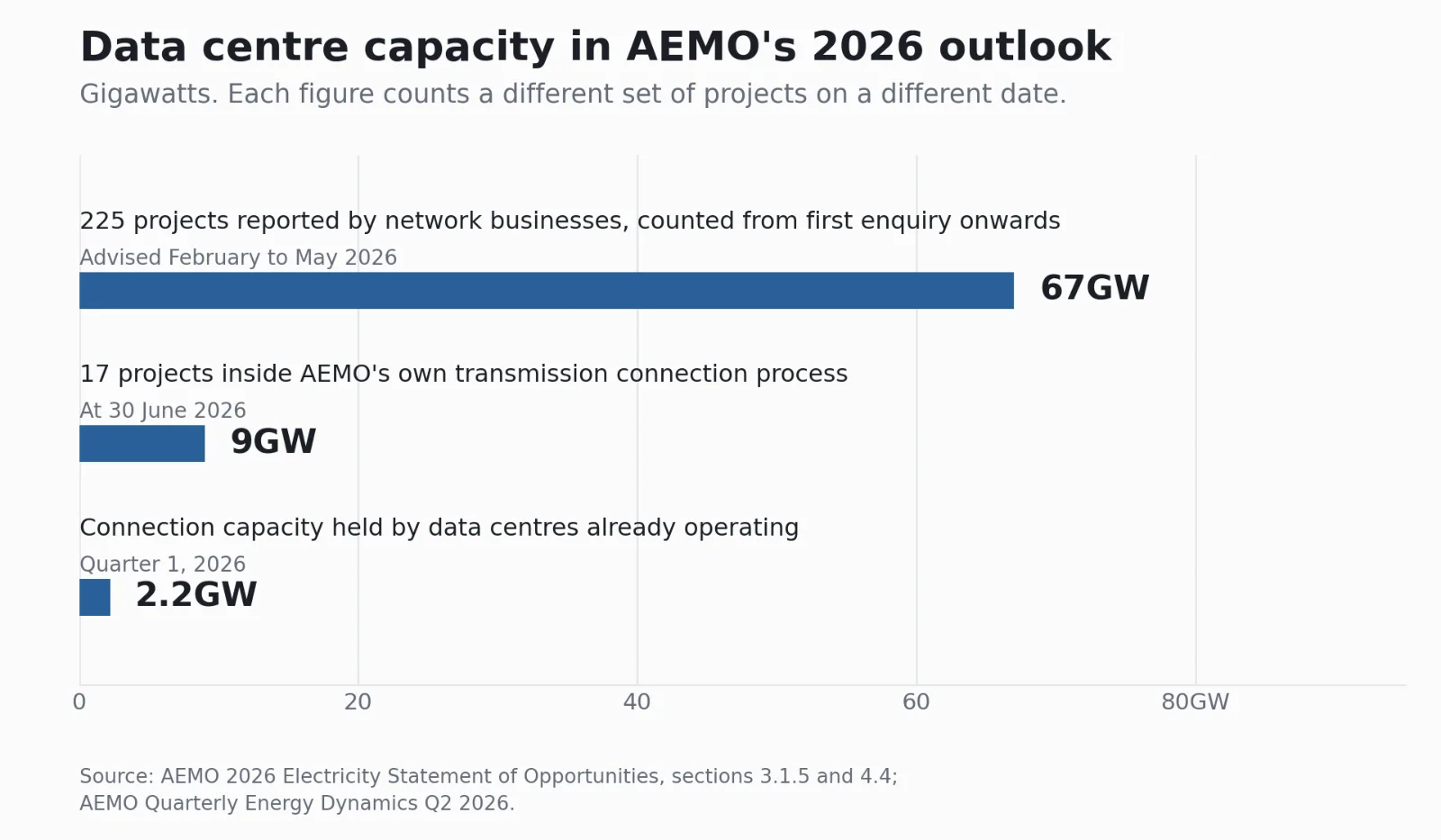
The three figures count different sets of projects on different dates. Only the 2.2GW is capacity already in service.
AEMO expects a mature fleet to draw about half its connection
"Planning for that growth starts with understanding it, that's why this year's ESOO contains additional information on data centre demand," Westerman wrote on LinkedIn. One addition is a utilisation rate, meaning how much of a grid connection a data centre actually draws. AEMO expects a mature fleet to average 45 to 51 per cent of its connection capacity, and reports the fleet operating in the first quarter of 2026 drew 27 per cent of its 2.2GW, at a load factor near 90 per cent, so its demand at 3am is much the same as at 3pm.
Publishing a utilisation band alongside the consumption forecast is what lets one convert into the other. At 45 to 51 per cent, a 3.9GW draw needs 7.6GW to 8.6GW of connection capacity behind it. Take out the 2.2GW already connected and AEMO's 34TWh implies 5.4GW to 6.4GW of new connection, on our calculations. The network companies have reported 67GW. That range is a floor, because both ends apply AEMO's mature band to a fleet operators say takes five to ten years to fill.
AEMO reaches the forecast by probability-weighting the project lists against how projects actually moved between 2025 and 2026, then averaging that with an economic outlook. Oxford Economics Australia assisted, the same firm whose work underpins earlier analysis of how much of a connection queue becomes real demand. Approximately 36 per cent of the projects on AEMO's 2025 list have since been cancelled, while the reported pipeline grew by three-quarters, so connection capacity was added faster than it was shed. AGL's chief executive Damien Nicks cited a combined 34TWh in May 2026, built bottom-up from real sites.
Developers could deliver the new supply themselves
The outlook records two things moving in Canberra. The Commonwealth announced proposed connection requirements for large data centres on 15 July 2026, including an obligation to underwrite their own power supply. And in July 2026 the Australian Energy Market Commission gave energy ministers advice on making data centres cover their own demand, built around clean-power certificates from new generators, a duty to contract supply, market registration, and connection agreements covering flexible demand and co-located generation.
AEMO says the outlook did not explicitly model the contracting requirement, "as it is not possible to identify the specific supply projects that data centre proponents would contract with". It then sets out what it expects the rules to do. "If the framework is implemented as proposed, the increased development opportunities may be naturally delivered by the data centre developers, lowering supply scarcity risks to other electricity consumers," the report says.
Energy ministers went further than that advice on 28 July 2026, agreeing to progress an in-state renewables requirement, meaning new generation built in the same state as the data centre. The commission had recommended the clean-power certificates and left the location open.
What to watch
National cabinet on 26 August 2026. Extracts of Prime Minister Anthony Albanese's address to the Business Council of Australia's annual dinner, released on 25 August 2026, say: "Australia is in a strong position to attract investment in data centres, but maintaining social licence will be essential. That means ensuring energy bills do not rise, water security is maintained and locations are appropriate." Reporting puts renewable supply, water use and siting before the meeting, with legislation flagged for early 2027.
The 26GW of anticipated projects. Whether they convert on schedule decides the reliability outlook in the early 2030s. AEMO's 2027 outlook is the next reading.
The phase-in argument, September 2026. Energy ministers next meet then. AirTrunk has asked them to phase the in-state renewables requirement in over time, on the ground that a campus takes about two years to build and the generation behind it five to ten.