At a glance
Australia's first royal commission into AI starts in October and reports by 1 July 2027, with three commissioners and terms of reference still weeks away.
Water and energy usage is one of five subjects flagged, alongside state regulatory settings and national approaches to managing AI.
It was announced five days after Chris Bowen told the states they may set data centre rules tougher than the proposed national standard, but not weaker.
South Australia's essential-infrastructure pathway runs on unchanged, and nothing announced on 10 August attaches a new condition to any project.
The proposed Data Centre and AI Infrastructure Act, announced on 23 June, has still not been introduced to state parliament.
Malinauskas calls Australia's first royal commission into AI
South Australia Premier Peter Malinauskas has called Australia's first royal commission into artificial intelligence. It begins in October, costs about A$3 million, and reports by 1 July 2027. Three commissioners will be appointed and the terms of reference published within four to six weeks, and evidence will be taken from businesses, industry groups, unions, technology developers, academics and the creative industries. Malinauskas called AI an exciting opportunity to advance the cause of humanity while warning that, unchecked, it is "a material risk to the way our society operates".
It lands one day after he signed a memorandum of understanding with OpenAI at the company's San Francisco headquarters, reported as the first between an Australian state or territory and a major AI company, and after two months in which the state made the case that AI infrastructure belongs on its grid. South Australia released a data centre strategy on 23 June, with government modelling putting a 1GW campus at about A$6.8 billion in capital expenditure and 200 to 300 ongoing roles. It has an 800MW campus at Bundey holding a transmission connection agreement, and a quadrupled Adelaide to Perth fibre corridor into the west-coast cable landings.
Five subjects were flagged: economic and social opportunity for the state, state policy and regulatory settings, national approaches to managing AI, the effects on health and education, and technology's relationship with water and energy usage. State regulatory settings, national approaches and water and energy usage each bear on how a data centre gets approved and powered. Malinauskas flagged the water and energy subject five days after Bowen told the states they may set data centre rules tougher than the coming national standard.
Water and energy usage is one of the five subjects flagged
South Australia already tests water and power at the approvals stage. Amendments to the Planning, Development and Infrastructure (General) Regulations made in September 2025 require data centre applications to carry SA Water advice on water sufficiency and a Technical Regulator certificate on power-system compliance. The commission takes evidence on requirements the state has applied since September 2025.
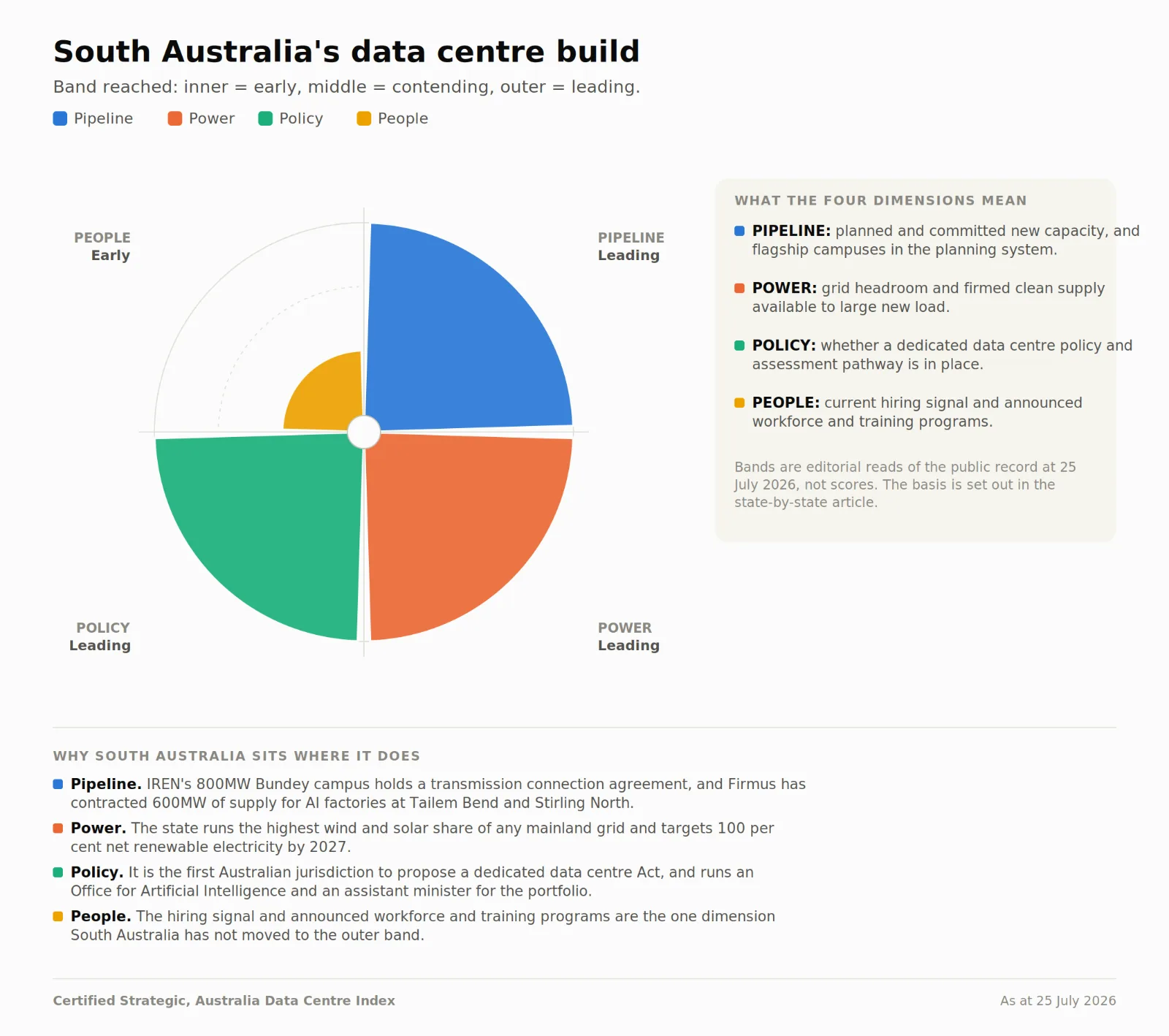
South Australia runs the highest wind and solar share of any mainland grid and targets 100 per cent net renewable electricity by 2027. It was also the only Default Market Offer region where the benchmark rose on 1 July 2026, up 1.4 per cent, with network cost increases outweighing the wholesale savings that cut bills everywhere else. A data centre that contracts new firmed supply brings generation and storage with it, which is the model the state's June strategy promotes.
Bowen told the states the national standard is a floor
Date | What happened |
|---|---|
15 July 2026 | Albanese announces an Office of AI and plans to legislate national AI standards |
28 July 2026 | Energy ministers agree an in-jurisdiction offset direction, Queensland and the Northern Territory opposing |
5 August 2026 | Bowen says states will be free to exceed the proposed national data centre standard |
10 August 2026 | South Australia calls a royal commission covering state and national settings |
Source: ministerial statements and contemporaneous reporting, July and August 2026.
At the National Press Club on 5 August, Climate Change and Energy Minister Chris Bowen said of the national data centre standard that "states will be free to add more rigorous requirements, but not to water them down". The framework goes to National Cabinet this month and legislation is targeted for early 2027. Energy ministers had agreed the in-jurisdiction offset direction on 28 July, with an opt-out for jurisdictions too small to host their own renewables, over opposition from Queensland and the Northern Territory.
Malinauskas put national approaches to managing AI among the five subjects, placing Commonwealth policy inside the evidence a state commission will take. The terms of reference, due by late September, are the first document that shows the scope.
South Australia is the first Australian jurisdiction to propose a dedicated data centre Act, and it runs an Office for Artificial Intelligence and an assistant minister for the portfolio. Victoria has an AI minister, and the New South Wales opposition has committed to an AI minister and a co-investment fund at its March 2027 election, on a state-by-state build running to four different rulebooks while the national standard is drafted.
South Australia's essential-infrastructure pathway is unchanged
A royal commission takes evidence and reports. Its recommendations reach the statute book only where a government legislates them, and nothing announced on 10 August pauses an assessment, alters the state's planning route or attaches a term to any project.
The proposed Data Centre and AI Infrastructure Act, which would give data centres essential-infrastructure status and put major projects with the Coordinator-General, was announced on 23 June and has not been introduced to state parliament. Section 130 of the Planning, Development and Infrastructure Act, which qualifying data centre projects can already use, continues to carry approvals alongside the faster assessment routes other states have built.
IREN targets energisation at Bundey from 2028 and the Koolunga battery targets commercial operation in the first half of 2028, both after the commission's 1 July 2027 report. Bundey holds four 330kV feeder exits sized to carry 800MW without network upgrades. Firmus has contracted GreenPoint Energy's 200MW Koolunga battery, the first physical asset under its 12-year, 600MW supply agreement with Gunvor, ahead of the AI factories it firms at Tailem Bend and Stirling North.
Labor was returned in March 2026 with an expanded majority, and the report lands roughly three years before the next scheduled South Australian poll.
What to watch
The terms of reference, due by late September. Whether the energy and water subject is scoped to AI systems generally or to data centre facilities decides whether the inquiry reaches the connection queue.
The three commissioners. They are named with the terms of reference, four to six weeks from 10 August, and their backgrounds indicate how the water and energy subject gets run.
Whether the Data Centre and AI Infrastructure bill is introduced before October. Introducing it before the commission sits keeps the approvals pathway ahead of the inquiry. Holding it until July 2027 hands the commission the drafting.
South Australia at National Cabinet. The AI standards go to National Cabinet this month, and South Australia was among the six jurisdictions that backed the direction energy ministers agreed on 28 July.
Submissions from named operators. IREN has a connection agreement sized for 800MW at Bundey and Firmus a 600MW supply agreement, and evidence opens when the commission sits in October.