At a glance
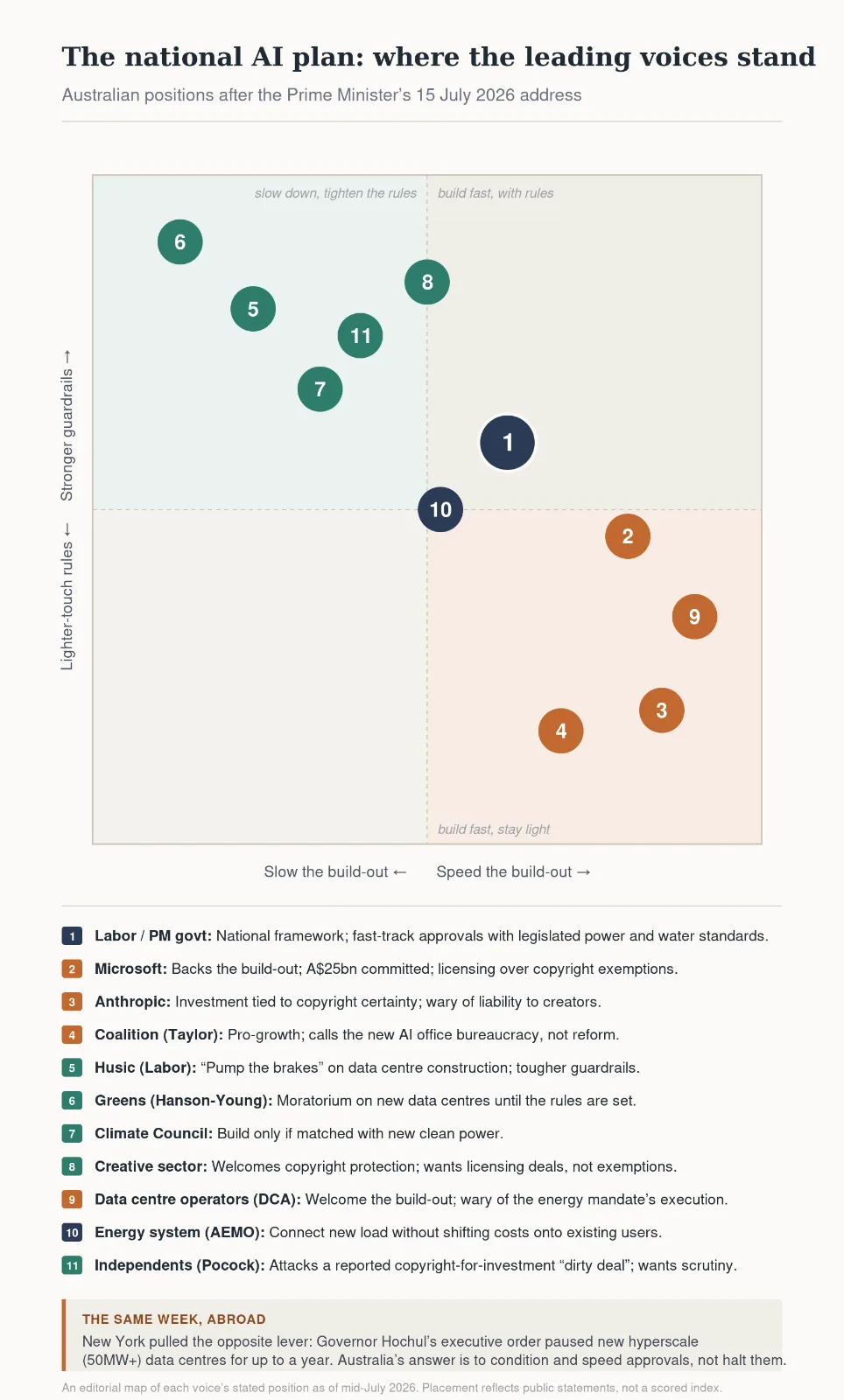
Certified Strategic has plotted the eleven leading responses to the national AI plan on one matrix, mapping build-out pace against regulatory posture.
The government sits alone in the contested middle, holding “build fast” and “with rules” together, and almost no one opposes AI outright.
The sharpest split is over the pace and terms of the data centre build-out, from Microsoft’s backing to moratorium calls from the Greens.
Copyright is the fault line with money attached: Anthropic ties investment to certainty while independent David Pocock attacks a reported exemption-for-investment deal.
None of it binds yet: the standards go to National Cabinet in August 2026, with legislation targeted for early 2027.
Where the leading voices have landed
The government’s National AI plan, unveiled by Prime Minister Anthony Albanese at the University of Sydney on 15 July, reversed Labor’s hands-off approach: an Office of AI inside his own department, legislated Australian AI standards, and faster approvals to court investment. Certified Strategic set out what the plan actually does for data centres, and the grid bottleneck it leaves untouched, when it was announced. This piece is about the reaction, and the reaction does not line up on a simple for-or-against axis.
We have plotted the eleven most consequential voices on a single matrix, mapping how fast each wants the build-out to move against how tightly they want it governed.
Voice | On data centre build-out | On rules and copyright |
Albanese government | Speed approvals, with power and water conditions | Legislated standards; a choice-based copyright model, no blanket exemption |
Microsoft | Backs the build-out; A$25bn committed | Supports the framework; licensing over exemptions |
Anthropic | Wants to scale Australian capacity | Ties investment to copyright certainty |
Coalition (Angus Taylor) | Pro-growth, competitiveness first | Calls the Office of AI bureaucracy, not reform |
Ed Husic (Labor) | “Pump the brakes” on construction | Wants tougher, consistent guardrails |
Greens (Sarah Hanson-Young) | Moratorium until rules are set | Regulate big tech before approvals |
Climate Council | Build only if matched with clean power | Align expansion with emissions targets |
Creative sector | Largely neutral on build pace | Welcomes protection; wants licensing deals |
Data centre operators (DCA) | Welcome the build-out; wary of the energy test | Support certainty; watch the copyright outcome |
Energy system (AEMO) | Connect new load without shifting costs | System planner, not an advocate |
Independents (Pocock) | Want scrutiny before approvals | Oppose any copyright exemption trade |
Source: Primary statements and reporting, July 2026.
The government sits alone in the contested middle, trying to hold “build fast” and “with rules” together. Almost no one is arguing against AI; the fight is over the pace and terms of data centre construction. The Coalition’s Angus Taylor calls the new office bureaucracy; Labor’s own Ed Husic wants to “pump the brakes” on a construction “frenzy”; Greens senator Sarah Hanson-Young wants a moratorium, which Industry Minister Tim Ayres called “pretty dopey”; and independent senator David Pocock is pressing for scrutiny, most pointedly on copyright.
The mandate operators will price first
The standard that reshapes the build-out is an energy test: large data centres would have to add at least as much power to the grid as they draw, pay the full cost of their grid connections, and meet water rules, with the government casting it as a way to keep household bills down. The states had already diverged on how they approve data centres, which is the patchwork the national standard is meant to replace.
Operators have been measured. The sector’s industry body, Data Centres Australia, welcomed the direction while resisting the framing of its energy footprint, noting much of its power is already offset through renewable power purchase agreements. Their concern is execution: underwriting generation and paying the full cost of grid connections is a cost and timing variable that favours operators already contracting new supply. On the energy side the mandate reads less as a burden than as a demand signal. Forcing new load to bring its own generation channels capital toward firmed renewables and storage, close to the outcome the Australian Energy Market Operator has pushed as it connects large loads without shifting costs onto other users, with a 5.4GW pipeline in the connection queue.
Copyright is where the money is
Copyright is where the standoff is most direct. The government ruled out a blanket text and data mining exemption and flagged a world-first alternative: a regime letting rights holders choose whether their work trains AI, and how they are paid. “Not everything produced in Australia is up for grabs,” Albanese said. The tension is commercial. Anthropic has tied a planned investment, reported at around A$21.6 billion, to greater copyright certainty, while Microsoft has struck a content-licensing deal with Nine Entertainment that it says returns revenue to publishers. Two of the largest AI investors in the country are pursuing opposite copyright strategies, and the framework does not resolve which one wins. We covered the groundwork when Anthropic signed its Australian memorandum of understanding with the government and met with NEXTDC, AirTrunk and CDC.
In late June, independent senator David Pocock alleged cabinet was weighing an industry proposal to trade an exemption for data centre investment plus a creators’ fund, and branded it “the ultimate dirty deal.” Ministers rejected the characterisation. The gap between the stated “no exemption” line and a reported proposal to the contrary is the ground the independents and creators are now contesting.
Nothing is legislated yet
The key caveat is that this week’s announcement changes intent, not law. The Office of AI is an executive creation; the standards go to National Cabinet in August 2026 before any binding rules exist, with legislation targeted only for early 2027. Until then, the energy and water conditions are a signal to price against, not a rule to comply with. Business groups welcomed the ambition while warning that flawed execution could deter the investment it is meant to attract.
What this means and what to watch
For the data centre sector, unconditional growth is over. Approvals should get faster, but access is tied to power and water, favouring operators who lead on energy underwriting. That clarity is the gating item we flagged in our 12-to-18-month window analysis. In the same week, New York Governor Kathy Hochul signed the first US statewide moratorium on new hyperscale data centres above 50MW, a pause of up to a year. Australia has chosen the opposite instrument, the “build, but bring your own power” alternative to a freeze. The next real milestones are National Cabinet in August and the draft legislation, with the ALP national conference set to test how hard the restraint camp can push from inside government.
Sources and further reading
Primary sources:
View from The Hill: Albanese takes oversight of government’s response to AI, Michelle Grattan, The Conversation, 14 July 2026
Anthony Albanese maps out AI future with new national framework, ABC News, 14 July 2026
Albanese promises fast-track approvals for datacentres, The Guardian, 14 July 2026
Data centres forced to generate more power than they use, Australian Financial Review, 15 July 2026
A blueprint for Australia’s success in the AI era, Jane Livesey, Microsoft, 15 July 2026
Greens call for a moratorium on the building and approval of data centres, Australian Greens
First statewide moratorium on new hyperscale data centers, Office of Governor Kathy Hochul, 14 July 2026
Anthropic tells Chalmers A$21bn investment hinges on copyright, Australian Financial Review, 13 July 2026
Digital demand surge: preparing Australia’s power systems for the rise of data centres, AEMO