At a glance
Sydney runs about 667MW live across more than 90 sites on the Certified Strategic directory count, the country's largest operating base; Melbourne is ahead of Sydney on planned capacity, 799MW to 384MW, on figures from ratings agency Fitch reported by the AFR.
South Australia has tied new capacity to new generation: a 100% net renewable target for 2027, an 800MW campus at Bundey with a signed transmission connection agreement, and a proposed Act to treat data centres as essential infrastructure.
Queensland's industry launched its own state council in July, and both Queensland and Western Australia are live markets without a dedicated state data centre policy.
Infrastructure Australia projects a national infrastructure workforce shortage that could reach 300,000 workers by 2027; Victoria's State Electricity Commission will train 2,000 electrical apprentices from January 2027.
Operational capacity of about 1.6GW is forecast to reach 3.9GW by 2030, on DC Byte figures published by Data Centres Australia and Mandala on 26 August 2026, with South Australian modelling putting a single 1GW campus at 500 to 1,000 construction jobs.
Doubling Australia's capacity by 2030 will take thousands of trades and engineers
Australia runs about 1.6GW of operational data centre capacity today, on DC Byte figures published by Data Centres Australia and Mandala on 26 August 2026, and DC Byte now puts 2030 at 3.9GW, up from the 3.2GW it forecast in April. The announced pipeline stood at 21.6GW in the April 2026 count. AEMO has mapped 5.4GW of data centre demand seeking transmission connection, and the ABS named data centres the driver of the March quarter's capex record, with New South Wales up 22.1 per cent and Victoria 12.7 per cent.
South Australian government modelling puts a 1GW campus at 500 to 1,000 construction jobs and 200 to 300 ongoing roles. On AirTrunk's own forecast, its second Melbourne campus will employ more than 4,000 people through construction. The skills involved are specialised, from high-voltage electrical work and controls to cooling and water engineering, and some of the engineering is new to this market: AWS plans to cool a western Melbourne campus on recycled water from the day it opens, which the parties describe as a Victorian first.
Five states moved this year. South Australia published a data centre strategy and a proposed Act in June. Queensland's industry launched a state council in July. Four proposed campuses entered Victoria's planning system between April and July, New South Wales has a parliamentary inquiry reporting by 3 November, and in Perth, Singapore-listed AsiaPhos signed a non-binding term sheet in June for 51 per cent of DC Alliance, which owns Pier DC.
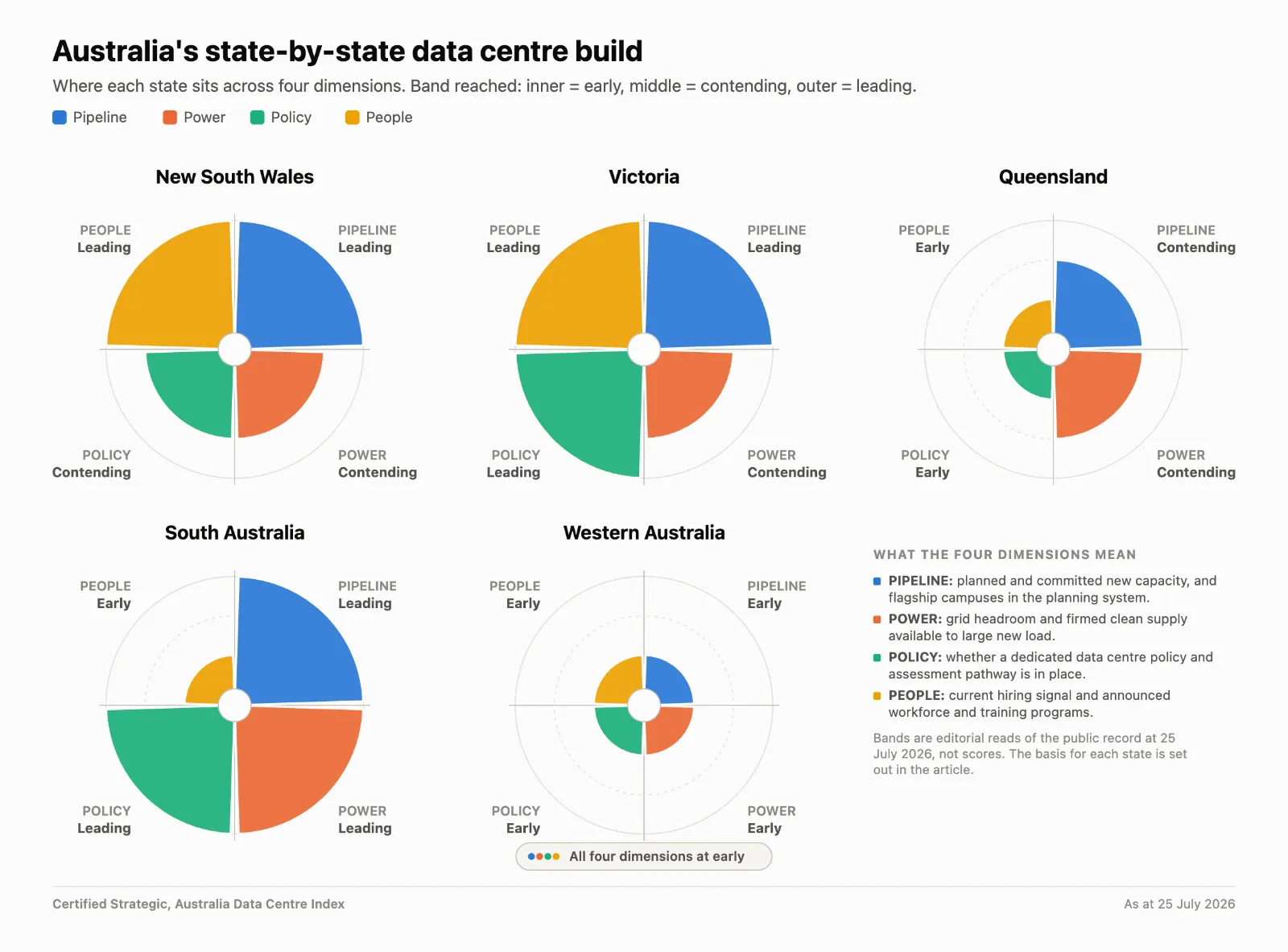
New South Wales, Victoria, Queensland, South Australia and Western Australia each hold a different part of that pipeline. Across the five, the capacity in planning, the power to carry it, the policy settings around it and the workforce to build it all stand at different stages. Each dimension sits in one of three bands, from early through contending to leading, reflecting the public record as at 25 July 2026, and the basis for every band is set out state by state.
New South Wales runs the largest live fleet
Sydney operates about 667MW across more than 90 sites, the largest single block in the directory of Australian data centres, and Western Sydney is where it grows: data centres account for A$14.2 billion of the A$31.1 billion in private investment lodged across the airport city, on figures from the Bradfield Development Authority, which oversees it, and ten of the 15 data centre projects backed by the state's Investment Delivery Authority sit in Western Sydney councils. TransGrid, which owns and operates the NSW transmission network, says it has fielded more than 10GW of connection enquiries, with about 1.5GW already contracted in Western Sydney, and chief executive Brett Redman says "plenty of it is real"; its rule change would have data centres fund the grid capacity they unlock, and Sydney Ring South is the transmission build the region is waiting on. Macquarie Technology exercised the site option in July on its proposed 200MW Macquarie Park campus, which the company has costed at A$2.5 billion to A$3 billion excluding land.
NSW's policy process is still running: a consultation paper set out five principles in March, a Legislative Council inquiry reports by 3 November 2026. That leaves it mid-table on the state-by-state policy comparison. Pipeline: leading, on the breadth of the lodged book rather than Fitch's 384MW metro planning figure. Power: contending. Policy: contending. People: leading, on the largest share of the national electrical trade, at 28.5 per cent.
Victoria holds the larger planned pipeline
Fitch's June analysis, reported by the AFR, puts Melbourne ahead of Sydney on planned capacity, 799MW to 384MW, and credits the gap to larger, more accessible land and fewer grid constraints. That lead sits in the forward book while Sydney keeps the larger live fleet. The planning queue keeps filling: four proposed campuses entered the planning system between April and July, NEXTDC banked 169 hectares at Geelong, and Keppel's proposed 720MW Morwell campus sits in the Latrobe Valley. The Sustainable Data Centre Action Plan carries the state's A$25 billion opportunity figure and commits to choosing sites using transport, energy and water data, and the State Electricity Commission, the state-owned energy body, takes the first electrical apprentices into its training academy in January 2027. The constraint travelling with that growth is connectivity: the western corridor's fibre has not kept pace with its power and land.
Victoria has both a published data centre policy and a state-owned apprenticeship program feeding the electrical trades those campuses need. The variable is the election on 28 November, which decides who holds the planning portfolio that most large Victorian data centre decisions run through. Pipeline: leading. Power: contending. Policy: leading. People: leading.
Queensland's pipeline is growing without a dedicated state policy
Queensland has operating campuses and, since July, an industry body of its own. Quinbrook Infrastructure Partners is developing its Supernode campus at Brendale, north of Brisbane. Quinbrook values the campus at A$2.5 billion and plans four hyperscale data centres alongside a 250MW battery whose full storage capacity, on the company's account, is under a long-term Origin Energy offtake. NEXTDC's Brisbane campuses give the state an established operating base. The Queensland Data Centres Council launched in July as a state-scoped, member-funded advocate, positioning itself as "purpose-built for Queensland's regulatory, environmental and social landscape."
Queensland is one of the two states to watch for a dedicated data centre policy next, with the council putting industry advocacy in place before any formal policy process has started. Pipeline: contending. Power: contending. Policy: early. People: early, with no data centre-specific state training program announced.
South Australia ties new campuses to new power
South Australia published its data centre strategy on 23 June with a principle in its own words, "new energy for new demand", and a proposed Data Centre and AI Infrastructure Act that would treat data centres as essential infrastructure with the Coordinator-General taking over decisions. The Act has been announced, not yet introduced to parliament. One campus is already at that stage: IREN's 800MW campus at Bundey has a signed transmission connection agreement, energisation targeted from 2028, and sits at the centre of the Northern Transmission Project proposed by ElectraNet, South Australia's transmission network operator. The state targets 100 per cent net renewable electricity by 2027, and Fitch's June figures showed Adelaide appearing in the planning queue with 800MW from almost nothing.
South Australia's government has published per-campus economic modelling that no other state strategy reviewed here carries: about A$6.8 billion in capex, 500 to 1,000 construction jobs and 200 to 300 ongoing roles for a 1GW campus. Pipeline: leading, a position that currently rests largely on a single campus. Power: leading. Policy: leading. People: early, with the modelling published and more than 700 jobs committed at Bundey on IREN's figures, and hiring and training programs still to come.
Western Australia has an established base and a withdrawn flagship application
Perth runs an established colocation market with NEXTDC and others operating, a gateway for neoclouds serving Australia and Asia. Its largest disclosed deal this year, a Singapore-listed company's move for control of Pier DC, remains at non-binding term sheet stage. No AI-scale campus has been publicly announced as under construction in the state as at 25 July 2026. GreenSquareDC withdrew its 120MW, roughly A$600 million Hazelmere application on 14 May after 1,836 objections, with council planners recommending refusal on generator noise grounds; the company disputed the noise assessment methodology as unrealistic.
Western Australia has a real market and live demand, but its highest-profile application of the year ended in withdrawal before any decision was made. Pipeline: early. Power: early. Policy: early. People: early, each band reflecting what has been announced, against an operating base that predates the AI cycle.
Tasmania and the territories hold pieces the mainland states do not
Tasmania published a draft Statement of Expectations for data centres and AI infrastructure on 7 September 2026 and sits inside Firmus' Project Southgate, with the Bernacchi-1 subsea cable targeted, on Firmus and SUBCO's timetable, to more than double Bass Strait fibre capacity in the second quarter of 2027. The Northern Territory granted land exclusivity for Beetaloo Energy's proposed 2GW gas-powered campus concept near Darwin, a project whose A$40 billion figure, on the proponent's numbers, attaches to a greenfield site with no named tenant. And the ACT hosts CDC Data Centres' Canberra campuses, which serve government and sovereign workloads.
The jobs modelling that exists is project by project
Infrastructure Australia's 2025 Market Capacity Report counts 204,000 workers engaged on infrastructure as at October 2025 and projects a workforce shortage that could reach 300,000 by mid-2027 as privately funded energy projects enter delivery, with regional shortages quadrupling. Victoria's State Electricity Commission academy commits to 2,000 electrical apprentices over four years, all employed by the commission. South Australia has published campus-level job modelling, and IREN puts Bundey at more than 500 construction jobs and more than 200 ongoing roles. The trade at the centre of every one of these builds is already stretched. Jobs and Skills Australia counts 193,200 electricians nationally, 28.5 per cent of them in NSW, 23.1 per cent in Queensland and 22.7 per cent in Victoria, and its 2025 Occupation Shortage List, updated in March, has Electrician (General) in shortage in every state and territory. The states competing for campuses are competing for the same electricians, a constraint tracked role by role in the 2026 hiring landscape and on the data centre jobs board.
Between them, the published numbers cover construction headcounts, capex and one state's per-campus modelling; beyond Victoria's apprenticeship intake, who fills the roles, where the rest train, who pays for that training and which skills must be imported sit outside the documents above. The ABS has begun the measurement work with a spotlight on data centres in economic statistics, and in a June speech Assistant Minister Andrew Charlton noted that most of the March quarter's record equipment spend was imported.
What to watch
The NSW inquiry. The Legislative Council inquiry reports by 3 November 2026, with a formal data centre strategy expected to follow. NSW finishing its process would shift the national policy map more than any other single event on this list.
The SA Act. Introduction of the Data Centre and AI Infrastructure Act to state parliament turns an announced pathway into a legislated one.
Victoria's election. Victorians vote on 28 November. State-assessed data centre applications that run past the vote will be decided by whichever government holds the planning portfolio.
Queensland and WA policy movement. Two live markets without a dedicated policy: one now has an industry council lobbying for the conversation, and the other saw its highest-profile application withdrawn before a decision.
The workforce numbers. Infrastructure Australia's shortage projection peaks in 2027, the year the State Electricity Commission's first apprentice intake begins, a year ahead of Bundey's target energisation.