At a glance
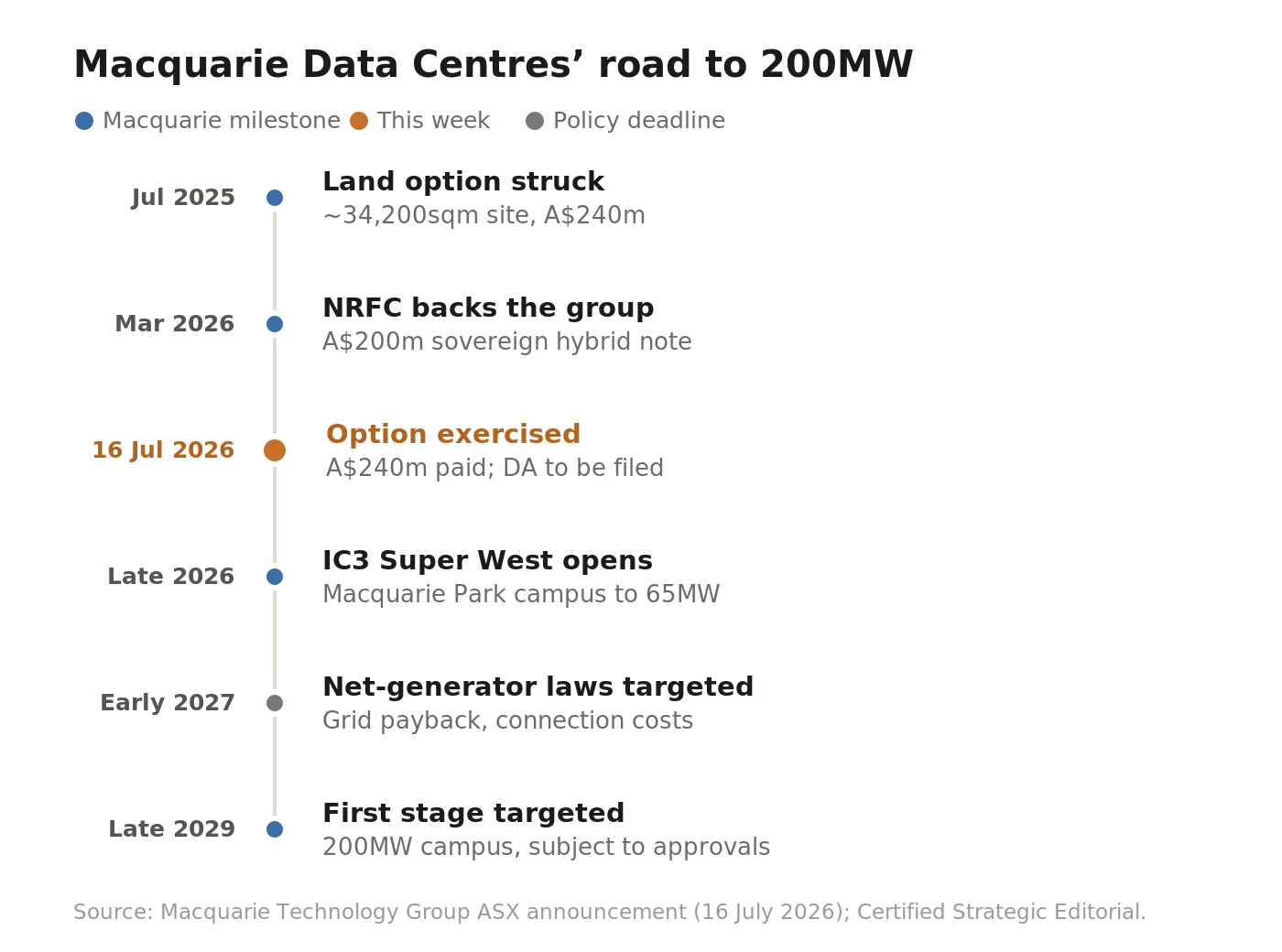
Macquarie Technology has exercised an option over a 34,200sqm Macquarie Park site for a proposed 200MW campus.
Construction is costed at A$2.5 billion to A$3 billion excluding land, with a first stage targeted for late 2029.
The site sits within walking distance of the existing Macquarie Park campus, which reaches 65MW once IC3 Super West opens.
A development application, community consultation and grid connection all come before any build.
Prime Minister Anthony Albanese flagged laws a day earlier, targeted for early 2027, that would require large data centres to become net energy generators.
Biggest build lands as rules tighten
Macquarie Data Centres, the data centre arm of Macquarie Technology Group, has exercised a put-and-call option, first struck in July 2025, over a roughly 34,200sqm light-industrial site between Talavera Road and the M2 motorway in Macquarie Park. The purchase price is A$240 million, funded from existing cash reserves and the group’s corporate debt facility, according to the company’s ASX announcement. Macquarie has previously flagged construction costs of A$2.5 billion to A$3 billion excluding land, and says it is exploring capital recycling of existing assets and development partnerships to fund the build.
The Financial Review described the proposed 200MW campus as the biggest project to date for David Hirst, who leads Macquarie Data Centres. “The modern world doesn’t run without compute infrastructure,” Hirst told the paper. “The most responsible place for it to be is inside a data centre.” Macquarie has said it will file a development application, arrange community consultation and organise a grid connection for baseload power before construction, and expects to complete a first stage by late 2029 if approvals hold.
The commitment came a day after Prime Minister Anthony Albanese set out an AI plan that promises faster approvals but also flags laws, targeted for early 2027, that would require large data centres to put at least as much energy into the grid as they take out, pay their full share of connection costs and cut usage when the grid is strained. On the timeline Macquarie has set out, and if those laws pass as flagged, the new campus would be built and powered under them.
Sovereignty is the pitch
Asked by the Financial Review whether community opposition, which by the paper’s account has forced some data centre proposals to be pulled, would slow development, Hirst leaned on sovereignty. By his account, applications that Australians use every day will be “consumed or built offshore” without local data centres, leaving no domestic control over the data inside them. It is the operator’s standard defence, and Macquarie’s certification record gives it a stronger basis than most to make it.
Macquarie holds the highest Hosting Certification Framework rating for both cloud services and data centre facilities under the Australian government’s scheme, and says it is the only operator to do so; its existing Macquarie Park centres already serve hospitals, banks and government agencies that need low-latency processing. In March the company secured A$200 million from the National Reconstruction Fund Corporation, a Commonwealth investor, structured as what the NRFC called a first-of-its-kind hybrid note for an unrated company. With the government already a capital partner in its sovereign infrastructure, Macquarie can make the sovereignty argument from a position few operators share. The new campus could also be used to train AI models, a step beyond the low-latency work the existing campus was built for, according to the company.
Power is the gating item
Macquarie has said it still needs to arrange the grid connection. It has to secure baseload power for 200MW of demand in the state that carries most of the national data centre pipeline, and it must do so as the connection and net-generator rules the government has flagged take shape. The company says the campus will use advanced air cooling with limited water use, which speaks to the water side of those expectations; the power side is the one still open. Planning is the other real constraint: the development application has not yet been lodged, community consultation has not started, and by the Financial Review’s account some NSW proposals have been withdrawn under local opposition. Because the campus is far larger than the 15MW threshold, it will be assessed as State Significant Development. That puts the decision with the NSW government; the City of Ryde council and residents can make submissions but do not hold the consent.
Ausgrid’s Macquarie Park sub-transmission substation is already close to full. It carries about 140MVA of firm capacity, and in 2024 regulatory filings the network said that once a third transformer is added, five major loads would take every connection bay, with no room for new loads at the site. Ausgrid has since fielded connection applications from data centres it cannot supply from the existing network, and has proposed about A$162 million to build a new substation, part of a wider move in NSW toward making data centres fund the grid capacity they unlock. Macquarie’s 200MW would stack on NEXTDC’s planned 80MW-plus S5 in the same precinct and ISPT’s A$1.58 billion project nearby in North Ryde.
The new campus joins 39 data centre projects already under way in NSW, according to the Financial Review, in a state that holds about 60 per cent of Australia’s 5.4GW disclosed pipeline on AEMO’s numbers. That concentration is part of why power and water sign-off have moved to the centre of the state’s crowded approvals process. A 200MW baseload draw would land on the same grid the government’s flagged rules are designed to protect.
Community benefits, by design
Macquarie has built community benefit into the site. Its plan includes Generations Community Park, more than one acre with a community garden for City of Ryde residents, an outdoor art gallery, and space for research and learning with Macquarie University, which already runs a research partnership with the company. The inclusions fit the current policy environment, in which the Australian government has urged developers to ensure new data centres benefit host communities, including proposals for developers to contribute to local community funds. On the plan as described, community benefit is built into the campus design from the outset.
How Macquarie pays for a build several times its earnings
Data centres contributed around a third of Macquarie Technology’s A$58 million in group earnings before interest, tax, depreciation and amortisation in the six months to 31 December 2025, so a build the company has flagged at up to A$3 billion runs to many multiples of the segment’s current earnings. The figure also sits above the whole company’s market value, which was about A$1.7 billion in mid-July. To fund it, Macquarie has said it is exploring capital recycling of its existing assets and development partnerships; the Financial Review reported this could include selling majority stakes in the existing data centres.
The stock has had a strong run on the sovereign story. MAQ shares climbed about 30 per cent through the June quarter to a 12-month high near A$78 after the National Reconstruction Fund deal, then gave much of it back, trading around A$66 by mid-July for a roughly flat year to date. They were modestly higher on the day the land purchase was reported. The campus still depends on approvals and customers that do not yet exist.
The interests in the deal line up on several sides. Macquarie would gain scale and a domestic venue for AI training; Macquarie University would gain teaching and research space; the surrounding community would gain a park and gallery; and the government would gain a certified, onshore option for sensitive workloads. The cost sits on the grid, where 200MW of new baseload demand would meet an energy system the same government is moving to shield. Macquarie Technology, which is unrelated to the financial services group of the same name, operates two data centres in Canberra and four in Sydney, and has said its total capacity across those sites will reach 68MW once IC3 Super West is finished, of which the Macquarie Park campus accounts for 65MW.
What to watch
Four near-term markers will show whether a late-2029 first stage is realistic: the development application lodgement and the start of community consultation, the grid-connection application that tests how 200MW is powered, the first anchor customers for a campus that has none, and any move to sell stakes in the existing centres to fund the build.