Data centres are the engine rooms of the digital economy, but most people never think about them until something breaks, slows down, or disappears. They power the cloud, AI, streaming, payments, and the services that now sit underneath everyday life. This article is here to explain what data centres actually do, why they matter, and why they’ve become one of the most important pieces of infrastructure in Australia’s future.
The cloud is physical infrastructure
Every tap-and-go payment, Medicare claim, hospital record, video stream and AI query in Australia relies on a data centre: a secure building filled with servers, storage and networking equipment, running with constant power and cooling. “The cloud” is really a distributed network of these facilities. Australia now has more than 200 tracked in our live directory, and together they account for around 2% of the country’s electricity use, roughly on par with shopping centres, according to Mandala’s figures.
Data centres are spreading fast, but what happens inside them still remains opaque to most people. This piece pulls back the curtain: where the power goes, who operates the buildings, and how to find out what a facility hosts.
Anatomy of a gigawatt: where the power goes
Start with the machine itself. In a modern data centre, most of the power goes to the servers. The IEA puts that at around 60% of total electricity use, with storage at about 5% and networking up to 5%. Cooling can be as low as 7% in efficient hyperscale sites or more than 30% in older enterprise facilities. The point is simple: the service is the hardware.
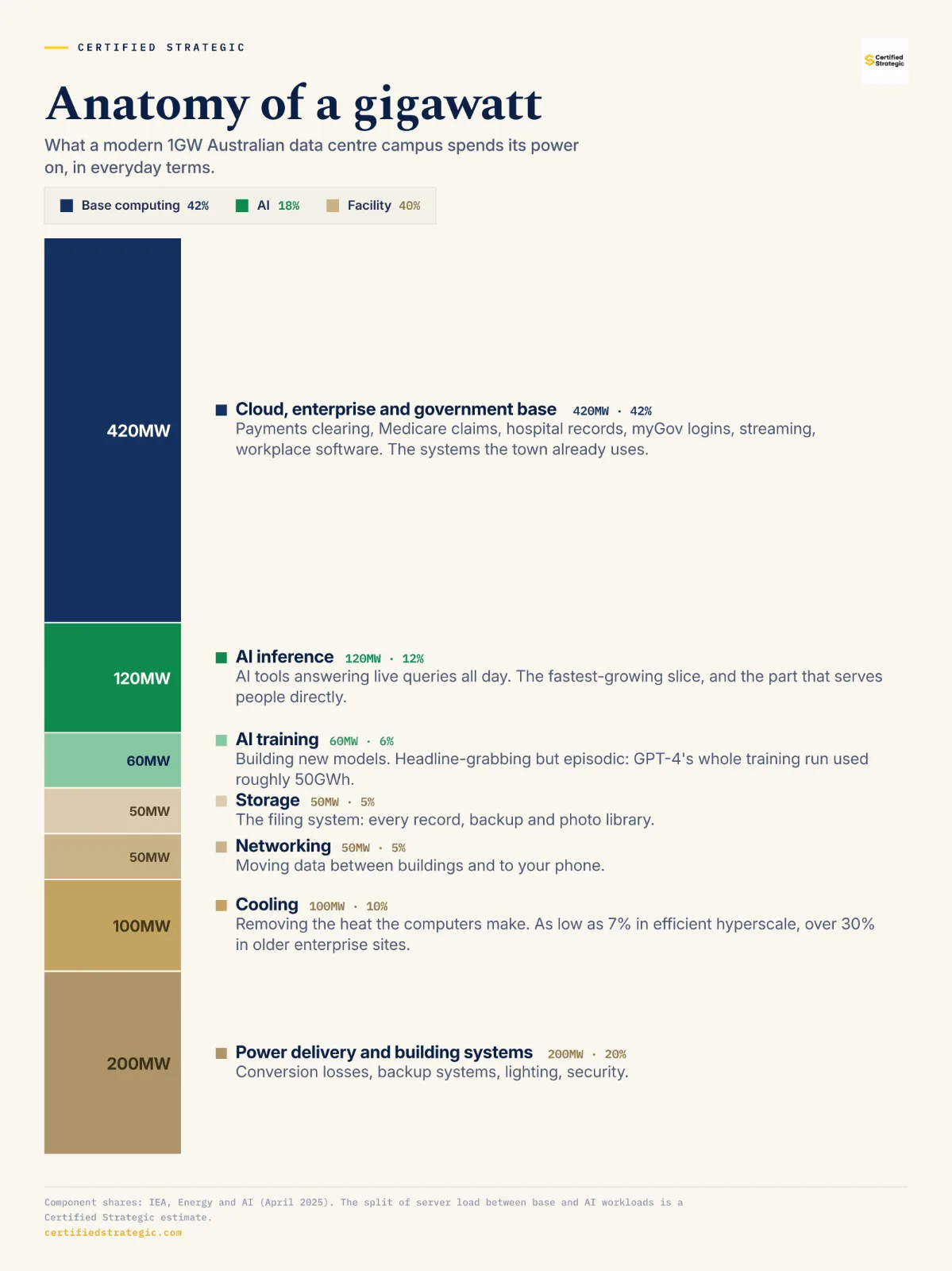
Load inside a data centre | Share of electricity | What it is in everyday terms |
Servers | ~60% | The computers running payments, Medicare claims, hospital records, streaming, and AI tools |
Storage | ~5% | The filing system: every record, backup and photo library |
Networking | up to 5% | The connections moving data between buildings and to your phone |
Cooling | ~7% (efficient hyperscale) to 30%+ (less efficient enterprise) | Removing the heat the computers make |
Power delivery and building systems | remainder | Conversion losses, lighting, security |
Source: IEA, Energy and AI, April 2025. Shares are IEA estimates and vary by facility type.
Global data centre electricity demand grew 17% in 2025, while consumption by AI-focused facilities surged 50%, on the IEA’s 2026 update. AI is the marginal driver of growth. The base load remains the everyday systems: cloud platforms, enterprise software, banking, logistics and government services. When someone asks what a data centre does, the first answer is that it runs the systems the town already uses, and the second answer is that a growing share now also runs AI.
Within the AI share, the split that matters is training against inference. Training runs are the headline-grabbers: Epoch AI estimates GPT-4’s training consumed roughly 50GWh. But training is episodic, and it is inference, the work of answering queries from live users, that now makes up about two thirds of all AI compute on Deloitte’s 2026 estimate and keeps growing as adoption spreads. The IEA projects electricity use by AI-oriented accelerated servers to grow 30% a year to 2030. Inference is also the part that serves people directly, every day. For what an AI factory does and how it differs from the buildings described here, see What is an AI data centre?
The AI factory framing is useful, but only up to a point. NVIDIA’s line is simple enough: power goes in, intelligence comes out. In Australia, that helps put a number on the sector. Mandala’s research values the technology sector, including data centres, at about A$12.6 billion in gross value added per TWh of energy consumed, ahead of mining and manufacturing, and it estimates that the on-premise servers this capacity replaces would need more than seven times the electricity for the same computation.
But megawatts are not all equal. A facility training models for an offshore developer does not deliver the same local benefit as one running inference for Australian government or banking services. Both use power, but they create different outcomes in jobs, latency and sovereignty. Our tokens-per-watt analysis is one way of showing that difference.
Three operators, three operating models
An easy way to understand what data centres hold is to look at how Australia’s biggest operators use theirs.
AirTrunk: the hyperscale wholesaler
AirTrunk leases whole halls, and sometimes whole buildings, to single tenants: the global cloud and content platforms. The platform spans more than 3.3GW of operating and planned capacity across 22 campuses in the Asia-Pacific, by AirTrunk’s account. Its tenants are rarely named. The anchor tenant at its first Sydney campus was not identified at launch and has never been disclosed; in Singapore, its SGP2 site is a rare public exception, awarded in 2023 to an AirTrunk-ByteDance tie-up under the city-state’s data centre pilot. Tenant confidentiality is standard in hyperscale wholesale leasing; AirTrunk’s own Understanding Data Centres guide explains the model in community terms. For the neighbourhood, an AirTrunk building powers the apps on your phone.
CDC Data Centres: the sovereign campus
CDC builds campuses purpose-designed for Australian Government, defence and national critical infrastructure workloads. Its contracted capacity passed 1GW in 2026 with a 555MW, 30-year contract that Infratil, its largest shareholder, calls the largest data centre contract in Australia’s history. By Infratil’s account, CDC is the only major operator in the region with Certified Strategic accreditation across all its facilities under the Australian Government’s Hosting Certification Framework, the standard for hosting sensitive government data. Discretion is a security requirement. A CDC building holds the state’s own records.
NEXTDC: the multi-tenant marketplace
NEXTDC runs the opposite model: many tenants in one building. Its ecosystem counts 750+ partners, including direct on-ramps to Microsoft Azure, AWS and Google Cloud, and its halls host everything from single racks to sovereign GPU clusters like Sharon AI’s at Melbourne’s M3. As an ASX-listed company it reports utilisation twice a year: 416.6MW contracted at 31 December 2025, 119.8MW billing, and a 296.8MW forward order book. A NEXTDC building hosts the businesses you deal with daily.
How to tell what a data centre hosts
Tenant lists are confidential, but plenty sits on the public record. Five channels show what a facility holds.
Procurement registers. AusTender names the agency, the provider, the value and the term of every Commonwealth hosting contract. Defence’s A$91.5 million data centre services contract with CDC (2022 to 2025) sits on the public record alongside the 288 contracts that took CDC’s government work past A$1 billion (reported by DCD from public tender documents). If an agency’s data lives in a building, the contract that put it there is usually searchable.
ASX disclosures. Listed operators must report utilisation. NEXTDC’s half-year accounts convert a private building into public numbers.
Hyperscaler capex announcements. Microsoft’s A$5 billion Australian expansion (October 2023) and AWS’s A$20 billion commitment to 2029 (June 2025) translate into leased halls at wholesale operators who never name them. When a hyperscaler announces 29 Australian sites and builds only some of them itself, the difference sits in somebody’s data centre.
Planning and grid filings. NSW treats data centres above 15MW as State Significant Development, so full technical specifications become public. The Marsden Park approval discloses a 504MW campus with its own 720MVA substation. Power density tells you the workload: racks above 120kW mean AI, racks at 5 to 10kW mean conventional cloud and enterprise systems.
Certifications. Hosting Certification Framework status means government data; the register is public, and the full certified estate is tracked in our directory of Australian data centres. NVIDIA DGX-Ready status, held by NEXTDC and CDC, points to AI capability. IRAP assessment indicates security-cleared workloads.
What this means
Australia’s data centre capacity is forecast to grow from about 1,350MW to more than 3,100MW by 2030, with around A$26 billion in new investment and direct employment rising from about 8,300 to 17,900, according to Mandala’s projections. That growth will be visible in more than just the skyline. Every new facility changes how power is used, who controls the building, and what the public record can tell us about it. For a closer look at the wider debates around bills, water and jobs, see our fact-check of seven common data centre claims.