At a glance
Coretora, a new fibre developer led by Adam Gibson, plans a carrier-grade route from south of Geelong into Melbourne’s western data centre zone, with first-stage service targeted for early 2028.
NEXTDC runs its GE1 campus at Corio near Geelong, and operators are buying transmission-adjacent land along the corridor, drawn west by grid access rather than by fibre.
Telstra InfraCo already owns roughly 250,000km of fibre nationally and is adding up to 20,000km of new route to 2027, marketing an “Aura” network aimed at AI and data centre customers.
Vocus is building what it calls Australia’s first ducted long-haul route between Sydney and Melbourne, a A$500 million project it has named the Australian Digital Infrastructure Platform, with completion targeted for 2029.
The unmet need is dedicated high-count dark fibre delivered into the new precincts, a stretch the incumbents have not built and a nimble specialist could reach first.
Coretora targets a fibre gap west of Melbourne
Victoria’s data centre interest is no longer clustering where the fibre is thickest. It is moving toward Geelong and the western corridor, pulled by land and grid capacity. Coretora, a fibre developer founded by connectivity executive Adam Gibson, has now proposed the input that has not kept pace: by the company’s account, a carrier-grade route linking areas south of Geelong with Melbourne’s western availability zone, with first-stage service targeted for early 2028.
An availability zone, a term borrowed from cloud computing, is the established cluster of power, land and connectivity that operators build next to. Melbourne’s western zone, around Derrimut, Truganina and Deer Park, is one such cluster. Coretora’s pitch is that the zone is now stretching west faster than the fibre serving it, and that the corridor toward Geelong needs its own dedicated route.
Land and power pulled the campuses toward Geelong
The move west is already on the record. NEXTDC runs GE1 at Corio, a 4.4MW facility on Geelong’s northern edge, and its Melbourne fleet runs from M1 through the A$2 billion M4 at Fishermans Bend. Operators are also buying transmission-adjacent land along the Geelong corridor, the kind of parcel a hyperscale campus needs, though most of that land is still being held with no builds confirmed.
Large data centres are gated by access to stable, high-capacity power, so operators site them next to transmission. AEMO has mapped 5.4GW of data centre demand seeking transmission connection nationally, with about 40 per cent of it in Victoria, and that pull is now reaching corridors west of Melbourne. Power set the direction of travel; fibre is the input being asked to catch up. The same western zone already carries hyperscale commitments, including AWS cooling a western Melbourne campus with recycled water in a Victorian first.
Telstra InfraCo adds 20,000km to a 250,000km network
The backbone any western route would branch from is already extensive and incumbent-owned. Telstra InfraCo, the passive-infrastructure arm carved out of Telstra, reports roughly 250,000km of fibre, links into 133 data centres, and around 4,000 access points spaced about every five kilometres. It is adding up to 20,000km of new intercity route to 2027 and markets an “Aura” network explicitly aimed at AI workloads. No other Australian holder of fibre is close to that footprint.
Vocus is the other mover. It is building what it calls Australia’s first ducted long-haul route between Sydney and Melbourne, a A$500 million project it has named the Australian Digital Infrastructure Platform, with up to 6,912 fibre cores and completion targeted for 2029. Vocus also ran the long-haul playbook west before, as covered in our analysis of its Adelaide to Perth AP2 route. The incumbents are spending on fibre too; they have aimed their capital at the trunk routes between capitals, where the returns are largest. Inside the established clusters, the metro and interconnect layer is already dense, with dark-fibre specialists and network-as-a-service providers such as Megaport selling connectivity where the campuses already sit.
The gap is dark fibre into the new precincts
The three inputs stack into three layers, and only one is open.
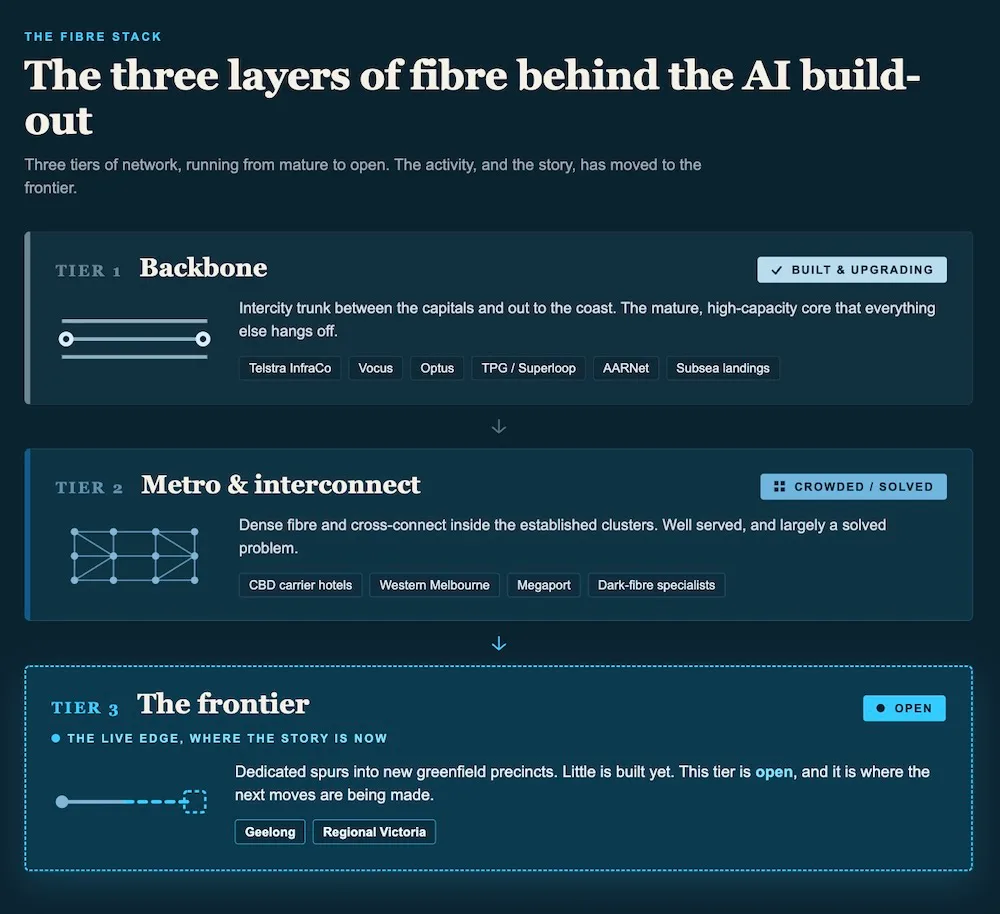
Layer | What it carries | Where it stands |
Backbone | Intercity trunk between capitals and to the coast | Built and being upgraded by InfraCo and Vocus |
Metro and interconnect | Dense fibre and cross-connect inside established clusters | Crowded, competitive, effectively solved |
The frontier | Dedicated spurs into new greenfield precincts | Largely unbuilt |
Source: InfraCo and Vocus disclosures, July 2026.
Dark fibre, unlit strands leased to a customer who controls the equipment and capacity, is what hyperscalers increasingly want to own instead of buying a carrier’s lit service. Legacy fibre already runs along the Geelong highway and rail corridor. The new precincts still lack dedicated, high-count dark fibre delivered right into a specific campus with diverse routing. That last stretch, fibre into the campus itself, is the entire opening a new developer can claim. A big carrier will build it once an anchor tenant signs, and only then.
Flag on an unbuilt stretch
Coretora has a founder with a connectivity background. It has not disclosed most of what would make the route bankable. On the company’s account the network will be ducted and high core-count, with physically diverse routing and a nominated carrier partner, and first-stage service is targeted for early 2028. The carrier partner is not named. No capacity figure, funding amount, backer or anchor customer has been disclosed, and the route is described only as running south of Geelong into the western zone. Coretora is at the positioning stage: a company with a route concept and a website, and no fibre yet in the ground.
The interests here are straightforward. Coretora gains if it can pre-build conduit and sign an anchor tenant before a larger carrier commits, the standard playbook for a specialist dark-fibre entrant. The risk runs the other way: if the Geelong load materialises, Telstra InfraCo or Vocus can extend into the corridor with far deeper balance sheets, or a hyperscaler can lay its own fibre and bypass a third party entirely. A first mover with no named anchor and no disclosed backer is the kind of player that gets bought, partnered with, or routed around once the demand is proven. That reflects the economics facing any single-route entrant, Coretora included.
What to watch
Three markers will show whether the frontier is being built or just announced. Whether Coretora names a carrier partner and an anchor tenant, the signed load that turns a planned route into a funded one. Whether Telstra InfraCo or Vocus extend dedicated capacity into the Geelong corridor, which would signal the incumbents see committed load. And whether operators in the corridor move from holding land to seeking grid connection, the committed demand a western fibre route would serve. For now, the fibre is a plan and the demand it would serve is still forming.