At a glance
Jobs and Skills Australia, the Australian Government's labour market agency, rates refrigeration mechanics, electricians, linesworkers and data cablers in shortage in every state and territory.
Technicians and trades workers filled 55.1% of advertised vacancies in the March quarter, the lowest of the eight occupation groups.
Electrical engineers are in shortage nationally and in four of the eight states and territories.
Mechanical engineers are rated in shortage in South Australia, Western Australia and the Northern Territory only.
Engineering firm Jacobs reported its data centre revenue up 62.2% in 2025 and its project pipeline up 500%.
Jacobs reported data centre revenue up 62.2% and pipeline up 500%
Engineering and design firm Jacobs reported its data centre business grew 62.2% in 2025 and its project pipeline grew 500%. Engineering News-Record, the US trade title that ranks design firms by revenue, counts data centre design work inside its telecommunications market. That segment rose 31.3% in 2025, and about 87% across 2023 to 2025.
ENR's telecommunications segment grew more than four times faster in 2025 than the Top 500's total design revenue, which rose 7.4% to US$158.7 billion. Jacobs returned to No. 1 on the Top 500 in 2026 and reports 18 No. 1 rankings across ENR's 2026 sector tables, data centres and telecommunications among them.
ENR ranks its Top 500 on revenue earned in the United States. US engineering firm Ulteig, 87th on the same list, told ENR that "the surge creates opportunity while tightening capacity, especially for specialized talent".
Refrigeration mechanics and electricians are in shortage in every state and territory
Jobs and Skills Australia's Occupation Shortage List rates 916 occupations for shortage nationally and in each state and territory. Eight of them cover the trades and professions used to build, cool and connect a data centre.
Occupation | National rating | States and territories in shortage |
|---|---|---|
Airconditioning and refrigeration mechanic | Shortage | All eight |
Electrician (general) | Shortage | All eight |
Electrical linesworker | Shortage | All eight |
Cabler (data and telecommunications) | Shortage | All eight |
Civil engineer | Shortage | All eight |
Construction project manager | Shortage | All eight |
Electrical engineer | Shortage | Four: NSW, SA, WA, NT |
Mechanical engineer | No shortage | Three: SA, WA, NT |
Source: Jobs and Skills Australia, Occupation Shortage List, 2025 assessment.
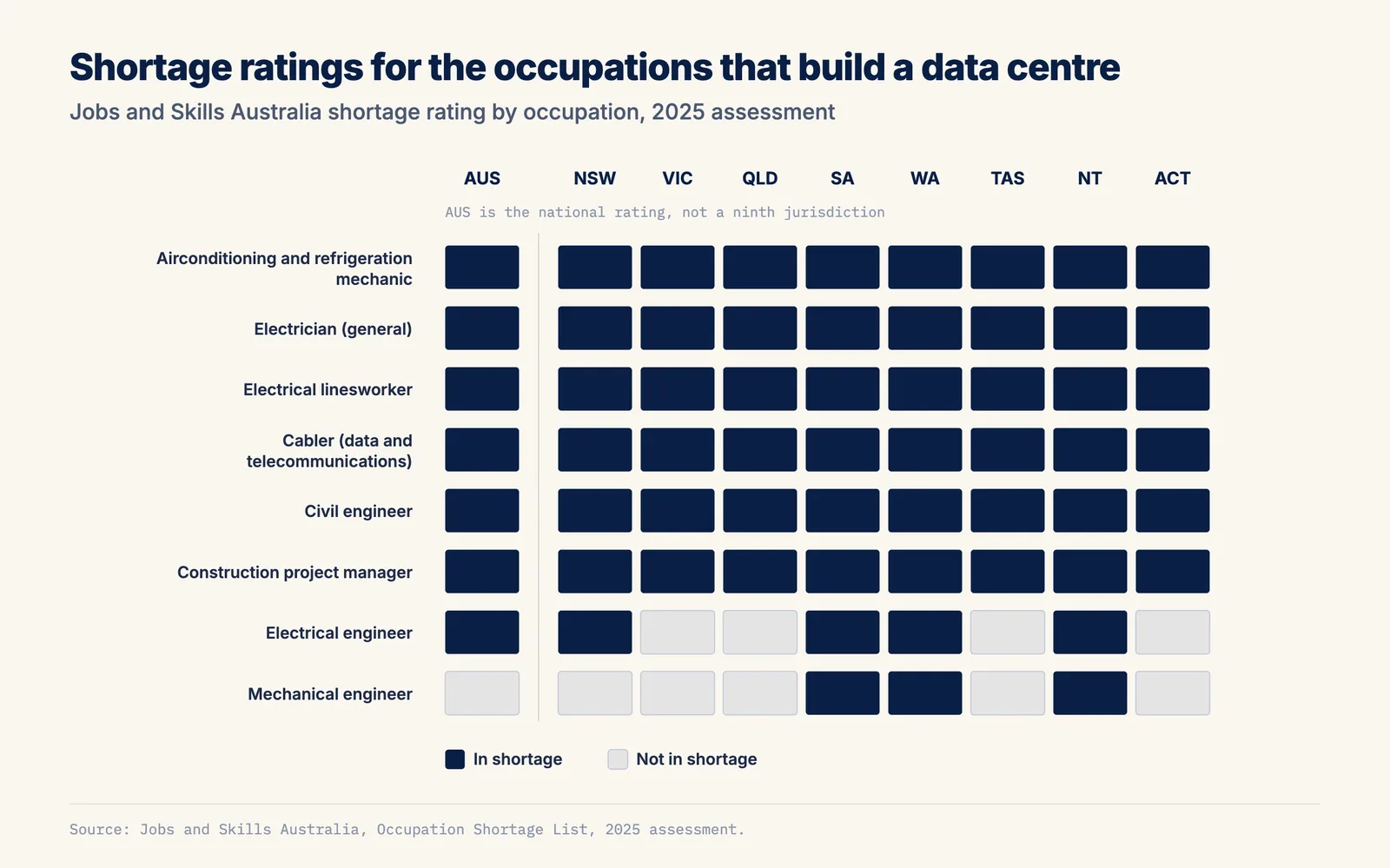
Six of the eight are rated in shortage in every state and territory, and four of those six are installation and commissioning trades. Those four install and commission the cooling plant, the electrical fit-out, the site's connection to the network and the structured cabling inside the hall.
Jobs and Skills Australia assesses each occupation across every employer that advertises for it, so a shortage rating for electricians reflects housing, mining, the energy transition and data centres together. In research for the industry body Data Centres Australia, economics consultancy Mandala Partners put the data centre workforce gap at 8,300 people by 2030, from 9,600 full-time equivalents to 17,900, and counts about 15 construction jobs for every permanent operational role.
Technicians and trades filled 55.1% of vacancies in the March quarter
Jobs and Skills Australia's March 2026 Occupation Shortage Report, published on 3 June 2026, measures how many advertised vacancies employers actually fill. It draws on the agency's Survey of Employers who have Recently Advertised.
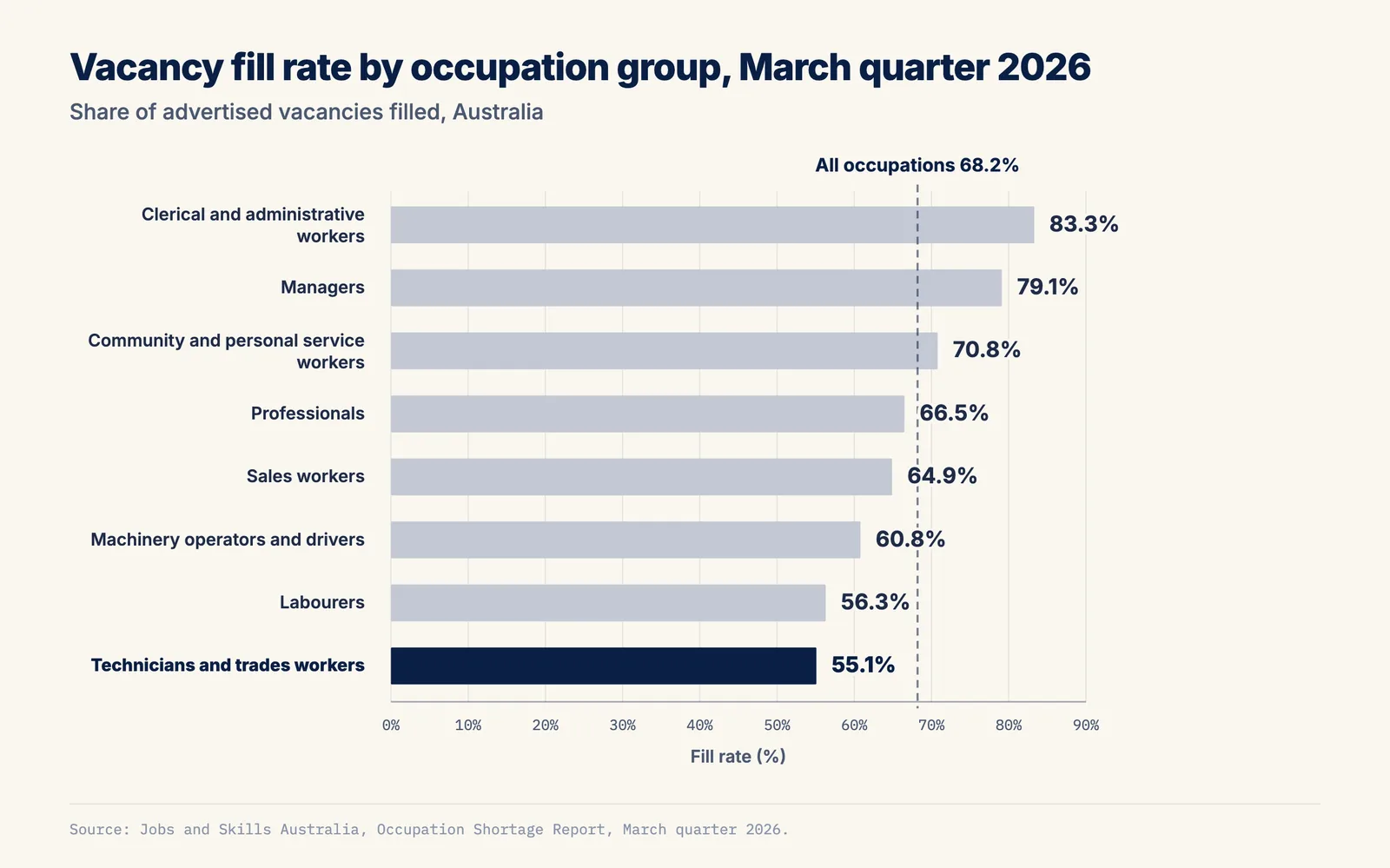
Technicians and trades workers recorded a 55.1% fill rate, the lowest of the eight major occupation groups, against 66.5% for professionals. Employers advertising trade roles received 6.8 qualified applicants per vacancy, against 8.2 for professional roles.
Jobs and Skills Australia's national fill rate has fallen in every quarter since June 2025, from 72.1% to 68.2%. Professional roles fell 5.3 points over the year and machinery operators and drivers 9.4 points, the two steepest falls among the five groups that declined.
Regional employers fill fewer of their vacancies than metropolitan ones, at 65.0% against 69.7%, and the gap widened over the quarter. At skill level 3 of the occupational classification, the band that covers trade qualifications, the regional fill rate was 52.9% against 57.3% in the cities.
LinkedIn's inaugural Australian Cities on the Rise ranking, which covers metros outside Sydney and Melbourne, puts data centres in eight of the ten fastest-growing job markets.
Four of eight jurisdictions rate electrical engineers in shortage
Jobs and Skills Australia rates electrical engineers in shortage nationally, and in New South Wales, South Australia, Western Australia and the Northern Territory. It rates mechanical engineers in shortage in South Australia, Western Australia and the Northern Territory only.
In a separate 2023 analysis of why occupations run short, the agency placed electricians in its longer-training-gap category, where employers receive few qualified applicants and the qualifying pathway is an apprenticeship. The agency notes that this carries time lags in training. It placed civil engineering professionals in its suitability-gap category, where applicants are qualified but employers judge too few of them suitable, usually for want of relevant experience.
AEMO's data centre connection queue reached 9GW at the end of June
AEMO counted 17 data centre projects in the National Electricity Market transmission connection process at 30 June 2026, with a maximum connection capacity of 9GW, against 11 projects and 5.4GW three months earlier. AEMO notes that "realised demand is typically lower than the connection capacity". Its 1 June 2026 digital demand surge update puts an approximate two-year timeframe between application and energisation, with large sites ramping over five to ten years. Separately, the Australian Government announced faster data centre approvals on 15 July 2026.
Operators are hiring across the same period, with roles on the Certified Strategic data centre jobs board and the year's pattern set out in data centre jobs in Australia. Microsoft and Victoria University opened Victoria's first Datacentre Academy at the Footscray Nicholson campus in Melbourne, running fee-free courses for data centre technician roles.
What to watch
The Office of AI. Prime Minister Anthony Albanese announced it on 15 July 2026, inside the Department of the Prime Minister and Cabinet, with a remit to accelerate implementation of the Australian Standards on a national level. Minister for Industry and Innovation Tim Ayres and Assistant Minister for Science, Technology and the Digital Economy Andrew Charlton are named in the announcement.
The June quarter Occupation Shortage Report. Jobs and Skills Australia publishes the series quarterly, and the next reading shows whether the trades fill rate holds at 55.1% and whether the national rate continues the slide from 72.1% in the June quarter 2025.
AEMO's Q3 Quarterly Energy Dynamics, due late October 2026. It is the first quarter that can show application-stage capacity converting into implementation.
Apprenticeship commencements in the electrical trades. Electricians sit in Jobs and Skills Australia's longer-training-gap category, where the agency puts the qualifying pathway at an apprenticeship and flags the lag between training and supply.