
Approval waits put the 3.9GW data centre forecast at risk
By Winston Su, Editor · · Add us as a preferred source on Google
At a glance
Data Centres Australia and DC Byte forecast 3.9GW of data centre capacity by 2030, up from 3.2GW. 1.6GW was running at September 2026.
Committed capacity rose two-thirds to 5.2GW. Capacity being fitted out rose 0.2GW.
The forecast needs about 0.5GW a year. At the recent pace, on the report's rounded figures, Australia reaches about 2.5GW by 2030.
Investors tell Certified Strategic that due diligence, approval and connection take 18 to 24 months in Victoria. NSW approval alone takes 12 to 18. Modular builds wait just as long.
Victoria approved one campus in 75 days, but investors say no state offers a clearly faster path to construction.
Federal policy uncertainty "is causing a lot of investor anxiety", Data Centres Australia said on 30 October 2026.
Data Centres Australia and DC Byte published the second Australian Data Centre Forecast Report on 30 October 2026, and the pipeline of data centres in Australia has firmed up since the April issue. The tracked total grew 5.2GW to 26.8GW, committed capacity went from 3.1GW to 5.2GW, and the 2030 forecast rose 0.7GW to 3.9GW. Committed projects still short of permits or power now face due diligence, planning consent and a grid connection that together take about two years in Victoria and longer in New South Wales. The forecast needs 0.5GW a year to come out the other end, and at the pace of the last six months, on the report's rounded figures, Australia would reach about 2.5GW by 2030.
Phase, national (GW) | April 2026 | October 2026 |
|---|---|---|
Operational | 1.5 | 1.6 |
Under construction | 0.2 | 0.4 |
Committed | 3.1 | 5.2 |
Early stage | 16.8 | 19.6 |
Total pipeline | 21.6 | 26.8 |
Source: Data Centres Australia and DC Byte, Australian Data Centre Forecast Report Issues 1 and 2, data at 31 March and 30 September 2026.
Committed capacity rose 2.1GW and construction rose 0.2GW
DC Byte calls a project committed when it holds high confidence the project will run, because land, power and permits are secured or the developer has a reliable record. Under construction is narrower: data halls being fitted with their electrical and cooling equipment, the last step before they go live. Between April and October, committed capacity added ten times as much as construction did.
Melbourne led the shift. It moved 1.2GW into committed while its capacity in fit-out rose 0.1GW, and its total pipeline reached 10.7GW, above Sydney's 7.8GW. The report says the Melbourne move "may indicate the impact of faster approval processes through the Victorian Government's Development Facilitation Program compared to the NSW State Significant Development process". Sydney added 0.7GW of committed capacity while its capacity in fit-out stayed at 0.1GW, while its total pipeline fell 3.6GW, which the report puts down to "Sydney's announced energy constraints, less certain policy approval timelines and recent policy announcements".
A 75-day approval in Victoria left the two-year wait in place
Victoria's faster approvals cover one part of the wait. The Development Facilitation Program lets the planning minister decide significant projects directly, and NEXTDC's Port Melbourne campus was approved in 75 days in January 2026. NEXTDC has since paused the A$2 billion campus among projects without customer contracts. The power and water utilities did not answer its referrals, so their requirements were left to detailed design, and the recycled-water cooling it was approved with has been dropped. The report also notes "an apparent pause on approvals in the lead up to the November 2026 state election" in Victoria.
New South Wales assesses large data centres as State Significant Development, with public exhibition and agency referrals. At least four of its six Sydney data centre consents in 2026 each took more than a year, and Microsoft's Honeman Close took 32 months from the close of exhibition.
Sydney project | Lodged or exhibited | Consent |
|---|---|---|
Goodman Project Apollo, Macquarie Park | Lodged March 2025 | 2 September 2026, about 18 months |
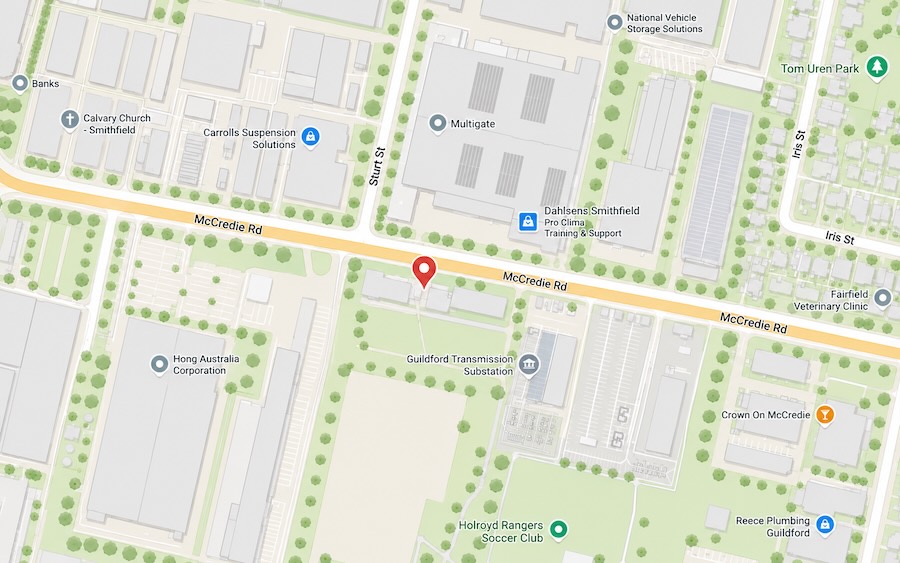
Goodman Project Pluto, Guildford West | Exhibited May 2025 | 23 July 2026, about 14 months |
Stockland Road 1, Macquarie Park | Exhibited September 2025 | 1 October 2026, about 13 months |
Source: NSW Planning Portal determinations for Project Apollo, Project Pluto and Road 1.
The consent is only one of three steps before construction. Infrastructure investors have told Certified Strategic in private discussions that technical due diligence, planning approval and the utility connection together take 18 to 24 months in Victoria, so the faster consent saves little on the path to construction. In New South Wales they plan on 12 to 18 months for the approval alone. Their view is that, as things stand, no state offers a clearly faster path from site to construction. CBRE's annual Australian report, published on 27 October 2026, lists six gates before construction: site control, community consultation, planning approval, a grid connection, funding and a customer, any of which can delay or shrink a project.
The grid connection sets the pace in both states. Margarida Pimentel, who runs onboarding and connections at AEMO, the market operator, has described an approximate two-year timeframe from connection application to energisation, with timelines varying by project readiness and system conditions. Local works can add to it, even at a site that is running. In September 2026 the distributor Jemena suspended part of the line works supplying NEXTDC's M3 data centre in West Footscray, citing safety and site access amid community opposition, and the local council, as road authority, withheld consent pending further consultation. Jemena does not expect to resume before February 2027, NEXTDC told the ASX on 21 October 2026.
The delay has cost NEXTDC revenue. It cut its guidance for the year to June 2027 from A$615-640 million to A$475-500 million, and its shares closed down 41.7 per cent that day, AAP reported. It has also put all new development projects and land acquisitions on hold, and is considering selling selected development sites, it told the ASX on 21 October.
Modular designs such as NVIDIA's DSX POD save time in construction, after consent. They get no shorter wait before it, because planning assesses the site, its land use, power, water, noise and traffic, and the grid connection is sized to the load. Western Australia's planning schemes do not define a data centre use, so CDC's Maddington campus near Perth, 150MW in its planning documents, was assessed as warehouses and ancillary structures.
The rules are also moving while projects wait. The federal government is drafting data centre legislation, which the AFR reported on 29 October 2026 would ban new data centres in suburban areas. "While Data Centres Australia understands there is no intention for the federal government to ban data centres in suburban areas, the lack of policy certainty is causing a lot of investor anxiety and damaging Australia's reputation as a safe place for investment," Data Centres Australia chief executive Belinda Dennett told the newspaper on 30 October. In Victoria, the Municipal Association of Victoria, which represents local councils, has passed a resolution asking the state government to stop approving new or expanded data centres until a taskforce develops a comprehensive planning and environmental framework.
New capacity at the recent pace leaves Australia more than 1GW short in 2030
Reaching 3.9GW means switching on 2.3GW more by 2030, and that capacity has to clear the wait first. All of the 0.7GW rise in the 2030 figure came from outside Sydney: Melbourne's 2030 forecast went from 1.1GW to 1.4GW and the rest of Australia's from about 0.1GW to 0.5GW, worked out by subtraction from rounded figures, while Sydney's stayed at 2.0GW.
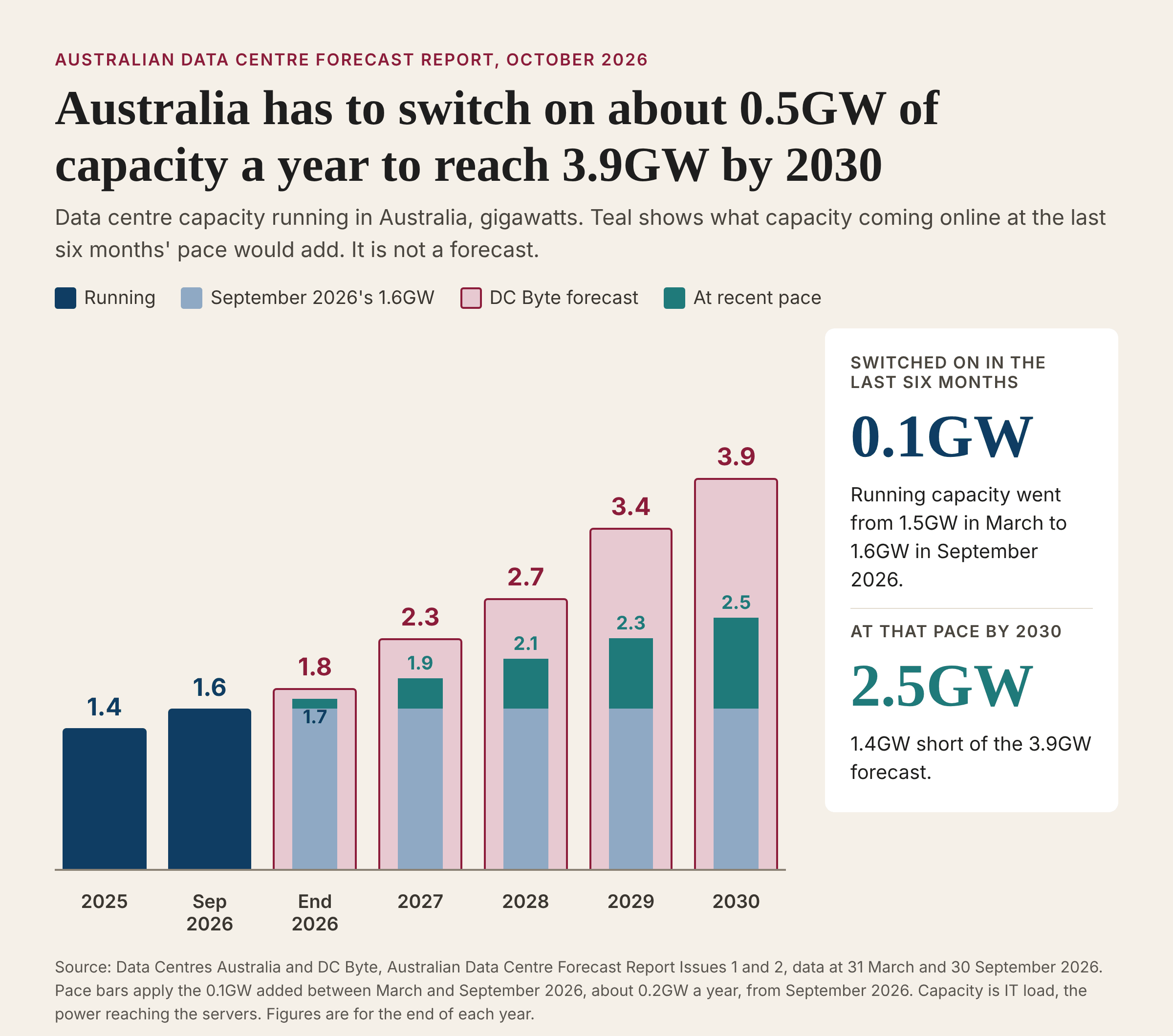
The 0.4GW in fit-out at September covers less than one year of that path. The rest has to come from committed and early-stage projects, including the projects due in 2027 and 2028, and on the investors' timelines a project starting due diligence in late 2026 is unlikely to start construction before mid-to-late 2028. The December quarter is the first test. Reaching 1.8GW by 31 December 2026 means about 0.2GW switched on in three months, twice what was added in the whole of the previous six months, on the report's rounded figures.
At the pace of the six months to September, about 0.2GW a year on the report's rounded figures, Australia would have about 2.5GW running by 2030, 1.4GW short of the forecast. Measured from the end of 2025 instead, the pace is about 0.3GW a year and the 2030 figure about 2.7GW. Capacity under construction sets the upper end. CBRE counts all capacity being built, about 2.2GW, where DC Byte counts only data halls in fit-out, 0.4GW. If every building CBRE counts were finished, fitted out and connected by 2030, Australia would reach about 3.7GW, still short of 3.9GW, and anything more has to clear the two-year wait first. Reaching 3.9GW by 2030 needs almost every building now under construction finished and switched on, and the projects behind them cleared through approvals and grid connection at about twice the recent pace or more.
Year | National operational (GW) | Added in year (GW) |
|---|---|---|
2025 | 1.4 |
|
2026 forecast | 1.8 | 0.4 |
2027 forecast | 2.3 | 0.5 |
2028 forecast | 2.7 | 0.4 |
2029 forecast | 3.4 | 0.7 |
2030 forecast | 3.9 | 0.5 |
Source: Data Centres Australia and DC Byte, Australian Data Centre Forecast Report Issue 2, data at 30 September 2026.
DC Byte can rate a project committed before its power is secured
DC Byte counts a project as committed in one of two ways: its land, power and permits are secured, or the developer has a reliable record of building. A project in the second group can be counted as committed before its grid connection or power supply is locked in, so some of the 5.2GW can rest on the developer's record rather than on secured power.
The federal government now wants that power settled earlier. In a request the Australian Energy Market Commission, the electricity rule maker, received on 20 October 2026, Climate Change and Energy Minister Chris Bowen asked it to consider requiring data centres to back their demand with firm energy contracts, such as power purchase agreements, storage and demand response in the same market region. The request asks whether a facility without enough cover could be required to reduce its electricity use until it meets the obligation. The rule would apply to data centres above a size the AEMC has yet to set. AEMO's connection queue held 17 data centre projects seeking 9GW of connection capacity at the end of June 2026.
Rest of Australia holds 31% of the pipeline
The newer markets enter the same two-year process from further back. The report puts the share of tracked capacity outside Sydney and Melbourne at 31 per cent in September 2026, up from 19 per cent two years earlier. Regional New South Wales added 1.3GW and regional Victoria 0.7GW, both early stage, and the report names early-stage projects in Queensland, Tasmania, South Australia and Western Australia. Dennett expects the pattern to continue "as new workloads like AI and neoclouds increase demand and bring different siting requirements".
The next two issues will show how much of the committed column converts. The December quarter figure will settle whether 1.8GW is operating at the end of 2026. The April 2027 issue is likely to show whether Victoria's new data centre rules and the 28 November 2026 election change its committed capacity. In both, the construction figure will show how much of the 3.9GW can be built by 2030.
Keep reading the market
Get The Strategic Brief in your inbox every Thursday.
The leading Australian data centre and AI infrastructure newsletter.
Your Next Read
Goodman holds 3.6GW of secured power for data centres
NSW approves Goodman's A$1.365bn Project Apollo at Macquarie Park
NSW approves Goodman's A$1.11bn Project Pluto data centre
Latest Headlines
Alphabet loses nearly US$500bn as AI spending climbs
31 Oct 2026DXN shares fall 47% as first US AI customer moves to cancel
31 Oct 2026SCX.ai CEO: AI inference doesn't need new data centres
30 Oct 2026Albanese plans a ban on suburban data centres
30 Oct 2026Dover's 200MW South Morang data centre awaits a federal ruling
30 Oct 2026
Interested in reaching this audience? Advertise with us.