At a glance
Goodman won consent on 2 September 2026 for Project Apollo, a A$1.365 billion, 135MW data centre at 4-10 Talavera Road, Macquarie Park.
Eight data halls sit inside a five-storey building on a 23,190sqm site, with 400 construction jobs over about two years and 60 operational roles.
New South Wales published its data centre guidelines on 17 August, and the department applied them to Apollo sixteen days later as a relevant consideration.
The consent asks for three things: firmed renewable supply matched to the whole load, contracting started within six months of construction, and efficiency figures published every year.
City of Ryde filed the sole submission during exhibition, and no resident lodged one.
Eight data halls and 135MW at 4-10 Talavera Road
The New South Wales Department of Planning, Housing and Infrastructure approved Project Apollo on 2 September 2026, a data centre for Goodman Property Services (Aust) Pty Limited at 4-10 Talavera Road, Macquarie Park, at an estimated development cost of A$1,365,463,075. The consent covers a five-storey building of 28,878 square metres on a 23,190 square metre site, holding eight data halls to a maximum height of 45 metres, and caps total power consumption at 135 megawatts. W.Media reported the determination on 4 September. The assessment report puts employment at 400 full-time equivalent construction jobs over about 24 months and 60 operational roles, the kind of intake tracked on the data centre jobs board.
It joins a precinct where City of Ryde counts 12 data centres existing and proposed, five built or approved and seven awaiting determination. The precinct already holds NEXTDC's S1 and S2, Macquarie Data Centres' campus and the A$3 billion, 200MW Talavera Road site Macquarie Technology bought in July, and Stockland won a 76.4MW consent there in March. Apollo's position against the rest of the city is on the Sydney data centre infrastructure map.
Goodman lodged the application in March 2025 and has consent 17 months later, in a precinct where zoning already permits the use and the connection, fibre and customers are in the street.
The state's new guidelines reached a consent in sixteen days
New South Wales published its data centre guidelines on 17 August, the full document here. Apollo is the first new data centre the state has determined since, with Project Pluto on 23 July the one before it, and the department says it treated the guidelines as a relevant consideration under section 4.15 of the Environmental Planning and Assessment Act.
For anyone with a project in the New South Wales queue, this is the first look at what that costs. The consent asks Goodman for three things.
The first is power. Before the building can operate, Goodman has to show the Planning Secretary that all of its electricity demand, computing and cooling together, is matched with a portfolio of additional firmed renewable supply at all times, contracted through a power purchase agreement and a firming agreement for NSW-based supply inside the National Electricity Market.
The second is a clock. Within six months of construction starting, Goodman has to produce written evidence that the contracting process has begun, then update every six months.
The third is disclosure. The site has to meter its computing electricity, its total electricity and its total water separately, and publish power usage effectiveness and water usage effectiveness every year. Australian operators mostly publish design targets. Apollo is conditioned to publish measured figures.
Sydney Water is studying non-potable supply in the Marsfield zone
Cooling runs on 36 open-circuit evaporative towers, and the assessment allows up to 1,500,000 kilolitres of water a year, a ceiling Sydney Water calculated on Goodman's worst-case operating assumptions rather than a forecast of normal use. On IPART's 200 kilolitre benchmark that is the annual use of about 7,500 Sydney households, or 0.27 per cent of the 556,551 megalitres Sydney Water produced in 2024–25.
Sydney Water told the assessment that Apollo sits in the Marsfield Water Supply Zone, that its network studies "may include the availability and requirements for non-potable water for data centre use", and that servicing gets settled at the Section 73 certificate stage. Goodman has the Notice of Requirements and is reviewing a planning agreement to fund a servicing study. The guidelines ask evaporative cooling to run on recycled water where a utility can supply it, so the answer for this site is Sydney Water's to give.
No member of the public made a submission
The department exhibited the application from 21 March to 17 April 2025. Its assessment report records that it received no submissions from the public, one submission from City of Ryde objecting, and advice from eight government authorities, utility providers and State-owned corporations. The council objected on urban design, and the assessment moved a long way toward it: the approved landscaping retains 77 trees, removes 55 and plants 175 new ones across 7,671 square metres, 30 per cent of the site, at a floor space ratio of 1.18:1 against an allowable 1.5:1.
That profile also decided who signed. On 18 August the Minister for Planning and Public Spaces delegated determination of data centre applications to the Director, Industry Assessments where there are fewer than 15 unique public objections and no reportable political disclosure. Apollo met both tests and an acting director determined it.
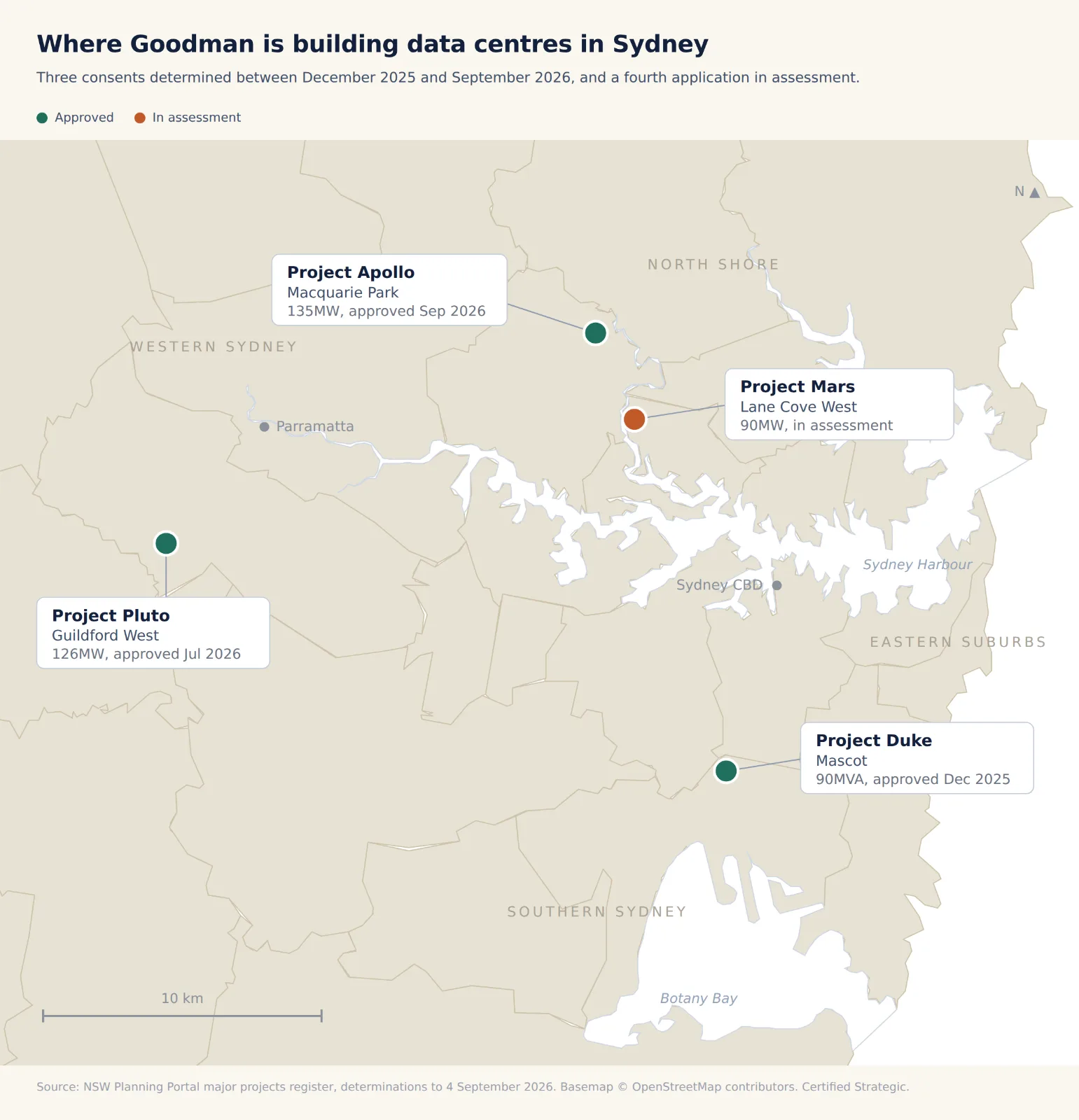
Goodman's 90MW proposal at Lane Cove West, five kilometres away and beside housing, drew 374 submissions with 358 objections. Macquarie Park is a business precinct that permits data centres with consent, and the separation from homes is what the applicant named as the reason for choosing it. At Lane Cove West, Goodman has offered A$1.1 million to the council plant nursery next door while that application is assessed.
Goodman won three Sydney consents in nine months
Project and site | Value and scale | Status |
|---|---|---|
Project Duke, Mascot | 90MVA, nine halls | Approved 22 December 2025 |
Project Pluto, Guildford West | A$1.11 billion, 68MW IT load, nine halls | Approved 23 July 2026 |
Project Apollo, Macquarie Park | A$1.365 billion, 135MW total power, eight halls | Approved 2 September 2026 |
Source: NSW Planning Portal major projects register and the determination documents for each project, September 2026. The three power figures are a power demand, an IT load and a consented total consumption cap.
The Sydney consents now total A$3.65 billion. Goodman's FY26 results carry a global power bank of 6GW across 16 metropolitan markets, against guidance in February that data centres would make up 73 per cent of its A$18 billion work in progress by June 2026. Project Pluto converted the former Castrol lubricants site at Guildford West in July, adding to the Western Sydney build, and a fourth Sydney application at Lane Cove West is at the response to submissions stage. Apollo joins the Australian data centre directory once it is operating.
What to watch
Goodman's first annual efficiency report. It puts a measured PUE and WUE for a Sydney hyperscale campus on the public record.
The six-month contracting evidence. The first test of what a firmed renewable obligation does to a construction financing timetable.
Sydney Water's Marsfield studies. They decide whether recycled water reaches Talavera Road, and with it whether the guidelines' water measure can bite on any project in the precinct.
The IPART water review. Submissions close on 2 October, and the tribunal sets what a data centre pays for Sydney water.