At a glance
Stockland won consent on 1 October 2026 for the Road 1 Data Centre, a A$630 million, 49MW, ten-storey building at 1-5 Khartoum Road, Macquarie Park.
A separate 76.4MW Stockland building on the same Macquarie Park lot was approved on 11 March 2026, so the two consents total 125.4MW.
The October consent requires renewable power matched to the full load at every hour and annual publication of measured efficiency figures, conditions drawn from guidelines that postdate the March consent.
Generator use is capped at 55.4 hours a year outside unplanned outages, and the generators cannot sell into the grid, cut the site's grid draw on request or run through planned outages.
Five residents made submissions, three of them objections, and the air-quality limits were set by a planned apartment tower on the same lot.
NSW approves Stockland's A$630m Road 1 data centre
The New South Wales Department of Planning, Housing and Infrastructure approved Stockland's Road 1 Data Centre at 1-5 Khartoum Road, Macquarie Park on 1 October 2026. It is a ten-storey building costed at A$630,439,030, and it is Stockland's second data centre consent on the same lot in seven months. The 1-5 Khartoum Road Data Centre, a 76.4MW building with 24 data halls on the north-eastern part of the lot, was approved on 11 March 2026.
The department applied the NSW Data Centre Guidelines of 17 August 2026 to the October consent as a relevant consideration, as it did on Goodman's Project Apollo further along Talavera Road on 2 September. Two Stockland consents for neighbouring buildings on one Macquarie Park lot, written seven months apart, show what the guidelines added: a renewable supply obligation covering the whole load at all hours, annual publication of measured power and water efficiency, and a ban on running generators through planned outages.
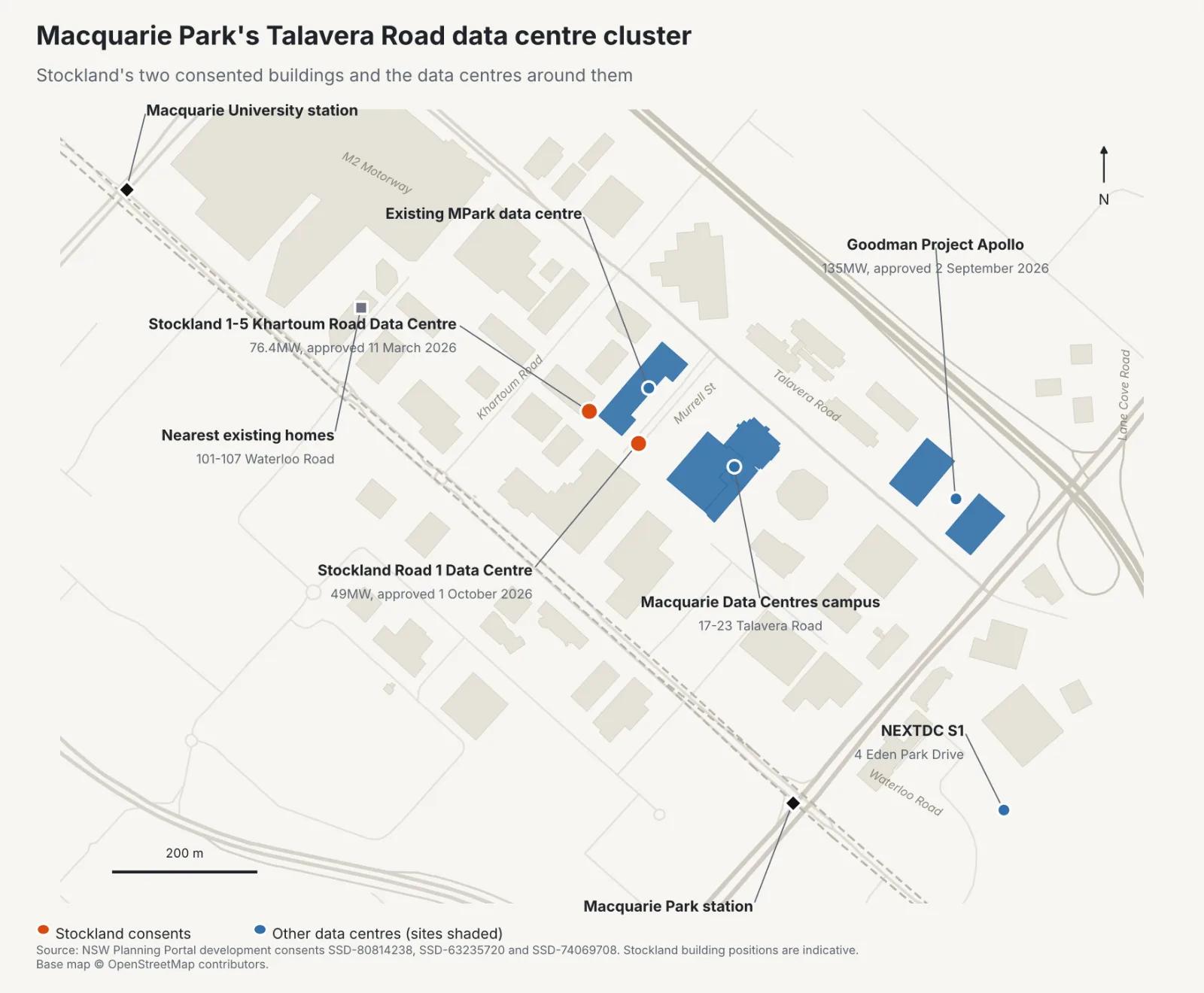
Stockland now has 125.4MW approved in Macquarie Park
Stockland said in its FY25 results on 20 August 2025 that it had secured power and zoning for more than 100MW of data centre development at MPark Stage 2, the second stage of its Macquarie Park precinct. The two consents now total 125.4MW of permitted power consumption. Stockland's 3Q26 update on 30 April 2026 listed MPark Stage 2 among three sites with secured power totalling 450MW. The other two are Cherry Lane and Brooklyn in Victoria. On 3 March 2026 the company told the ASX it had finalised documentation for Stockland EdgeConneX, a 50/50 partnership with the EQT-backed United States operator EdgeConneX to develop, own and operate an Australian portfolio of data centres.
The Road 1 building rises ten storeys and 72.8 metres on an 8,096 square metre site. Stockland told the department the vertical form makes efficient use of a small site, and the building sits well under the 130 metre height limit that applies there. The assessment report puts construction at 30 months, with up to 250 full-time equivalent construction jobs and 50 operational roles. Power is to come from Wallumatta, a proposed new substation of Ausgrid, Sydney's electricity distributor, which supported the application.
The existing MPark data centre at 11-17 Khartoum Road adjoins the lot to the west, and Macquarie Data Centres' Talavera Road campus expansion adjoins it to the east, with Goodman's Apollo at the eastern end of Talavera Road and Macquarie Technology's 200MW site on the same street. City of Ryde counts 12 data centres existing and proposed in the precinct, and the Sydney data centre map places them against the rest of the city.
The consent requires renewable power matched to every hour of demand
Condition | March 2026 consent, 76.4MW | October 2026 consent, 49MW |
|---|---|---|
Generator fleet | 84MW installed, no more than 200 hours a year including testing | 55MW installed, no more than 55.4 hours a year outside unplanned outages |
Generator uses barred | Grid export and cutting the site's grid draw on request | Grid export, cutting grid draw on request, and planned outages |
Renewable supply | Greenhouse gas mitigation plan with a periodic review of power efficiency | All demand matched with new renewable supply, backed for all hours, under NSW contracts, before operation |
Efficiency disclosure | No annual power or water efficiency reporting | Annual power and water efficiency and emissions reporting under a Sustainability Management Plan |
Lapse | Five years | Five years |
Source: Development consents SSD-63235720 (11 March 2026) and SSD-80814238 (1 October 2026), NSW Planning Portal.
Condition B22 of the October consent requires Stockland, before the building operates, to show that all operational electricity demand, computing and cooling together, is matched at all times with additional firmed renewable supply. Firmed means new wind or solar backed by storage or other generation so it is available at every hour, and the supply has to be contracted through power purchase and firming agreements for NSW-based supply inside the National Electricity Market. Condition B23 requires written evidence within six months of construction starting that the contracting has begun, and an update every six months after that. Condition B24 requires separate metering of computing electricity, total electricity and total water, with power usage effectiveness (PUE), water usage effectiveness (WUE) and emissions published every year. Apollo received the same three obligations on 2 September.
The design targets those reports will be measured against are a PUE of 1.35, a WUE of 1.5 and a five-star NABERS rating, the national building energy rating. The hybrid evaporative cooling draws up to 2,018 kilolitres of water a day at peak, and the environmental impact statement puts operating emissions at about 222,000 tonnes of carbon dioxide equivalent a year before the renewable matching condition applies. The Sustainability Management Plan also has to identify recycled and other non-drinking water supply options as they become available, which answers the one public submission that asked for on-site water recycling.
Back-up generators are capped at 55.4 hours a year
The back-up fleet is 18 generators of 3MW and one of 1MW. Condition A6 caps total power consumption at 49MW, of which 34.3MW is computing load, and installed generating capacity at 55MW. Condition A7 caps generator operation, outside unplanned outages, at 55.4 hours a year counted collectively in real time, allows one generator under test at a time at full load, and sets a diesel storage ceiling of 2,000 tonnes. The 55.4 hours matches the testing regime in Stockland's application. Each generator runs at full load three times a year for 30 minutes and once for 65 minutes, plus a five-minute cooldown each time.
Condition A8 states that the consent does not permit the generators to run for the purpose of generating electricity for the National Electricity Market, for load curtailment (cutting the site's grid draw on request) at the site, or during a planned power outage. The first two also appear in the March consent; the third is new. The exhaust stacks must vent 72.8 metres above ground, and total nitrogen oxide emissions from the generators are held below 3.5 tonnes a year. Condition B17 requires an emissions test on at least one generator every twelve months. An Air Quality Management Plan with a power outage notification protocol is due before operations begin.
Exhaust treatment cuts generator emissions by 85 per cent
The nearest existing homes are about 230 metres away at 101-107 Waterloo Road. The assessment turned on closer, higher receivers, the points where exposure is measured: four future homes up to the 39th floor of the build-to-rent apartment tower Stockland plans on the adjoining part of the lot. Initial modelling of routine generator testing predicted exceedances of the one-hour nitrogen dioxide criterion at three of them, and the department asked for more mitigation.
Stockland responded with higher-performance generators fitted with selective catalytic reduction, exhaust treatment designed to cut nitrogen oxide emissions by 85 per cent, and computational fluid dynamics modelling to track how exhaust disperses among residential towers. The modelling showed compliance at all three receivers, with the highest predicted concentration at 54 per cent of the criterion. The department's worst case, all 19 generators at full load for more than an hour during a critical outage, still showed modelled exceedances, and the department accepted that the reliability of the surrounding network makes the event highly unlikely.
Noise modelling met the planning criteria at every receiver in every period, including the future tower at night. Condition B7 sets a night limit of 43 decibels at any residence, and verification reports are due within three months of operations starting and again at full operation.
The building drew five public submissions and no council objection
The department exhibited the application from 11 September to 8 October 2025, 13 months before consent. It received five public submissions: three objections, one in support and one comment. The objections raised noise, air pollution, electricity and water consumption, and whether a data centre belonged on land near the Metro and Macquarie University. City of Ryde did not object, according to the assessment report. Its submission went to the planning agreement the council expects for the precinct, the car parking position, the Road 1 frontage, and the engineering of Road 1 and Road 23, both of which Stockland builds in part. The consent requires a local infrastructure contribution to council of 1.5 per cent of the development cost, about A$9.46 million, plus the state Housing and Productivity Contribution, before construction can be certified to start.
Because fewer than 15 unique public objections were lodged and no reportable political donation was made, the application fell under the delegation the Minister for Planning and Public Spaces issued on 18 August 2026, and the acting Director, Industry Assessments signed the consent. The same delegation determined Apollo on 2 September and Microsoft's 96MW Honeman Close Data Centre at Huntingwood, approved on the same day as Road 1. The building joins the Australian data centre directory once it is operating.
What to watch
The six-month contracting evidence. Two Macquarie Park projects now carry the same clock, and the first filings will show what a renewable supply obligation does to a construction financing timetable.
The first construction certificate on the lot. It will show which of the two buildings Stockland starts first.
The operator. Both consents describe an operator fitting out the halls and leasing to cloud, content and government customers, and Stockland EdgeConneX is the vehicle Stockland formed to develop, own and operate.
The annual efficiency report. With Apollo and Road 1 both conditioned to publish measured PUE and WUE, Macquarie Park will put two sets of operating figures for Sydney hyperscale buildings on the public record.