
Where in WA can an AI data centre be built?
By Winston Su, Editor · · Add us as a preferred source on Google
Updated 15 September 2026
At a glance
Premier Roger Cook told a Perth breakfast on 8 September that data centre developers keep approaching Western Australia about the Mid West and the North West.
CDC's Maddington campus, approved in September 2025 for 150 megawatts of computing, was assessed as warehouses and ancillary structures.
Kalbarri is the northern end of the state's main electricity grid, and the Pilbara runs on separate networks owned by APA, Horizon Power, Rio Tinto, BHP and Fortescue.
Energy Policy WA has put a connection charge of $100,000 a megawatt on the table for grid connections of 10 megawatts or more.
Karajarri traditional owners hold a third of the company behind a proposal south of Broome that would build its own wind, solar and gas.
Western Australia's Premier Roger Cook told a business breakfast in Perth on Tuesday 8 September 2026 that data centre developers keep approaching the state about building in the Mid West and the North West. Those are the regions running up the coast from Geraldton through the Pilbara. He said land and power are two of the key ingredients, and that the state has a lot of both there. WAtoday reported the remarks the same morning, alongside a count of 15 data centres in the state, 13 of them in metropolitan Perth.
No company, site or capacity was named. A regional site still needs four things settled: a planning pathway, fibre, electricity and water.
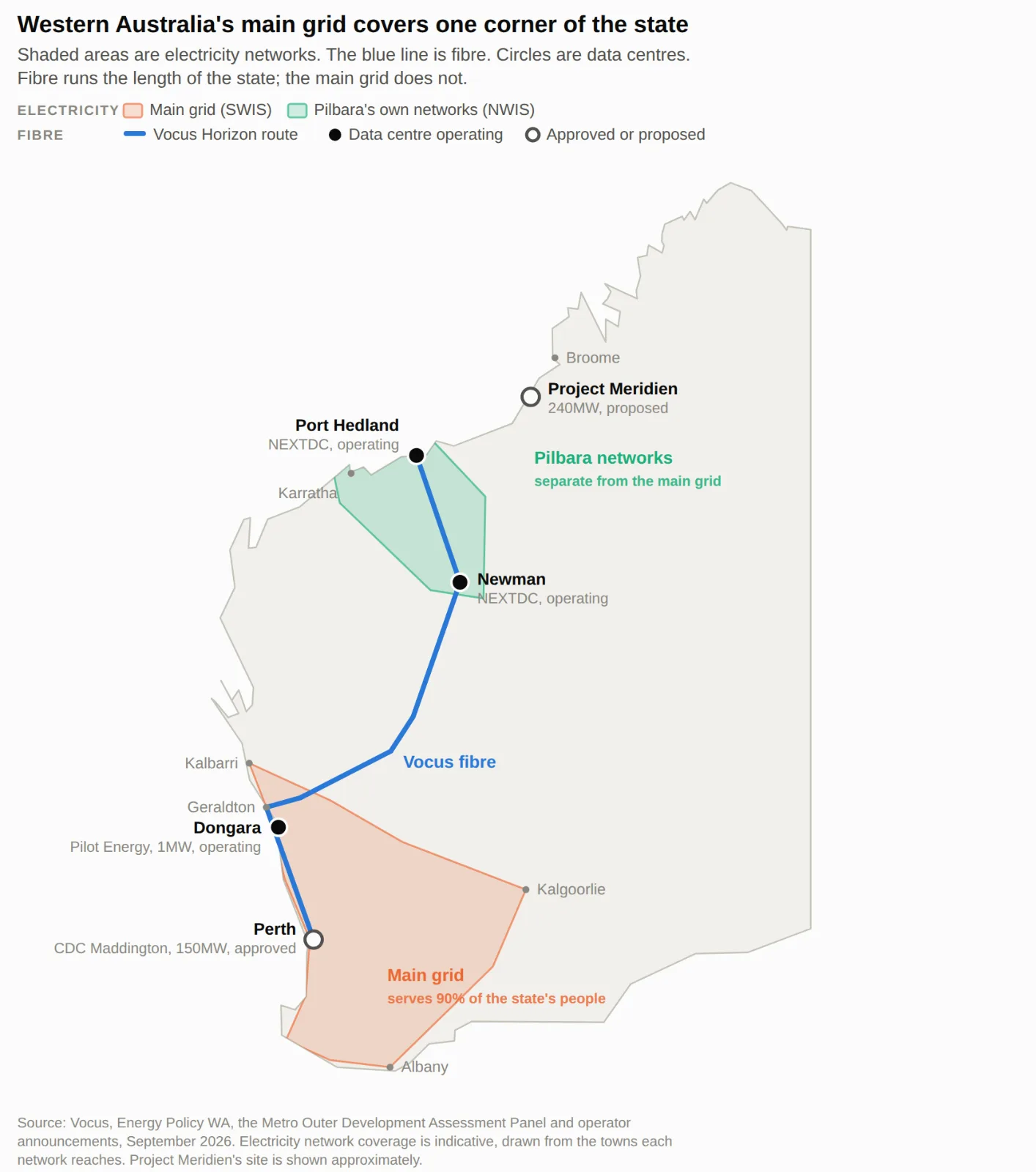
Vocus finished a 2,000km fibre route to Port Hedland in June 2026, so both regions have capacity today. Western Australian planning schemes carry no defined use for a data centre, and a 150MW Perth campus went through as warehouses. Electricity is what a project has to solve for itself. The main grid ends at Kalbarri, the Pilbara runs on separate networks under an access code that leaves the terms to the parties, and the two regional projects with published detail, at Dongara and south of Broome, both generate their own power.
CDC's Maddington campus was approved at 150 megawatts
Most of what exists and what is approved sits in Perth. The Metro Outer Development Assessment Panel approved CDC's Maddington campus on 10 September 2025. It covers four buildings in the City of Gosnells, with the first stage costed at A$415 million. The planning documents put it at 150MW of IT capacity, CDC markets the campus at over 200MW at full build, and industry trackers list the first building as under construction.
The application was described as proposed warehouses and ancillary structures, because Western Australian planning schemes carry no defined use for a data centre. Planning lawyer and town planner Belinda Moharich told the ABC in August 2026 that an unlisted use is either shoehorned into another category, usually warehousing or industry, or treated as a use not listed, which makes it capable of approval in any zone. She said guidance would give local governments proper tools for an emerging land use. The City of Gosnells resolved in July 2026 to write its own data centre policy, covering energy, waste, water and noise, to apply to future proposals.
NEXTDC has 6MW built at P2 in the Perth CBD and 5.5MW at P1 in Malaga, against 20MW and 10MW planned. DC Alliance carries 6MW of IT load at Canning Vale, and Fujitsu, Equinix, Vocus and Zettagrid hold smaller sites. The directory of Australian data centres lists what is certified.
Vocus fibre runs 2,000km from Perth to Port Hedland
Vocus completed and lit Horizon, a 2,000km fibre route from Perth to Port Hedland, in June 2026. It runs inland through Geraldton, Meekatharra and Newman, and carries 38 terabits a second, which Vocus says it can lift beyond 90 terabits.
NEXTDC opened PH1 at Port Hedland in August 2023, with BHP, Vocus and Microsoft as launch partners, and completed NE1 at Newman in July 2024. Horizon connects to both. Both are edge sites, built to put processing next to mine sites rather than in Perth.
Perth is the landing point for three international cables in service: the Australia Singapore Cable, INDIGO West, and the Oman Australia Cable to Barka. An Australia Singapore Cable break on 4 September met an INDIGO repair still under way from August, and traffic to Asia ran east across the Pacific, which is the case for checking route diversity as well as cable count.
WA's main grid reaches north to Kalbarri
Western Australia's electricity runs on two interconnected systems, separate from the national grid on the east coast. Everything outside them draws on town systems and small local networks. Energy Policy WA calls the larger system, the South West Interconnected System, one of the most isolated large grids in the world. It extends from Kalbarri in the north to Albany in the south and Kalgoorlie in the east, serving more than 90 per cent of the state's population.
Geraldton and the Mid West sit inside that grid. Western Power is upgrading the line from Malaga to Three Springs under Clean Energy Link North, a 354km corridor due for completion by the end of 2027. It will let around 400MW of existing wind and up to 1GW of new renewable generation connect. The ABC reported on 4 August 2026 that the corridor ends 140 kilometres short of Geraldton.
Joanne Fabling, chief executive of the Mid West Chamber of Commerce and Industry, put a 330kV transmission line onward from Three Springs to Oakajee at about $300 million. Whoever built it could not own it once it connected back into the grid, she told the ABC. Oakajee is the greenfield industrial area 23km north of Geraldton, the site the state puts in front of large Mid West projects.
The North West Interconnected System links Port Hedland, Karratha and Newman. Energy Policy WA describes it as a set of loosely connected networks carrying around a fifth of the region's electricity. APA, Horizon Power, Rio Tinto, BHP and Fortescue are among the owners, and a new customer negotiates access with them under a code that leaves the terms to the parties. Consultation papers published on 21 March 2025 would let electricity cross several of those networks on entry and exit rights alone.
Energy Policy WA has proposed $100,000 a megawatt to connect
The Electricity Industry Amendment (Capital Charges) Act 2026 received assent on 19 August 2026 and commenced the next day. The new Part 9C of the Electricity Industry Act says regulations may set capital charges on network connections. Those regulations had not been made at the time of writing, so no rate is yet law.
Under the department's proposal, a new or expanded transmission connection of 10 megawatts or more carries $100,000 per megawatt, set in 2025 dollars. A 100MW campus would pay $10 million once, covering its share of the shared lines and transformers, with equipment built for that project alone charged on top. The department consulted until 7 September 2026 on how the charge would work where a project joins transmission that already exists.
That charge would apply only on the main grid. In the Pilbara a connection costs whatever a developer negotiates with the network owner. Both sit inside a longer bill, and what it costs to join the grid queue in Australia runs well past it.
Port Hedland draws about 80 per cent of its groundwater licence
Asked about water, Cook listed desalination plants the state will need, among them the West and East Pilbara.
The West Pilbara plant is being built. Rio Tinto and the WA Government announced an even joint venture over the A$1.1 billion Dampier Seawater Desalination Plant on 4 March 2026. A second stage takes it to 8 billion litres a year, with first water in 2027.
Water Corporation reports the Port Hedland town scheme drawing about 80 per cent of its groundwater licence, from two shallow aquifers that refill when cyclones cross, and lists a local desalination plant among the options it is investigating.
The Department of Water and Environmental Regulation found in 2023 that the Mid West's groundwater falls short of projected demand, and that significant expansion there should draw on recycled water or desalination. A closed loop recirculates the same water instead of drawing more, and spends more power doing it.
Region | Electricity | Water |
|---|---|---|
Perth metropolitan | On the main grid; assessed as warehousing or as a use not listed | Scheme supply |
Mid West, including Geraldton and Oakajee | On the main grid; the current upgrade ends at Three Springs | Groundwater short of projected demand, per the 2023 finding |
Pilbara, including Port Hedland and Newman | Separate networks, several owners, access negotiated | Dampier desalination reaching 8 billion litres a year, first water 2027 |
Source: Energy Policy WA, Water Corporation and the Department of Water and Environmental Regulation, September 2026.
Gingerah Energy plans 240 megawatts south of Broome
Both regional projects with published detail generate their own power. Pilot Energy installed a 1MW data centre module at the Cliff Head oil plant at Dongara, with Kala Data, and reported in April 2026 that it plans to reach 4MW in the second half of the year. It runs on the gas-fired generators already standing there, on a brownfield site that came with its own generation and licences.
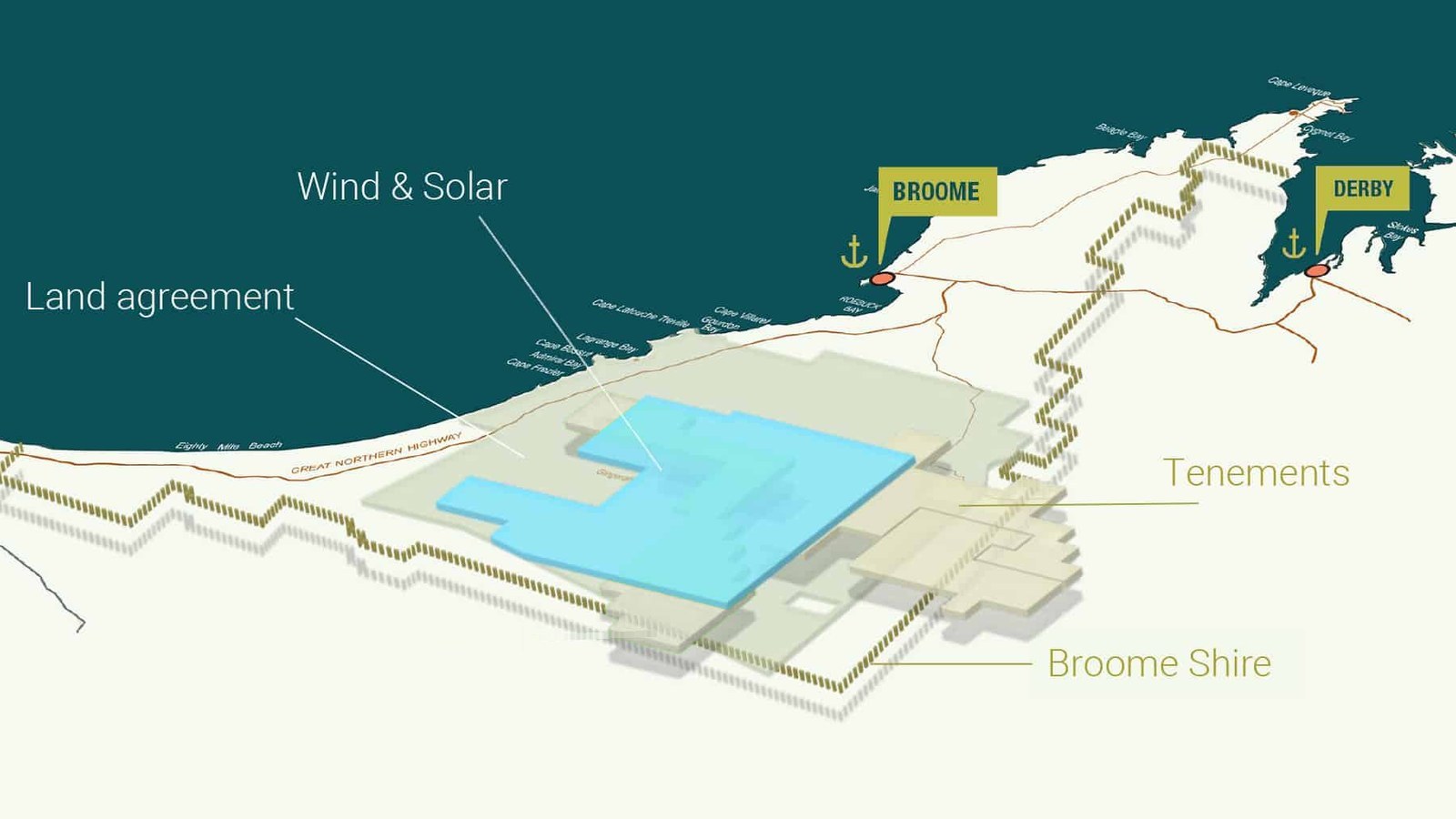
Project Meridien, south of Broome, is the larger proposal, from Gingerah Energy, a joint venture of the Karajarri Traditional Lands Association, Dutch geodata company Fugro and Longreach Capital Investment. In April 2026 the ABC reported that it would start at around 240MW of computing and reach four times that, and that the Karajarri association holds a third of the company.
Project Meridien would run on wind, solar and batteries backed by gas, cooled in a closed loop, on a footprint of about 275 square kilometres. That footprint sits inside a Karajarri land use agreement covering more than 30,000 square kilometres. The nearest transmission network is hundreds of kilometres away, so the project generates everything it uses. Chairperson Thomas King told the ABC that traditional owners are becoming partners in a green energy project. Gingerah's own materials target a first 48MW ready for service in 2030; the ABC reported an opening in 2032.
Fortescue is building generation for customers of that kind. It committed US$680 million on 25 April 2026 to 200MW of firmed renewable capacity in the Pilbara, due by 2028, and said it is extending the model particularly to data centres. Fortescue Metals chief executive Dino Otranto told Reuters on 20 August 2026 that the company will sell the technology beyond Fortescue once a wider commercial market exists.
What to watch
Energy Policy WA's consultation on the connection charge closed on 7 September 2026. Western Power finishes the Three Springs corridor by the end of 2027. Between them they set what a Mid West project pays to join the grid.
No referral for Project Meridien appears on the Environmental Protection Authority's register of referred proposals, current to 6 September 2026, or among the referrals published under federal environment law. Gingerah says it is in feasibility and preparing for approvals. A referral for an AI data centre at that scale, on country held under agreement with its traditional owners, would be the first of its kind in Australia.
Metro and regional projects meet the same planning question. The Chamber of Commerce and Industry WA asked the state in December 2025, in a report called Powering AI, for a data centre strategy and a single contact point for investors.
No state has published a proponent name yet. Tasmania is fielding six confidential proposals worth as much as 705MW and has not published the proponents, while Queensland has mapped the corridors it wants them in and New South Wales has fielded a 5GW approach from Anthropic. A regional WA project will surface first as a connection application or a referral.
Keep reading the market
Get The Strategic Brief in your inbox every Thursday.
The Australian data centre week, every figure sourced.
Your Next Read
Plan for a 1GW data centre south of Broome opens for comment

Lane Cove bid is first to quit NSW data centre fast-track
HyperDC lodges plans for a 400MW data centre at Moorabool, near Geelong
Latest Headlines
Four predictions for Australia as NVIDIA puts AI factories in containers
26 Oct 2026NEXTDC renews its board and Scroggie forgoes FY27 bonuses
26 Oct 2026Anthropic in talks for a second US$45bn Nscale deal
23 Oct 2026Data centre construction costs: how Australia compares with Asia
23 Oct 2026NVIDIA says DSX POD can deploy AI factories in 14 days
22 Oct 2026
Interested in reaching this audience? Advertise with us.