
Four predictions for Australia as NVIDIA puts AI factories in containers
By Winston Su, Editor · · Add us as a preferred source on Google
At a glance
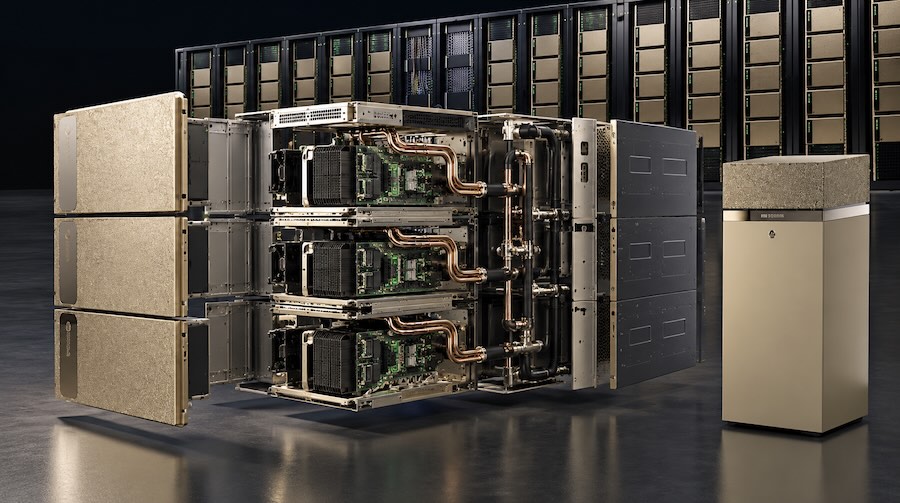
NVIDIA launched DSX POD on 21 October 2026, a complete AI factory built and tested on a production line, which it says can start work as little as 14 days after reaching a prepared site.
In Australia a large grid connection takes about two years and sets how big each site gets, so AirTrunk, NEXTDC and Firmus use factory-built parts inside large campuses while WinDC, DXN and UPS Solutions ship whole data centres in containers.
Canberra's Datapod has a reported Oracle agreement worth about A$2.3 billion to supply modules to the United States and Europe.
NVIDIA chief executive Jensen Huang launched DSX POD at GTC Berlin on 21 October 2026, a complete AI factory of seven racks of Vera Rubin chips that partners assemble, cable and test on a production line and ship in a container. NVIDIA says a pod can start work as little as 14 days after it reaches a prepared site, against six months for an on-site build. "An AI factory creates value when it starts producing tokens, not when construction is complete," Huang said.
In Australia, a large data centre waits about two years for its grid connection, and that wait sets how big each site gets. Certified Strategic's assessment is that the largest operators, including AirTrunk and NEXTDC, use factories for the power and cooling plant and build the data hall on site. Firmus also makes each hall's cooling and electrical fit-out in a factory, while WinDC, DXN and UPS Solutions ship whole data centres in containers of 2MW or less. Certified Strategic makes four calls to the end of 2027:
The first DSX PODs in Australia sit at a power station, behind the meter, at sites like WinDC's, ahead of any grid-connected campus.
Grid-connected AI campuses keep getting bigger, and off-grid sites stay at a few megawatts.
An Australian supplier sells its first 800 volt DC module, the power design NVIDIA's pods are built for.
Australia's largest disclosed modular deliveries go offshore, because Canberra's Datapod has a reported A$2.3 billion Oracle agreement to supply the United States and Europe.
A factory saves weeks once a site has power, and the grid connection takes two years
Schneider Electric, one of NVIDIA's 17 pod partners, says the market is moving "from traditional building methods to manufacturing AI capacity at-scale", and a study it ran with US developer Compass Datacenters cut on-site installation from 75.5 hours to 15 hours a pod. In Australia, Delta Electronics delivered 12 prefabricated power units to a hyperscale site in 16 weeks, against the 30 to 40 weeks it says a conventional build takes, and AirTrunk's first Sydney phase used precast panels and factory-made pipework to finish in 44 weeks.
AEMO, the national electricity market operator, targets about two years from application to switch-on for a large data centre connection, and its queue of data centre projects reached 9GW at 30 June 2026. Those savings start once a site has power, so the first operators to gain from factory building are those that hold a grid connection or run their own generator. Operators with a connection build to its size, and those without one build to the size of the generator beside them.
NVIDIA built its Spectrum-XGS switching, which joins separate data centres into one AI factory, because single sites are reaching the limit of the power they can draw. Microsoft runs its Fairwater sites in Wisconsin and Atlanta, about 1,100km apart, as one system, and each houses hundreds of thousands of NVIDIA GPUs.
AirTrunk, NEXTDC and Firmus use factory parts inside campuses of hundreds of megawatts
NEXTDC's S4 campus at Horsley Park in western Sydney, planned at 350MW and due in mid-2027, uses "extensive modular construction methods", including prefabricated plant rooms, lift cores, columns and façade elements, The Urban Developer reported in April 2026. At AirTrunk's Melbourne campus, the chillers, generators and UPS systems were prefabricated off-site and set on steel platforms either side of the building, according to builder FDC. The first stage of NEXTDC's smaller PH1 site at Port Hedland went up as a prefabricated Vertiv module, built in 12 months.
Firmus, the Australian AI infrastructure company, also makes the inside of the hall in a factory. Its HyperCube modules carry each hall's liquid cooling and electrical fit-out and are made at Benmax's Queanbeyan plant. Firmus agreed in August 2026 to buy Benmax's fabrication, design and projects businesses for A$300 million, and says its manufacturing supply chain is designed to support up to 1.5GW of AI facilities a year.
George Town Council approved 288MW at Bell Bay on 25 August 2026, on a site proposed to connect directly to Tasmania's 220kV transmission network. Firmus has appealed a permit condition on backup generators to Tasmania's Civil and Administrative Tribunal, and at least five Rowella residents have appealed the approval itself. Firmus is also building 90MW in Launceston.
A DSX POD adds the racks and the cooling loop, so these operators could buy the whole contents of a hall from a factory. NVIDIA's product page names large, new, liquid-cooled AI builds as the first buyers, including NVIDIA Cloud Partners, the GPU cloud companies NVIDIA certifies, a group that includes Firmus. The site team prepares land, foundations and power, and the pod partner engineers the generation and conversion upstream of the container's 800V DC input, NVIDIA's technical blog says.
Smaller builders ship whole data centres in containers of 2MW or less
WinDC plans 230MW of modular capacity at regional sites in 2027, in 1.77MW units from Armada placed behind the meter, wired straight to a power station so they draw nothing from the grid. Each Armada Leviathan carries up to 576 of NVIDIA's current GB300 chips, and the 230MW plan works out to about 130 units. The generator beside each site sets how many units it takes.
DXN, the ASX-listed modular maker, announced an A$12.2 million contract on 24 August 2026 for a 2MW AI hall. It followed a 1.36MW pilot for a US GPU cloud provider in June, and DXN reported a backlog of A$40.9 million at 30 August 2026.
UPS Solutions is an Australian-owned power protection company, operating since 2002, that says it supports more than 100,000 battery backup (UPS) units. Its factory-built XRT-AI range runs from rack nodes of 25 to 90kW, each with its own UPS, to liquid-cooled container halls of 400 to 800kW, load-tested before delivery. In 2025 it supplied the micro data centre for Western Sydney University's brain-scale AI supercomputer, running racks at 20kW against a conventional 3kW.
Company and product | How big each one is | Where it is used in Australia |
|---|---|---|
Firmus HyperCube, made by Benmax in Queanbeyan | One module per data hall | 288MW Bell Bay approved; 90MW Launceston under construction |
1.77MW, 576 GB300 GPUs | First unit January 2026; 230MW planned for 2027 | |
DXN AI module | 2MW hall, A$12.2 million | Contract announced 24 August 2026, online within 12 months |
UPS Solutions XRT-AI | 25 to 90kW per rack; 400 to 800kW per container hall | Western Sydney University AI supercomputer, 2025 |
Delta Electronics power train unit | One container of backup power and cooling | 12 units at an Australian hyperscale site in 16 weeks, January 2024 |
Vertiv prefabricated module | First stage of a regional data centre | NEXTDC PH1 first stage, Port Hedland, built in 12 months |
AirTrunk plant | Prefabricated chillers, generators and UPS | Melbourne campus, more than 84MW in total; FDC's build ran 52 weeks |
NEXTDC S4, built by Multiplex | Prefabricated plant rooms, cores, columns and façade | Horsley Park, Sydney, planned at 350MW, due mid-2027 |
Source: Firmus, Armada, WinDC, DXN ASX announcements, UPS Solutions, Delta Electronics, Vertiv, FDC, The Urban Developer, 2024 to October 2026.
Four calls for Australia to the end of 2027
1. The first DSX PODs in Australia sit at a power station, behind the meter, ahead of any grid-connected campus. Armada is one of NVIDIA's 17 pod builders, with WinDC as its Australian partner. WinDC says its sites are power-ready, and a pod ships to a site with power in place. NVIDIA's eight Australian partners, among them NEXTDC and AirTrunk, could move first by installing pods in grid-connected halls they have built.
2. Australia's grid-connected AI campuses keep growing, and off-grid sites stay small. This publication's September call was that the next ten AI factory announcements average under 150MW. WinDC's 230MW, spread across many small sites, fits that call, while Bell Bay at 288MW and a 1GW plan near Broome run larger. Certified Strategic expects the gap between the two to widen, with AirTrunk and NEXTDC using factory plant inside ever larger campuses and WinDC's units staying at a few megawatts each. AEMO's 9GW queue could hold back the largest projects for longer than any factory saves.
3. An Australian supplier sells its first 800 volt DC module in 2027. WinDC's Armada units, UPS Solutions' XRT-AI range and Delta's power units run AC power through a UPS. NVIDIA's 800 volt DC design, used in the DSX POD and in its Kyber racks from 2027, carries 85 per cent more power through the same cable than 415V AC, the three-phase supply used in Australian data centres. Delta launched a prefabricated AI data centre with 800V DC in-row power in June 2026, and Vertiv unveiled its 800V DC MGX reference architecture in October 2025. Firmus, DXN, UPS Solutions and Canberra's Datapod are the Australian builders placed to sell one. NVIDIA's design also accepts an 800V rack fed from existing 415V AC, which lets buyers keep AC supply, and Schneider has validated its prefabricated pod design to US standards, with the international standards Australia uses to follow.
4. Australia's largest disclosed modular deliveries in 2027 go offshore. Oracle signed a six-year agreement with Datapod worth about A$2.3 billion (US$1.65 billion) for modules in the United States and Europe, the Australian Financial Review reported on 27 April 2026. Oracle's agreement is more than 50 times DXN's A$40.9 million backlog. Firmus could outbuild that at home, with a supply chain it says is designed to support up to 1.5GW of AI facilities a year for campuses such as Bell Bay and Launceston.
Certified Strategic will score these four calls in January 2028, and the September set in January 2027.
Keep reading the market
Get The Strategic Brief in your inbox every Thursday.
The Australian data centre week, every figure sourced.
Your Next Read
NEXTDC S4 Sydney: A$1.5 Billion Raise to Power Western Sydney AI Capacity
Australia's new data centre capacity: the 2026 to 2030 guide

The ASX stocks cashing in on Australia's data centre boom
Latest Headlines
NEXTDC renews its board and Scroggie forgoes FY27 bonuses
26 Oct 2026Anthropic in talks for a second US$45bn Nscale deal
23 Oct 2026Data centre construction costs: how Australia compares with Asia
23 Oct 2026NVIDIA says DSX POD can deploy AI factories in 14 days
22 Oct 2026Jensen Huang says an AI gigawatt costs US$50bn
22 Oct 2026
Interested in reaching this audience? Advertise with us.