At a glance
Jensen Huang priced a 1GW AI factory at about US$50 billion at GTC Berlin on 21 October 2026, chips included.
Australian building and chip costs add up to US$43 billion to US$59 billion a gigawatt.
SoftBank's Ohio campus needs US$37.5 billion of gas plant and power lines, a cost grid-connected Australian sites skip.
NVIDIA's partners will ship AI factories in containers from early 2027, cutting set-up to about a month.
IREN announced a 300MW Spanish campus at the same event.
NVIDIA chief executive Jensen Huang stood on stage in Berlin on 21 October 2026 and gave the AI factory a price. A gigawatt costs about US$50 billion, he said, "land, power, shell, all of the compute networking storage, power cooling all connected together", and it should return about US$40 billion a year. IREN, the Sydney-founded company among the neocloud providers in Australia, used the same event to announce its first European campus. Eight days earlier, the grid operator for 13 American states had filed to study SoftBank's 10GW campus in Ohio, the one slated for OpenAI.
What a gigawatt costs has been an open question for data centres in Australia through 2026, and the quotes have ranged from an operator's A$50 billion in Bali to US$100 billion on an American podcast, because each counts different things. Anthropic's tender asked bidders how they would raise US$12 billion to US$15 billion for at least 1.4GW. Zerra's Western Downs application carries A$31.9 billion at full build. IREN's Redbank plan near Wagga Wagga was reported at more than A$10 billion for 900MW.
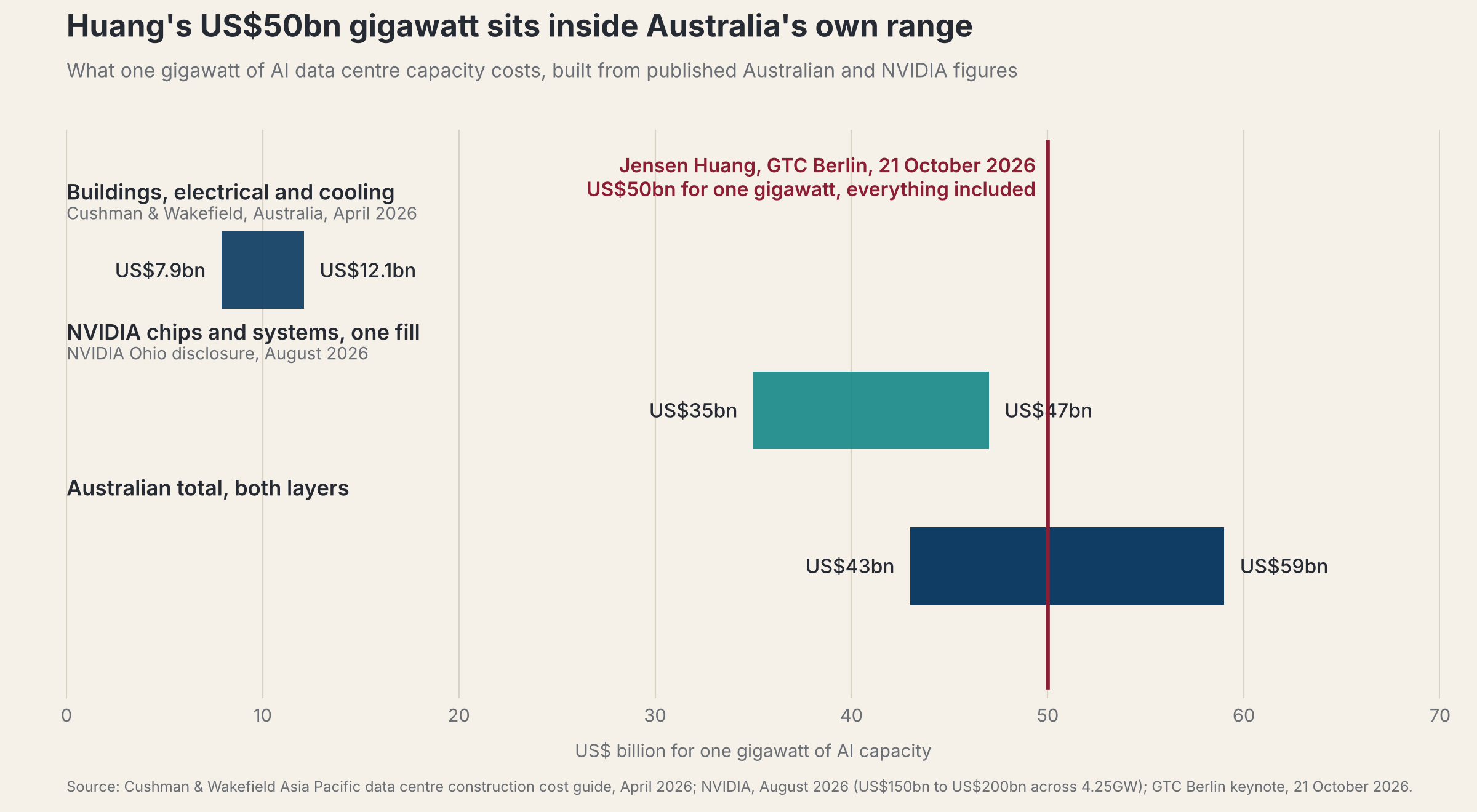
Add Australia's published building costs to NVIDIA's own chip prices and an Australian gigawatt comes to US$43 billion to US$59 billion, with Huang's US$50 billion in the middle. Grid-connected Australian sites also skip the costly extra Ohio has to fund: a power station of its own.
Each gigawatt should earn US$40 billion a year, Huang says
Huang's figure is a global one, and the only part NVIDIA has itemised is its own: the chips and systems, which cost the same wherever they are installed. The return, he said, is "tens of billion dollars per year", which he put at US$40 billion. On that return a quarter's delay is about US$10 billion of revenue, and "$10 billion worth of revenues will make anybody anxious", he said, in the transcript published by Investing.com.
Vera Rubin is in full production, Huang said. It runs large language models about 30 times faster than Blackwell, which was itself about 30 times faster than Hopper. The buildings and the grid connection stay put while the hardware inside them turns over, which is why NVIDIA's own financing attaches to land, power and shell rather than to chips. Huang also confirmed nearly US$10 billion invested in Europe.
SoftBank's Ohio campus needs US$37.5 billion of gas plant and power lines
SoftBank's campus on a former uranium enrichment site in Pike County, Ohio, shows what power costs when a site makes its own. PJM Interconnection, the grid operator for 13 states and Washington DC, filed a study agreement with the US energy regulator on 13 October 2026 for the project, which it calls Flagship. The first 800MW runs on the existing grid. The rest, 9.6GW more, depends on 10.2GW of gas generation SoftBank's SB Energy will build in phases through 2032, and three new 765kV transmission lines, the highest voltage on the American grid.
The money was set out by the US Department of Energy in a fact sheet dated 20 March 2026: US$33.3 billion of Japanese funding for at least 9.2GW of gas generation under the United States-Japan trade agreement, plus US$4.2 billion from SB Energy for the 765kV lines and four substations. That is US$37.5 billion of power and wires for a 10GW campus, about US$3.75 billion a gigawatt before a single hall goes up. Anatomy of a 10GW AI campus put the Ohio land, power, wires and buildings at no less than US$67.5 billion.
Assistant Energy Secretary Tim Walsh said in Cincinnati on 15 October 2026 that construction starts in 2027 and the first data centre shell and generation come online by the end of 2028 or 2029, WCPO reported. "The data center developer is paying for all the necessary infrastructure and power generation," Walsh said. The Energy Department ties the project to the Trump administration's Ratepayer Protection Pledge.
Queensland Premier David Crisafulli set the same principle as the first of his two conditions for OpenAI and Anthropic, but the two states build different things. In Ohio, SB Energy has 10.2GW of gas turbines to buy in a market where GE Vernova's backlog reached 116GW at the end of June 2026 against manufacturing capacity of about 20GW a year. In Queensland, Anthropic's lease at Zerra's Western Downs campus sits beside the Braemar substation on the Queensland data centre map and existing gas-fired power stations, so it starts beside existing generation rather than a gas build of its own.
Australian construction costs match Huang's figure
Cushman & Wakefield, the global property firm, put construction of Australian data centres at US$7.9 million to US$12.1 million a megawatt in April 2026, which is US$7.9 billion to US$12.1 billion for the construction of a gigawatt. NVIDIA's own disclosure for the Ohio campus, 1.5 million GPUs and US$150 billion to US$200 billion of revenue across the first 4.25GW, works out at US$35 billion to US$47 billion of chips and systems for every gigawatt.
What is being priced | Per gigawatt | Source |
|---|---|---|
Construction, Australia | US$7.9bn to US$12.1bn | Cushman & Wakefield, April 2026 |
NVIDIA chips and systems, one fill | US$35bn to US$47bn | NVIDIA Ohio disclosure, August 2026 |
Australian total, two layers | US$43bn to US$59bn | Sum of the two rows |
Everything, one gigawatt | About US$50bn | Jensen Huang, GTC Berlin, 21 October 2026 |
Gas generation and 765kV lines, Ohio | About US$3.75bn | US Department of Energy, March 2026 |
Source: Cushman & Wakefield Asia Pacific data centre construction cost guide 2026; NVIDIA, August 2026; GTC Berlin keynote transcript, 21 October 2026; US Department of Energy fact sheet, 20 March 2026.
The Australian projects fit those rates. Anthropic asked its landlord to raise US$12 billion to US$15 billion for at least 1.4GW, and Cushman & Wakefield's rate puts that much capacity at US$11 billion to US$17 billion. On the reported figure of more than A$10 billion for 900MW, Redbank works out at about A$11 billion a gigawatt.
On Huang's figure, the buildings an Australian operator pays for are about a fifth of a gigawatt's cost, and the chips are the rest. The operator's share is the smaller part and the one that lasts decades.
NVIDIA's partners will ship AI factories in containers from early 2027
NVIDIA's answer to the delay cost is DSX POD, a design for a complete Vera Rubin AI factory built and tested inside a shipping container: seven liquid-cooled racks and 17 kilometres of cabling, ready to plug in on arrival. Huang said the time from equipment arriving to tokens being produced should fall "from many months, we think something along the lines of four to five months down to about a month". NVIDIA will not build PODs itself; Dell, HPE, Gigabyte, Delta and QCT are among the partners, with deliveries expected worldwide from early 2027, ServeTheHome reported.
NVIDIA's eight Australian partners, among them Firmus, IREN, Sharon AI, NEXTDC, CDC and AirTrunk, are building toward the same year: land, power and shells for up to 2GW of AI factories, in Australia and the wider region. The container arrives once the building and the power are ready, which is the part of the job those partners fund.
The POD runs on dry coolers with coolant up to 45 degrees Celsius, so heat goes to air without evaporating water, and NVIDIA says a 2GW campus built this way saves 54 million litres of water a day. Zerra has designed a closed-loop approach for its Western Downs campus near Dalby, where Anthropic has signed a lease. The campus is to be filled from roof rainwater and treated coal seam gas water.
IREN plans a 300MW campus in Spain
IREN chose GTC Berlin to establish IREN Europe and announce a planned 300MW campus at Badajoz in Extremadura, in Spain's south west, with grid-connected power and the civil works licence secured and initial operations targeted for 2028. Built to NVIDIA's DSX design with closed-loop cooling, it will sell AI cloud services to customers who want their data kept inside Europe.
Former Banco Santander chief executive Ángel Corcóstegui chairs the IREN Europe board, with former Macquarie Capital banker Roberto Purcaro as executive director for Europe, on a foothold IREN gained through its June 2026 acquisition of Spanish developer Nostrum Group. "Spain has exceptional conditions to become a European hub for AI digital infrastructure, thanks to its excellent connectivity and abundant, competitive renewable energy," Corcóstegui said.
Badajoz joins a portfolio IREN now describes as more than 5GW of grid-connected power across North America, Europe and Asia-Pacific. In Texas, its 2GW Sweetwater hub was conditionally included as base load in ERCOT's Batch Zero process on 8 September 2026, with the first 300MW targeted for the fourth quarter of 2027. In Australia, Bundey in South Australia has its grid connection signed for up to 800MW with power from 2028, and Redbank targets a 2029 connection in a region Transgrid names for large loads, subject to network upgrades. NVIDIA holds a five-year US$2.1 billion warrant over IREN shares.
Every one of those sites connects to a grid rather than building a power station: the operator's spend goes into shells and connections, and on NVIDIA's timetable the first container can be producing tokens a month after it arrives.
A three-month delay costs a gigawatt US$10 billion in revenue
Huang's delay figure gives Australia's connection and approval queues a dollar value. On his numbers, a gigawatt that opens one quarter late forgoes US$10 billion of revenue, about what an Australian operator spends on the buildings for that gigawatt.
AEMO reported on 21 October 2026 that 80.9GW of generation and storage is queued for the grid, with data centre connections being planned in Sydney and Queensland and secured in South Australia. The AEMC's final determination on access standards for large loads is due on 29 October 2026. Huang argued on 23 March 2026 that a data centre willing to give up guaranteed supply should be sold a faster connection, and Firmus has contracted up to 220 flexible hours a year under its South Australian supply agreement.
Bundey's signed connection, Redbank's 2029 target and the Braemar substation beside Zerra's campus are worth more after Berlin, because every quarter they save a tenant is now priced at US$10 billion.
What to watch
PJM's Flagship study. Its findings will show whether three 765kV lines are enough for 10GW.
The first DSX POD deliveries. NVIDIA expects partners to ship from early 2027. The first Australian container, and which of the eight partners takes it, will show whether the 2GW target is on its 2027 date.
IREN's next filings. IREN lodges its Redbank scoping report with the NSW planning department at the end of October 2026 and holds community sessions in Wagga Wagga on 4 and 5 November 2026.
Anthropic's Queensland capacity. A capacity figure for Anthropic's Western Downs lease would let an Australian campus be priced against Huang's gigawatt line by line.