At a glance
SB Energy is building a 10GW AI campus in southern Ohio, and OpenAI has leased about 8GW of it for 20 years.
Anthropic asked NSW about up to 5GW here, which makes the Ohio build the closest thing to a price list.
The 9.2GW gas plant going up on the site is bigger than any power station running in America today.
Land, power, wires and buildings come to at least US$67.5 billion.
The campus is NVIDIA-exclusive, and NVIDIA expects to earn four to six times the cost of the site from the computers going into it, every hardware generation.
Run over Anthropic's 5GW, the silicon alone comes to US$176 billion to US$235 billion.
Anthropic wants 5GW in Australia. Ohio is where that gets priced
An Infrastructure NSW email released under a parliamentary order says Anthropic's chief executive wanted to discuss locating up to 5GW of AI training capacity in New South Wales, outside Sydney. Australia runs about 1.6GW of operational data centre capacity across the 207 sites in our directory, so the request is roughly three times the national fleet. The whole National Electricity Market, every home and business on the east coast, peaked at 33,645MW in January 2026. One campus is being assembled at twice the size Anthropic asked about, with public numbers attached to the work, and it sits in southern Ohio.
It is a big build by US standards too. The campus is planned to draw 10GW, and because the regional grid has no room for it, SB Energy is putting at least 9.2GW of gas generation on the site itself. The Grand Coulee Dam is the largest power station in the United States at 6,809MW of nameplate capacity, 7,079MW at maximum. One private campus is therefore installing more generating capacity than anything operating on the American grid, and about two and a half times Florida's West County Energy Center, the country's largest gas-fired station at 3,777MW.
Split into layers, the land, the power, the wires and the buildings come to at least US$67.5 billion. On NVIDIA's own revenue figure, the computers inside them run to four to six times that for every generation of hardware, and they get bought again each cycle while the concrete stands for decades.
A ceremonial groundbreaking was held on 20 March 2026 in Pike County, the first 800MW comes into service in 2028, and the buildout runs to 2032. SB Energy, a SoftBank Group company, is building and will own the campus. OpenAI has signed a 20-year lease over about 8GW of computing capacity, which measures the power reaching the processors, not the 10GW of generation feeding the site. The campus will host NVIDIA compute exclusively, and NVIDIA has committed up to US$105 billion of credit support across defined portions of the lease and power payments plus a residual value commitment, securing the land, the power and the shell.
We have split the build into seven layers below. That is our own way of cutting it, not an industry standard, and the layers run in the order the work happens. Each one gates the next. Land, generation and transmission all have to exist before the first building is watertight, and the building has to be finished before a single processor arrives, so a delay in the cheapest line stops the most expensive one.
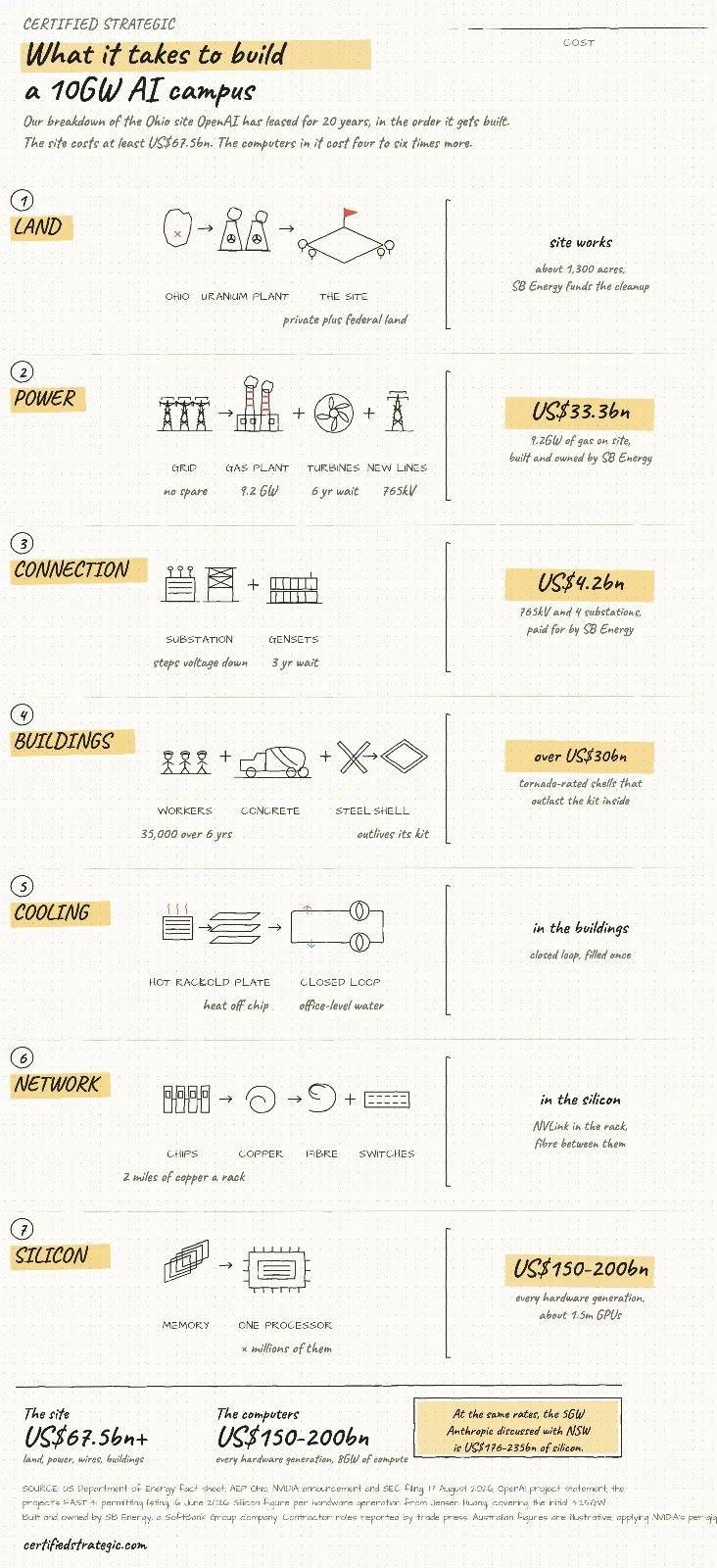
1. Land: 1,300 acres beside a Cold War enrichment plant
SB Energy has taken about 1,300 acres of private ground beside the federal Portsmouth site in Pike County, alongside remediated federal land leased from the Department of Energy. It is funding the accelerated cleanup of that federal land as part of the arrangement, which puts a contaminated Cold War site back into productive use faster than the public purse was going to manage on its own.
Two things come with an old enrichment plant that a paddock cannot offer. Heavy industrial zoning already contemplates this kind of use, and the federal government controls the neighbouring site, which shortens the permitting path. The project holds a FAST-41 listing, the American federal register for large infrastructure on a coordinated permitting timetable, granted on 16 June 2026 as the first project listed under its high-performance computing sector.
2. Power: 9.2GW of gas, at US$33.3 billion, built on the site
The regional grid cannot carry 10GW of new demand, so SB Energy is building one of the largest gas-fired power stations in the world next door to the halls. At least 9.2GW, developed and owned by SB Energy, funded with US$33.3 billion of Japanese money under the United States and Japan strategic trade and investment agreement. The Department of Energy says excess capacity will be made available to the grid for public consumers, so the plant serves the region as well as the campus.
GE Vernova's gas turbine backlog reached 116GW by the second quarter of 2026 against annual output of about 20GW, so close to six years of its production is already spoken for, with capacity expanding toward 30GW a year by 2030. Standby generators run their own queues. An operator holding a signed lease cannot buy its way to the front of either line.
Six years from groundbreaking to full capacity is what the turbine queue allows. The schedule is a supply chain document.
3. Connection: AEP Ohio runs 765kV lines to the site for US$4.2 billion
AEP Ohio is building 765kV lines and four substations, and SB Energy is paying for the work so Ohio network charges stay where they are. Engineers step the voltage down from transmission levels to something a data hall can use, and duplicate enough of it that one fault leaves the campus running.
The first 800MW opens in 2028 on grid capacity that exists today, because 800MW is the largest block the existing network can serve while everything else is under construction. The new lines carry the site from 2029. Every megawatt above that first block waits on steel in the ground.
4. Buildings: more than US$30 billion of shell that outlives its equipment
Shells are the second largest infrastructure line and the longest-lived layer on the site. Rated for tornadoes, a powered concrete box will stand through several complete replacements of the equipment it houses. Lenders know it, which is why NVIDIA's support attaches to the land, the power and the shell, and leaves the hardware alone.
Bechtel is reported on the data centres, Kiewit on the generation and AEP Ohio on the transmission. A build like this hires electricians, pipefitters, plumbers, welders, boilermakers, millwrights, operating engineers, ironworkers, linemen, controls technicians, refrigeration and fire protection specialists, and commissioning technicians. On OpenAI's and SB Energy's figures the project runs to 35,000 construction roles across the six-year buildout, counted cumulatively and not at peak, and 2,500 permanent operating positions once it is running. SB Energy has committed an initial US$80 million to a community benefits fund and OpenAI a further US$40 million.
5. Cooling: a closed loop, filled once, decided years in advance
This is the layer where the engineering has moved furthest in five years. The campus fills its cooling loop with water once and then recirculates it. Cold plates sit directly on the chips, a heat exchanger pulls the heat into the loop, and fans reject it to air instead of evaporating water through a tower. Racks face each other across a cold aisle, with the heat drawn off the back. Liquid, free-air and hybrid methods all have a place in Australian halls, and the water question decides between them. Direct-to-chip liquid cooling at gigawatt scale did not exist as a deployable product when the previous generation of hyperscale halls was designed.
OpenAI says ongoing water use will be comparable to an office building supporting a similar number of people, covering bathrooms and maintenance and not the process itself, and that it will publish the expected figure once design is finalised. An open evaporative design at this scale would draw water on the order of a city. Nobody can retrofit the choice once the plant is in, and it gets made years before anyone can measure it, which for an Australian operator facing the same community questions makes cooling the layer that settles the water argument.
6. Network: NVLink, fibre, and why a hall is sold by the rack
Several million processors are worth nothing unless they behave as one machine. NVLink carries traffic between chips inside a rack, fibre and switching carry it between racks, and CUDA addresses the fleet as a single system.
NVIDIA counts this inside the systems spend, so it never appears as its own line, and operators price a hall by the rack for the same practical reason. A rack arrives complete with its own cabling, its own power and its own cooling, which makes it the smallest thing you can buy and the unit a data hall gets designed around.
7. Silicon: US$150 billion to US$200 billion every generation
NVIDIA has put a number on this layer, though it is a revenue figure and not a price. Jensen Huang says each generation of NVIDIA AI factory systems deployed at the campus could represent approximately 1.5 million GPUs, or approximately US$150 billion to US$200 billion in NVIDIA revenue, across the initial 4.25GW. Divide it out and every gigawatt of computing capacity carries about US$35 billion to US$47 billion of NVIDIA revenue. Rack density is what moves that figure: GB300 racks draw about 120kW today, and NVIDIA's Kyber generation is specified at 600kW from the second half of 2027.
Across the full 8GW OpenAI has leased, one generation of hardware sits somewhere between US$282 billion and US$376 billion, against a little over US$67 billion of infrastructure beneath it. Every one of those processors has to be powered, cooled and connected to the others within a few metres of copper, which is the engineering problem the other six layers exist to solve.
NVIDIA expects to earn four to six times the cost of the campus from the computers that go into it, and to earn it again every generation while the concrete stands for decades.
What the same seven layers would look like in Australia
Anthropic's confidential Australian tender sought at least 1.4GW, with a build reported at up to US$15 billion and at least 1GW live by the end of 2027. Its first question asked how the company owning the site would raise the US$12 billion to US$15 billion in debt and equity that the campus needs.
Two Australian figures already on the record bracket what the civil works would run to. Macquarie Technology has costed its 200MW Macquarie Park campus at A$2.5 billion to A$3 billion excluding land, and NEXTDC will spend up to A$5.75 billion in the 2027 financial year to switch on 197MW. Scale the first and a 1.4GW campus comes to roughly A$17 billion to A$21 billion of buildings and power, which sits inside the US$12 billion to US$15 billion Anthropic asked bidders to raise. The tender number is not a stretch; it is close to what Australian operators already spend per megawatt.
Run Huang's per-gigawatt figure over those numbers and the silicon for a 1.4GW campus comes to US$49 billion to US$66 billion, and the 5GW discussed with NSW to US$176 billion to US$235 billion. Set that against the US$12 billion to US$15 billion the tender asks bidders to raise and the relationship holds exactly as it does in Ohio. Buildings and power are the smaller half of the program by a wide margin, and they are the half an Australian operator has been asked to fund.
Those Australian figures illustrate a ratio and do not quote a price. They apply NVIDIA's own revenue-per-gigawatt disclosure for one American site to Australian capacity numbers, and they assume NVIDIA silicon throughout, which Anthropic's own fleet does not support: it runs substantially on Google TPUs and AWS Trainium. They also assume the Australian gigawatt figures describe computing load and not grid draw, and the Infrastructure NSW email does not say which. On a computing-load reading, 5GW of grid capacity is closer to 4GW of compute and US$141 billion to US$188 billion. Read them for the gap between silicon and civil works.
Anthropic told bidders to lead with sites where power is made on the property or built alongside a private power company, for projects above 300MW. That restates the Ohio generation layer as a procurement requirement, and it is the layer Ohio needed a government-to-government agreement to fund.
Connection is the one layer an Australian builder can already put a number on, and what it costs to join the grid queue is the closest Australian precedent. AEMO's data centre queue reached 9GW in the second quarter of 2026. On the fee NSW has proposed, A$200,000 for every megawatt connected between Sydney, Newcastle and Wollongong and A$100,000 a megawatt everywhere else, a 1.4GW campus outside the ring pays A$140 million, inside it A$280 million, and 5GW outside the ring pays A$500 million. Ohio's equivalent line ran to US$4.2 billion, because SB Energy bought the 765kV towers outright instead of contributing toward someone else's.
On the Ohio arithmetic, an Australian 5GW campus is a silicon program in the hundreds of billions sitting on civil works the tender prices in the low tens. The smaller number decides whether it happens.
What to watch
What connection actually costs. The two proposed fees set the third layer's price on any Australian campus, and they are only payable if the Electricity Infrastructure Investment Amendment Bill 2026 passes. Submissions close on 14 September 2026.
Anthropic's decision. The Australian Financial Review reported on 5 July 2026 that the work could be split across four or five providers. The decision remains outstanding.
Turbine and generator lead times. Close to six years of GE Vernova's production is committed. Any Australian campus making power on site joins the same queue, which is why the second layer decides the schedule wherever the site is.
The first Ohio building ready for service. NVIDIA's obligations begin in phases as data centres become ready, expected from 2028.