At a glance
Turner & Townsend published its tenth annual data centre construction cost index on 22 October 2026, covering 62 cities and more than 500 projects.
Sydney costs US$10.74 a watt to build and Melbourne US$10.58, both cheaper than Tokyo, Osaka, Singapore, Hong Kong and Auckland.
The firm's survey of 400 industry experts names access to power as the biggest obstacle to building data centres.
NVIDIA's Jensen Huang priced a complete AI data centre at about US$50 billion a gigawatt on 21 October 2026, most of it chips.
Read together, the two suggest a faster grid connection is worth more to an AI tenant than a cheaper building.
Turner & Townsend, the construction consultancy majority-owned by property group CBRE, published its annual data centre construction cost index on 22 October 2026. Now in its tenth year, the index tracks what it costs to build a data centre in a given city. This edition prices 62 cities, draws on more than 500 live or recent projects and surveys 400 people who build data centres.
The firm's own summary, posted by its Ireland managing director Philip Matthews, leads on four themes: access to power is the biggest challenge, skills shortages are holding back delivery, AI is changing what data centres need, and Europe is now the costliest region to build in.
Sydney and Melbourne are both in the index, and it came out the day after NVIDIA chief executive Jensen Huang told a Berlin audience what a complete AI data centre costs. Set side by side, the two show which part of an Australian AI data centre is expensive, and which part decides where one gets built. On the index, Sydney and Melbourne are among the cheaper places in Asia-Pacific to build a data centre. The industry's bigger problem, on Turner & Townsend's own survey, is getting connected to power.
Sydney costs US$10.74 a watt to build
The index quotes the cost of building a typical 60MW data centre in US dollars for each watt of capacity. Sydney comes in at US$10.74 a watt and Melbourne at US$10.58, within 2 per cent of each other. Applied to a 100MW data centre, the Sydney rate puts the building at a little over US$1 billion.
That figure covers the building, its electrical and cooling plant, and the builder's costs and margin. Land, the grid connection and the computers that go inside are extra.
Both Australian figures are 1.7 per cent higher than in the 2025 index, though the comparison is loose. Turner & Townsend now benchmarks a bigger building, and a stronger Australian dollar lifts any Australian cost quoted in US dollars, so the rise is not a straight measure of local prices.
Power is the industry's biggest obstacle
In the survey behind the index, power comes top. Fifty-six per cent of respondents named access to power as a major obstacle to delivering a project. Fifty-three per cent said a grid connection takes one to two years, and another 32 per cent said longer. The share using or exploring alternative power sources has tripled since the 2025 survey, to 42 per cent.
Australian operators face the same queue. Transgrid, which runs the New South Wales high-voltage network, said on 10 September 2026 that it has signed 1.5GW of data centre connections, holds 20GW of enquiries and has no further Sydney capacity until a transmission project due in the mid-2030s. That makes a site with a signed transmission connection agreement, such as IREN's 800MW site at Bundey in South Australia, one of the scarcer assets in the market.
A Bloomberg review published on 23 October 2026 found that 10 of more than 40 large projects planned or under construction in Sydney and Melbourne have publicly confirmed a power supply or grid connection. NEXTDC revised its FY27 guidance in October 2026 after a delay to the next increase in power at its M3 campus in Melbourne.
Labour comes next. Eighty-one per cent of respondents described skilled labour in their region as tight, with mechanical, electrical and plumbing trades in highest demand. Turner & Townsend's July 2026 construction report found Australia and New Zealand shorter of labour than any other region, and the Powering Skills Organisation estimates data centres account for 13,000 of the 72,000 extra trades workers Australia needs by 2030.
Chips make up most of an AI data centre's cost
Huang told NVIDIA's GTC Berlin conference on 21 October 2026 that a complete 1GW AI data centre costs about US$50 billion, counting the land, power, building, chips and networking. Applied to a gigawatt, Turner & Townsend's Sydney rate gives about US$10.7 billion for the building. NVIDIA's disclosure for OpenAI's Ohio campus works out at US$35 billion to US$47 billion of chips and systems a gigawatt, and those cost the same wherever they are installed.
The building is about a fifth of the bill. Huang also said a gigawatt should earn about US$40 billion a year. On that figure, three months of delay costs its owner about US$10 billion in revenue, close to what the whole building costs.
The same split shows up in Anthropic's Australian tender, reported by the AFR in July 2026. It sought at least 1.4GW and asked bidders how a landlord would raise US$12 billion to US$15 billion. At the Sydney rate, the buildings for 1.4GW cost about US$15 billion, the top of that range, so the money the tender asks landlords to raise roughly matches the cost of the buildings alone.
Anthropic has since signed its first Australian lease, at Kogan in Queensland, and entered advanced talks to anchor AirTrunk's Kurri Kurri campus in the Hunter.
Australia is cheaper to build in than Singapore, Tokyo and Hong Kong
The index measures only the building, the smaller part of the bill, and on that measure data centres in Australia compare well with the Asian cities they compete with for AI and cloud tenants. The index prices 17 cities in Asia-Pacific, and the chart below shows all of them.
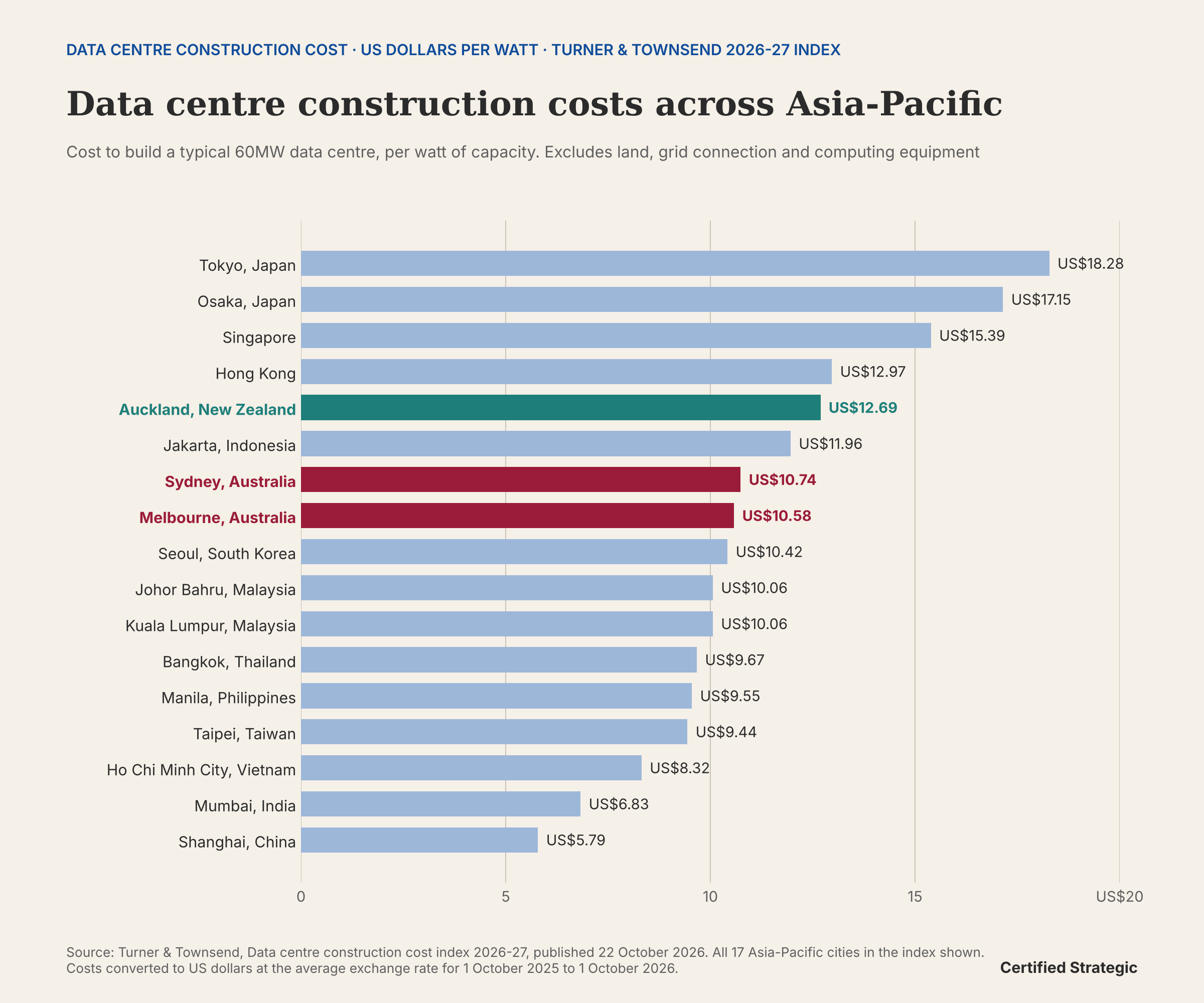
Tokyo is the dearest city in the whole index for a fourth year, at US$18.28 a watt, with Osaka next at US$17.15. Singapore is US$15.39, Hong Kong US$12.97 and Auckland US$12.69. Building in Sydney costs about 30 per cent less than in Singapore. Seoul, the two Malaysian cities, Bangkok, Mumbai and Shanghai all cost less than Australia.
Singapore is short of land and power. Lower building costs, and JPMorgan's finding that Singapore rents are double Sydney's, give global AI cloud companies such as CoreWeave, Nebius and Nscale a reason to look at Australia, where they would compete with the neocloud providers in Australia.
Australian AI compute providers are building across the region too. One of Certified Strategic's predictions for the rest of 2026 was that they would put their next gigawatt in Southeast Asia, and Firmus is building a 360MW campus at Batam in Indonesia and two sites in Malaysia, serving American AI companies that want capacity near Singapore. Building costs there are close to Australia's: Johor Bahru and Kuala Lumpur are about 6 per cent below Sydney, and Jakarta is above it. The prediction will be scored in January 2027.
What to watch
The AEMC's large-load rules. The national energy rule maker is due to publish its final decision on 29 October 2026. It sets the technical standards data centres and other large electricity users must meet to connect to the grid.
Anthropic's contract prices. No price has been disclosed for Kurri Kurri or Kogan. When one is, it can be measured against the index's building cost and Huang's figure for a complete AI data centre.