At a glance
JPMorgan’s Malaysia equities research team puts Malaysia’s data centre pipeline at 12.7GW through 2030, ahead of Indonesia’s 5.8GW, Thailand’s 5.1GW and Singapore’s 1.7GW.
The note prices Singapore rents at US$330–475 per kilowatt a month and describes them as more than double Sydney and Northern Virginia.
CBRE’s Q1 2026 data puts Sydney at US$188 per kilowatt a month, below Northern Virginia, Tokyo and Hong Kong, at 4.5% vacancy.
TNB electricity supply agreements covered 7.1GW of Malaysia’s pipeline as of September 2025, and metered demand ran at 47% of declared maximum in June 2025.
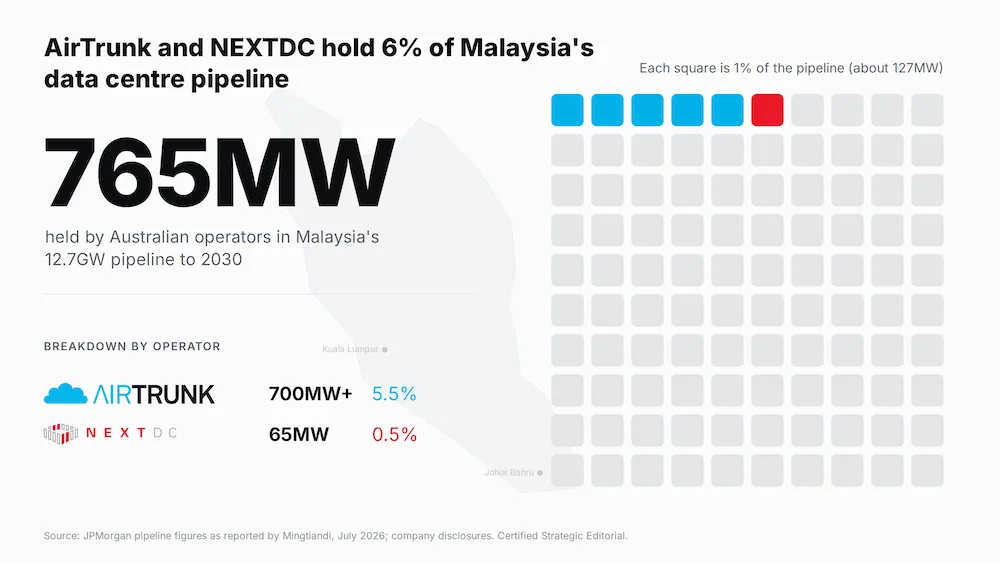
Australian capital sits on both sides of the comparison, with AirTrunk holding more than 700MW across Johor and NEXTDC’s KL1 live in Kuala Lumpur.
JPMorgan counts 12.7GW in Malaysia’s pipeline
JPMorgan’s Malaysia equities research team argues that Malaysia’s data centre pipeline has outgrown every neighbour while Singapore keeps its position as the region’s premium market. The note, dated 7 July 2026 and led by head of Malaysia equities research Yen Voo, was covered by Mingtiandi on 12 July and The Business Times on 13 July. It counts 12,695MW (12.7GW) of Malaysian capacity live, under construction, committed or in early stage through 2030. Indonesia follows at 5.8GW, Thailand at 5.1GW and Singapore at 1.7GW, which makes the Malaysian pipeline alone larger than the other three combined.
Market | Pipeline through 2030 |
Malaysia | 12.7GW |
Indonesia | 5.8GW |
Thailand | 5.1GW |
Singapore | 1.7GW |
Source: JPMorgan, as reported by Mingtiandi, July 2026.
The two leading markets run opposite models, and JPMorgan names Singapore’s draft Digital Infrastructure Bill as the structural catalyst. The bill mandates baseline energy and water efficiency for any data centre with a critical IT load of 3MW or more, and carries penalties of up to 10% of an operator’s annual Singapore turnover. JPMorgan expects the rules to push operators toward 1.25–1.3 power usage effectiveness over time, with new supply held to about 200MW under the DC-CFA2 allocation, and scarcity holds rents at US$330–475 per kilowatt a month. Malaysia admits hyperscale projects at a looser 1.4 PUE threshold and builds at about US$7 million per megawatt against Singapore’s US$12 million, with green power access under the CRESS scheme and tax allowances covering 60–100% of qualifying capital expenditure. JPMorgan compresses the split into one line: “Singapore optimises every MW; Malaysia captures the next MW.” The stock picks follow the same logic: Keppel DC REIT for Singapore scarcity, and Sunway Construction, working on five data centre projects across Johor and the Klang Valley, for Malaysian volume.
Malaysia’s 12.7GW pipeline is more than eight times Australia’s roughly 1.5GW live fleet and more than double the 5.4GW moving through AEMO’s connection process. The scale explains why the corridor keeps drawing Australian capital, a flow we have tracked since AirTrunk and NEXTDC committed close to A$11 billion to Kuala Lumpur and Johor.
Sydney data centre rents are less than half Singapore’s
The note names Sydney directly, describing Singapore rates as more than double Sydney and Northern Virginia. CBRE’s Global Data Center Trends 2026, published 17 June 2026 on Q1 2026 data, carries the underlying numbers. On CBRE’s figures the Sydney claim holds, with Singapore’s US$403 average at 2.1 times Sydney’s US$188, while against the top of Northern Virginia’s US$190–235 range the ratio is about 1.7 times.
Market | Rent (US$/kW/month) | Vacancy |
Singapore | 403 average (330–475) | 2% |
Hong Kong | 295 | 18% |
Tokyo | 280 | 6% |
Northern Virginia | 190–235 | 0.3% |
Sydney | 188 | 4.5% |
Source: CBRE Global Data Center Trends 2026, Q1 2026 data. Sydney and Northern Virginia rates quoted for 250–500kW requirements.
Sydney sells data centre capacity at less than half Singapore’s average rate, below Tokyo, Hong Kong and Northern Virginia. CBRE nonetheless places Australia in its five-market APAC Leading tier alongside Japan, mainland China, India and Malaysia, as we covered in our read of the CBRE 2026 Asia Pacific outlook. Cushman & Wakefield ranks Sydney second among APAC primary markets in its 2026 Global Data Center Market Comparison. The IDCA’s Sigma Index puts Australia 11th in the world for growth readiness, with Singapore 77th once water and grid headroom are factored in.
A market in the region’s top quality tier is renting capacity at US$188 per kilowatt a month, with vacancy at 4.5% and CBRE forecasting a combined 1.5GW Sydney and Melbourne supply shortfall by 2028. For tenants weighing an APAC deployment, the pricing is an argument for landing workloads in Australia.
JPMorgan also lists social licence among execution risks. The Business Times’ account of the note cites protests in Johor over resource use and pushback in the United States and Singapore; Mingtiandi’s account adds community petitions in Australia on power, water, noise and heat. Australian planning systems have processed those objections without a Johor-style halt, a record we examined in our review of data centre regulation and social licence in Australia.
A little over half the pipeline has a power contract
The 12.7GW headline measures announcements. Tenaga Nasional Berhad had signed 49 electricity supply agreements covering 7.1GW of future data centre demand as of September 2025, as we set out in our Australia versus Malaysia grid connection benchmark. On that September 2025 count, at least 5.6GW of the pipeline JPMorgan tallies had no signed power agreement, though TNB has kept signing since. Parliamentary data reported by Bernama shows metered data centre demand of 603MW in June 2025 against a declared maximum of 1,276MW, a 47% utilisation rate.
Johor stopped approving Tier 1 and Tier 2 water-intensive data centres in November 2025, after rejecting about 30% of applications on resource grounds. Prime Minister Anwar Ibrahim confirmed in February 2026 that a moratorium on non-AI data centre applications remains in force. Malaysia’s energy ministry projects data centres will take 31% of national electricity by 2035, from 7% in 2026.
In January 2025 the same JPMorgan team downgraded Sunway Construction to underweight, warning US chip export curbs could affect about two thirds of Malaysia’s then 4GW of planned capacity. Eighteen months later Sunway Construction is the preferred pick. The chip policy stayed unresolved through the swing: Washington rescinded the AI diffusion rule in May 2025 without finalising a replacement, and Malaysia has required trade permits for US-origin AI chips since 14 July 2025.
Australia’s pipeline carries discounts of its own, and its regulators publish them: AEMO’s 5.4GW of progressing connections sits inside more than 44GW of total requests. Australian projects queue for grid connection before they build. Malaysian projects run a single-utility process under TNB’s Green Lane, which JPMorgan puts at about three years to energisation against Thailand’s four and which has connected projects in as little as 12 months. Projects then compete for water, chips and tenants.
AirTrunk and NEXTDC hold more than 765MW in Malaysia
AirTrunk has committed MYR27 billion (US$6.8 billion, about A$10 billion) across four Johor campuses totalling more than 700MW, with JHB1 and JHB2 reported by w.media as close to fully contracted. NEXTDC opened the 65MW Tier IV KL1 in Kuala Lumpur on 14 May 2026 with A$8.4 billion of pro forma liquidity behind a four-city Asian pipeline.
Together the two operators hold more than 765MW of committed IT load and close to A$11 billion of capital in Malaysia. Both remain among the largest holders of Australian capacity in our 2026 ranking of the country’s top data centres. Firmus took its AI factory model offshore in June with a 360MW campus in Batam sized for up to 170,000 NVIDIA GPUs. AirTrunk is preparing a Singapore REIT float of up to US$1.5 billion.
What to watch
AirTrunk’s Singapore REIT targets a September 2026 listing, and its pricing will put a public multiple on contracted APAC capacity. Singapore’s DC-CFA2 allocation, at least 200MW with applications closed 31 March 2026, will show how much supply the premium market releases and to whom. Singapore’s Digital Infrastructure Bill, the mechanism JPMorgan expects to enforce the efficiency floor, remains in draft. Malaysia’s current TNB tariff structure runs to 31 December 2026, with data centre treatment in the next regulatory period still to be set. CBRE’s H2 2026 update will show whether Sydney’s US$188 rate holds as the forecast supply shortfall tightens. The AEMC’s final rule on large load connections, covered in our grid connection benchmark, is expected in the second half of 2026.