At a glance
Gingerah Energy has referred Project Meridien, a renewable energy hub and data centre of up to 1GW of IT load about 100km south of Broome, under federal environment law.
Public comment on the referral opened on 21 October 2026 and closes on 4 November, according to the federal environment portal.
The referral pairs about 5,200MW of solar and 1,500MW of wind with 5,000MWh of batteries on 27,520 hectares of pastoral lease in the Shire of Broome.
The project description lists up to 1,500MW of dispatchable generation to firm the off-grid supply, with open-cycle gas turbines as the reference technology.
The Karajarri people hold native title over the site, and their native title body, the Karajarri Traditional Lands Association, is an equal partner in Gingerah Energy.
A plan for up to 1GW of data centre load south of Broome is open for public comment under federal environment law. Gingerah Energy, a Perth-based joint venture with the Karajarri traditional owners, referred Project Meridien on 16 September 2026. The federal environment portal opened it for comment on 21 October. Comments close on 4 November.
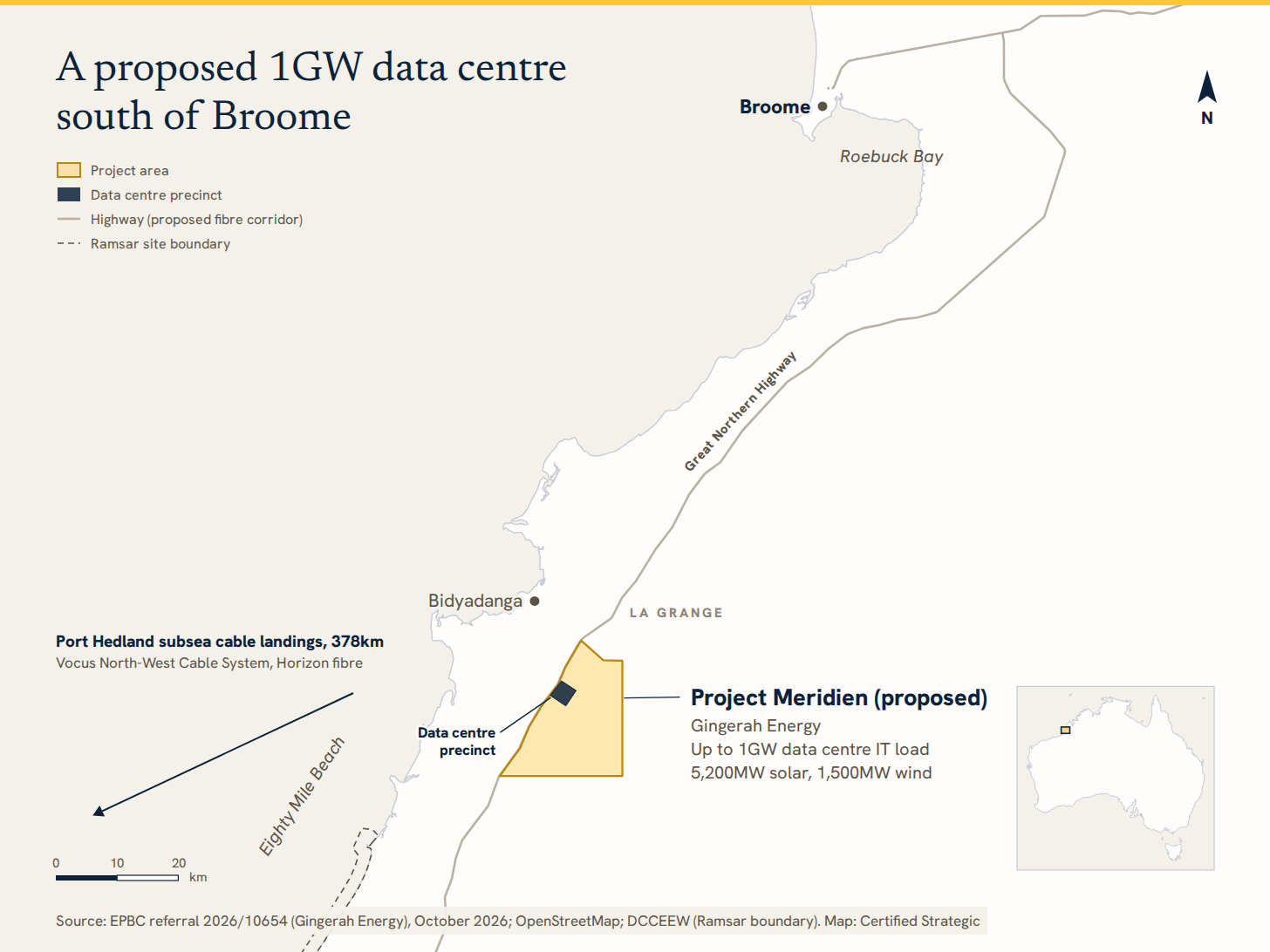
The site covers two pastoral leases at La Grange, east of the Great Northern Highway. It lies about 100km south of Broome and 400km north-east of Port Hedland, according to the referral.
The referral pairs 6,700MW of solar and wind with up to 1,000MW of data centre IT load, or 6.7MW of renewable generation for every megawatt of IT load. Its 48MW first step alone would be more than double the 20MW-plus that NEXTDC plans at P2 in Perth, the largest figure the Certified Strategic directory holds for a Western Australian data centre.
The Western Australian Government's investment site listed a first phase of about 240MW for the project in April. Certified Strategic covered the data centre plan in September, in a review of Western Australian data centre sites, before the referral was lodged.
The hub began as a hydrogen plan before turning to AI compute
The project first appeared on the state's investment site in November 2023 as the Gingerah Energy Hub, a hydrogen and ammonia proposal from Theia Energy in partnership with the Karajarri association. The listing invited investors to fund a pre-feasibility study, seeking A$10 million to A$40 million, with low-emissions hydrogen and ammonia "for domestic use and/or export to Asian markets", archived copies show.
CSIRO's hydrogen project database described three gigawatts of new renewable generation. An independent screening in December 2024 found hydrogen non-viable because demand was limited, the project description says.
The Karajarri partnership and the renewable resource carried over. By 8 April 2026 the state's investment site described a first phase of about 240MW of IT capacity, powered by 1.4GW of renewables. The listing now seeks equity, with a minimum commitment of A$50 million, and the federal referral followed in September.
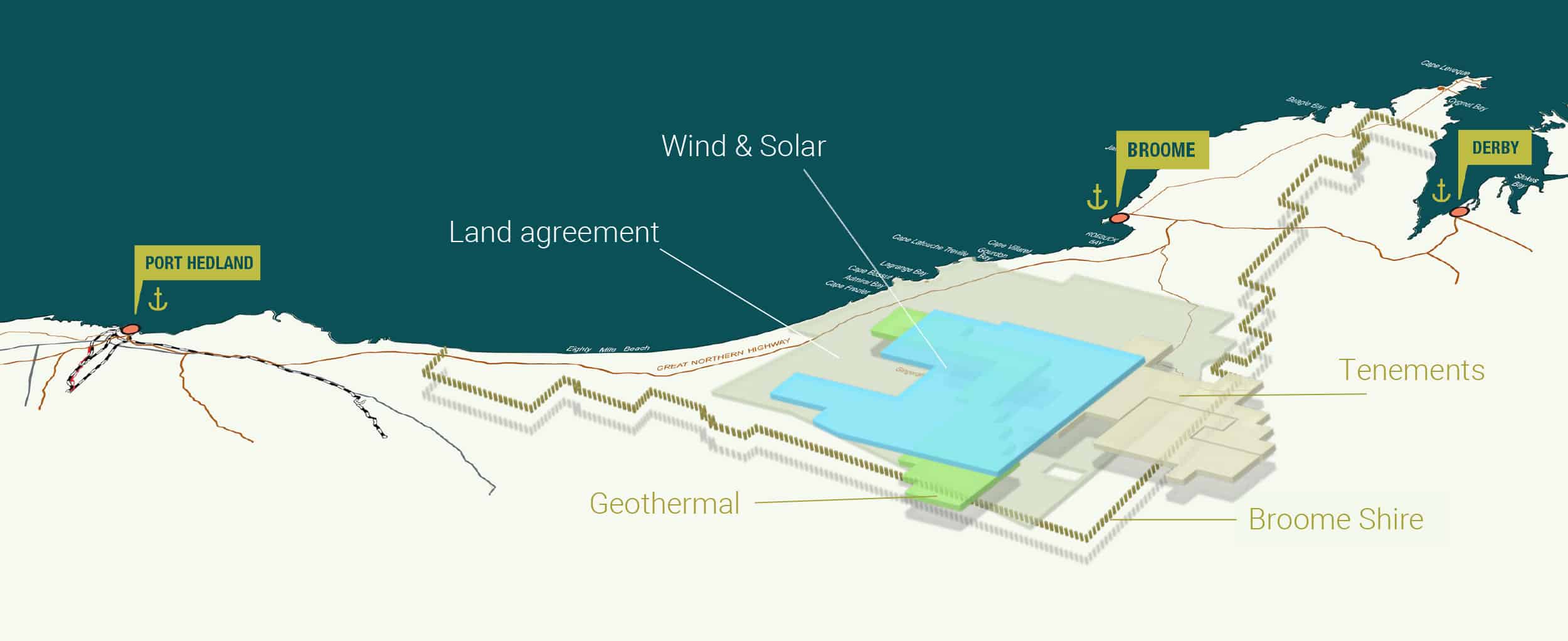
The earlier Gingerah Energy Hub concept map. Image: Gingerah Energy listing on WA Investments, Government of Western Australia.
Project Meridien starts at 48MW and targets 1GW by 2038
The referral sets out stages of 48MW, 120MW, 240MW, 620MW and 1,000MW of IT load. The attached project description lists the same steps without the 120MW stage.
The first 48MW is to be built "as soon as practicable", the project description says. Construction of the 240MW first stage is expected to start in 2029, with commissioning between 2030 and 2032. Growth to 1,000MW follows from about 2032 to 2038, "subject to market demand".
Gingerah's listing on the state's investment site puts the project's capital cost at A$41 billion, excluding chips and data centre fit-out. It prices a first phase of 100MW to 350MW at A$5 billion to A$15 billion. Gingerah is seeking equity partners, with a minimum commitment of A$50 million, and targets a final investment decision by 2029.
The referral form gives an earlier estimated start date, 1 July 2028.
The data halls are mostly single-storey buildings of 12MW IT modules, cooled by a closed-loop water system. Gingerah's listing on the state's investment site gives a target power usage effectiveness below 1.4. Power usage effectiveness is total site power divided by the power the IT equipment uses.
Gas turbines back up 6.7GW of solar and wind on a private grid
Gingerah plans to make its own power on site rather than connect to the state grid. The project description says Gingerah set aside one alternative, exporting renewable power to the grid, because of "a lack of regional transmission infrastructure", while leaving room to reconsider it.
Batteries store up to 5,000MWh. A dedicated 220kV microgrid links the plant through about 88km of overhead lines and up to ten substations.
Firming is the backup supply used when the wind drops or the sun goes down. The project description lists "up to approximately 1,500 MW of thermal generation capacity" for that role. It names open-cycle gas turbines as the current reference technology, with gas storage, and possibly diesel storage, on site.
Gingerah's investment listing puts gas firming at about 15 per cent. The project description expects firming to decrease as the project scales up.
Component | Size in the filings |
|---|---|
Data centre IT load | Up to 1,000MW, in stages from 48MW |
Solar | About 5,200MW |
Wind | About 1,500MW, up to 250 turbines |
Battery storage | Up to 5,000MWh |
Dispatchable firming | Up to about 1,500MW, open-cycle gas turbines as reference |
Project area | 27,520 hectares, of which 18,203 hectares is disturbance footprint |
Operating water use | About 250ML a year |
Construction water use | About 1,500ML a year for the first 10 years |
Source: EPBC referral 2026/10654 and its attached project description (Gingerah Energy, September 2026). Figures are as the proponent states them.
The nearest subsea cables land at Port Hedland
A third-party provider would build the fibre link to the site, generally along Great Northern Highway easements, the project description says. Gingerah sent the association a proposal on 20 May 2026 covering the fibre corridor, land tenure and water licences, according to the stakeholder engagement report.
Gingerah's investment listing gives a latency of about 55 milliseconds to Singapore. Its own website gives about 50 milliseconds.
The nearest subsea cable landings are at Port Hedland, 378km from the site in a straight line by Certified Strategic's measure. Vocus's North-West Cable System runs from Port Hedland to Darwin and forms part of its Darwin-Jakarta-Singapore Cable.
Vocus lit its 2,000km Horizon fibre from Perth to Port Hedland in June 2026, and Horizon links into that cable, Vocus said. Horizon ends at NEXTDC's PH1 in Port Hedland.
Karajarri traditional owners hold an equal share of the venture
Gingerah Energy is a joint venture of the Karajarri Traditional Lands Association, a Fugro company and a Longreach company, the filings say. The referral describes the association as an equal partner. It appoints two directors to the Gingerah board.
The Karajarri people hold exclusive possession native title over the area, and the association is their registered native title body corporate. An Indigenous Land Use Agreement for the project was registered by the National Native Title Tribunal on 4 March 2025. Under it, Gingerah has rights to develop large-scale renewable energy projects within the Karajarri determination area. Native title holders authorised the agreement at a meeting in Broome in October 2024, with a majority voting in favour, according to Gingerah's stakeholder engagement report.
Thomas King, co-chair of the association, told the ABC in April that it was rare for traditional owners to co-own a project of this size. "It's unique in the sense traditional owners are becoming partners in a green energy project powered by renewable energy," he said.
Support was not unanimous among association members, the ABC reported. "As with any projects that have an impact on country and our heritage protection, you're always going to have an element that is not too comfortable," King said. "That is something we have to discuss internally so that, in general, a majority of people are in support."
The community of Bidyadanga lies about 15km north-west of the site, the referral says. About 600 people live there.
Chief executive Jop van Hattum told the ABC that customers might include mining companies using AI training and Singaporean companies.
The data centre needs about 50ML of groundwater a year
Once operating, the project needs about 250ML of groundwater a year, according to the project description. About 20 per cent of that, or about 50ML, is for the data centre. The solar, wind and battery hub uses the rest. Construction needs about 1,500ML a year for the first 10 years.
The intended source is the Broome Sandstone aquifer, subject to a groundwater licence. In the La Grange North subarea, that aquifer has an allocation limit of 35GL a year, according to the referral, and existing pastoral, horticultural and stock users already draw on it.
The data centre's 50ML a year equals about 0.14 per cent of that allocation limit, and the whole project's 250ML about 0.7 per cent. Construction would take about 4.3 per cent while it runs. The cooling loop recirculates its water after a one-off fill of 50ML to 60ML.
Concerns about construction and operating water volumes were raised at an April 2025 workshop with traditional owners, according to Gingerah's stakeholder engagement report.
Threatened species make a federal assessment likely
Gingerah considers the project likely to be a controlled action under federal law, because of a credible potential for significant impact on listed threatened species. The referral names the critically endangered northern blue-tongued skink and the vulnerable greater bilby.
It also lists ten bird species, among them the eastern curlew and the great knot, for which wind turbines are the main risk.
The site is less than 15km from the coast. The referral puts the Eighty Mile Beach wetland, listed under the Ramsar Convention, 25km to 30km away, and finds no Ramsar wetlands within or near the project.
Gingerah has asked for an accredited assessment, run by the Western Australian Environmental Protection Authority under Part IV of the state's Environmental Protection Act. The Shire of Broome has told the company the data centre will require an amendment to its local planning scheme, according to the stakeholder engagement report.
Fortescue wants national rules to recognise off-grid supply
Energy ministers agreed in July to progress rules requiring data centres to offset their demand with new renewables built in their own state. Fortescue told the Senate in September that those rules should recognise "equivalent additionality outcomes for off-grid or private-network projects", pointing to the Pilbara.
Top image adapted from the Gingerah Energy Hub map on the project's listing on WA Investments, Government of Western Australia.
What to watch
Comments close on 4 November 2026: the federal referral decision follows, on whether the project is a controlled action and how it is assessed.
The Western Australian EPA: Gingerah has said the project will be referred under Part IV of the state Environmental Protection Act. A listing on the EPA's register will show the state referral has been made.
The Shire of Broome: the data centre needs an amendment to the local planning scheme, according to Gingerah's stakeholder engagement report.
Tenure: the association's September 2025 application to the Department of Planning, Lands and Heritage seeks an option to lease the project area, with long-term leases to follow.
The first 48MW: Gingerah's website targets ready-for-service in 2030.