At a glance
Marles called the seabed “a major field of contest” and listed cable incidents in the Baltic and Taiwan Strait as “historically unprecedented.”
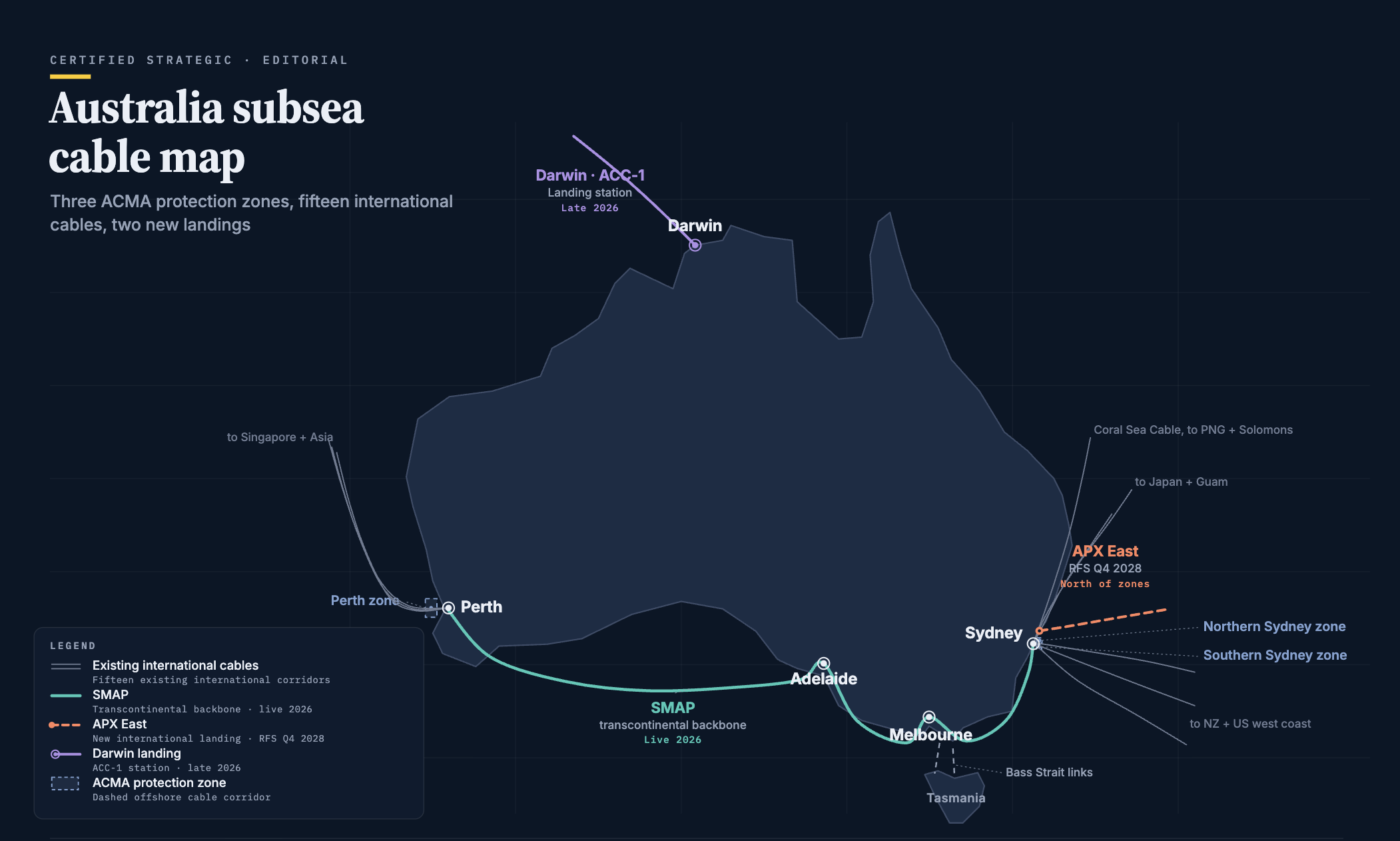
Australia relies on roughly 15 international cables. They cluster into three ACMA protection zones at Northern Sydney, Southern Sydney and Perth.
The Southern Sydney zone was extended 4.1 kilometres south on 23 October 2025 to cover the new Tabua landing.
Australia signed the 17-nation Guide pact on underwater infrastructure at Shangri-La 2026. The United States and China did not.
The same weekend, AUKUS partners announced a Pillar Two project to jointly develop uncrewed undersea vehicles, with first deliveries in 2027. Cable protection is one of the named mission sets.
SUBCO’s SMAP hypercable goes live this month, adding 400Tbps of east-west capacity inside Australia.
SUBCO’s APX East, announced 19 January 2026, will run Sydney to California for Q4 2028 service. It lands north of Sydney’s current zones and will need a new ACMA protection zone.
What Marles said about the seabed
Richard Marles spoke at the Shangri-La Dialogue Plenary Session Three on 30 May 2026. The speech was framed around cooperative maritime security.
He told delegates: “the seabed has become a major field of contest.” He then listed the recent incidents. A vessel severed two Baltic cables in November 2024. The tanker Eagle S dragged its anchor for nearly 100 kilometres across the Gulf of Finland, cutting four telecoms lines and a power link. A new Helsinki to Tallinn fibre cut was detected on 31 December 2025. Taiwan reported five seabed cable incidents in 2025, up from three each in 2024 and 2023.
Then he turned to Australia. “Around ninety-nine percent of Australia’s internet traffic flows through just fifteen subsea cables,” he said. “Fifteen physical assets on the ocean floor carry essentially the entirety of our international digital connectivity.”
The most concrete line in the speech was about how cuts happen. Cables, he said, “can be cut with an anchor in the middle of the night.”
The fifteen cables, mapped
The ACMA submarine cable register and industry registers list around 18 in-service international cable systems landing on Australian soil as of late 2024. The 15-cable figure is consistent with counting only the systems carrying material commercial traffic at scale.
The current map clusters tightly into three protection zones plus a small set of outliers:
Landing region | In-service international systems | ACMA protection |
Northern Sydney | Australia Japan Cable (north), Southern Cross legacy, Southern Cross NEXT, Hawaiki Cable, JGA-S, Telstra Endeavour, PPC-1 | Northern Sydney Protection Zone |
Southern Sydney | Australia Japan Cable (south), Tabua Cable | Southern Sydney Protection Zone (extended south in October 2025 to cover Tabua) |
Perth | Australia–Singapore Cable, INDIGO West, INDIGO Central international segment, SEA-ME-WE 3 | Perth Protection Zone |
Sydney–PNG–Solomons | Coral Sea Cable System | Outside declared protection zones |
Bass Strait | Bass Strait-1, Bass Strait-2 (Tasmania internet lifeline) | Outside declared protection zones |
North-West Cable | Port Hedland to Darwin domestic | Outside declared protection zones |
Source: Certified Strategic Editorial, ACMA submarine cable register, TeleGeography 2026, May 2026.
The Northern Sydney zone sits 74 kilometres offshore from Narrabeen Beach and has been in place since 2007. Industry registers report it currently extends over seven international cables along the Northern Beaches landing corridor. The Southern Sydney zone runs from Tamarama and Maroubra beaches. ACMA extended it 4.1 kilometres south on 23 October 2025 to cover the new Tabua landing. The Perth zone covers the westbound systems.
Everything else sits outside statutory protection. That includes Bass Strait, the Coral Sea Cable into PNG and the Solomons, and the new Darwin landings coming in late 2026. The unspoken architecture of Marles’ speech is simple. Around 99 percent of Australian internet traffic flows through about 15 cables. The commercially load-bearing majority of those converge inside three offshore polygons.
All of these systems, alongside SUBCO’s domestic SMAP backbone, sit on the Certified Strategic SMAP interactive map, which overlays international and domestic subsea routes against landing stations, data centres and renewable energy zones. SMAP itself is a 5,000-kilometre transcontinental cable from Sydney to Perth via Melbourne and Adelaide. It is domestic, so it does not change the 15-cable international count, but it is the inter-capital backbone for the share of Australian traffic that does not need to leave the country. We set out the commercial detail in our SUBCO SMAP analysis in February.
Sovereign international capacity
SUBCO announced APX East on 19 January 2026. It is Australia’s first sovereign-owned international hypercable. The cable runs Sydney to California direct, with 16 fibre pairs and no intermediate landings. It is designed to be powerable from one end if the other end fails. Ready for service is Q4 2028. A Hawaii branch follows in Q4 2029. A Fiji branch is also planned for 2029.
One detail in the announcement is important for the protection-zone map. APX East will land “in a new diverse location to the north of Sydney’s existing cable protection zone, separate from all announced hypercables landing in the Southern Cable Protection Zone.” That means a fourth statutory protection zone is now in waiting. A new commercial landing at scale north of Narrabeen has no statutory protection today. ACMA would need to declare a new zone to bring it inside the regime. The procedural timeline for that declaration is the gating item for risk-weighting APX East, more than the cable build itself.
The capacity case SUBCO published with the announcement is the number to remember. Founder Bevan Slattery stated: “Hyperscalers and neoclouds are looking to deploy 3GW of AI factories in Australia between now and 2028. This is going to need between 75Tb-150Tb of international capacity to deliver those tokens to the world.” Hawaiki, Southern Cross NEXT and Bosun alone cannot carry that demand. Without new international fibre on Australian-aligned ownership terms, the announced AI factory pipeline is constrained at the international edge. Domestic capacity from SMAP, INDIGO Central and Project Southgate does not close that gap. The 12-to-18 month window we identified for Australia’s AI infrastructure capture has a subsea component that is rarely priced into market models.
Darwin finally joins the map
For two decades the international cable map into Australia has had two anchors: Sydney and Perth. That is about to change.
Inligo Networks’ Darwin Cable Landing Station is on schedule to complete in late 2026. The 19,000-kilometre Asia Connect Cable-1 (ACC-1) will terminate there. Other ACC-1 landings include Batam, Jakarta, Davao, Makassar, Dili, Manado, Guam and Los Angeles. Indonesia also commissioned the Pukpuk Submarine Cable System to Papua New Guinea on 9 May 2026. It is the first direct cable between those two countries.
Darwin will be the first new international cable landing region in Australia outside the Sydney and Perth anchors. For operators, this matters in three concrete ways. Northern Territory sovereign workloads now have a domestic landing option that did not exist in mid-2025. Defence-aligned compute near Robertson Barracks can sit closer to international fibre. Short-haul latency between Australia and Timor-Leste improves materially. APX East gives Australia a sovereign route east to the United States. Darwin gives it a new route west into Asia. The two together build out a more diverse Indo-Pacific cable footprint that does not need to transit Singapore or Jakarta.
The Pacific Island single-cable exposure
A sharp line in Marles’ speech was about the neighbours. “Pacific Island nations are, in many cases, served by a single cable.”
The Australian-funded Coral Sea Cable System lands at Sydney and runs to Port Moresby and Honiara. It was built because Solomon Islands and Papua New Guinea were single-cable jurisdictions. Their connectivity sovereignty mattered to Australian strategic interest. SUBCO’s APX East Hawaii and Fiji branches, due in 2029, follow the same logic. So does Tabua, whose new Maroubra landing triggered the Southern Sydney protection-zone extension. The 2026 subsea map is increasingly an Australia-Pacific map as much as an Australia-Singapore-US map.
The AUKUS undersea drone announcement
On the same weekend as the speech, Australia signed up to a Pillar Two project under AUKUS to jointly develop uncrewed undersea vehicles. The joint statement from UK Defence Secretary John Healey, US Defense Secretary Pete Hegseth and Marles describes the platform as a “suite of highly adaptable multi-mission UUV payloads.” First deliveries are scheduled for 2027.
Two of the named mission sets are directly relevant to the cable map. The first is detection of seabed activity that could threaten critical underwater infrastructure. The second is anti-submarine and contested-littoral manoeuvre, which include the grey-zone vessels Marles described in his speech. The AUKUS announcement is the operational response to the detection and deterrence side of the threat.
What this means for Australian operators
First, the SMAP landings have crystallised the carrier-neutral interconnect picture. Equinix’s Perth and Sydney IBX sites have been selected as the SMAP landings, with points of presence at Adelaide and Melbourne. NEXTDC and CDC remain the primary Tier-1 colocation anchors on the east coast and at Perth. NEXTDC has announced D1 in Darwin CBD with Vocus as anchor tenant and a larger D2 land parcel intended for hyperscale capacity. Once ACC-1 lands at Darwin in late 2026, that NT footprint sits inside a new international cable region rather than alongside one.
Second, SUBCO has framed the AI factory buildout as constrained at the international subsea edge, not only at the power edge. SUBCO’s stated 75-150Tbps figure for serving 3GW of Australian AI factory inference traffic by 2028 is the proponent’s own number, published with the APX East announcement. Taken at face value, it implies that the announced AI factory pipeline, including the neocloud pipeline we have tracked at more than 1,600 MW, depends on new international fibre capacity arriving before the compute does. Whether other operators or independent analysts confirm SUBCO’s capacity number is the next thing to watch.
Third, the Guide pact gives operators a political reference point rather than a regulatory regime. The 17 signatories, including Australia, have endorsed a voluntary, non-binding framework focused on information-sharing, early warning on incidents, and exchange of best practices. The Guide is not a forum that aligns national legislation, port-state measures or attribution standards. It is the soft-power scaffolding on top of which national regulation, including the legislation Marles called for in his speech, would need to be built.
What to watch
Five concrete items will define the next 18 months of Australian subsea decision-making:
A new ACMA protection zone north of Sydney. APX East needs a landing outside the existing zones. Whether ACMA opens consultation on a fourth declared zone in 2026 will signal regulator alignment with the sovereign-cable thesis.
Darwin’s ready-for-service date. Inligo Networks’ landing station and ACC-1 are scheduled for late 2026. A confirmed RFS opens the first new international landing region in Australia in two decades.
APX East financial close and offtake. SUBCO has stated Q4 2028 RFS. Route survey progress, disclosed hyperscaler offtake and project finance close before end of 2026 will determine whether the date holds.
Marinus Link fibre commissioning toward 2030. The HVDC interconnector’s fibre component closes the Tasmania single-state blackout risk.
The next cable cut. Wherever it happens in the SEAIOCMA zone, the response time sets the policy temperature for whether Australia begins a conversation about its own cable repair vessel.