At a glance
New power waiting to connect to the grid reached 80.9GW, above the 77GW in service for the first time, AEMO reported on 21 October 2026.
Batteries make up 55 per cent of that queue.
Data centre grid connections are being planned in Sydney and Queensland and secured in South Australia.
NEXTDC's M3 campus in Melbourne expects its next power increase in FY28, with the affected capacity still under contract and FY27 guidance revised.
CDC says its power delivery timelines are tracking as anticipated.
The Australian Energy Market Operator (AEMO) reported on 21 October 2026 that more new power stations and batteries are waiting to connect to Australia's main grid than the grid has running. Its September quarter Connections Scorecard counts 80.9GW of generation and storage moving through the National Electricity Market's connection process, more than the 77GW in service, for the first time. The pipeline grew 43 per cent in a year.
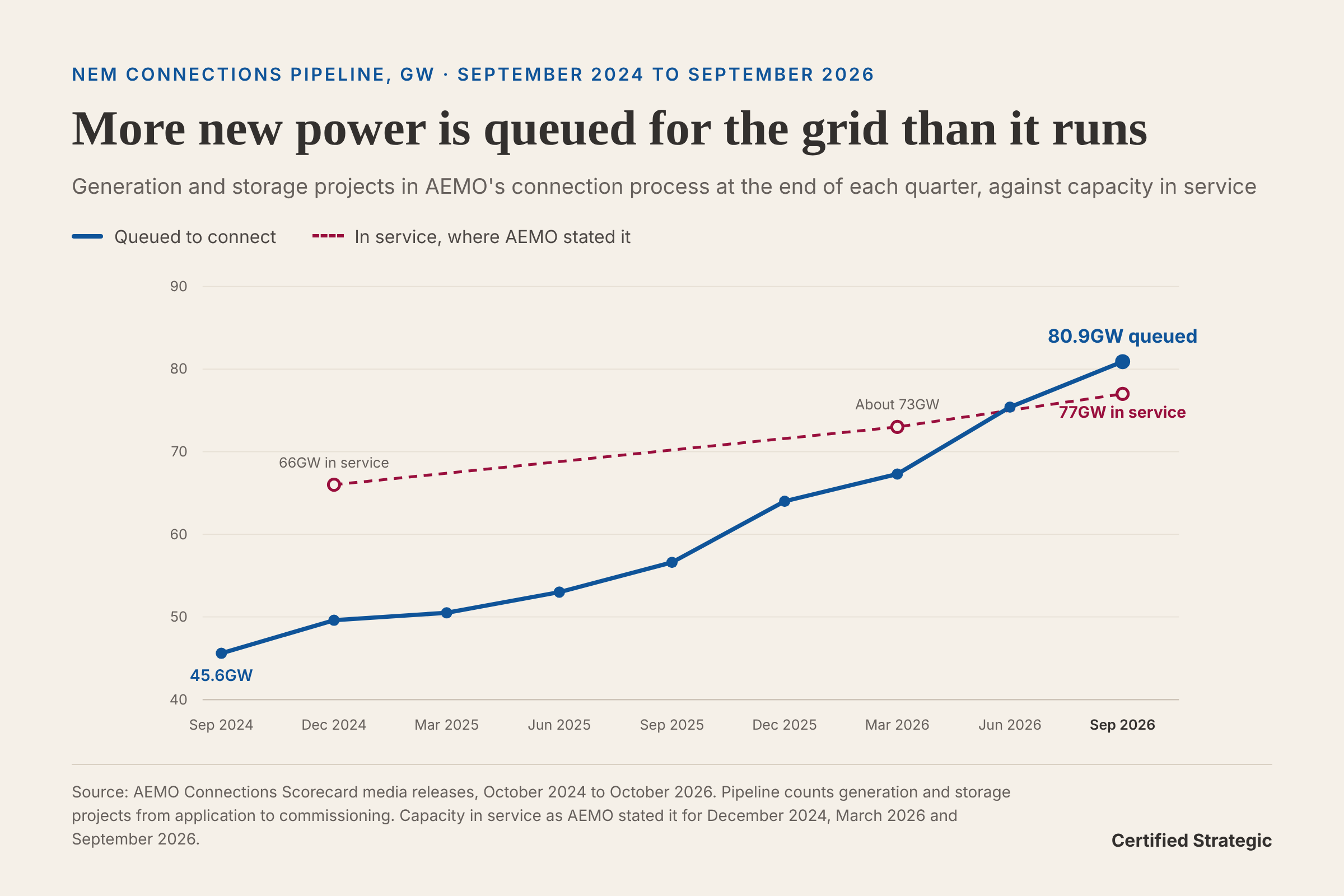
Source: AEMO, Connections Scorecard media releases, October 2024 to October 2026.
AEMO's August 2026 outlook forecast data centre electricity use to triple to around 15TWh by 2029-30, and found the grid can keep up with that growth if new generation, storage and transmission arrive on time. The 80.9GW waiting to connect is where much of that new supply would come from.
Generation is only the first step in powering a data centre. The second is the network connection that carries electricity from the grid to each campus, built by the transmission or distribution company that serves the site.
NEXTDC's M3 campus in Melbourne is waiting on network works for its next increase in grid supply, and investors asked CDC's part-owner about power delivery timelines at CDC's sites. Operators and network companies in Sydney, South Australia and Queensland are planning and securing that same step for their own campuses.
Batteries make up 55 per cent of the 80.9GW pipeline
Grid-scale batteries account for 55 per cent of the pipeline's capacity, hybrid solar and battery projects a further 19 per cent, and wind 15 per cent. Nearly 40 per cent of the battery projects can supply three to ten hours of storage, which AEMO says can make the system more resilient when wind and solar output is low.
Projects moved through every stage during the September quarter. AEMO approved applications for 23 projects totalling 4.5GW, four projects totalling 1GW were connected, and seven projects totalling 1.3GW reached full output. Another 25 applications totalling 7.5GW arrived.
About 88 per cent of the 80.9GW sits at the application and implementation stages, so most of it is still working through the connection process. AEMO expects consumption across the market to rise by more than 40 per cent, and it notes that not every project will reach commissioning. Whether a given data centre gets that power on time also depends on its network connection.
Sydney's grid owner plans up to 2GW of new capacity, funded by data centres
Data centres are getting grid power in different ways, and four connections announced or updated between June and October 2026 show the range: new shared capacity paid for by data centres, existing capacity at a substation, a direct link that bypasses the local network, and an upgrade of local lines to an operating campus.
In Sydney, Transgrid, which owns the state's high-voltage network, said on 26 August 2026 that a proposed new South Creek substation in Western Sydney and other upgrades could unlock up to 2GW of additional capacity in Sydney, with the cost borne by the data centre proponents creating the demand. About 1.5GW has been allocated to signed data centre agreements in Western Sydney, and Transgrid has received 20GW of connection enquiries for large new loads.
Transgrid and local distributor Endeavour Energy also plan a A$136.7 million project at Kemps Creek in the Western Sydney Aerotropolis, announced in October 2025: a A$111.7 million bulk supply point, a substation linking the transmission grid to local networks, plus A$25 million of local upgrades, due by the end of the decade.
IREN announced a transmission connection agreement on 3 June 2026 for its 800MW campus at Bundey in South Australia, securing four high-voltage connection points that it expects to support the full 800MW without network upgrades, with energisation from 2028.
In Queensland, Zerra DC's 1.44GW Western Downs Digital Park is planned to connect directly to the substation instead of relying on regional distributor Ergon Energy's local network, a Zerra spokesperson told the ABC.
The fourth is M3. It sits in an established suburb of Melbourne's inner west, so its next increase in power runs through the local distribution network.
Local power line upgrades set the timing at NEXTDC's Melbourne campus
NEXTDC's M3 data centre in West Footscray takes its power from Jemena's 66kV distribution network, and Jemena is upgrading poles and lines through Yarraville and West Footscray to deliver M3's next increase in supply.
Jemena paused parts of that work in September 2026. According to NEXTDC's ASX release, Jemena cited safety concerns, site access amid community and stakeholder opposition, and the local council withholding consent as road authority while it consults further. Jemena is consulting the community and seeking approvals to restart, and does not expect to resume before February 2027. On Jemena's indicative estimate, NEXTDC now expects M3's next increase in grid supply in FY28, and has revised its FY27 guidance.
The steps after that depend on the high-voltage network. NEXTDC said later increases at M3 rely on new transformers at Brooklyn Terminal Station, which supplies the area's 66kV network. Jemena and fellow Victorian distributor Powercor proposed a new transformer there in an August 2026 draft report, at an estimated A$29.8 million and timed for 2027-28, and recorded more than eight major data centre connection requests in the supply area it covers.
Jemena's report shows the network in Melbourne's inner west is fielding demand from several data centre projects at once. The pole and line works for M3 run through residential streets, which makes community consultation and council consent part of their timetable.
NEXTDC's Melbourne capacity remains under contract
M3's customer commitment stays in place while its power date moves. NEXTDC told the ASX on 21 October 2026 that the affected capacity remains under contract, subject to the customer's rights, and that data hall construction continues. It is working with the customer on a revised schedule for delivering power to the data halls, and with Jemena to bring the power forward.
NEXTDC said the timing and scale of the affected contracts' contribution is uncertain and has taken them out of its FY27 guidance, which lowers the midpoint of both net revenue and underlying EBITDA guidance by about A$140 million. The capacity is expected to start billing shortly after the FY28 power increase.
FY27 guidance | Previous | Revised, 21 October 2026 |
|---|---|---|
Net revenue | A$615m to A$640m | A$475m to A$500m |
Underlying EBITDA | A$385m to A$410m | A$245m to A$265m |
Capital expenditure | A$5,250m to A$5,750m | A$4,500m to A$5,000m |
Source: NEXTDC ASX release, 21 October 2026. Revised net revenue and underlying EBITDA exclude the affected M3 contracts. The revised capital expenditure range includes about A$230 million of capitalised interest, which the August range did not; before that, the cut is about A$980 million.
NEXTDC reported A$8.675 billion of liquidity at 30 September 2026, made up of cash, undrawn senior debt facilities and A$700 million committed from a hybrid securities issue, subject to conditions. It remains within its debt covenants, and its earliest scheduled debt maturity is December 2029. It is focusing spending on contracted capacity due over the next 12 to 18 months, has paused new development projects and land purchases, and will report the outcome of a capital expenditure review by its annual general meeting on 20 November 2026. NEXTDC also expects the Victorian Government's planning decision on M3 Stages 6 and 7, lodged in February 2026 under the state's Development Facilitation Program, after the state election on 28 November 2026.
CDC's power and construction timelines are tracking as anticipated
Investors asked about power delivery timelines at CDC too. Infratil, which owns just under half of CDC Data Centres, told the NZX on 21 October 2026 that it had received investor questions about power delivery timelines for sites under construction in Australia.
CDC confirmed it has robust delivery plans for all its sites under construction, that power delivery and construction timelines are tracking as anticipated, and that CDC-related financial guidance is unchanged.
What to watch
NEXTDC's annual general meeting. The board has committed to report the outcome of its capital expenditure review by the annual general meeting on 20 November 2026, along with any update on the revised power schedule with its M3 customer.
Jemena's restart. Jemena does not expect to resume the works before February 2027, and is consulting the community and seeking the approvals to restart. NEXTDC is also considering new pole locations or underground cables.
The M3 Stages 6 and 7 decision. NEXTDC expects the Victorian Government's planning decision after the state election on 28 November 2026.
Brooklyn Terminal Station. Jemena and Powercor intend to publish the final report on the A$29.8 million transformer by the end of 2026, confirming the preferred option. The draft put its timing at 2027-28.
AEMO's December quarter scorecard. The next Connections Scorecard will show how far the 80.9GW pipeline grows and how much of it reaches commissioning.