At a glance
Zerra DC says the first building at its proposed Western Downs Digital Park near Dalby, which Anthropic has agreed to lease, could run on rainwater from its roof through drought, the ABC reported on 16 October 2026.
On Zerra's figures, the building needs 13,000 litres a day from outside after recycling. A 35,000 square metre roof would collect that from about 136mm of rain a year.
Bureau of Meteorology records show Dalby Airport received 168.4mm in 2019, its driest year since the station opened in 1992, and at least 421mm in every other year.
The 2019 total covers the need only if the roof captures about 80 per cent or more of the rain. With 34.8mm falling between July and December 2019, the building would have relied on about 1.2 to 1.6 million litres of stored water.
Zerra has not published the size of its planned rainwater storage.
Zerra DC, a Singapore-based developer, says its proposed data centre campus near Dalby in southern Queensland could keep operating through severe drought using rain collected from its roofs. Chief data centre officer Matt Ward told the ABC on 16 October 2026 that the buildings would have "35,000-odd square metres of roof space" and that the company's modelling showed they would collect enough water even in 2019, when Dalby received less than 200mm of rain.
The 1.44GW Western Downs Digital Park is before Western Downs Regional Council, and Anthropic has agreed to lease its first stage. Residents have raised water use among their concerns, the Financial Review reported in September, and Dalby resident Robyn Sheehan told the ABC she was tired of big industries making "empty promises" in the area. Certified Strategic compared Zerra's published water figures for the first building with the Bureau of Meteorology's monthly rainfall record for Dalby Airport from 1992 to 2025. It converted the building's daily need into the rainfall its roof must catch each year, and ran a month-by-month water balance for 2018 and 2019 to estimate the storage required in a dry year.
Over a full year, Zerra's figures require about 136mm of rain on the first building's roof, and the driest year on the Dalby Airport record brought 168.4mm. Storage determines whether the building gets through the dry months within such a year.
Dalby Airport recorded 168.4mm of rain in 2019
Zerra's project website puts the first building's water use at about 21 kilolitres a day, of which it says 8 kilolitres would be recycled on site. The remaining 13 kilolitres a day comes to about 4.7 megalitres a year. A 35,000 square metre roof collects that volume from about 136mm of rain if every millimetre is captured, the same assumption Zerra's own drought-year figures use.
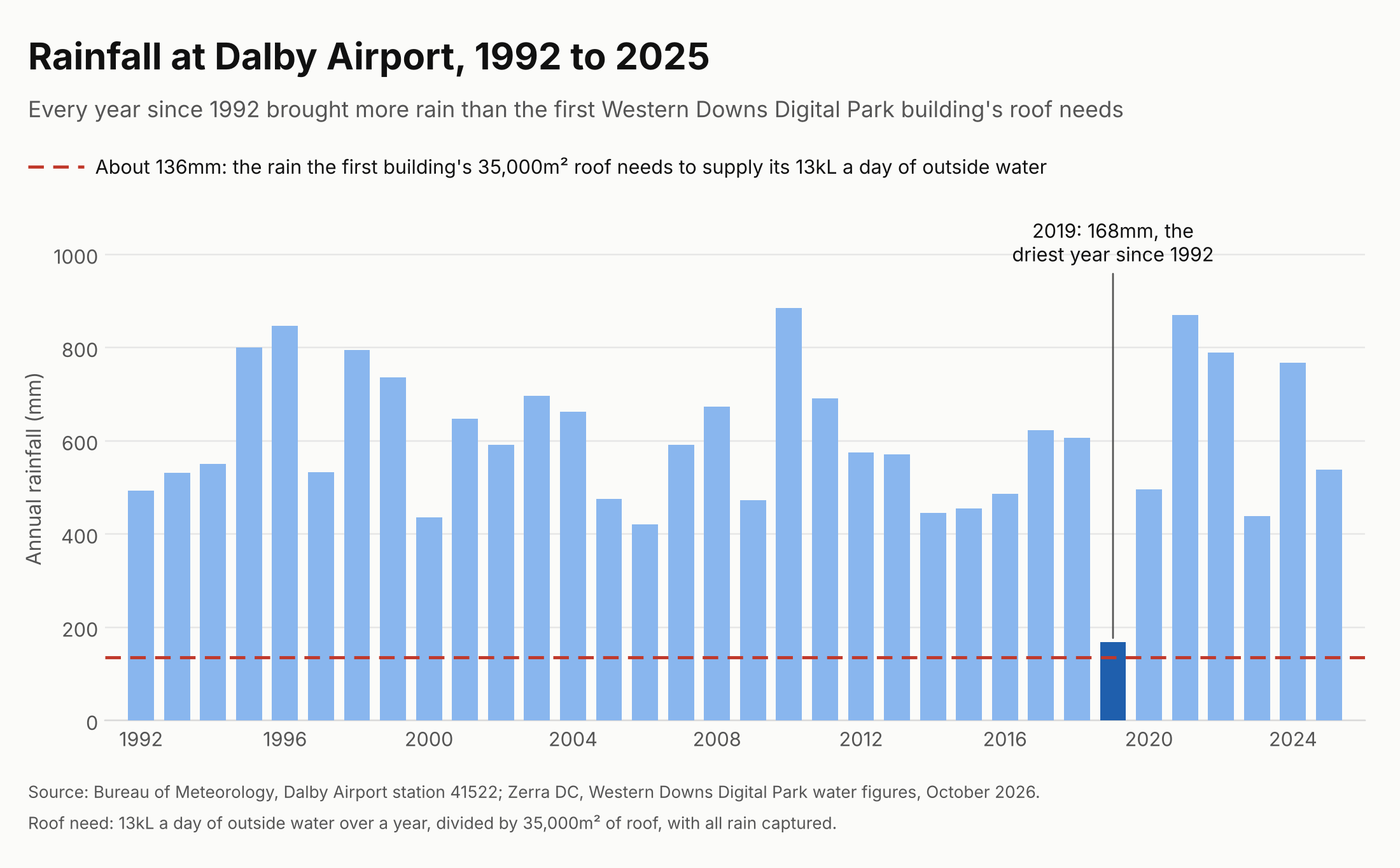
The Bureau of Meteorology's Dalby Airport station has recorded an average of 598.6mm a year since it opened in 1992. The lowest annual total was 168.4mm in 2019, about 1.2 times the volume the first building requires on Zerra's figures. No other year fell below 421mm. Zerra's water factsheet gives 2019 rainfall as 200mm, which it describes as the lowest for the local area since 1972.
The margin in a dry year depends on capture and storage
Rainwater systems do not capture every millimetre. The first flush of a storm is commonly diverted, and gutters overflow in heavy rain. In an average year at Dalby, the roof would collect about four times the building's requirement. In a year like 2019, 168.4mm meets the 4.7 megalitre requirement only if the roof captures about 80 per cent or more of it, according to Certified Strategic calculations from Zerra's figures and the Bureau record.
Rainfall in 2019 was also uneven. Dalby Airport recorded 93.6mm in March and 34.8mm across July to December. Over those six months the building would have required about 2.4 megalitres, against about 1.2 megalitres collected.
A month-by-month water balance using Dalby Airport rainfall for 2018 and 2019 puts the largest shortfall at the end of 2019. Bridging it would have required about 1.2 million litres of stored water with full capture, or about 1.6 million litres at 80 per cent capture. Zerra says the project will include on-site storage, with an existing dam on the site and water trucked in from outside the region as backup sources. It has not published the storage capacity.
Zerra's water figures for the campus
Zerra says most of the first building's water would be used by workers, in bathrooms and kitchens, and for fire testing and maintenance. It says the servers would be air-cooled, with water circulating in a closed loop that releases heat to the air rather than through evaporation. The development application lodged on 17 August 2026 put a completed building's use at 16.5 kilolitres a day; Zerra's website says its current figures reflect later modelling.
The site at Kogan, shown on the Queensland data centre map, is about 15km from the nearest town water main, according to the application, and no connection is proposed. Zerra says it does not plan to extract bore water and would use groundwater only as a last resort, subject to approvals.
Water need | Amount | Source |
|---|---|---|
First building, each day | About 21kL, 13kL from outside after recycling | Zerra DC website |
All four buildings, each year | About 25.5ML, 15.3ML from outside after recycling | Zerra DC water factsheet |
One-off fill and flush of each building's cooling pipework | About 26.9ML | Development application, HDR infrastructure report |
Construction at its peak, each day | About 380kL, planned to come mainly from processed coal seam gas water | Zerra DC website |
Source: Zerra DC, Western Downs Digital Park website (accessed October 2026) and water factsheet (September 2026); HDR infrastructure services report, August 2026.
The one-off commissioning fill of 26.9 megalitres per building is slightly larger than the 25.5 megalitres a year Zerra estimates for all four buildings in operation. Zerra says the fill would mostly use treated coal seam gas water from nearby gas operations, subject to a supply agreement.
Zerra says tenants would pay for new power supply
Ward told the ABC that supplying new power to the grid would be the responsibility of tenants such as Anthropic, with Zerra acting like the "landlord of any commercial building". Zerra, in which Macquarie Capital invested in October 2026, says on its website that the campus would connect to the high-voltage network at the Braemar substation, fund that connection, and buy power from existing Queensland generators and from new generation adding more supply than the campus uses.
Tim Buckley, director of think tank Climate Energy Finance, told the ABC that both sides needed to be "collectively held to account" for new renewable generation. "If they aren't held to account in substance over the life of the project, we will inevitably see higher power prices for everyone across Queensland as a result," he said. National Cabinet agreed in August that the Commonwealth will write mandatory standards for data centre energy, water and land use.
What to watch
The storage capacity. Zerra's detailed design will set the tank and dam volumes available to the first building through a dry half-year.
Public notification. Western Downs Regional Council told Zerra's planners, Urbis, on 1 October 2026 that public notification of the application could begin, after Zerra responded to the state referral agency's information request.
Who decides. Queensland plans to take data centre approvals from councils. Mayor Andrew Smith says the state has assured Western Downs it remains the assessment manager for this campus, where Zerra and the council have been negotiating a community payment since September.
The coal seam gas water agreement. Zerra plans to draw construction water and most of the commissioning fill from nearby gas operations, with trucked water from outside the region as the backup.