At a glance
NVIDIA says it has committed nearly US$10 billion to Europe's technology ecosystem, naming planned stakes in nine French and British startups on 13 and 14 October 2026.
Selling AI computing to governments and national companies, which NVIDIA calls sovereign AI, brought it more than US$30 billion in revenue in its year to January 2026.
The EU is tendering for up to seven large AI data centres, and EU countries will jointly buy computing time from them.
NVIDIA's eight Australian partners are preparing land, power and buildings for up to 2GW of AI factories by 2027, a figure NVIDIA did not split by country, and NVIDIA holds shares in Firmus and the right to buy shares in IREN.
More European deals, worth US$2 billion, are due within a week of 13 October, with Jensen Huang's Berlin keynote on 21 October.
NVIDIA chief executive Jensen Huang began a tour of Europe in Paris on 13 October 2026 by telling a Paris audience that "Europe needs to get in the race". He said NVIDIA would announce US$2 billion of new European investments within a week, The Next Web reported. That is on top of roughly US$8 billion NVIDIA says it put into Europe over the past year, Fortune reported. NVIDIA puts the total at "nearly $10 billion".
On 13 and 14 October, NVIDIA named stakes in nine French and British startups working in fields including health, materials, robotics, drug discovery, quantum computing and business software. Its existing European investments include French model developer Mistral AI and British AI cloud company Nscale.
In Australia, NVIDIA said on 9 September it is working with eight partners in Australia, among them Firmus, NEXTDC and AirTrunk, on land, power and buildings for up to 2GW of AI factories by 2027, a figure NVIDIA did not split by country. NVIDIA supplies the design, chips and software. It holds shares in Firmus and the right to buy shares in IREN.
Selling AI computing to governments and national companies brought NVIDIA more than US$30 billion in revenue in its last financial year. Europe has what that business needs: a government tender to buy computing, steady low-carbon power and its own model developers.
NVIDIA named planned stakes in nine European startups in two days
In Paris, NVIDIA named planned investments in health booking platform Doctolib, materials startup Entalpic, robotics company Genesis AI and business planning software maker Pigment. In London the next day it named five more: Boltz and Prima Mente in drug discovery, Hiverge in algorithm design and Riverlane in quantum computing. The fifth, Foresight, helps owners of major infrastructure projects, including hyperscale data centres, predict completion dates. NVIDIA did not disclose amounts, and Tech Funding News reported the four French stakes as minority positions.
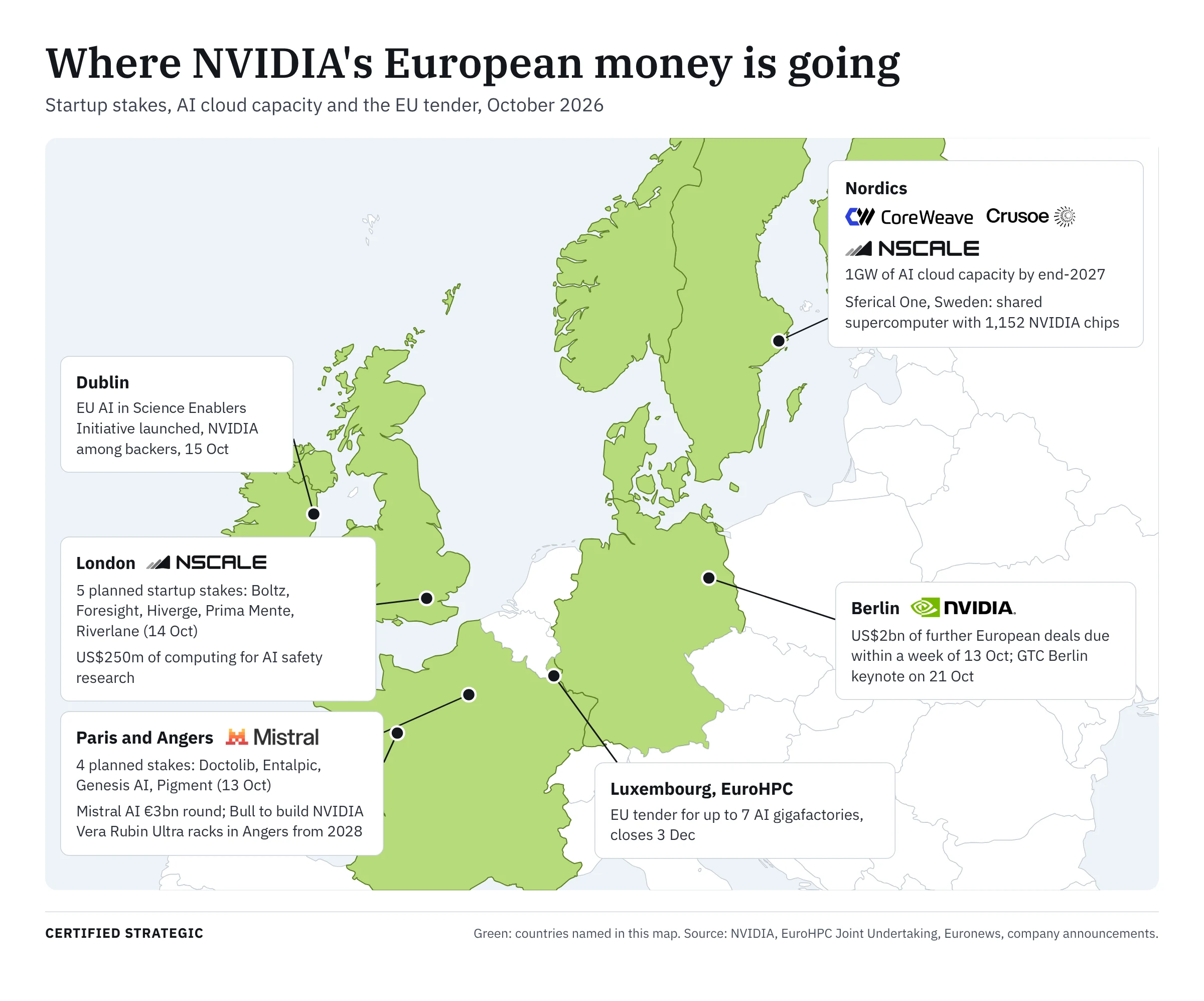
In September 2026, NVIDIA took part in Mistral AI's €3 billion round, led by Samsung. It also backs Nscale, a neocloud, meaning a company that builds GPU computing capacity and rents it to AI developers. Huang told a London audience that Nscale had been a "zero" before NVIDIA invested and helped recruit its board, Fortune reported. Nscale is preparing to list, at a valuation reported at US$30 billion to US$35 billion. In the UK, NVIDIA also committed US$250 million of computing over five years to UK research on the safety and security of AI agents.
Sovereign AI brought NVIDIA more than US$30 billion in revenue in a year
Sovereign AI is NVIDIA's term for computing that governments and national companies buy to keep their data and AI under their own control. That business more than tripled to over US$30 billion in the financial year to January 2026, NVIDIA told analysts in February. It said customers in Canada, France, the Netherlands, Singapore and the UK drove most of it. It was about 14 per cent of NVIDIA's US$215.9 billion revenue, and NVIDIA expects countries to spend on AI "proportional to their GDP".
The large US cloud providers still account for roughly half of NVIDIA's data centre sales, Fortune reported. Huang gave Fortune his reason for investing: "It is also strategically super smart to do because everybody we invest in is connected into Nvidia's ecosystem, and so we're making our platform more vibrant, and we're able to reach into new markets we otherwise couldn't."
In Paris and London, his pitch centred on open models, whose underlying weights are published so others can run and adapt them. In Paris, he said open models matter because they can be adapted to a country's languages and to its own sovereignty, The Next Web reported. Mistral trained its latest model, Mistral Large 4, on 4,000 NVIDIA Grace Blackwell chips. As Fortune noted, open models lower costs for the companies building them, but the money spent on chips still goes to NVIDIA.
The risk for Europe, Fortune wrote, is that sovereignty ends up meaning dependence on a single American chipmaker. Huang said what matters is who runs the service: "So long as you can operate the service yourself, that's the most important."
EU countries will buy computing time from up to seven new AI sites
The European Commission set aside €20 billion in February 2025 for AI gigafactories, very large data centres for training and running AI models. The EuroHPC tender for up to seven of them opened on 30 July 2026 and closes on 3 December, with winners expected in early 2027. Each site must hold at least three to four times the advanced AI chips of Europe's most powerful existing AI factories.
The EuroHPC Joint Undertaking and several EU countries will jointly buy computing time from the groups that win. The EU also funds 19 smaller AI factories at research centres. The one in Sweden is opening its capacity to startups in Inception, NVIDIA's startup support program.
NVIDIA's Nordic announcement credits the region's "abundant renewable energy, rigorous data governance and a research tradition". It counts 1GW of AI cloud capacity due across the Nordics by the end of 2027. The companies building it include US neoclouds CoreWeave and Crusoe and Britain's Nscale.
In Sweden, Ericsson, AstraZeneca, Saab, bank SEB and Wallenberg Investments have launched Sferical One, a shared supercomputer with 1,152 NVIDIA chips. In Dublin, NVIDIA's Deepu Talla pointed to Europe's manufacturers, saying "Around 70% of GDP is in the physical world", where AI runs robots and machines. Europe also makes much of the equipment inside its data centres. The map of Europe's data centre industry lists 14 power, cooling and generator suppliers, ten of them headquartered in Europe, including Schneider Electric, ABB and Siemens.
In Australia, NVIDIA is working with the companies building data centres
NVIDIA's main Australian move came a month before the European tour, and it went into building data centres. Its 9 September statement named Firmus, Sharon AI, IREN, ResetData, Megaport, CDC, NEXTDC and AirTrunk as its partners. Together they are preparing land, power and buildings for up to 2GW of AI factories by 2027, not split by country. The partners will run the sites. NVIDIA supplies its blueprint for a complete AI factory, which it calls DSX, along with the chips, networking and software.
NVIDIA holds shares in Firmus and the right to buy shares in IREN. It took part in Firmus's US$2 billion round in August, and in October 2025 signed up as anchor customer of Project Southgate, the AI factory rollout Firmus planned with CDC, a partnership that has since ended after about 42MW in a single Melbourne hall. It also holds a US$2.1 billion right to buy IREN shares at a set price. After Firmus pulled its ASX float on 9 October, the Australian Financial Review reported it was looking to NVIDIA and existing backers for a private round, and Bloomberg reported talks with existing investors and others.
Firmus is also building elsewhere in Asia-Pacific. Its 360MW Batam campus in Indonesia is sized for up to 170,000 NVIDIA chips. NVIDIA has committed to take 360MW in Indonesia and 14MW in Australia as a customer, the AFR reported. Elsewhere in the region, Singapore is the one Asia-Pacific country among the five markets NVIDIA said drove its sovereign AI sales. In South Korea, NVIDIA agreed in October 2025 to supply more than 260,000 chips to the government and companies including Samsung and Hyundai.
On four factors behind NVIDIA's European push, Australia lines up as follows.
Factor | Europe | Australia |
|---|---|---|
Government role | EU tender for up to seven AI gigafactories, with EU countries jointly buying computing time | Five national expectations for data centres and AI infrastructure, March 2026 |
Power | French nuclear, Nordic hydro and wind | Tasmanian hydro, where Hydro Tasmania is assessing about 444MW of proposed Firmus demand |
Capacity planned | AI cloud capacity of 1GW across the Nordics by end-2027 | Land, power and buildings for up to 2GW of AI factories by 2027, not split by country |
Model builders | Mistral AI | Maincode, Sovereign Australia AI |
Source: NVIDIA, European Commission, EuroHPC Joint Undertaking, Hydro Tasmania, company announcements, October 2026
What does Europe show for Australia?
In Europe, NVIDIA backs both the companies building capacity and the companies using it. Nscale is building in the Nordics, part of the 1GW due by the end of 2027. Mistral and the nine startups named on 13 and 14 October use the computing. EU governments will buy too, through the gigafactory tender.
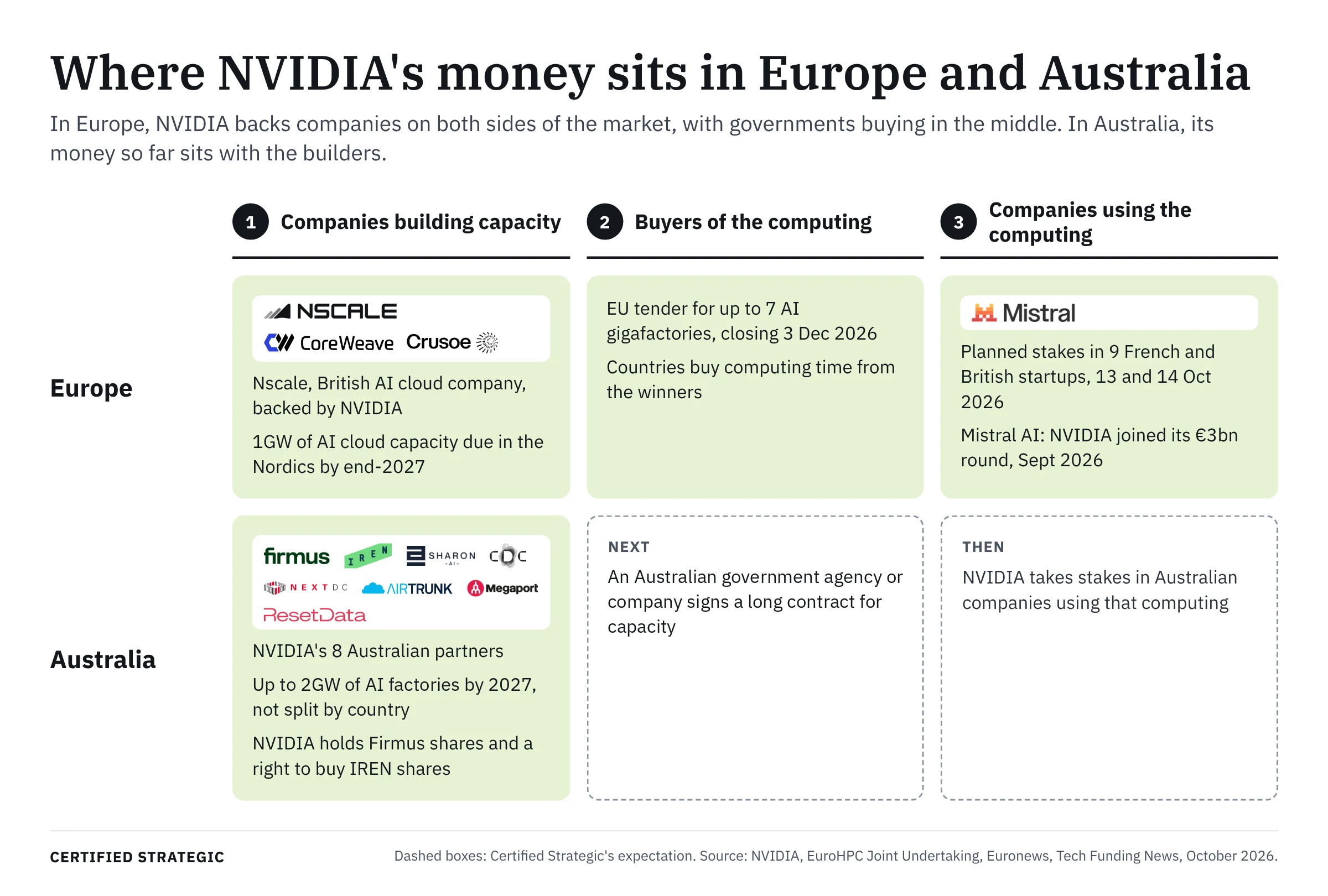
In Australia, the companies NVIDIA has backed so far are builders. Its eight partners are preparing land, power and buildings for up to 2GW of AI factories by 2027, not split by country. NVIDIA holds shares in Firmus and the right to buy shares in IREN. That capacity still needs more customers. They could include government agencies, Atlassian, which uses NVIDIA's open models, and model developers Maincode and Sovereign Australia AI. The map of Australia's data centre industry sets out the companies in each layer.
We expect an Australian government or a large Australian company to sign a long contract for capacity with one of the eight partners, and NVIDIA's first stake in an Australian company that uses AI computing to follow. NVIDIA invests in companies that run on its chips. A long contract gives those companies a reason to build their business on Australian capacity.
What to watch
GTC Berlin on 21 October. The US$2 billion of further European deals is due within a week of 13 October, and Huang gives his keynote on 21 October. The test is whether any of the money goes into data centres.
The EU gigafactory tender, closing 3 December. The winning groups' chip choices will show how much of Europe's public computing spend goes to NVIDIA.
Firmus's private round. The size of NVIDIA's share, after its August investment, is the next measure of its money in Australia.