At a glance
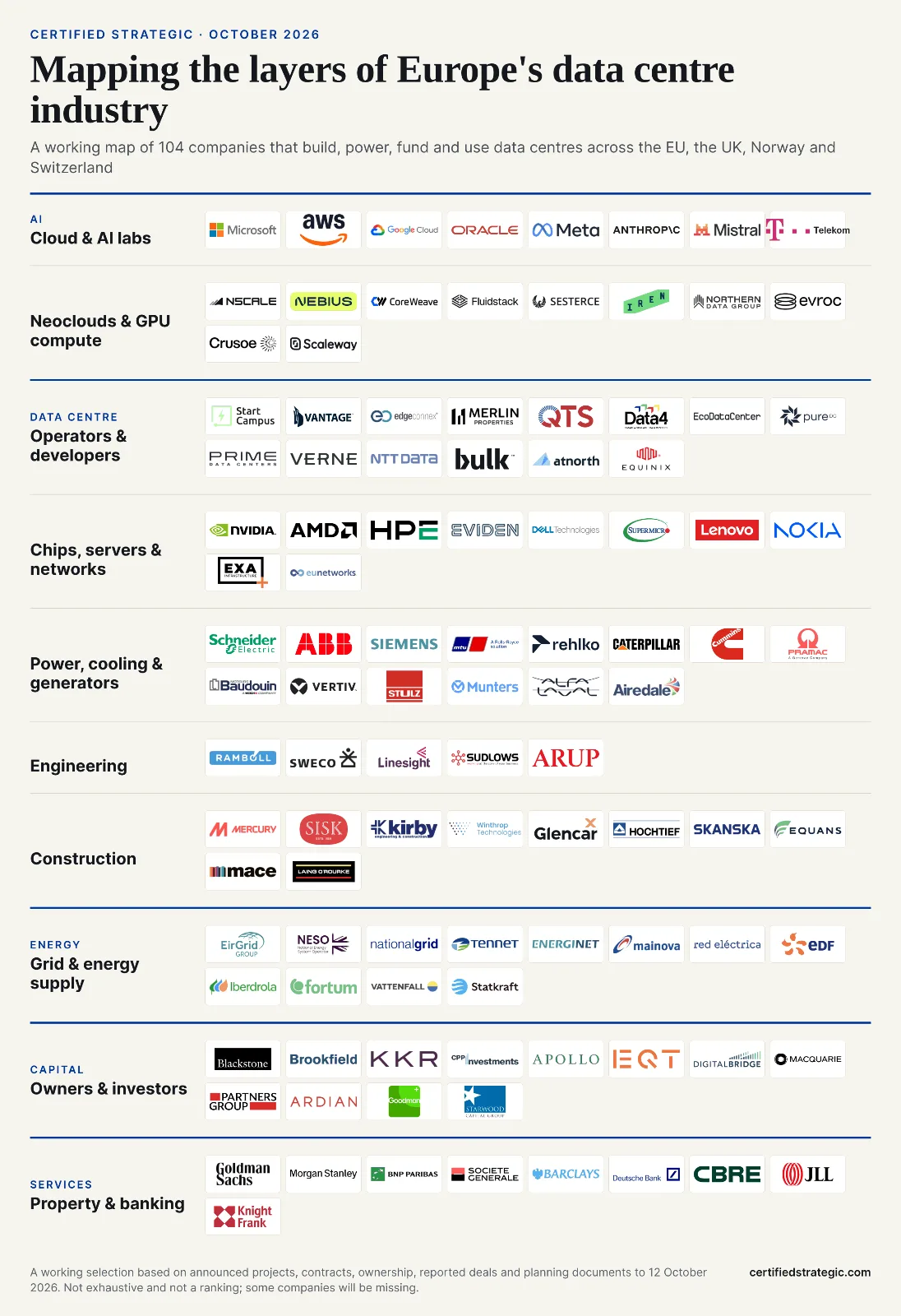
A working map of Europe's data centre industry places 104 companies in ten layers, covering AI labs, chipmakers, cooling suppliers, builders and grid operators across the EU, the UK, Norway and Switzerland.
NVIDIA's Blackwell chips are going into both markets: Mistral AI is installing 13,800 GB300s south of Paris, and Firmus has a deal covering about 18,400 in Melbourne.
Ten of the 14 power, cooling and generator makers on the European map are headquartered in Europe. All five on the Australian map are headquartered overseas, while some switchboards and circuit breakers for Australian data centres are made in Adelaide.
The European Commission has proposed an A to G efficiency label for data centres from August 2027, and Germany requires new sites to reach a power usage effectiveness of 1.2. Australia's federal government requires the data centres it uses to hold a five-star NABERS energy rating.
German law requires new data centres to reuse at least 10 per cent of their waste heat, and the European Commission estimates about 1.8 per cent of EU data centre heat is reused. In NSW, data centre guidelines ask for recycled water to be prioritised for cooling.
Grid operators in Ireland, the Netherlands and Denmark have restricted or paused new connections. Germany, Great Britain and Transgrid in NSW give capacity to projects that show they are ready to build.
Certified Strategic's map of Australia's data centre industry, published on 7 October 2026, placed 86 companies in nine layers, including the AI labs buying capacity and the chipmakers, cooling suppliers, builders and grid operators behind each site. This European edition applies the same test to the EU, the UK, Norway and Switzerland and places 104 companies in ten layers, so the two stacks can be read side by side.
Every company on it plays a part in a named European data centre project, whether building, leasing, equipping, owning, financing, powering or advising on a site, or setting the rules for connecting one. Each role is backed by an announcement, filing, planning document or press report published by 12 October 2026. The map is a working selection, and companies with smaller or undisclosed roles are likely to be missing.
Property adviser CBRE puts colocation supply, the data centre space leased to tenants, at 7,894MW in the European markets it tracks in the second quarter of 2026, and researcher DC Byte puts Australia's operational capacity at 1.6GW in June 2026, in figures cited by industry body Data Centres Australia and Mandala. The European Commission says EU data centres used 68TWh of electricity in 2024, and the Australian Energy Market Operator puts data centre use on the national electricity market at about 5TWh a year. Australia is one country, and the European map spans 30 countries with more than 500 million people.
Both markets are installing NVIDIA's Blackwell chips. Further down the stack, the two markets differ in who makes the power and cooling equipment, what rules govern a site's efficiency and waste heat, and how the grid decides who connects.
Mistral, Telekom and Firmus are deploying NVIDIA's Blackwell chips
Mistral AI is installing 13,800 NVIDIA GB300 chips, part of NVIDIA's Blackwell range, at Eclairion's 44MW site at Bruyères-le-Châtel, south of Paris, and plans further computing at EcoDataCenter's Borlänge campus in Sweden. Deutsche Telekom's industrial AI cloud in Munich, built with NVIDIA, launched in February 2026 with about 10,000 Blackwell chips. In Australia, Firmus signed a multi-year deal in March 2026 to provide computing capacity on about 18,400 GB300 chips in Melbourne, and Sharon AI has been bringing a 1,000-chip B200 cluster online at NEXTDC's M3 in Melbourne, built with Lenovo.
In Norway, Microsoft agreed in April 2026 to lease 30,000 NVIDIA Vera Rubin chips, NVIDIA's next generation, at Nscale and Aker's 230MW campus near Narvik. The site was first announced in July 2025 as Stargate Norway with OpenAI, but talks between OpenAI and Nscale reportedly ended without a deal. OpenAI also paused its Stargate UK project on 9 April 2026, citing energy costs and regulatory uncertainty, and is on the Australian map but not the European one.
On 31 May 2026, NVIDIA named 11 cloud providers as early adopters of confidential computing on Vera Rubin, which keeps data encrypted while it is being processed. They include CoreWeave, Nebius and Nscale, and two Australian-founded companies, Firmus and IREN.
Nebius plans an AI factory of up to 310MW at Lappeenranta in Finland, Sesterce plans a 1GW campus at Bosquel in the Somme with SoftBank Group, and Fluidstack has an agreement with the French government for a 1GW AI supercomputer. IREN is the one neocloud, or GPU cloud provider, on both maps. It holds a connection agreement for an 800MW campus at Bundey in South Australia and completed its purchase of Spanish developer Nostrum Group, with about 490MW of secured grid power, on 15 June 2026.
Eviden built the hardware for JUPITER, Europe's first exascale supercomputer
JUPITER, inaugurated at Jülich in Germany on 5 September 2025, runs about 24,000 NVIDIA GH200 chips on Eviden's BullSequana XH3000 platform. EuroHPC, the EU body that procured it, calls it the first European supercomputer capable of one exaflop, a quintillion calculations a second. It is cooled with warm water, and its waste heat is designed to warm buildings on the Jülich campus.
Eviden, part of France's Atos Group, is the one European server maker on the chips, servers and networks row, and Nokia, EXA Infrastructure and euNetworks are the European network companies on it. NVIDIA, AMD, HPE, Dell Technologies, Supermicro, Lenovo and Nokia are on both maps.
A 1.2GW plan at Sines heads Europe's operator row
Start Campus plans 1.2GW at Sines on Portugal's Atlantic coast. Vantage expects more than 1GW across three campuses in the South Wales AI Growth Zone, and EdgeConneX plans up to 1GW at Skellefteå in Sweden. QTS, Data4, Merlin Properties, EcoDataCenter, Pure DC, Prime Data Centers, Verne, NTT DATA, Bulk and atNorth follow, each with a reported site or programme of 350MW or more. Equinix, which has a site at South Mimms north of London, is the only operator on both maps.
Ten of the 14 power, cooling and generator makers are headquartered in Europe
Schneider Electric, Siemens, ABB, Rolls-Royce Power Systems (mtu), STULZ, Munters, Alfa Laval, Airedale, Pramac and Baudouin are the European-headquartered suppliers on the map. Generator makers are included only where a planning document or supply contract names them at a site. UK Environment Agency permit files name mtu 20V4000 generators at Iron Mountain's LON-3 in Slough, and name Cummins as the generator supplier for AWS's campus on the former Didcot power station site in Oxfordshire.
Caterpillar units back up Telia's Helsinki data centre, Pramac supplied nine generators to Aruba's campus near Bergamo, and Baudouin engines power gensets at Eni's Green Data Centre in northern Italy. Rehlko, formerly Kohler Energy, supplied UPS systems to Green Mountain in East London. Vertiv, Caterpillar, Cummins and Rehlko are headquartered in the United States.
Schneider Electric, ABB, Vertiv and Cummins are on both maps, and all five power and cooling suppliers on the Australian map are headquartered overseas. Some switchboards and circuit breakers are made locally. Mayfield Group won A$27 million to supply more than 90 switchboards for an Australian data centre development, and Schneider is doubling circuit breaker production at Gepps Cross in Adelaide, naming data centres as a source of demand.
Caterpillar is tripling engine capacity as both markets build
Caterpillar told investors on 30 April 2026 it will triple its large reciprocating engine capacity from 2024 levels, with its order backlog for those engines up more than three and a half times since January 2024. Rolls-Royce Power Systems is building a new plant alongside its Friedrichshafen works that will assemble mtu Series 4000 engines from 2028, and ABB is spending US$200 million over three years on medium-voltage manufacturing in Europe, citing data centre growth.
In Australia, Hitachi Energy's managing director said in August 2026 that transformer lead times had "basically doubled". The Powering Skills Organisation estimates data centre construction and operations could need an extra 13,000 energy trades workers in Australia by 2030, and every UK respondent to a Turner & Townsend survey reported shortages of mechanical, electrical and plumbing workers.
Germany sets an efficiency limit of 1.2 for new data centres
Power usage effectiveness, or PUE, divides a site's total power by the power its computers use, so a PUE of 1.2 means the site uses 20 per cent more power than its computers alone, for cooling and other overheads. Under Germany's Energy Efficiency Act, data centres opening from 1 July 2026 must reach a PUE of 1.2 within two years and reuse at least 10 per cent of their waste heat, a share that rises to 20 per cent for sites opening from 1 July 2028. A government bill now before the Bundestag would give new sites four years to meet both, ease the limits for existing sites to 1.6 from 2027 and 1.4 from 2030, and allow exemptions where no heat network can take the heat.
The European Commission reported on 21 September 2026 that the 770 data centres in the first round of EU reporting had an average PUE of 1.36, and that about 1.8 per cent of data centre heat in the EU is reused. The same day it proposed a mandatory A to G label rating the energy and water efficiency of sites of 500kW or more, with the first labels from 15 August 2027 unless the European Parliament or Council objects. In Australia, the federal government requires the data centres it uses to hold a five-star NABERS energy rating under its Net Zero in Government Operations Strategy.
Data centre heat warms Finnish towns, and NSW wants recycled water for cooling
Two of the map's heat reuse projects are in Finland. Nebius says its data centre at Mäntsälä has supplied more than 30GWh of heat over two years, covering up to 72 per cent of the town's annual heating demand, and Fortum has started two heat pump plants that will take heat from Microsoft's data centres at Espoo and Kirkkonummi from 2027, meeting about 40 per cent of the area's district heating. atNorth's DEN01 near Copenhagen will heat more than 8,000 homes from 2028, and Equinix's PA10 in Paris supplies heat to the aquatics centre built for the 2024 Olympics.
In Australia, NSW's data centre guidelines ask for recycled water to be prioritised for cooling, and Sydney Water's A$1.2 billion Kemps Creek plant, which opened in September 2026, will supply recycled water to Western Sydney data centres. NEXTDC could not get planning approval for a recycled water pipeline to its planned 612MW S7 site at Eastern Creek and is switching to closed-loop liquid cooling, which uses far less water but more energy.
Irish contractors build data centres from Frankfurt to Gävle
Mercury delivered Equinix's FR13 in Frankfurt as principal contractor, John Sisk & Son was general contractor on Microsoft's data centre at Roskilde in Denmark, Kirby was main contractor on the GVX22 data centre at Gävle in Sweden, and EdgeConneX has appointed Winthrop to build at Skellefteå. Hochtief, Skanska, Equans, Mace, Laing O'Rourke and Glencar are also on the construction row, with Ramboll, Sweco, Linesight, Sudlows and Arup in engineering.
Australia's builders are mostly local firms such as Hickory, Kapitol and Erilyan, and European groups reach the country through ownership. Bouygues owns A W Edwards, which holds AirTrunk's SYD3 contract, and Belgium's BESIX owns BESIX Watpac, which is building Microsoft's Garden Drive data centre in Melbourne.
Grid operators in Ireland, the Netherlands and Denmark have held back connections
Irish grid operator EirGrid said in 2024 that it would not accept new data centre applications in greater Dublin until 2028. Ireland's energy regulator set its large energy user connection policy in December 2025, requiring new data centres to bring generation or storage that can run when the grid needs it, on site or nearby, with stricter terms for larger connections. Amsterdam caps new data centre grid capacity, and Dutch grid operator TenneT's high-voltage grid in North Holland has no room for new large users until about 2032. Danish grid operator Energinet paused new grid connection agreements in Denmark for three months from May 2026.
In Germany, Frankfurt utility Mainova says large new connections will not be available at scale until the mid-2030s. In Great Britain, the National Energy System Operator (NESO) has told Parliament it holds 72.8GW of data centre connection requests to 2039. In Sydney, NSW transmission operator Transgrid said on 26 August 2026 that new data centre connections in the Sydney basin can proceed only after upgrades paid for by the customer are delivered, with about 1.5GW of agreements signed in Western Sydney.
Germany, Great Britain and NSW allocate grid capacity by project readiness
For large users, data centres included, Germany's four transmission operators replaced first come, first served with a test of how ready a project is on 1 April 2026. Britain's energy regulator Ofgem had approved a similar reform of Great Britain's connection queue in April 2025. Transgrid's network capacity allocation policy took effect on 14 August 2026 and does the same for large loads of 30MW and above in NSW and the ACT. Capacity goes to projects that can show planning approval, construction contracts, land, long-lead equipment, financial commitment and a complete connection application accepted for review. The Australian Energy Market Commission (AEMC), which writes the national electricity rules, is due to make its final decision on connection standards for large users on 29 October 2026.
As in Ireland, Australian regulators want data centres to bring some of their own power, and also to cut their use when the grid is under strain. The AEMC's advice to energy ministers, published on 5 August 2026, says data centres should bring their own clean, firmed energy, operate flexibly and connect efficiently. NSW's consultation paper of 17 August 2026 proposes that connection agreements require data centres to cut grid demand by 25 per cent for up to two hours when the system is stressed, and the NSW Data Centre Guidelines released the same day ask for storage of at least 25 per cent of contracted generation capacity for four hours. A National Grid trial with Emerald AI at Nebius's London site, reported in March 2026, showed the data centre cutting its power use by up to 40 per cent while critical work kept running.
Origin, AGL and EnergyAustralia are studying data centres at power station sites
EDF has picked developers for former power station sites at Montereau, Bouchain and Loire-sur-Rhône, Uniper is planning a data centre hub at its Staudinger plant in Hesse, and Iberdrola holds 20 per cent of a joint venture with Echelon in Madrid. In Australia, Origin has started a preliminary feasibility assessment of data centres at its generation and storage sites, including Eraring, AGL has said its Liddell hub has the potential to host data centres, and EnergyAustralia held early discussions with operators about its Yallourn site in late 2025.
Blackstone, CPP, Partners Group, Macquarie, Goodman and Starwood are on both maps
Six of the 12 owners and investors on the European map also appear on the Australian one. Blackstone owns QTS, which has outline planning approval for a £10 billion, 720MW campus at Cambois in Northumberland, and leads the consortium that owns AirTrunk, in which CPP Investments is also an investor. CPP and Equinix completed their purchase of atNorth in September 2026, with Partners Group, which owns GreenSquareDC in Australia, reinvesting for a 10 per cent stake. Macquarie Asset Management holds a minority stake in Virtus, which plans a 204MW campus at Wustermark outside Berlin. Goodman and CPP have an A$14 billion European data centre partnership, and Starwood Capital is the major shareholder in Echelon.
Goldman Sachs, Morgan Stanley, CBRE and JLL are on both maps' property and banking rows. Vantage raised €640 million by securitising four German data centres in June 2025, turning their lease income into bonds sold to investors, and Yondr followed with £532 million backed by its Slough campus in February 2026.
The two maps layer by layer
Layer | Australia | Europe |
|---|---|---|
Cloud and AI labs | 6: AWS, Microsoft, Google Cloud, Oracle, OpenAI, Anthropic | 8: the same less OpenAI, plus Meta, Mistral AI and Deutsche Telekom |
Neoclouds and GPU compute | 7, led by Firmus and IREN | 10, led by Nscale and Nebius; IREN on both |
Operators and developers | 16, from AirTrunk, CDC and NEXTDC to Zerra DC | 14, from Start Campus to Equinix; Equinix on both |
Chips, servers and networks | 12 | 10, including France's Eviden |
Power, cooling and generators | 5, all headquartered overseas | 14, ten headquartered in Europe |
Engineering | Combined with construction: 8, mostly local firms | 5, including Ramboll and Sweco |
Construction | See engineering | 10, including Irish contractors Mercury, Sisk, Kirby and Winthrop |
Grid and energy supply | 10; Transgrid gates Sydney basin connections on customer-funded upgrades | 12; holds or pauses in Dublin, North Holland and Denmark |
Owners and investors | 15 | 12; six also on the Australian map |
Property and banking | 7 advisers, banks and media | 9; Goldman Sachs, Morgan Stanley, CBRE and JLL on both |
Counts reflect each map's selection, not the size of either market. Source: company announcements, filings, planning documents and press reports to 12 October 2026.
Where does Australia go next?
Transgrid's readiness test took effect four and a half months after Germany's, and NSW and the AEMC want data centres to bring some of their own power, as Ireland's regulator does, and to cut their use when the grid is strained.
We expect NSW's final connection rules to keep the proposal that data centres cut their grid use by a quarter for up to two hours when asked, because the AEMC's advice also asks data centres to operate flexibly. We also expect an Australian energy company to select a data centre developer for one of its power station sites before the end of 2027, because Origin is assessing its sites, AGL and EnergyAustralia have each pointed to theirs, and EDF has picked developers for three in France.
What to watch
Germany's Energy Efficiency Act amendment. The bill had its first reading in the Bundestag on 24 September 2026, and its economy and energy committee held a hearing on 5 October 2026.
The EU data centre label. The European Parliament and Council have two months from the Commission's 21 September 2026 proposal to object, and consultation on minimum performance standards closes on 14 December 2026.
The AEMC's final rule on access standards for large loads, due on 29 October 2026, and NSW's regulations on data centre connection and cost recovery, which follow consultation on the 17 August 2026 paper.
The EU's AI gigafactories call. Applications close on 12 November 2026, with selections expected in early 2027.
Ireland's first connection offers under the December 2025 policy. ESB Networks published its data centre connection process in June 2026, and EirGrid handles the largest connections.