At a glance
Firmus expects to contract about 444MW of electricity for its three Tasmanian AI data centres once they are fully built.
Hydro Tasmania confirmed to the same inquiry that it is assessing that 444MW request and has made no decision.
The state-owned generator set out two ways a deal could work, and said Firmus could also contract through a third party, as it has in South Australia.
TasNetworks told the committee that connecting more big electricity users puts downward pressure on electricity prices for all Tasmanians.
Firmus asked for public reporting of energy and water use to be set in regulation or legislation.
Tasmania's parliamentary inquiry into AI data centres has published the submissions it received up to the 21 September 2026 close. Two of them put a number on how much power the state's AI data centres will need and set out who might supply it. Australian AI infrastructure company Firmus puts the figure at about 444MW. Hydro Tasmania, the state-owned generator Firmus has asked to supply it, says the request is under assessment.
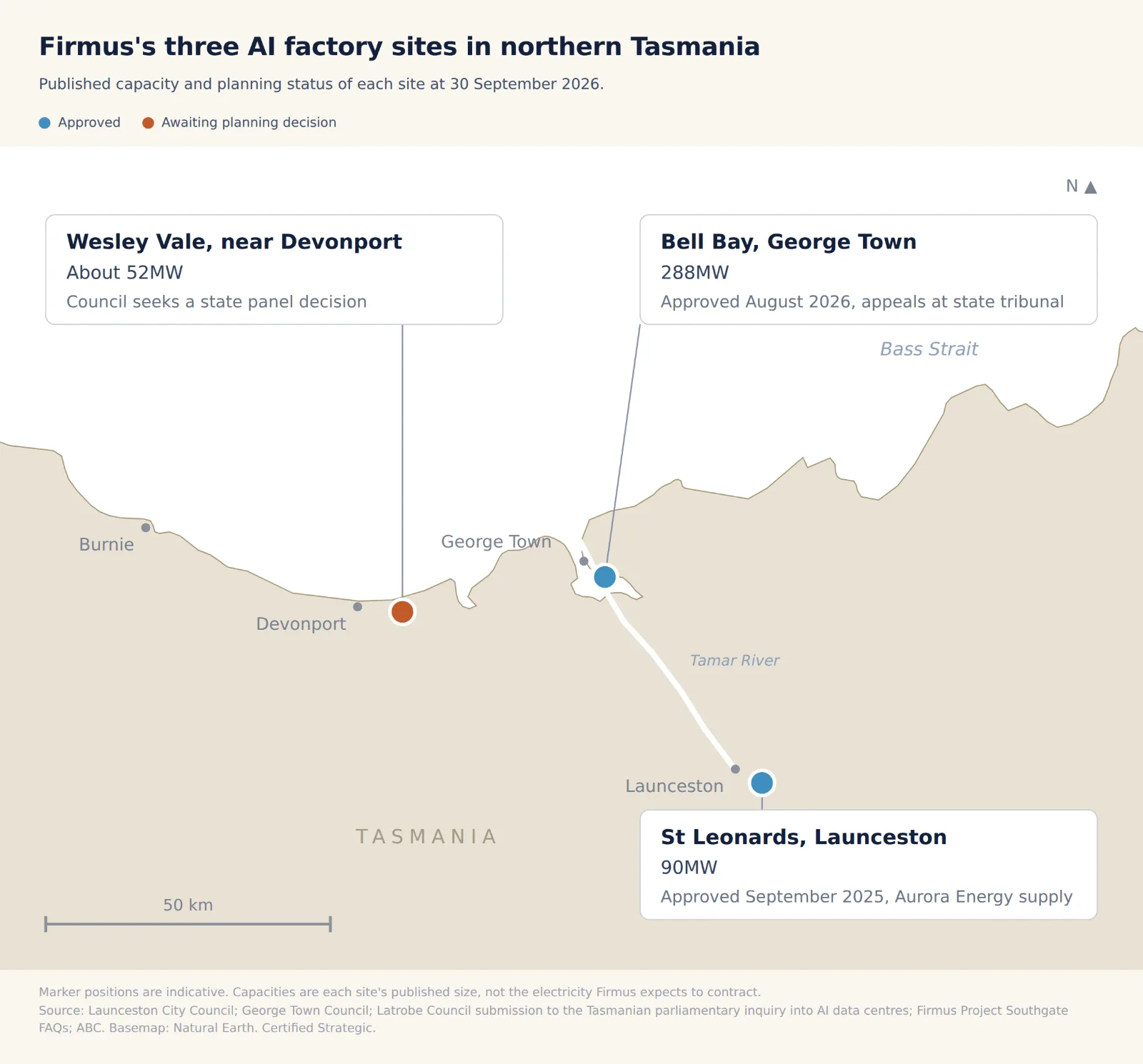
Firmus, one of the neocloud providers in Australia, builds and runs AI factories, data centres designed around dense GPU computing, and has three in Tasmania's north: St Leonards in Launceston, Bell Bay in George Town and Wesley Vale near Devonport. Energy Minister Nick Duigan put the programme at about 400 megawatts in June, two months before Tasmania's AI data centre inquiry opened. In September the ABC reported Firmus had asked Hydro Tasmania for a long-term 450MW contract.
Firmus and Hydro Tasmania now use the same number, 444MW, in separate submissions to parliament. Hydro Tasmania describes it as "a material increase in demand" for a state it says is "at, or close to, annual energy balance", meaning Tasmania generates about as much electricity as it uses over a year. It lists the tests it applies before signing a contract of that size, including the buyer's financial strength and how long the demand will last.
Firmus expects to contract 444MW at full build
"Across our Tasmanian portfolio, we expect to contract for approximately 444 MW of electricity capacity at full build," the Firmus submission states. The sites are not expected to draw that amount continuously. Firmus expects them to run at about 85 per cent of it on average and to use around 3.3 terawatt hours (TWh) of electricity a year.
Each site's approved or proposed size, set out below, measures something different from the power Firmus expects to buy.
Site | Published capacity | Status at 30 September 2026 |
|---|---|---|
St Leonards, Launceston | 90MW | Approved September 2025, supplied by Aurora Energy under a 104MW contract |
Bell Bay, George Town | 288MW | Approved by George Town Council on 25 August 2026; appeals lodged with the state tribunal |
Wesley Vale, Latrobe | About 52MW | Council has asked the planning minister to move the decision to a state panel |
Source: Launceston City Council, George Town Council, Firmus Project Southgate FAQs, Latrobe Council submission to the inquiry, September 2026.
Under its Australian energy policy, Firmus says it will support at least 2MW of new renewable generation for every 1MW it contracts, and its new AI factories aim to use no more than about 15 per cent extra power, for cooling and other building systems, on top of what the computers draw. The submission says the Tasmanian arrangements "have not yet been finalised", and that a grid built on hydro may call for a different mix of new generation and hydro upgrades than states that lean mainly on standalone batteries.
Hydro Tasmania sets out two ways to supply 444MW
Hydro Tasmania frames its assessment around one question, set out in its submission: "Can up to 444 MW of additional demand be supplied in a manner that does not impact reliability of supply to existing customers, delivers appropriate commercial value and positive returns, and appropriately manages risks?"
Tasmania's on-island generation of about 10,700 gigawatt hours a year broadly matches what the state consumes. Hydro Tasmania says the pressure on that balance is sharpest until Marinus Link, the new interconnector to Victoria, opens its first 750MW stage, due in 2030. It also says it "would not enter into a new agreement that adversely affects energy availability to existing Tasmanian customers".
The submission names two models. Under the first, Firmus signs directly with renewable generators and Hydro Tasmania supplies the back-up power when their output falls short. Under the second, Firmus signs with Hydro Tasmania, which then procures the new generation itself and manages how it matches Firmus's demand. Either way, Hydro Tasmania says, additional renewable generation would have to be developed.
Hydro Tasmania also says a contract with it is "not a requirement" for Firmus to grow. Firmus could instead use a third party to fix its power price and help deliver new generation, "which is the approach Firmus has taken with Gunvor Group in South Australia", where it holds a 12-year, 600MW supply agreement. Hydro Tasmania has said it expects an outcome by the end of 2026.
TasNetworks says big new users lower network charges
TasNetworks, which owns the state's high-voltage and local networks, told the committee in its submission that "connecting more load to the transmission network puts direct downward pressure on electricity prices for all Tasmanians". The regulator caps the total revenue TasNetworks can collect from its high-voltage network over each five-year period, so more customers spread a fixed cost further. About 60 per cent of that cost is charged to homes and businesses on the local network, so most of the saving reaches them.
TasNetworks also says a dedicated connection built for one customer is paid for by that customer alone, and that it cannot reserve network capacity for a project until the project has its approvals, its land, its funding secured and a signed connection agreement. It says its existing regulatory obligations give a sufficient framework for connecting large new customers.
Firmus asks for mandatory energy and water reporting
The terms of reference asked the committee to consider mandatory public reporting of how much power and water these facilities use. Firmus supports it. "Firmus would encourage the adoption of a consistent reporting framework for AI and data infrastructure projects through regulation or legislation," its submission states, adding that "mandated reporting standards would give government, Parliament and communities a clearer basis" for checking projects against their forecasts.
That goes further than the state's draft Statement of Expectations of 7 September 2026, which encourages developers to publish energy and water use without compelling them. Firmus's six recommendations also cover reporting to parliament on the sector as a whole, a requirement that large new electricity users support new generation and pay their own network and connection costs, and assessment of each project on its actual impacts through the existing planning system, with no separate approval pathway added.
The submission also gives forecast water use by site. Launceston is modelled to be cooled without water for 97 to 99 per cent of its operating hours and to use about 3.4 million litres a year for cooling. Bell Bay is expected to need about 18.6 million litres a year, with captured rainwater meeting more than half of it.
Bell Bay appeals reach the tribunal as Wesley Vale awaits the minister
Firmus lodged an appeal with the Tasmanian Civil and Administrative Tribunal on 10 September against a Bell Bay permit condition that limits its backup diesel generators to power failures, emergencies and weekday testing, calling the restriction unreasonable for the facility's operating needs. At least five residents of nearby Rowella have lodged separate appeals against the approval itself.
At Wesley Vale, Latrobe Council's submission records that it has asked the planning minister to declare the project a major project, which would move the decision to a state panel, and that no determination had been made when it wrote. On 25 September the council issued Firmus a notice of intention to issue an enforcement notice, asking whether excavation on the site went beyond its approved plan for clearing the land. Firmus agreed to stop the work while the council assessed it, and told the ABC it was general site maintenance and that no main works would start until all approvals were in place.
What to watch
The Firmus float. Reuters reported from a term sheet that the offer to institutional investors runs on 6 and 7 October, with the prospectus lodged on 8 October and trading on the ASX from 22 October. The Firmus prospectus is the next place the 444MW and its supply terms can appear.
The public hearings. The committee is planning hearings, where Hydro Tasmania, TasNetworks and Firmus could be questioned on the two supply models.
Hydro Tasmania's decision. It expects an outcome on the request by the end of 2026.
The Statement of Expectations. Comments on the draft close at 11.59pm on 12 October 2026.