
CBRE forecasts A$57bn Australian data centre market by 2030
By Winston Su, Editor · · Add us as a preferred source on Google
Updated 30 October 2026
At a glance
CBRE forecasts that the part of Australia's data centre market that investors can buy into will be worth A$57 billion by 2030, almost double its value in 2026.
AI is the driver, and CBRE ranks Australia a high-potential market for neoclouds, the GPU cloud companies.
Victoria's share of the market rises from 20 per cent to 29 per cent, nearly tripling in dollars.
Only about a fifth of the roughly 10GW pipeline is under construction, and running plus under-construction capacity almost matches research firm DC Byte's 3.9GW forecast for 2030.
CBRE says secured power increasingly shapes which projects get built, and sites with it may sell at a premium.
CBRE published Australia Data Centres: The Next Phase of Growth on 27 October 2026, its 2026 report on the Australian market. It sizes what CBRE calls the investable market: the data centres, running or under construction, that super funds and other large investors could buy into. The Future Fund and the Commonwealth Superannuation Corporation, for example, hold significant stakes in CDC Data Centres.
CBRE values that market at A$30 billion in 2026. It expects the market to almost double to A$57 billion by 2030 on AI demand, with Victoria taking a much bigger share. "The next phase of growth will increasingly be determined by access to secured power, infrastructure readiness, experienced operators, and creditworthy customers," the report says.
Australia's running and under-construction capacity together almost matches the 3.9GW research firm DC Byte forecasts for the end of 2030. That suggests the 2030 figures rest mainly on projects being built, rather than the much larger pipeline of planned ones.
CBRE attributes the higher forecast to AI demand
The new figure is well above CBRE's last forecast, which in September 2025 had the market reaching A$46 billion by 2029. AI is the driver, CBRE says, along with the AI data centres being built to run it. It expects AI to make up 29 per cent of the world's data centre workloads by 2030, more than double its share in 2025.
Australian data centre operators raised A$35 billion in debt and equity between January and early September 2026, CBRE says, against A$24 billion in all of 2025.
Neoclouds join hyperscalers as a source of Australian demand
CBRE names four sources of Australian data centre demand: hyperscalers, businesses, government, and neoclouds, the specialist cloud companies built around GPU computing for training and running AI models. It ranks Australia among Asia Pacific's high-potential markets for neoclouds because of its established hyperscale base, growing AI demand and potential access to large sites with power.
Its map of likely neocloud locations names Sydney, Melbourne, Brisbane, Perth and Adelaide, and Firmus' sites in northern Tasmania. Those reasons cover the neocloud providers in Australia such as Firmus and Sharon AI, and would apply equally to global GPU cloud companies such as CoreWeave, Nebius and Nscale if they entered Australia.
Australia sits between Asia Pacific's mature and emerging markets
CBRE counts Australia among Asia Pacific's leading data centre markets because it has both a large operating base and a strong pipeline. It is one of the region's five largest markets, with mainland China, Japan, India and Singapore. CBRE places it between mature markets such as Singapore and Hong Kong, which have less room to expand, and emerging markets growing fast from a small base.
CBRE says connectivity, land and an established cloud base used to decide where data centres went, and secured power, land that can scale, buildings designed for AI and confidence a project will be finished have joined them. Sydney and Melbourne are still among the region's fastest-growing established markets, but their next phase will increasingly depend on finding power and large sites outside residential areas.
Victoria's share of the A$57 billion rises to 29%
CBRE expects the investable market to spread beyond New South Wales, whose share falls from 66 per cent to 52 per cent by 2030. Victoria's value grows from about A$6 billion to about A$16.5 billion, nearly three times as much, while New South Wales grows by about half.
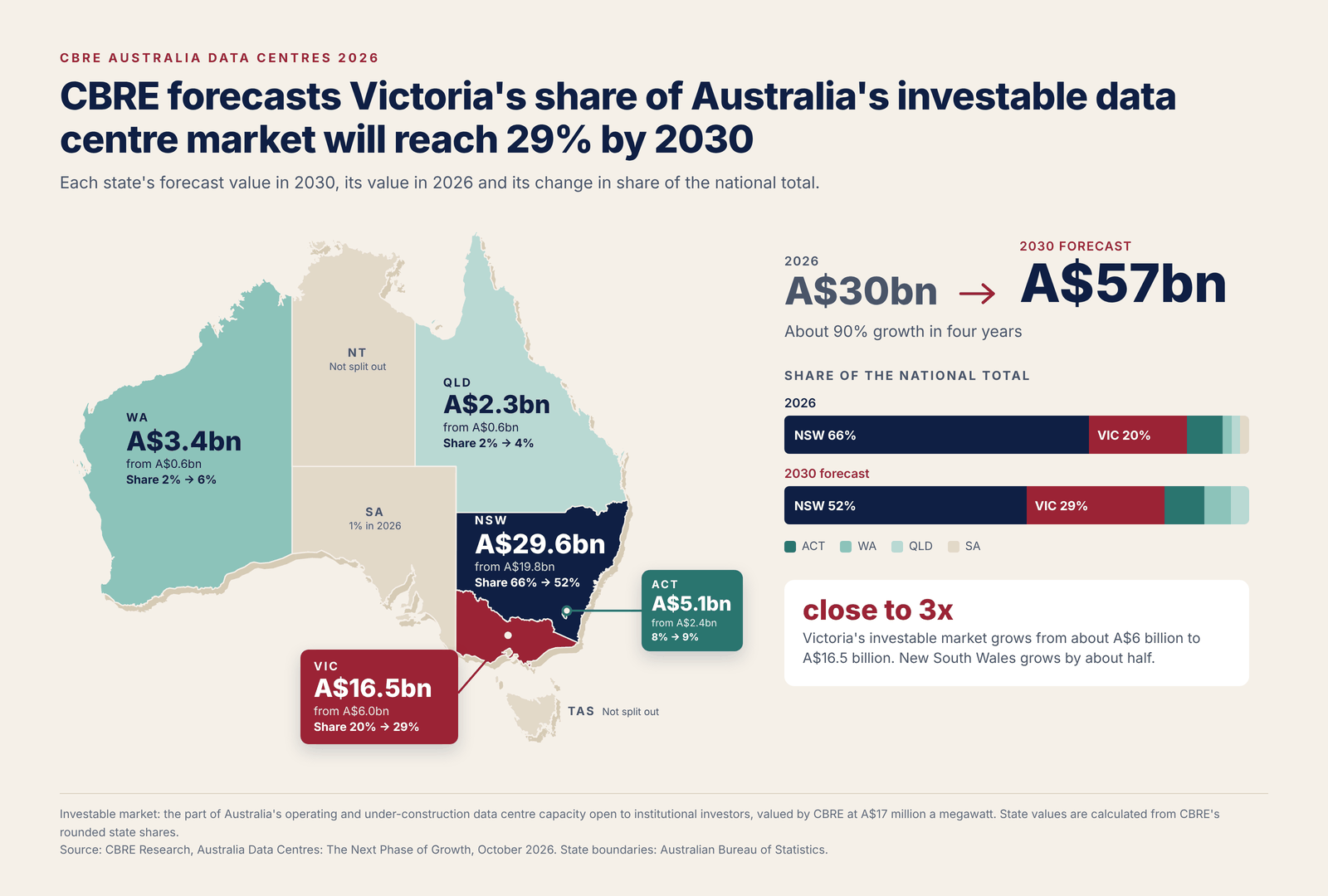
Western Australia's share triples to 6 per cent and Queensland's doubles to 4 per cent. Certified Strategic's predictions for the rest of 2026 named Brisbane as the next city to get a hyperscaler cloud region, with Adelaide second, and will be scored in January 2027.
New South Wales still holds almost double Victoria's share in 2030. Sydney and Melbourne together hold 87 per cent of Australia's data centre capacity, running and planned, on CBRE's figures. CBRE says Melbourne's advantage is larger development sites, and its main hurdles are grid capacity and the timing of new infrastructure.
About 2.2GW is under construction out of a 10GW pipeline
CBRE counts about 1.5GW of data centre capacity running in Australia and about 2.2GW being built. That 2.2GW is only about a fifth of the future capacity in its database, which puts the full pipeline at about 10GW. The other four-fifths are planned or at an early stage.
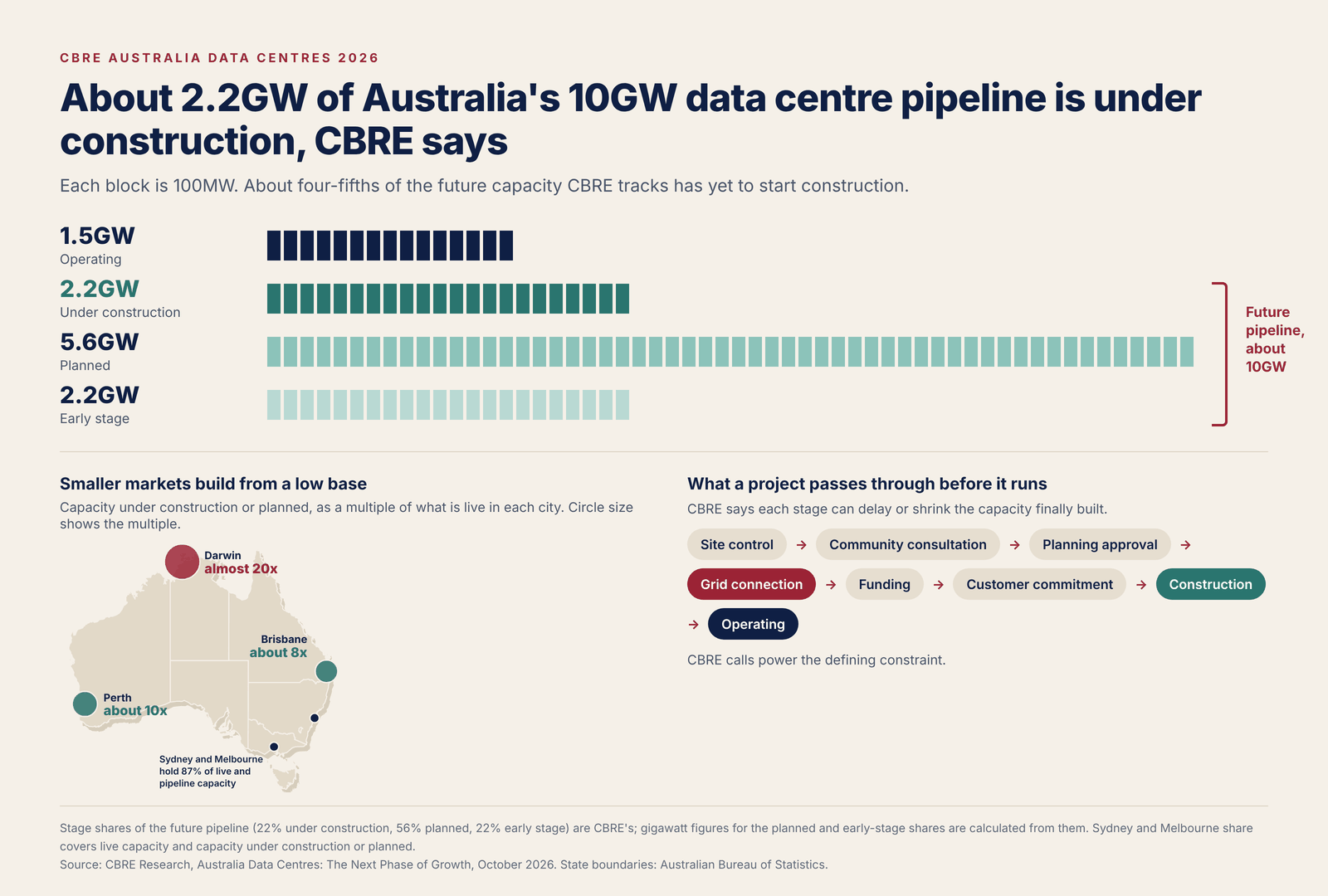
Each project has to clear site control, community consultation, planning approval, a grid connection, funding and a customer before construction starts, and CBRE says any of those steps can delay or shrink it. CBRE's examples of current Sydney campuses include CDC's 504MW Marsden Park and NEXTDC's S7 at Eastern Creek, which could pass 550MW, against 30MW for NEXTDC's earlier S2. CBRE also names the proposed A$7 billion AI campus OpenAI and NEXTDC plan in Western Sydney.
On CBRE's figures, Darwin's pipeline is almost 20 times its current capacity, Perth's about ten times and Brisbane's about eight. In Brisbane and Perth, CBRE says, securing power and customers are the main hurdles. It also names Wagga Wagga, where IREN expects to pay the council more than A$200 million over 30 years for its 900MW Redbank campus.
CBRE's figures sit close to DC Byte's 3.9GW forecast
Consultancy Mandala Partners published research for industry body Data Centres Australia on 25 August 2026. It cites DC Byte's forecast of 3.9GW of data centres in Australia running by the end of 2030. CBRE's running and under-construction capacity adds up to about 3.7GW.
If everything under construction is finished, DC Byte's forecast needs only about 200MW more by 2030, a small slice of the planned pipeline. That fits CBRE's own warning, in its May 2026 Asia Pacific outlook, that Sydney and Melbourne face a supply shortfall of 1.5GW by 2028.
CBRE's A$57 billion counts only the value of buildings investors can own. Oxford Economics, an economic consultancy, forecasts A$224 billion of capital spending on Australian data centres over the five years to 2029-30. Chips, servers and storage make up about half of that spending by 2030, it says.
Data centre power use triples by 2030 on AEMO's forecast
CBRE calls power the defining constraint. The Australian Energy Market Operator (AEMO) expects data centre electricity use to roughly triple by 2029-30 and to rise more than sixfold by 2035-36. New South Wales and Victoria take more than 85 per cent of it on the east-coast grid. CBRE says sites with secured power may sell at a premium.
The Australian Government published its expectations for data centre and AI infrastructure developers in March 2026. In July it proposed standards under which large data centres would underwrite, or guarantee payment for, new renewable generation and pay their own grid connection costs, which CBRE says could raise development costs. New South Wales has committed to assess qualifying projects within 75 days, one of several state data centre policies.
Powered shell yields sit at about 5% to 5.6%
CBRE's yield estimates for Sydney and Melbourne show what investors pay. A yield is the yearly income an investor receives as a share of the price paid, so a lower yield means a higher price.
Investment type | Estimated yield | What the investor owns |
|---|---|---|
Powered shell | About 5% to 5.6% | Building and power connection, leased to an operator for 15 years or more |
Fitted hyperscale facility | About 5.8% to 6.3% | Fully fitted data centre leased to a cloud company |
Fitted colocation facility | About 7% to 8.5% | Fully fitted data centre with space rented to many customers on three to ten-year terms |
Source: CBRE Research, Australia Data Centres: The Next Phase of Growth, October 2026. Yields read from CBRE's chart, assuming modern buildings leased to top-rated tenants.
A powered shell owner collects rent from an operator that fits out and runs the building. A colocation owner runs the facility, replaces its equipment and signs customers on shorter contracts, so investors want a higher yield to own one.
What to watch
The AEMC's grid connection rules for data centres. The Australian Energy Market Commission, the electricity rule maker, plans to publish its final decision on the technical standards large data centres must meet to connect to the grid on 12 November 2026. A draft decision was published in March 2026.
Redbank's scoping report. IREN said it would lodge the first planning document for its Wagga Wagga campus with the NSW planning department at the end of October 2026, starting the state's assessment of the 900MW project.
The Australian Government's standards. CBRE says the July 2026 proposals could affect delivery timelines as well as costs.
Keep reading the market
Get The Strategic Brief in your inbox every Thursday.
The leading Australian data centre and AI infrastructure newsletter.
Your Next Read

Data Centre Jobs in Australia: The 2026 Hiring Landscape for AI Infrastructure State of Play
Australia's new data centre capacity: the 2026 to 2030 guide
Top Data Centres in Australia: 2026 Directory and Market Overview
Latest Headlines
SCX.ai CEO: AI inference doesn't need new data centres
30 Oct 2026Albanese plans a ban on suburban data centres
30 Oct 2026Dover's 200MW South Morang data centre awaits a federal ruling
30 Oct 2026Recycled water pipeline to cool NEXTDC's S4 Sydney
30 Oct 2026NEXTDC drops recycled water at its M4 Melbourne campus
29 Oct 2026
Interested in reaching this audience? Advertise with us.