
NEXTDC drops recycled water at its M4 Melbourne campus
By Winston Su, Editor · · Add us as a preferred source on Google
At a glance
NEXTDC's M4 campus at Fishermans Bend in Port Melbourne is now designed to use no water, the operator told The Australian.
When Victoria approved the A$2 billion campus in January 2026, its design specified recycled water for cooling.
NEXTDC explored a recycled water connection and decided it was not commercially viable.
M4 is among the projects without customer contracts that NEXTDC paused, it told The Australian, after a power delay at its M3 campus cut its FY27 guidance on 21 October 2026.
S7 in Western Sydney dropped recycled water in July 2026, when the pipeline it needed had no planning approval.
NEXTDC has redesigned M4, its A$2 billion campus at 127 Todd Road in Port Melbourne, to run without water. In a statement reported by The Australian, NEXTDC said M4 is now designed to use "high-efficiency, closed-loop air-cooled technology, with no water used", after it decided a recycled water connection was not commercially viable.
The change comes as NEXTDC resets its build program. On 21 October 2026 the operator cut its FY27 guidance after a power delay at M3, its West Footscray data centre, and paused projects not backed by customer contracts. NEXTDC told The Australian that M4 is among them. On 26 October it said chief executive Craig Scroggie would give up his FY27 bonuses and chairman Douglas Flynn would retire once a successor is in place.
M4 follows S7 in Western Sydney, where NEXTDC dropped recycled water in July 2026, in moving to a cooling design that uses no water.
M4 was approved in January with recycled water cooling
NEXTDC announced M4 in June 2025 on the site of the former Westgate Park printing works, and received development approval from the Victorian Government in January 2026. Its approval release described a 162MW campus built around a hyperscale AI factory, and NEXTDC's site page gives 150MW of IT capacity. The release specified direct-to-chip, closed-loop liquid cooling at rack densities of 1,000kW, using recycled, non-drinking water.
M4 was assessed under the Development Facilitation Program, Victoria's accelerated pathway for significant economic projects, and approved in 75 days, The Australian reported. The planning report described the site as well serviced by existing power, water and sewer connections from its industrial past. CitiPower and South East Water did not respond to the referral, and the approval carries standard permit conditions so their requirements can be met at detailed design.
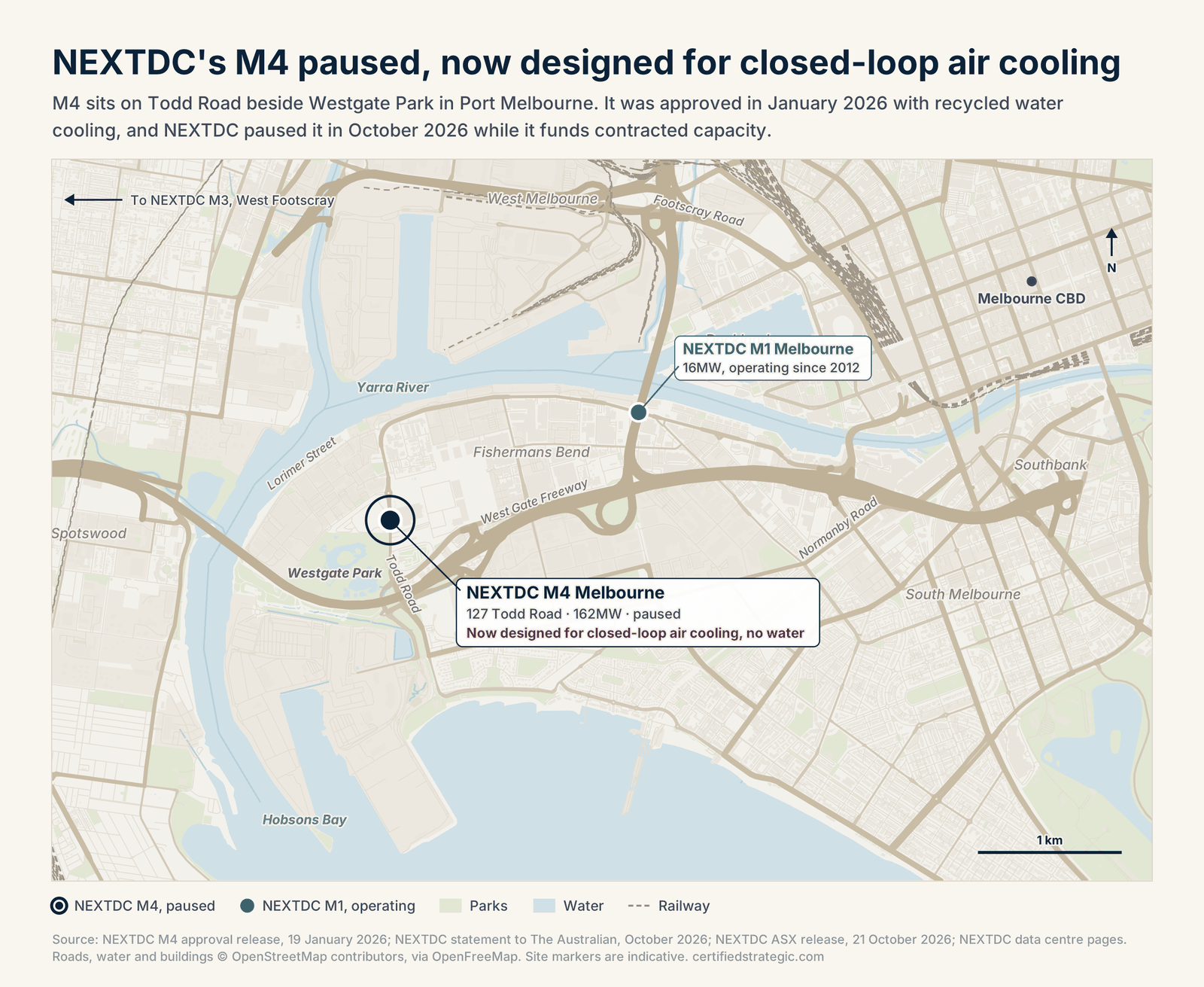
NEXTDC found recycled water was not commercially viable at M4
NEXTDC said it explored a recycled water connection for M4 and did not proceed with a commercial deal after deciding it was not commercially viable. "Assessing available utilities and cooling technologies is a standard part of NEXTDC's design process, with the objective of delivering an efficient solution while minimising water use and environmental and social impacts," the operator said.
S7 dropped recycled water because the pipeline was not approved
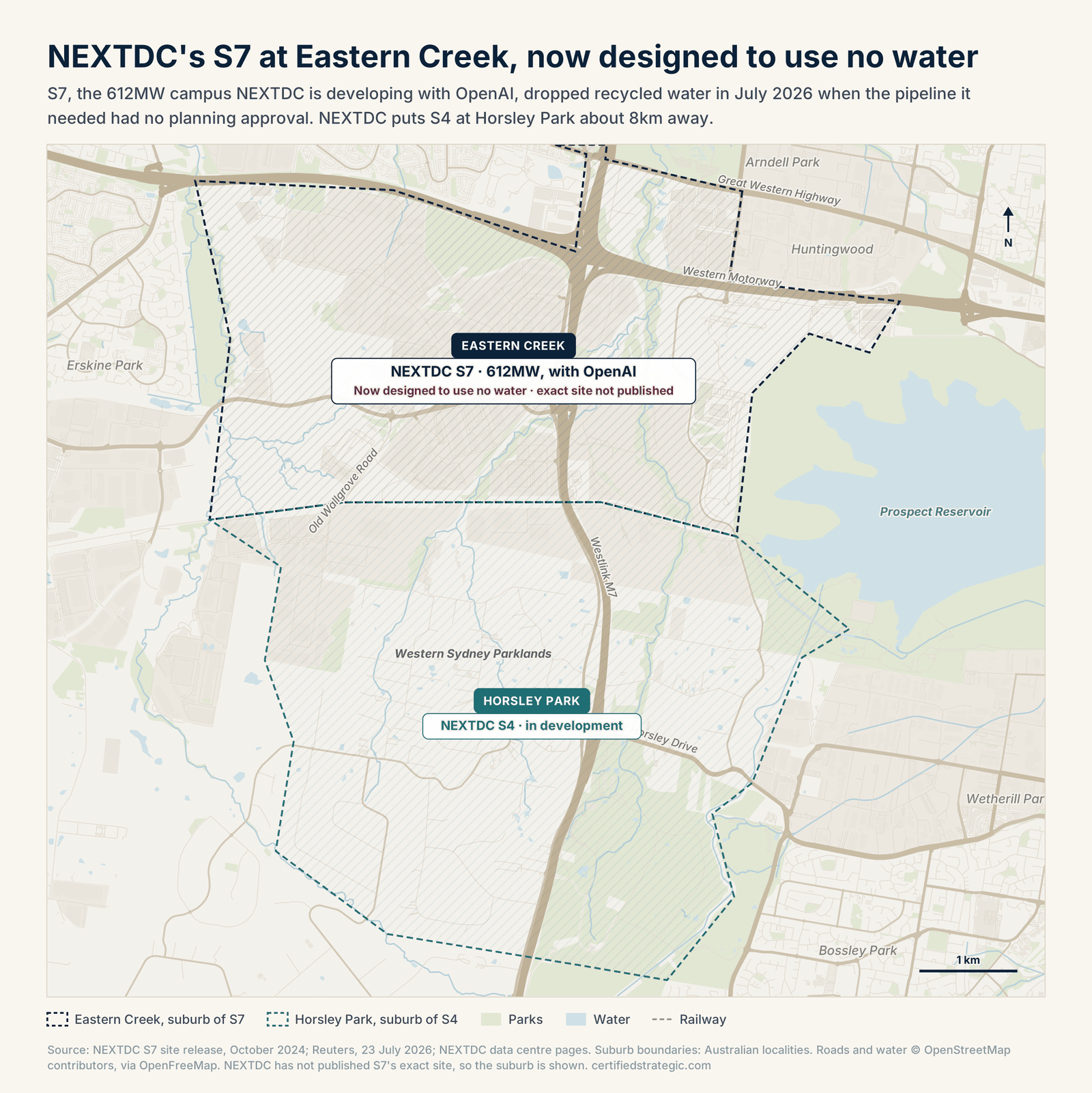
At S7, the 612MW campus at Eastern Creek that NEXTDC is developing with OpenAI, NEXTDC moved to a waterless design in July 2026 after it could not secure planning permission for the pipeline that would have carried recycled water to the site, Reuters reported. S7 circulates liquid coolant to the chips and fans the heat away, which experts told Reuters draws more electricity than the evaporative cooling recycled water would have supported.
At S7 the pipeline was not approved; at M4 the commercial terms did not stack up. NEXTDC's existing data centres in Australia use evaporative cooling, with a water usage effectiveness of 2.40 litres per kilowatt-hour in the year to June 2026, up from 2.25 a year earlier, Reuters reported. In western Melbourne, AWS has signed with Greater Western Water to cool a data centre on recycled water from the day it opens.
Victoria's new rules send cooling to recycled water
Victoria's Sustainable Data Centre Action Plan, published on 22 September 2026, expects data centres that use water-intensive cooling to meet cooling needs from recycled or other non-drinking sources and to pay the full cost of connecting to them. Its design water-use limit, 1.0 litres per kilowatt-hour on drinking water or 1.6 on non-drinking water, applies to new data centres generally. M4 was approved in January 2026, eight months before the plan was published.
NEXTDC is putting its capital behind contracted capacity
"With M3 revenue deferred, we have paused projects not backed by customer contracts and put that capital behind the capacity our customers have already contracted," Scroggie said when NEXTDC cut its FY27 guidance. Demolition at the M4 site has been under way in 2026, The Australian reported.
What to watch
The capital review. NEXTDC has committed to announcing the outcome of its capital expenditure review by its annual general meeting on 20 November 2026.
Development site sales. NEXTDC's board will look at selling selected development sites that are not needed in the near term.
Keep reading the market
Get The Strategic Brief in your inbox every Thursday.
The leading Australian data centre and AI infrastructure newsletter.
Your Next Read

Data Centre Jobs in Australia: The 2026 Hiring Landscape for AI Infrastructure State of Play
NEXTDC enters trading halt over M3 Melbourne power delay
NEXTDC puts 1,200MW on M5 and targets a nine-month build
Latest Headlines
Power Rankings: CDC tops Australia’s data centre operators
28 Oct 2026AirTrunk raises A$4.25 billion and plans A$75 billion more in Australia
27 Oct 2026SCX.ai joins SpaceX's Grok partner network
27 Oct 2026NVIDIA GPU rental prices set to stay high into early 2027
27 Oct 2026Australian AI companies pay 6% to 10% on GPU loans
27 Oct 2026
Interested in reaching this audience? Advertise with us.