
AirTrunk raises A$4.25 billion and plans A$75 billion more in Australia
By Winston Su, Editor · · Add us as a preferred source on Google
At a glance
AirTrunk announced on 27 October 2026 that it had raised A$4.25 billion to keep building SYD3, its data centre campus in Western Sydney.
The release says AirTrunk has spent more than A$12 billion on its Australian projects and will invest a further A$75 billion over the next decade. Bouygues Construction published the same figure in July as €48 billion.
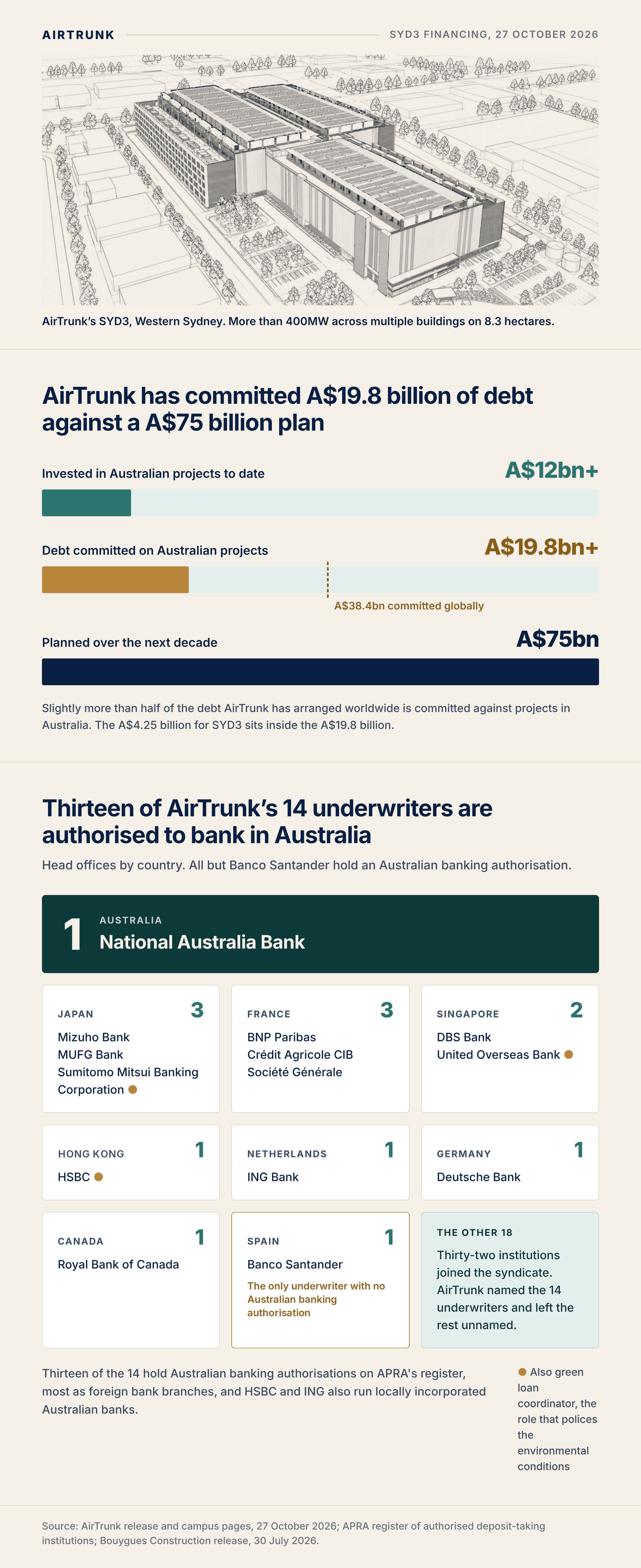
Thirty-two financial institutions joined the loan. AirTrunk named 14 as underwriters, of which National Australia Bank is the one Australian-headquartered name.
Commonwealth Bank and Westpac sit in the 19-name lead group on STACK's A$8.585 billion Melbourne loan, which launched into syndication a fortnight before SYD3 closed.
AirTrunk said on 27 October 2026 that it had raised A$4.25 billion from 32 financial institutions to continue building SYD3, the data centre campus it is expanding in Western Sydney. AirTrunk structured it as a green loan, so the interest rate moves with agreed environmental targets, and the company says any savings go to its community program.
The same release says AirTrunk has invested more than A$12 billion across its Australian projects and will put in a further A$75 billion over the next decade. AirTrunk raises that money largely campus by campus, with a different group of lenders on each, alongside platform-wide refinancings such as the one it closed in August 2025.
Bouygues Construction published the A$75 billion figure on 30 July
Bouygues Construction announced on 30 July 2026 that its Australian subsidiary A W Edwards had won the expanded SYD3 contract, and set out AirTrunk's Australian spending alongside it: more than €6.4 billion invested across four sites, with a further €48 billion expected for the country over the next decade. Bouygues footnoted those as A$10 billion and A$75 billion at its June 2026 reference exchange rate, which works out at 1.5625 for both.
The A$75 billion first appeared in euros, in Bouygues' release, and AirTrunk has now stated it in dollars. At that pace the program averages about A$7.5 billion a year, though AirTrunk has not said how it splits by campus, by state or by year, or how much it intends to borrow.
A W Edwards is building SYD3 under a contract worth about A$1.9 billion
Bouygues valued the contract at about €1.2 billion, roughly A$1.9 billion, with works scheduled to begin that month. AirTrunk says construction is underway and both companies expect completion by mid-2028. AirTrunk puts the construction effort at more than 10,000 jobs; Bouygues says it takes the jobs the project supports to 10,000.
AirTrunk says it bought from 1,436 suppliers across the Asia Pacific in FY26, 615 of them Australian, and that Australian supplier work came to A$3.4 billion. AirTrunk runs a 25,000 square metre buffer zone in Western Sydney where equipment is stored, staged and pre-commissioned before it goes to the campus, and charters dedicated ships into Port Botany and Port Kembla.
The 14 banks that underwrote the loan
Thirty-two financial institutions joined the syndicate, the arrangement in which a group of lenders shares one large loan to a single borrower. AirTrunk named the 14 that underwrote it, committing to the full A$4.25 billion up front before selling portions to the rest: Banco Santander, BNP Paribas, Crédit Agricole Corporate and Investment Bank, DBS Bank, Deutsche Bank, ING Bank, Mizuho Bank, MUFG Bank, National Australia Bank, Royal Bank of Canada, Société Générale, Sumitomo Mitsui Banking Corporation, HSBC and United Overseas Bank. Sumitomo Mitsui, HSBC and United Overseas Bank also took the green loan coordinator role, policing the environmental conditions.
All but Banco Santander hold Australian banking authorisations on APRA's register of authorised deposit-taking institutions, most of them as foreign bank branches, and HSBC and ING run locally incorporated Australian banks as well. AirTrunk's own description is "32 local and international financial institutions", and it left the other 18 unnamed.
AirTrunk calls the group one of the largest assembled for a data centre financing in Australia, a claim about the number of banks involved rather than the size of the loan. Counted by lead or underwriting group, SYD3 sits third among the deals in this table. AirTrunk used the same wording for JHB2 in July, calling that group one of the largest assembled for a data centre financing in Malaysia.
Financing | Date | Lead or underwriting group |
|---|---|---|
STACK, A$8.585bn, Melbourne | October 2026 | 19 names |
AirTrunk JHB2, US$2.325bn, Johor Bahru | July 2026 | 10 global coordinators and 5 underwriters |
AirTrunk SYD3, A$4.25bn, Western Sydney | October 2026 | 14 underwriters |
NEXTDC, A$1.8bn company-wide loan | May 2026 | 8 lead banks |
STACK MEL01, A$1.3bn, Melbourne | July 2025 | 5 lead banks |
Source: AirTrunk, NEXTDC and STACK announcements, and Debtwire for the STACK Melbourne syndication. Total syndicate sizes are published less often: AirTrunk gave 32 for SYD3 and 30 for JHB2, and more than 60 for its A$16 billion refinancing of August 2025, which covered assets in four countries.
Commonwealth Bank and Westpac are lead banks on a larger Melbourne campus loan
The Australian majors have long lent to data centres at company level, and they are now lined up for single-campus lending at a scale above SYD3. NEXTDC's A$1.8 billion loan of 5 May 2026 named eight lead banks, four of them Australian: ANZ, Commonwealth Bank, National Australia Bank and Westpac, alongside ING, Mizuho, MUFG and HSBC's Sydney branch. ANZ, Commonwealth Bank and NAB had also led NEXTDC's A$2.2 billion facility of 18 June 2025.
STACK Infrastructure then launched an A$8.585 billion five-year green loan into syndication on 13 October 2026 for a four-building Melbourne campus, with Commonwealth Bank and Westpac among 19 lead names, according to debt market news service Debtwire. Allocation and signing are scheduled for 27 November 2026. It went to market a fortnight before SYD3 closed, and at A$8.585 billion it is the larger of the two.
ING, Mizuho, MUFG and HSBC appear in both groups, leading NEXTDC's loan and underwriting AirTrunk's, so the foreign branches and the Australian majors are lending side by side. The older single-campus deals ran without the majors: STACK's Melbourne green financing of 23 July 2025 named Deutsche Bank, MUFG, Natixis, Oversea-Chinese Banking Corporation and Société Générale.
Firmus then went outside the banks altogether, raising a US$10 billion debt facility in February 2026 led by funds managed by Blackstone with Coatue. So in a single year Australian capacity has drawn money from an international bank syndicate, from the Australian majors and from private credit. The lenders committed in a month when the equity market turned on the sector: NEXTDC's shares fell 42 per cent after it cut FY27 guidance over power delays at M3, and Firmus withdrew its ASX listing application.
Data centres took 17 per cent of Australia's new syndicated lending in 2026
A Reserve Bank staff note by Bradley Speed, published on 23 September, counted at least A$35 billion raised by Australian data centre operators so far in 2026, on data to 8 September, against A$24 billion for all of 2025 and an annual average of A$4.6 billion from 2020 to 2024. Syndicated loans supplied A$25 billion of the 2026 figure, and the sector took 17 per cent of all new syndicated lending in Australia, up from 6 per cent a year earlier. Speed treats his estimates as a lower bound.
Lenders charge the sector close to what other companies pay. The median margin on these loans since 2024 has been 1.85 percentage points over the benchmark rate, against 1.75 points for other non-financial corporations, which the Reserve Bank calls in line with each other. It says that may reflect tenants committing to capacity before it is built. The full breakdown also records a further A$13 billion of syndicated loans announced in 2026 and still to complete. Bloomberg reported AirTrunk in the market for the SYD3 loan from June, so it may sit inside that A$13 billion.
Speed gives amounts and pricing. Lender names appear only where borrowers publish them: AirTrunk named 14 of its 32, and STACK's Melbourne group runs to 19. The rest of the market sits in the data centres in Australia directory.
SYD3 is the largest of AirTrunk's five Australian campuses at more than 400MW
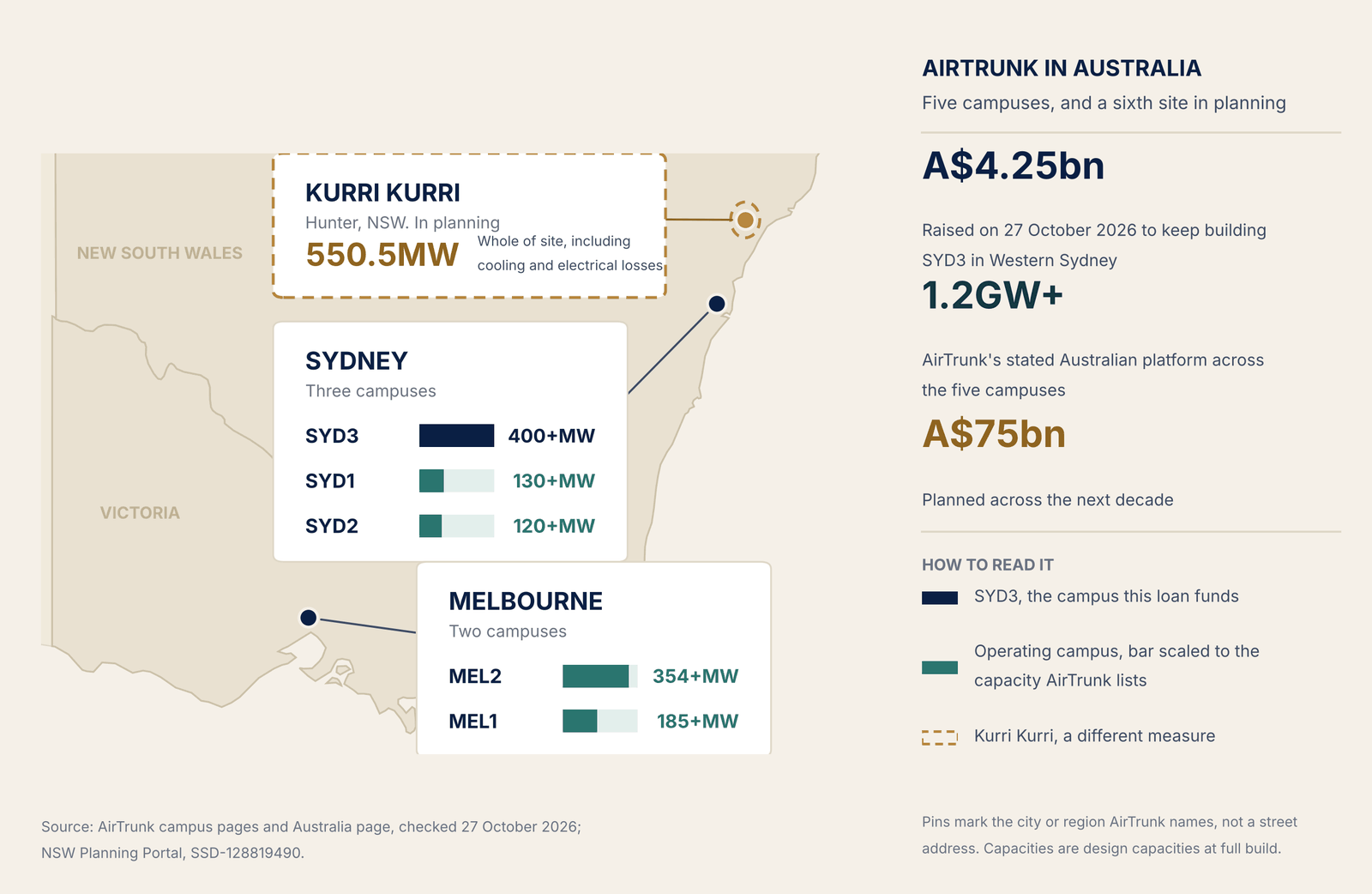
AirTrunk lists SYD3 at more than 400MW across multiple buildings on 8.3 hectares, and its campus page calls the site Asia Pacific's largest hyperscale data centre by megawatts.
AirTrunk has supply agreements with distributors for SYD3 and has signed two partners to build a large-scale battery storage system beside the campus, AirTrunk vice-president for origination and market expansion Tom Mackellar told The Australian on 27 October 2026, describing power in the major cities as "supply constrained". The battery project is a separate arrangement from the loan.
AirTrunk puts its Australian platform at more than 1.2GW across the five. A sixth site is in planning on the former aluminium smelter at Kurri Kurri in the NSW Hunter, lodged under the state planning pathway for large projects as SSD-128819490 and open for public comment until 11 November 2026. The NSW planning portal records it at 550.5MW, covering the whole site including cooling and electrical losses, and a capital investment value of A$3.71 billion.
AirTrunk publishes no megawatt figure of its own for Kurri Kurri and has put a draft offer of more than A$37 million in local infrastructure contributions to Cessnock City Council. The Australian Financial Review reported on 22 September 2026 that Anthropic is in advanced talks to anchor that campus, with nothing formalised. SYD3 and SYD1 both sit in the Western Sydney corridor, and all three Sydney campuses are plotted on the Sydney data centre map.
What to watch
STACK's Melbourne signing, 27 November 2026. Signing the A$8.585 billion loan with Commonwealth Bank and Westpac in the lead group would confirm the majors in single-campus lending at the largest size yet seen in Australia.
Kurri Kurri, 11 November 2026. Public comment on the Hunter proposal closes, and the next stages are response to submissions, then assessment. The financing group for that campus is the direct test of who funds AirTrunk's next Australian build.
Bank results, November 2026. NAB, Westpac and ANZ report full-year results, and any disclosed data centre exposure line would put a number against lending the sector shows only through its borrowers.
AirTrunk's committed debt. Facilities committed on Australian projects now exceed A$19.8 billion of about A$38.4 billion globally, so slightly more than half of what AirTrunk has arranged worldwide sits against projects here, and the A$75 billion implies it keeps climbing.
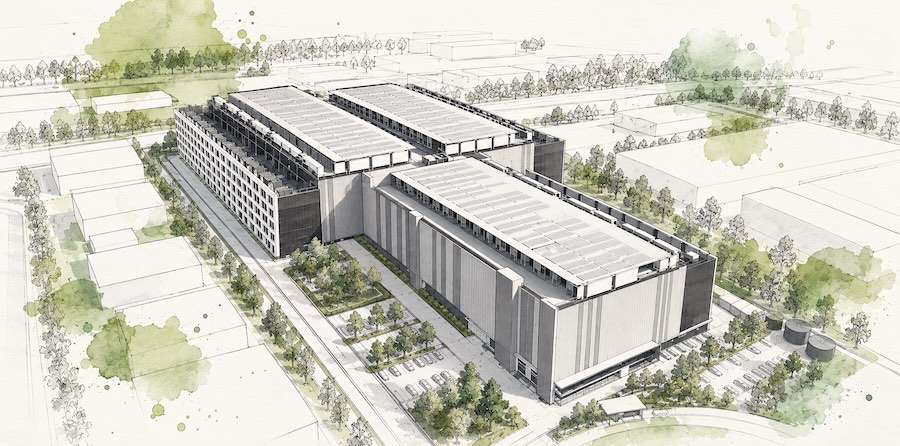
Hero image: AirTrunk render of SYD3 (stylised).
Keep reading the market
Get The Strategic Brief in your inbox every Thursday.
The Australian data centre week, every figure sourced.
Your Next Read

Japan's data centres: 3.8GW live, US$8bn AirTrunk bet

Australia’s AirTrunk readies Singapore’s biggest float since 2017

AirTrunk's Johor PUE target hit 1.37 as water rules tightened
Latest Headlines
SCX.ai joins SpaceX's Grok partner network
27 Oct 2026NVIDIA GPU rental prices set to stay high into early 2027
27 Oct 2026Australian AI companies pay 6% to 10% on GPU loans
27 Oct 2026Four predictions for Australia as NVIDIA puts AI factories in containers
26 Oct 2026NEXTDC renews its board and Scroggie forgoes FY27 bonuses
26 Oct 2026
Interested in reaching this audience? Advertise with us.