
Australian AI companies pay 6% to 10% on GPU loans
By Winston Su, Editor · · Add us as a preferred source on Google

At a glance
SpaceX announced an approximately US$40 billion lease of NVIDIA chips on 26 October 2026, under which an Apollo-managed company buys the chips and SpaceX rents them for about five years.
Australian neoclouds, which own GPUs and rent them out, borrow to buy their chips and pay about 6 to 10 per cent a year.
The customer renting the chips largely sets the price, and IREN pays the lowest rate, about 6 per cent, on chips rented to Microsoft.
Lenders protect themselves by holding the chips as security, lending only part of their cost and being repaid from the rental contracts.
Wall Street banks and private credit funds do most of the lending, and Macquarie Bank is the first Australian bank publicly named as a GPU lender.
SpaceX said on 26 October 2026 it had secured an approximately US$40 billion lease of NVIDIA's next-generation Vera Rubin chips, the graphics processing units (GPUs) that train and run AI models, in a deal led by Apollo and Goldman Sachs that the company described as "the largest committed GPU financing". Under the arrangement, a company managed by Apollo will buy the chips and lease them to SpaceX, which pays rent every quarter from delivery in the first half of 2027. Unite.AI reported, citing SpaceX's filing, that the rent repays the cost of the chips over about five years with interest on top, and the Apollo-managed company owns the chips while SpaceX leases them.
SpaceX is investing heavily in new computing capacity, TechCrunch reported, and chief financial officer Bret Johnsen said the lease "diversifies our funding sources" and covers a notable portion of the funding its growth plans require.
Australian companies finance their GPUs on the same principle and on a far smaller scale. Instead of leasing, they borrow to buy the chips and pledge them to the lender, and the rent from their customers repays the loan. The borrowers on record are neoclouds, the specialist companies whose business is owning GPUs and renting them to AI customers, and whose main assets are the chips and their contracts with customers. The largest technology companies, including Alphabet, Amazon and Meta, have instead sold bonds backed by their whole business to fund their AI spending, Reuters reported.
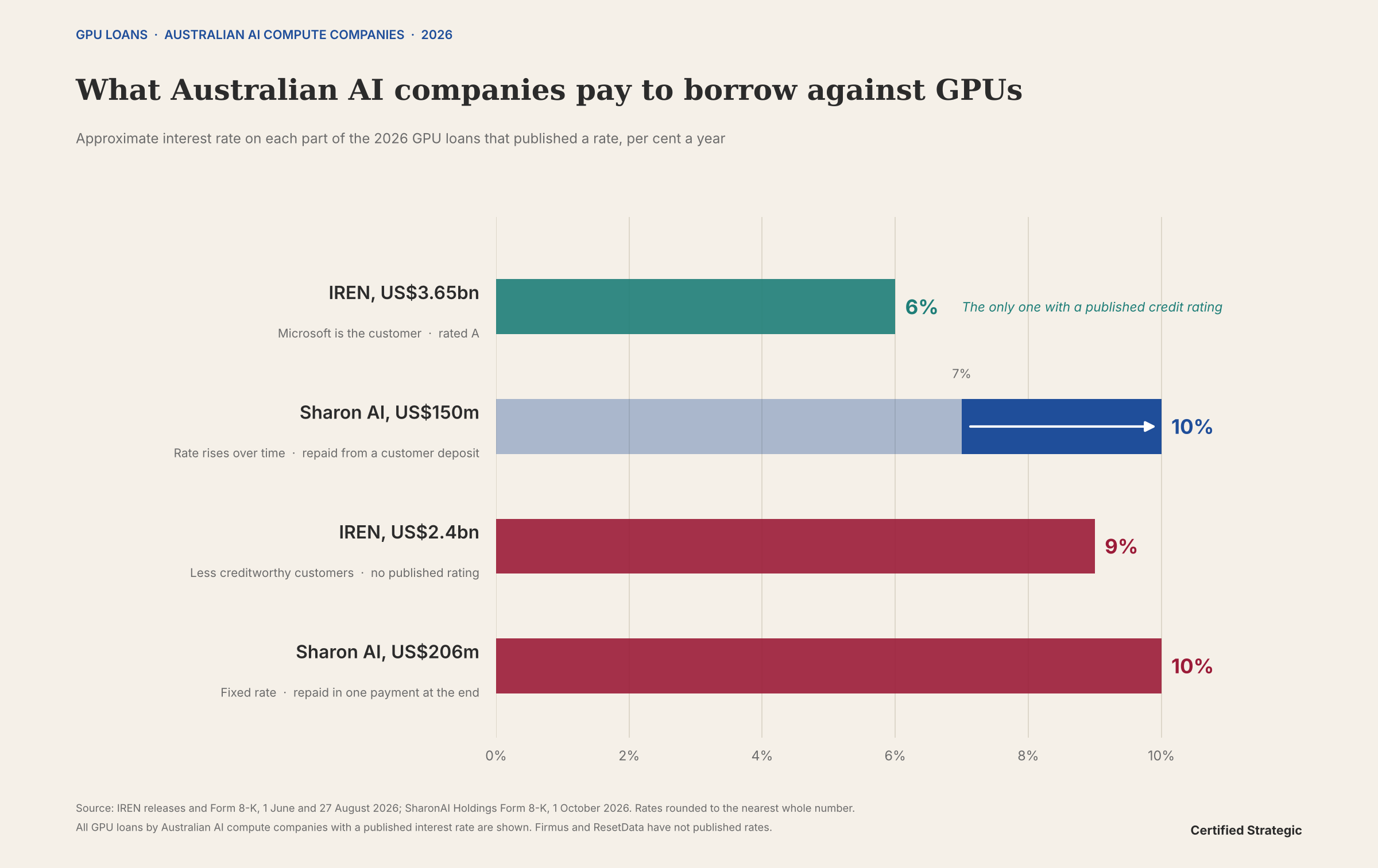
Three Australian neocloud loans from 2026 have published interest rates, from about 6 to 10 per cent a year, and the customer renting the chips largely decides where each loan falls. IREN, the Sydney-headquartered AI cloud company, pays about 6 per cent on chips rented to Microsoft and about 9 per cent on chips rented to less creditworthy customers. We expect the next Australian GPU loans backed by a large technology company or AI lab as the customer to be priced close to IREN's 6 per cent, because lenders price these loans on the customer that pays the rent.
Lenders hold the chips as security and are repaid from rent
Sharon AI set out how its business works in its annual report for 2025. A customer signs a contract to rent computing power for three to five years and pays part of the contract value up front. Sharon AI then orders the GPUs, which typically arrive within two to three months, and the customer starts paying monthly once the chips are running. After the first contract ends, Sharon AI expects to keep earning from the chips by renting them out again until they are about six years old, which depends on GPU rental prices holding up.
Lenders pay for the chips and are repaid from the rent. They take the chips and the rental contracts as security, meaning they can take over the chips and sell them at used GPU prices if the borrower stops paying. Sharon AI's US$356 million loan, signed on 28 September 2026, comes in two parts, which the chart shows separately. Sharon AI expects to repay some of the first part early from a customer's deposit, once that customer confirms the GPUs are running, and the rest of the loan in one payment after three and a half years.
Lenders also limit how much they lend against each chip. IREN's loan tied to its Microsoft contract, closed on 1 June 2026, covers nearly two-thirds of what the GPUs cost, with Microsoft's advance payments covering most of the rest. NVIDIA also offered a further safety net in July, agreeing to rent back unused GPUs at a fixed rate in return for a share of cloud revenue, and DatacenterDynamics named Firmus and Sharon AI among the first companies to take up the offer. The Wall Street Journal reported in late August that NVIDIA had paused some of those deals; NVIDIA says the model is still in place.
IREN borrows at about 6% against chips rented to Microsoft
IREN's loan tied to Microsoft carries an A rating from ratings agency Fitch, a grade that signals a low risk of default. Its next loan, at about 9 per cent, was described in its FY26 results as "supporting non-investment grade customer deployments", meaning customers with weaker credit ratings. The second loan also covers a bigger share of what the chips cost, which leaves lenders less of a cushion if something goes wrong. Both loans fund GPUs that IREN operates in North America.
Sharon AI's loan supports an unnamed customer contract and costs up to about 10 per cent, near the top of the range. All of these rates sit well below the close to 15 per cent that bond investors demanded to lend to US GPU cloud company CoreWeave in mid-October 2026.
Blackstone, Goldman Sachs and private credit funds lend to Australian neoclouds
Goldman Sachs, one of the two firms that led the SpaceX lease, arranged IREN's Microsoft loan with J.P. Morgan. It also lends to Sharon AI, alongside what Sharon AI's own release calls "select large private credit funds", investment funds that lend directly to companies. Investment firms Blue Owl and Pacific Investment Management Company (PIMCO) led IREN's 9 per cent loan, and funds managed by Blackstone led Firmus's US$10 billion debt financing, announced on 9 February 2026.
Banks in Australia and Taiwan fund GPU purchases
Macquarie Bank is the first Australian bank publicly named as a GPU lender, having agreed an A$165 million facility to fund ResetData's NVIDIA GPU purchases, announced on 13 August 2026. Law firm Allens, which advised ResetData, called it the first financing of its kind in Australia. Australian banks lend far more against the data centre buildings that house the chips, and a Reserve Bank staff note counted at least A$25 billion of loans shared among groups of banks to Australian data centre operators in 2026 to early September.
In Taiwan, CTBC Bank led a loan of about US$440 million to the Taiwan arm of GMI Cloud, a US company that rents out NVIDIA GPUs, which announced the loan on 30 September 2026. Loan-market publication IFR reported that the loan is capped at 55 per cent of the value of GMI's contracts with NVIDIA, which has agreed to lease any unused capacity for up to six years.
What to watch
Sharon AI's next loans. Sharon AI says its US$356 million loan is the first in an expected series supporting its plan to deploy more than 68,000 NVIDIA GPUs by mid-2027. Each loan it prices publicly will test whether a named, highly rated customer brings its borrowing cost closer to IREN's 6 per cent.
The US decision on GPU rental futures. The US Commodity Futures Trading Commission has extended its review of exchange operator CME Group's planned futures on GPU rental prices to 9 November 2026. Futures would let GPU owners lock in their rental income in advance, the money that repays these loans.
NVIDIA's financing agreements. NVIDIA signed memorandums of understanding on 10 August 2026 with six financial firms, including Apollo, Blackstone and Goldman Sachs, to mobilise over US$500 billion for its customers. The agreements were signed as memorandums of understanding, not final contracts, and two of the six, Goldman Sachs and Blackstone, lend to Australian GPU owners.
Keep reading the market
Get The Strategic Brief in your inbox every Thursday.
The Australian data centre week, every figure sourced.
Your Next Read
Australian AI providers have named 17 buyers, four onshore

Nscale is two years old and wants US$30bn from New York
Citadel unwinds 80% of its Situational Awareness risk
Latest Headlines
Four predictions for Australia as NVIDIA puts AI factories in containers
26 Oct 2026NEXTDC renews its board and Scroggie forgoes FY27 bonuses
26 Oct 2026Anthropic in talks for a second US$45bn Nscale deal
23 Oct 2026Data centre construction costs: how Australia compares with Asia
23 Oct 2026NVIDIA says DSX POD can deploy AI factories in 14 days
22 Oct 2026
Interested in reaching this audience? Advertise with us.