At a glance
A used eight-GPU NVIDIA A100 server, a 2020 design, sold for about US$84,000 in September 2026, a fifth more than a year earlier.
The same server sold for US$180,000 in September 2024, so the past year's rise follows a fall of 61 per cent.
Sharon AI and ResetData have both signed loans in 2026 secured on their NVIDIA chips.
One-year rental rates for H100 chips rose about 40 per cent between October 2025 and March 2026, NVIDIA says.
Australia has no published second-hand GPU price series, so the price data lenders can see comes from overseas.
Can Elbi, a partner at Swiss wealth manager Prio Partners, posted a chart on 3 October 2026 from Epoka, a Danish firm that buys and resells used data centre hardware, showing what second-hand NVIDIA AI servers have sold for since September 2024. Elbi presents the chart, built from more than 200 sales, as evidence that graphics processing units (GPUs), the NVIDIA chips inside AI data centres that build and run AI models, keep their value for five or six years and can therefore be borrowed against. Australian AI compute companies have started doing that in 2026, so used-chip prices now bear on their loans.
A used A100 server sold for US$84,000 in September 2026, up 20 per cent in a year. Two years earlier it had fetched US$180,000. The price rebounded after a steep fall, as NVIDIA's newest Blackwell chips stayed in short supply and older chips stayed in use running trained AI models. A lender holding GPUs as security has to assume what they would fetch if it ever had to sell them, and Australia has no second-hand GPU market of its own to take that number from.
Australian AI companies now use their GPUs as loan security
Sharon AI, one of the neocloud providers in Australia that rent GPUs to AI customers, signed a US$356 million facility on 1 October with Goldman Sachs and private credit funds, "secured against GPUs and associated cash flows". It followed a facility of up to US$500 million from GPU lender USD.AI in January. Macquarie Bank signed A$165 million of short-term finance for ResetData's NVIDIA chips, announced on 13 August. The larger facilities at Firmus and IREN are tied mainly to signed customer contracts, and those contracts are the lender's first source of repayment.
The nearest published resale data comes from overseas: Epoka, the Danish firm behind the chart, serves the region from Singapore. Law firm Gilbert + Tobin noted in April that commercial banks "particularly in Australia" had yet to lend materially against AI compute, four months before Macquarie Bank signed with ResetData.
NVIDIA is carrying some of that risk itself. In July it launched a revenue-sharing model with Firmus and Sharon AI as its first partners, under which it agreed to rent back unused GPUs at a fixed rate in return for a share of their cloud revenue. Under its US$500 billion financing program, announced on 11 August, it offered to support up to 25 per cent of a deal's residual value, the resale value a lender assumes the chips will hold when the loan ends.
A100 server prices rose 20 per cent in the year to September 2026
Epoka's chart tracks the sale price of eight-GPU NVIDIA servers across three generations: the A100 from 2020, the H100 from 2022 and the H200 from 2024. Epoka trades eight-GPU servers built by several makers to NVIDIA's reference design.
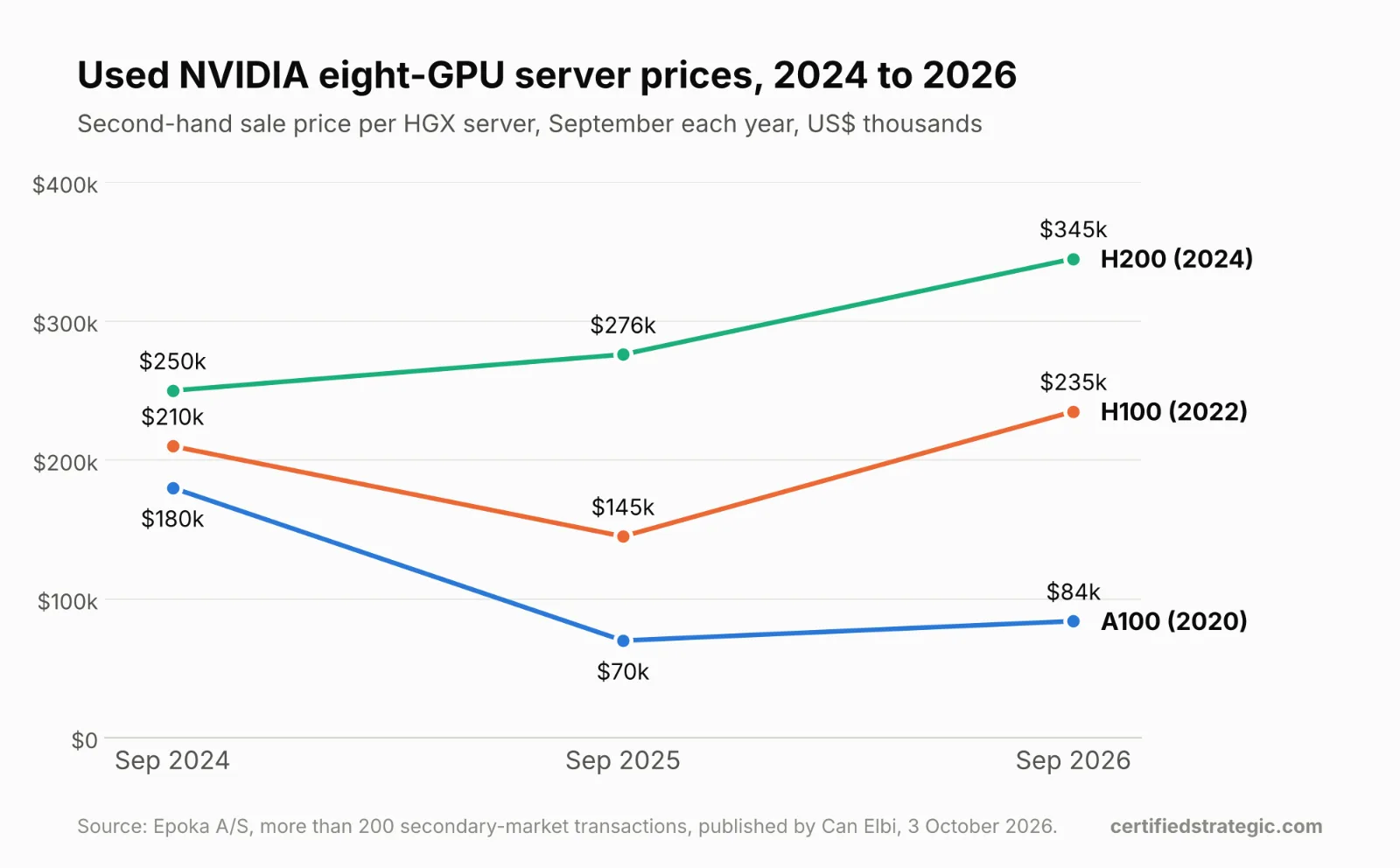
The A100 server fell from US$180,000 to US$70,000 in the year to September 2025, then rose 20 per cent to US$84,000. The H100 followed the same path on a shorter cycle, down 31 per cent in the year to September 2025 and then up 62 per cent to a price above where it started. Only the H200, still a current product, rose in both years. The DGX A100, NVIDIA's own version of the server, launched at US$199,000. The latest sale is 42 per cent of that. Elbi puts it at 56 per cent of original cost without naming the base he used.
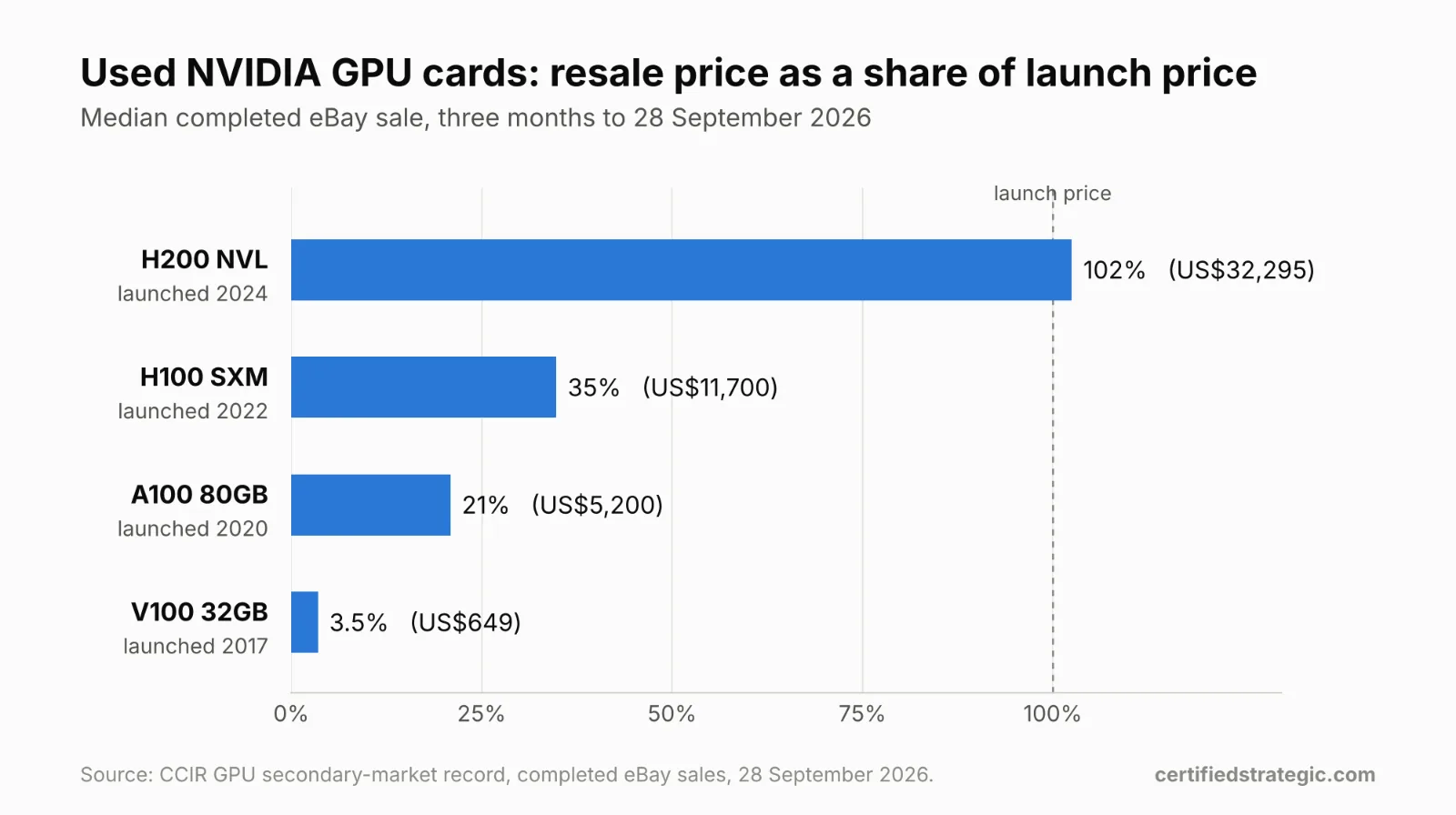
A single card sells for far less than its share of a working server. CCIR, which tracks completed eBay sales, puts the median A100 card at US$5,200 over the quarter to 28 September 2026. The card has kept about a fifth of its launch price. Eight A100 cards at that price come to about US$41,600, half what the whole server fetched, because buyers pay more for a tested, working machine than for its parts. Epoka's own guidance for sellers says A100 cards that are three to four years old "commonly" fetch "around 15 to 30 percent" of original value.
H100 rental rates rose about 40 per cent from October 2025
Rental rates moved the same way as hardware prices, and lenders can watch them daily. NVIDIA said one-year rental contracts for an H100 cost about US$1.70 an hour in October 2025. By March 2026 they cost about US$2.35. Silicon Data publishes a daily index of hourly H100 rental prices. Its reading for specialist AI cloud providers stood at US$2.82 on 6 October 2026. In December 2025 it was US$2.00.
Silicon Data traced the first jump, in December and January, to the largest cloud providers, such as AWS and Microsoft, putting capacity booked under long-term contracts first, which left little for everyone else. NVIDIA said on 11 August 2026 that the A100 "remains in active commercial use for AI training, fine-tuning, inference and high-performance computing" six years after its launch.
Australian rental prices are mostly private. AWS does not offer the 80GB A100 in any Australian region. Micron21, a Melbourne host, lists it at A$4.49 an hour, excluding GST.
What to watch
The Firmus prospectus. Firmus plans to list on the ASX in late October 2026 at A$11 a share, and its prospectus accounts will show how many years Firmus assumes its chips stay useful, across a fleet planned at 2 million GPUs.
Sharon AI's next facility. The company says more GPU-backed financings will follow, and their terms will show how lenders are pricing GPU security in Australia.
The national research computer. The National Computational Infrastructure runs 776 GPUs, 640 of them V100s, a 2017 design. Its refresh tender closed on 31 July 2026, and the award will show whether it buys current Blackwell chips or the older H100 and H200 chips that have regained value.
The rental indices. Silicon Data publishes its H100 index daily, and a fall back below US$2.50 an hour would be the first sign that the 2026 rise was a passing Blackwell shortage.