
NVIDIA GPU rental prices set to stay high into early 2027
By Winston Su, Editor · · Add us as a preferred source on Google
At a glance
NVIDIA's AI chips are renting for 9 per cent to 143 per cent more than they would if they had lost value steadily over six years, an Andreessen Horowitz chart shows.
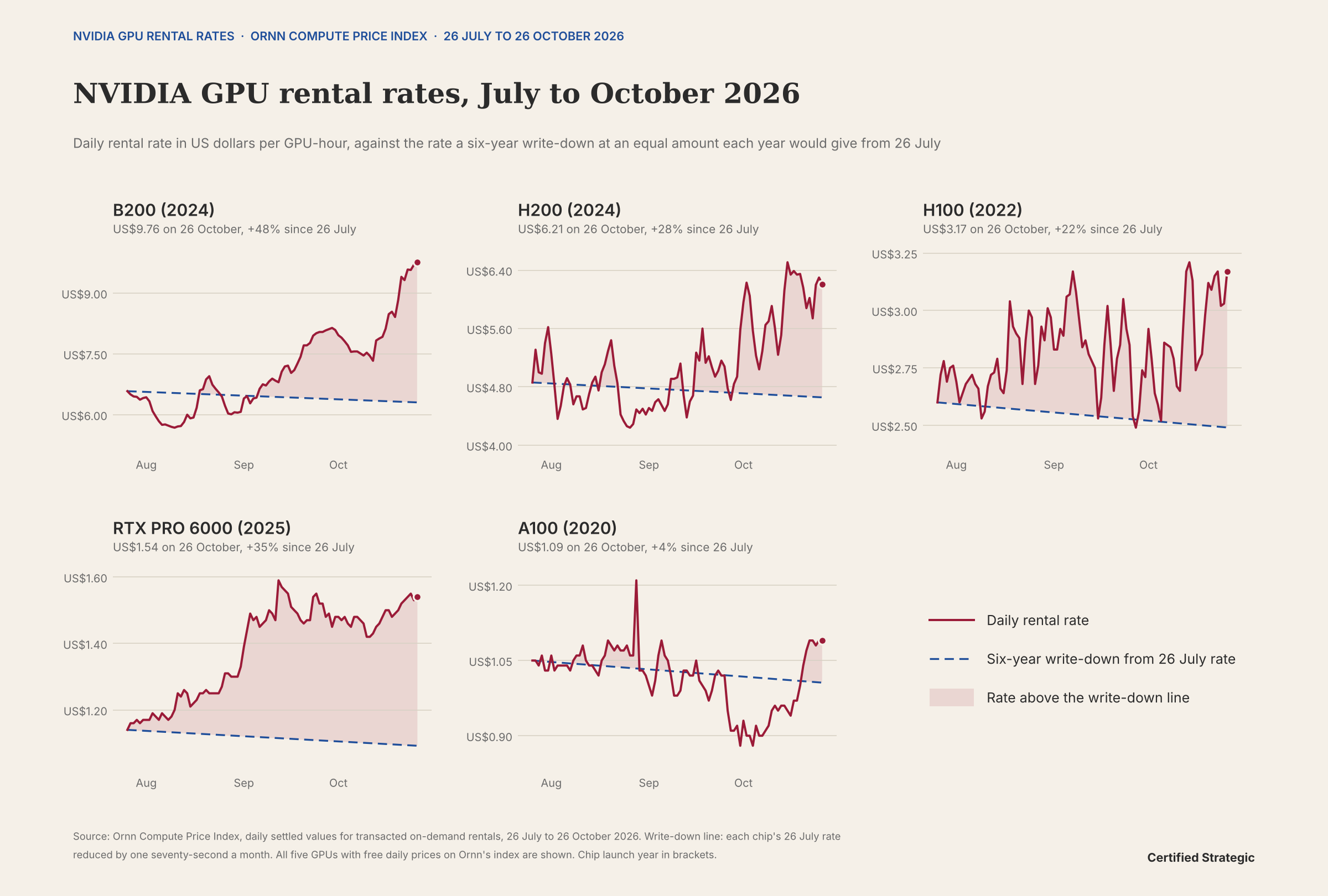
Renting a B200 cost US$9.76 an hour on 26 October 2026 on the Ornn Compute Price Index, a daily index of GPU rental prices, up 48 per cent since 26 July.
NVIDIA expects chip supply to stay tight at least until early 2028, and has price increases taking effect from February 2027.
The largest GPU deployments announced in Australia use NVIDIA's newest chips, including Firmus's contract for about 18,400 GB300s in Melbourne.
Higher rental rates support what Australian GPU owners such as Sharon AI can charge when their current contracts end, and what their chips would fetch if sold.
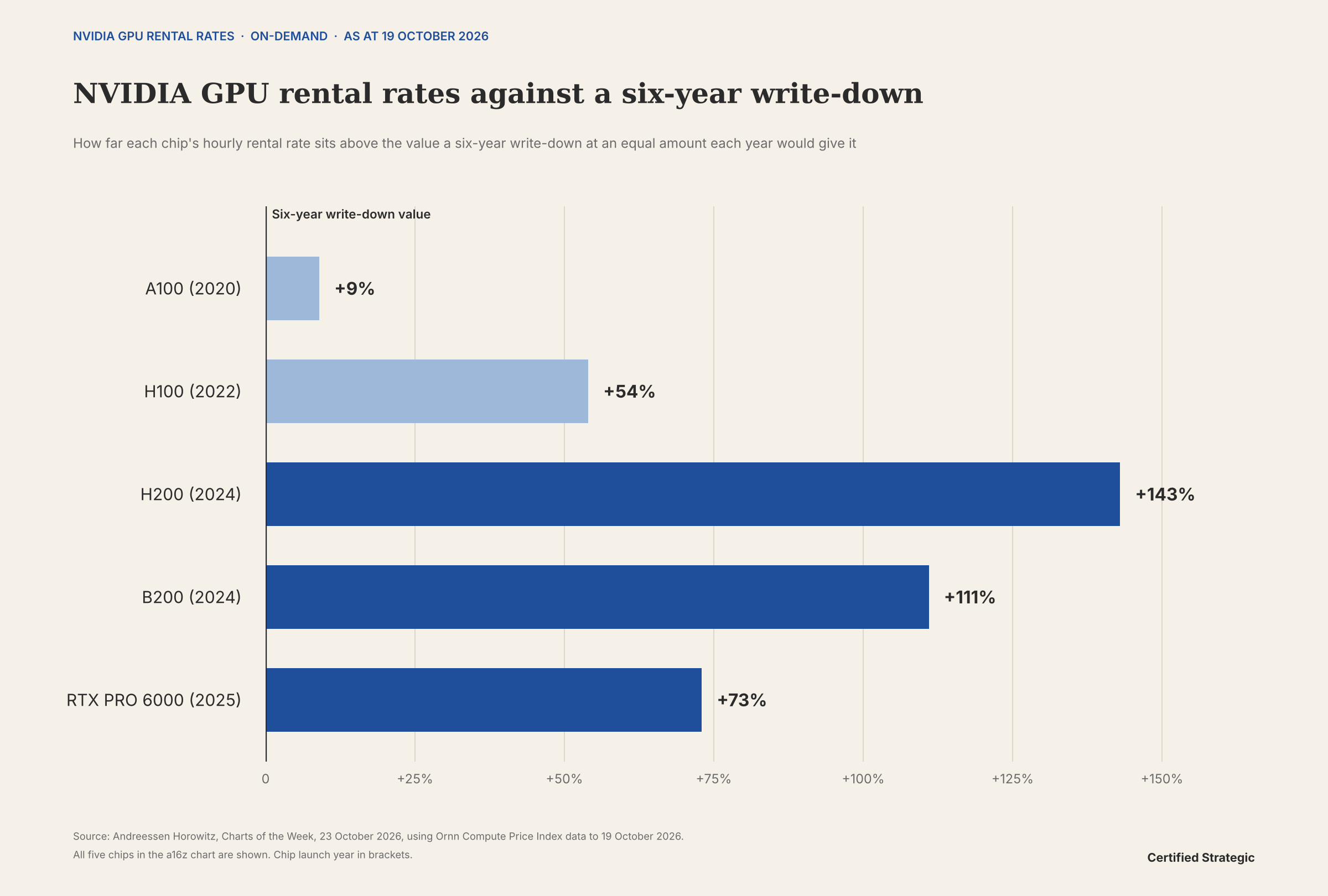
Companies that own NVIDIA's AI chips write down their value every year, on the expectation that newer chips make them worth less. In 2026 the price to rent them has gone the other way. US venture capital firm Andreessen Horowitz (a16z) published a chart on 23 October 2026 covering five NVIDIA graphics processing units (GPUs), the chips that train and run AI models inside AI data centres. Every one rents for more than it would if it had lost an equal share of its value each year over six years, and prices for used GPU servers have also rebounded. Australian companies that own GPUs and borrow against them need those rental rates to hold as NVIDIA's newer chips arrive.
Rental rates for all five NVIDIA chips with free daily prices on the Ornn Compute Price Index rose in the three months to 26 October 2026. NVIDIA expects chip supply to stay tight into 2028, and research firm TrendForce expects the price of the memory packed beside each AI chip to more than double in 2027. The bigger test comes after March 2027, as NVIDIA's next chip, Vera Rubin, reaches renters in volume. Until then, we expect:
The B200's monthly average on Ornn's index stays above US$7.50 an hour through March 2027, because tight supply keeps new Blackwell capacity scarce and NVIDIA's price increases from February 2027 make it dearer.
The H100's monthly average on Ornn's index stays above US$2.60 an hour through March 2027, because dearer new servers give renters less reason to swap an H100 for a newer chip.
The H200 rents for 143% above its six-year write-down value
The H200 rents for 143 per cent more than a six-year write-down would put it, the widest gap of the five chips a16z charted, as at 19 October 2026. The B200, NVIDIA's 2024 Blackwell chip, is 111 per cent above its line, and the 2020 A100 is 9 per cent above.
a16z's Moses Sternstein, who wrote the analysis, said April 2026 "is when things really took off", and tied the rise to token demand, the volume of text AI models read and write for users, which began climbing steeply that spring. He wrote that over their longer history "the older A100s and H100s spent more time below the line than above it".
a16z led Ornn's US$33 million seed round in June 2026. Ornn's index tracks hourly rentals and, under its methodology, excludes long-term contracts, but contract prices have risen too. NVIDIA said on 11 August 2026 that one-year H100 rentals rose about 38 per cent between October 2025 and March 2026, to about US$2.35 an hour.
B200 rental rates rose 48% in three months
On Ornn's index, B200 rental rates rose from US$6.58 an hour on 26 July to US$9.76 on 26 October 2026. The RTX PRO 6000, NVIDIA's 2025 workstation and server chip, rose 35 per cent, the H200 28 per cent, the H100 22 per cent and the A100, the oldest, 4 per cent.
The largest GPU deployments announced in Australia use NVIDIA's newest chips. Firmus has a contract for about 18,400 GB300s to be deployed at its Melbourne AI factory, Sharon AI is deploying a 1,000-GPU B200 cluster at NEXTDC's M3 data centre in Melbourne, and ResetData's Melbourne AI factory runs on H200s. Ornn's free index covers the B200 and H200, while its GB300 prices are open only to paying subscribers.
On 22 July 2026, prediction market Kalshi, which lets traders take positions on GPU rental prices, published its traders' expected prices for the months ahead. They showed A100, H100 and H200 rates "flat into 2027" and the B200 expected "to cheapen to $5.5 from the current ~$7.2 per hour" as more Blackwell chips came into service. Kalshi's GPU markets generally settle on Ornn's index, and the B200 averaged US$8.26 an hour on that index from 1 to 26 October, well above the price traders expected.
NVIDIA expects supply to stay tight until at least early 2028
NVIDIA chief financial officer Colette Kress told investors on 26 August 2026 that "we expect supply to remain a bottleneck at least through the end of fiscal year 2028", meaning NVIDIA's financial year to January 2028. On the second-quarter results call, she said NVIDIA had begun production shipments of Vera Rubin, its next chip platform after Blackwell, in August 2026. She expected it to be "the fastest product ramp in NVIDIA's history".
Kress said growth from the largest cloud companies would pick up again "as supply of Vera Rubin grows over time". Until Vera Rubin reaches renters beyond those companies, demand stays on the H100, H200 and B200.
Some of NVIDIA's biggest customers face server price rises above 15%
NVIDIA has price increases taking effect in the quarter starting February 2027, as memory gets dearer. Kress said on the August call that memory prices "are headed even higher into next year", meaning 2027. Bloomberg reported on 22 August 2026, as summarised by TrendForce, that NVIDIA would raise prices by more than 15 per cent for some of its biggest customers on Vera Rubin and Grace Blackwell servers shipped in early 2027.
TrendForce forecast on 29 September 2026 that the price of high-bandwidth memory, the stacked memory packed beside each AI chip, would rise 121 per cent in 2027 and stay in short supply all year. Dearer new servers make it more expensive for a renter to move off older chips, which supports their rental rates.
Sharon AI needs rental rates to hold when its GPU contracts end
Sharon AI's customer contracts typically run three to five years, so higher hourly rates do not lift its income until those contracts end. Rates matter for chips not yet under contract, for the price at re-contracting, and for what the chips would fetch if they were sold.
Sharon AI told investors in its annual report for 2025 that it expects its GPUs and network equipment to keep earning for "approximately 6 years". After the first contract, it can re-contract the chips "at potentially lower rates", sell the computing time by the hour, or move older GPUs to its own service that runs trained AI models for customers. That plan depends on rental rates for older chips holding up in their fourth to sixth years.
Sharon AI, Firmus and IREN, three neocloud companies that rent out GPU computing, have each signed loans in 2026 to pay for GPUs, and IREN's and Sharon AI's are secured on the chips. Lenders are repaid from the rent that customers pay, and they lend only part of what the chips cost. IREN's loan tied to its Microsoft contract covers nearly two-thirds.
Sharon AI's lenders test the size of its US$356 million GPU loan every quarter against the value of its servers. The loan agreement sets that value as what Sharon AI paid for the servers less straight-line depreciation, so a fall in rental rates does not by itself move the test. In August 2026 Macquarie Bank became the first Australian bank publicly named as a GPU lender, agreeing an A$165 million facility to fund ResetData's NVIDIA GPU purchases.
What to watch
The B200 and H100 monthly averages. We expect the B200 to stay above US$7.50 an hour and the H100 above US$2.60 on Ornn's index through March 2027. Their October averages to 26 October were US$8.26 and US$2.91.
The US decision on GPU futures. The US Commodity Futures Trading Commission has extended its review of exchange operator CME Group's planned H100 and B200 rental futures, based on research firm Silicon Data's index, to 9 November 2026. Futures fix a price for a future month, so once they trade they show what the market expects H100 and B200 rents to be. Silicon Data's B200 index stood at US$6.63 an hour in late October 2026, well below Ornn's, so the two benchmarks do not yet agree on the B200. Exchange operator ICE has published terms for similar contracts on Ornn's index, with no listing date set.
NVIDIA's results for the quarter to 25 October 2026. Vera Rubin's share of revenue, and any update on when supply loosens, indicate how quickly the new chips reach renters beyond the largest cloud companies.
Keep reading the market
Get The Strategic Brief in your inbox every Thursday.
The Australian data centre week, every figure sourced.
Your Next Read

NEXTDC's A$2.2 Billion Capital Plan and Sharon AI: What the Raise Means for Australia's Neocloud Tenant Base

Sharon AI's Sovereign GPU Cluster at NEXTDC M3: A Neo Cloud Deep Dive
Sharon AI's 100MW target: where the extra 30 to 50MW lands across NEXTDC's network
Latest Headlines
Australian AI companies pay 6% to 10% on GPU loans
27 Oct 2026Four predictions for Australia as NVIDIA puts AI factories in containers
26 Oct 2026NEXTDC renews its board and Scroggie forgoes FY27 bonuses
26 Oct 2026Anthropic in talks for a second US$45bn Nscale deal
23 Oct 2026Data centre construction costs: how Australia compares with Asia
23 Oct 2026
Interested in reaching this audience? Advertise with us.