At a glance
Australia's AI factory builds now have two outside reference points: a joint building spec from Google, NVIDIA, AMD and Meta, and an NVIDIA list of approved batteries and cooling units.
The building spec, first published by Google in December 2025 for its own TPU chips, lists all four companies as authors in the version effective 27 August 2026.
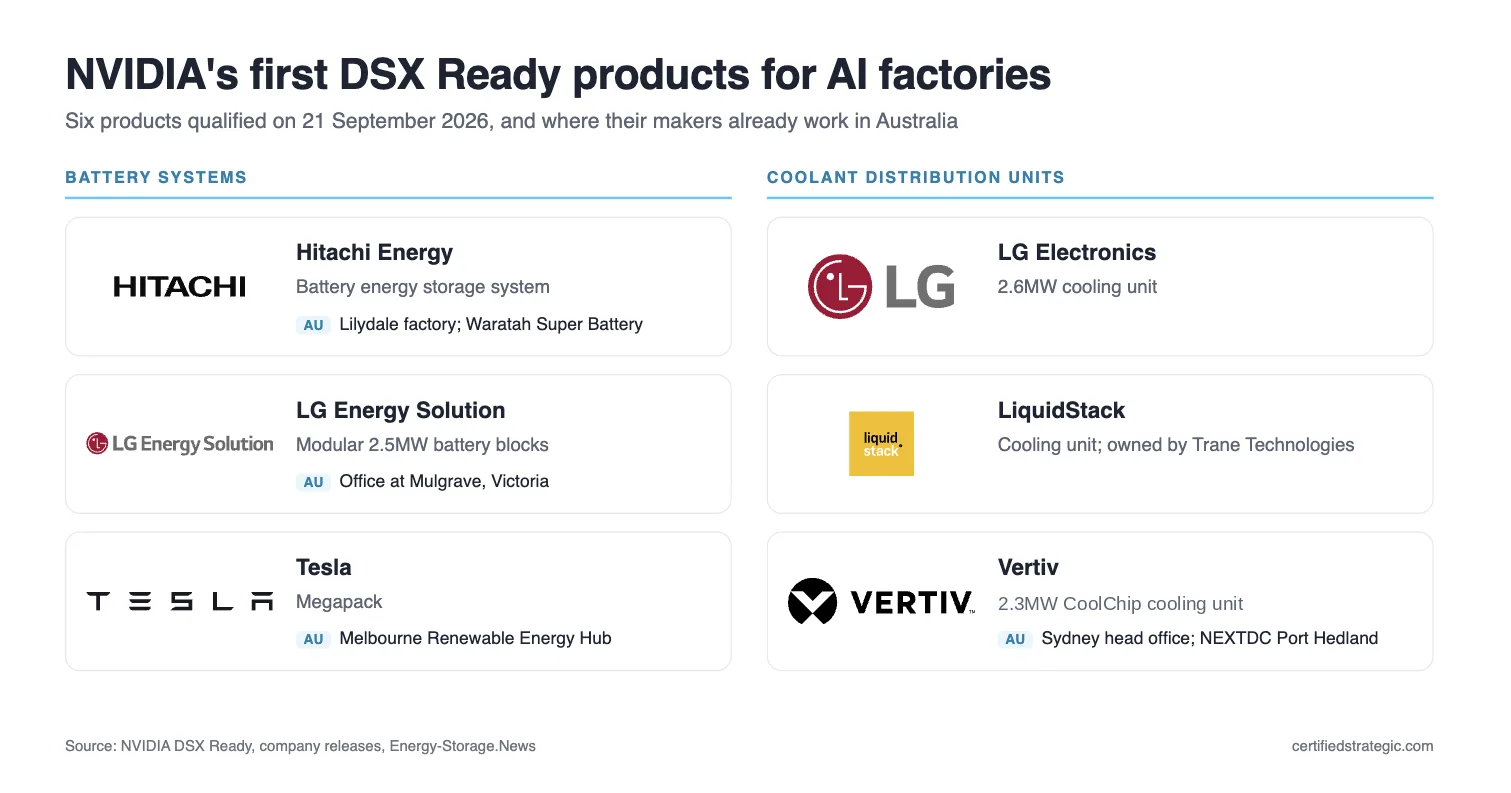
NVIDIA's DSX Ready list, launched 21 September, approves battery systems from Hitachi Energy, LG Energy Solution and Tesla, and cooling units from LG Electronics, LiquidStack and Vertiv.
Vertiv, Hitachi Energy and Tesla already have Australian grid or data centre projects on the record, including a 2024 edge build for NEXTDC at Port Hedland.
NVIDIA tests an approved battery only up to the point where it hands power to the site, so the risk of making it work on an Australian campus sits in contracts.
NVIDIA launched DSX Ready on 21 September, an approval stamp for specific pieces of power and cooling equipment used in AI factories, the data centres built to run large clusters of its chips. Twelve days earlier it named eight Australian partners for up to 2 gigawatts of AI factory capacity by 2027, from operators of data centres in Australia to GPU cloud providers.
Until August the design rules for these buildings came from two directions. Google published a facility specification through the Open Compute Project (OCP), the industry body where the large cloud companies share hardware designs for others to use, and wrote it for its own TPU chips. NVIDIA's reference designs start from its GPU racks and work outward to power and cooling.
Google's building spec now carries NVIDIA, AMD and Meta as co-authors, and NVIDIA is approving the batteries and cooling units that go inside. Its battery approval ends where the battery connects to the site, so the risk of making it work on each Australian campus sits in construction and supply contracts.
Google's building spec now lists NVIDIA, AMD and Meta as co-authors
Version 0.5.0 of OCP's Datacenter: Next-Generation ML Infrastructure Design Principles, dated 25 February 2026, had five Google authors. It "enables the deployment of Google's TPU Systems and can be expanded to include industry GPU systems".
Version 0.7.0, effective 27 August, lists AMD, Google, Meta and NVIDIA as authors. Its change note describes "collaborative 2027–2028 guidance unified across AMD, Google, Meta, and Nvidia, generalizing the scope for industry AI/ML systems", and records that Google-specific tables and campus layouts were removed.
Measure | February version, Google | August version, four companies |
|---|---|---|
Written for | Google's TPU chips, with GPUs as a possible extension | Machine learning systems generally, 2027 and 2028 |
Tallest rack | 95 inches (2.41m) | 100 inches (2.54m) |
Heaviest rack | 7,000lb (3.2 tonnes) from late 2027 | 8,000lb (3.6 tonnes) |
Batteries | Required from late 2027 to even out power swings on campuses drawing 600MW or more; lithium-ion barred from central backup power in 2026 and early 2027 | No battery requirement |
Source: Open Compute Project, Datacenter: Next-Generation ML Infrastructure Design Principles, versions 0.5.0 (25 February 2026) and 0.7.0 (effective 27 August 2026).
The August version sets a blended baseline of 82kW of computing load for every metre of rack row and asks for liquid cooling capacity to match it. It is written for 2027 and 2028, the years NVIDIA's Australian buildout is aimed at. With four chip designers on one spec, a hall built to it should be able to take more than one family of chips over its life.
NVIDIA's DSX Ready list approves products from six suppliers
DSX is NVIDIA's blueprint for AI data centres, covering the building, power, cooling, chips, networking and software. DSX Ready approves individual products rather than companies. The first two categories are battery energy storage systems, which sit between the grid and the building, and coolant distribution units, which pump liquid coolant to the chips and carry the heat away.
Battery makers run NVIDIA's tests and submit the data for review. Cooling unit makers run a self-qualification suite. Vertiv's 2.3MW CoolChip unit was, Vertiv says, the first cooling unit to qualify. LG Electronics qualified a 2.6MW cooling unit, according to James Lee, president of its Eco Solution Company, and LG Energy Solution qualified modular 2.5MW battery blocks.

NVIDIA's battery guideline sets out what the tests are for. An approved battery has to keep computing load running through grid voltage dips, absorb the rapid power swings AI workloads create, and restart a site's power on its own after an outage. In its launch post NVIDIA says more categories "across infrastructure and software will be rolled out over time".
NEXTDC and IREN describe their builds in DSX terms
Three of the eight Australian partners are tied to DSX in their own lines of NVIDIA's 9 September statement. NEXTDC chief customer and commercial officer David Dzienciol said the company continues to develop liquid-cooled, high-density infrastructure, including "AI factories built on NVIDIA DSX and interconnected with the world's leading cloud platforms".
IREN co-founder and co-chief executive Daniel Roberts called the DSX reference architecture "a repeatable blueprint to bring capacity online at scale", which IREN is applying to its 800MW Bundey campus in South Australia. Sharon AI, the third, is named for up to 68,000 NVIDIA GPUs "using the NVIDIA DSX platform". AirTrunk's line covers buildings delivered with power and direct-to-chip liquid cooling ahead of the computing equipment.
Vertiv, Hitachi Energy and Tesla have Australian projects on the record
Three of the six suppliers have Australian projects on the public record, and LG Energy Solution runs an Australian office at Mulgrave in Victoria.
Supplier | DSX Ready product | On the record in Australia |
|---|---|---|
Vertiv | Cooling unit, 2.3MW CoolChip | Opened a redesigned Sydney head office at Bella Vista in May 2025; delivered NEXTDC's modular edge data centre at Port Hedland, announced December 2024 |
Hitachi Energy | Battery system | Factory at Lilydale, Victoria; supplied the power conversion systems for the 840MW Waratah Super Battery in NSW |
Tesla | Battery system, Megapack | 444 Megapacks at the 600MW Melbourne Renewable Energy Hub, operating since December 2025 |
Source: Vertiv, Hitachi Energy, Energy-Storage.News.
Hitachi Energy also makes the high-voltage equipment that connects an AI campus to the grid. Bernard Norton, managing director of Hitachi Energy Australia, told Australian Manufacturing on 6 August that lead times for this equipment have "basically doubled". Hitachi Energy says a new AI facility needs about four large power transformers of more than 200 tonnes each.
NVIDIA leaves transformers, switchgear and site controls outside its battery test
NVIDIA's guideline draws the boundary of the test at the battery's AC terminals, the point where it hands power to the site, including the inverter equipment that converts it. "Site transformers, line reactors, switchgear, relays, generators, and campus control systems are outside the scope of this qualification," it says, and "passing qualification does not imply site-level stability". Cell chemistry is left to the manufacturer, and fire safety to the local authority that approves the site.
A DSX Ready approval gives a lender evidence that a battery meets a defined technical test. Whoever finances an Australian campus still has to know which party carries the risk of the battery, the transformers and the campus controls working together on that site's grid connection. That risk is allocated through warranties, performance guarantees and remedies, backed by a party able to pay. The approvals also leave the slower parts of an Australian build where they were: the grid connection, the transformers and planning approval all sit outside them.
Australian policy is pointing more campuses toward on-site batteries. The Australian Energy Market Commission's advice to ministers, published 5 August, says data centre investment in "behind-the-meter generation and storage" would reduce the renewable electricity certificates it proposes they surrender. Google's February version would have required batteries on campuses drawing 600MW or more, and Australia has plans at that scale, including IREN's Bundey and CDC's proposed 1.4GW campus at Wagga Wagga.
What to watch
The next DSX Ready categories. NVIDIA has said more are coming across infrastructure and software. A category covering the site equipment the battery test excludes, such as transformers and switchgear, would reach the equipment whose lead times Hitachi Energy says have roughly doubled.
Version 1.0 of the OCP spec. Google's Amber Huffman told OCP's EMEA Summit in April that the group is working toward a 1.0 release with AMD, Meta and NVIDIA contributing, TechArena reported. The August version carries no battery requirement, and the 1.0 release will show whether one returns.
The length of the approved list. Three battery makers qualified in the first round. If lenders begin asking for DSX Ready products, supply from a short list would matter to every Australian campus drawing on it.
The first named Australian deployment. NEXTDC, IREN and Sharon AI describe their builds in DSX terms. When one of NVIDIA's eight Australian partners names a DSX Ready battery or cooling unit in a specific build, that build will be the first Australian test of who carries the integration risk.