At a glance
Tim Buckley of Climate Energy Finance showed an Australian data centre pipeline of A$150 billion by 2030.
The morning delivery panel named labour and community consent as the binding constraints on what gets built by 2030.
All ten of the world's largest battery cell makers are Chinese.
Australia-China trade is at an A$300 billion high; Chinese investment here is at a two-decade low.
WinDC's Andrew Sjoquist argued the latency rule keeping data centres in cities is about twenty years old.
The delivery panel named labour and consent as the binding constraints
The 2 September program covered grid connection, contracting strategy, community engagement, safety and workforce, chaired by Infrastructure Sustainability Council chief executive Toby Kent. The morning delivery panel brought together Maria Vazquez of Engie, Tom Perkin of DT Infrastructure, Simon Currie of Energy Estate, Gordon Taylor of network operator Transgrid and Daniel Sartor of distributor Ausgrid, on what actually gets built by 2030.
Labour came first. Australia spent two decades building road, rail and metro, then asked that workforce to deliver wind, solar and transmission without retraining it. Panellists traced the difficulty to the geography rather than the skills: a crew that has delivered a metropolitan motorway is being asked to work a regional energy corridor, a different job with different stakeholders spread over a much longer line.
Consent came second. Communities are looking for agency, the panel said, and for ways they can influence a project. That is a procedural ask, and it sits beside the compensation question Certified Strategic examined in our analysis of community benefit fund proposals put to federal ministers in February 2026.
The engineering answer offered to both was modularisation: break a build into repeatable units, then automate the repeatable part. That is also the manufacturing logic behind a containerised data centre, which the afternoon came back to.
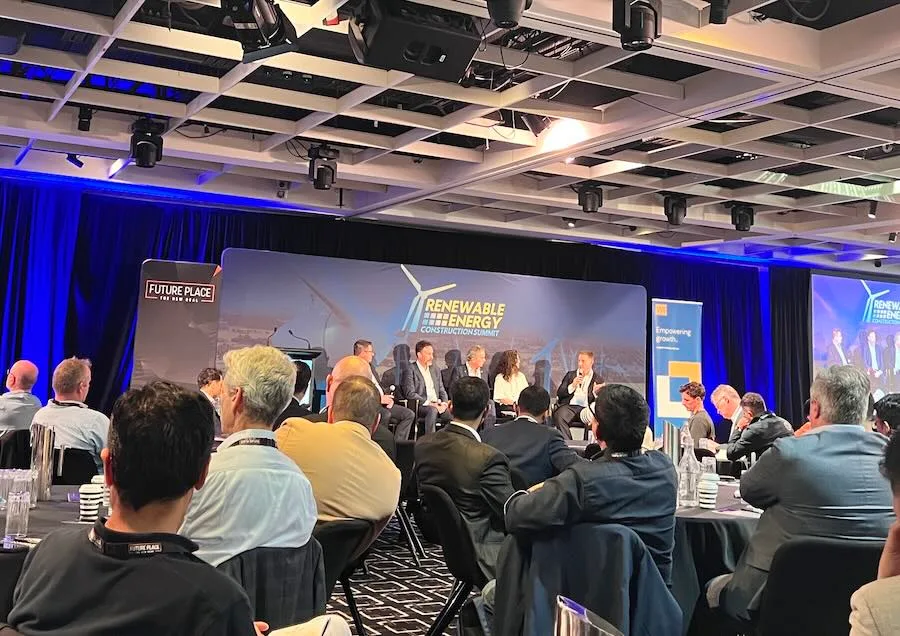
Buckley showed an A$150 billion Australian data centre pipeline
Tim Buckley directs Climate Energy Finance, which describes itself as a public interest think tank taking no government or corporate funding. He came to it from three decades in equity markets, including seventeen years at Citigroup to 2008, and a period running energy finance studies for Australia and South Asia at the Institute for Energy Economics and Financial Analysis. He presented after lunch, on the forces shaping what gets built next.
One slide carried the number that matters to this readership. Australia's data centre pipeline, his deck says, "is estimated at $150bn by 2030" as at the third quarter of 2026. He showed it as one component of national electrification demand, drawn from AEMO's August 2026 Electricity Statement of Opportunities and its 2026 Integrated System Plan, sitting alongside residential and transport load rather than in a category of its own.
Certified Strategic has reported the same figure from another direction, in Commonwealth Bank's A$150 billion estimate of the Australian build to 2030. The deck does not say whether Buckley's number derives from that estimate or was reached separately, so treat the two as one figure until he says otherwise.
The audience is what makes it worth reporting. Buckley showed the data centre build to a room of contractors, engineering leads and network businesses as a construction pipeline, not as a policy controversy.
Buckley credited Chinese manufacturing for the cost falls
Most of the deck is spent evidencing where the equipment comes from. Batteries are, in his framing, the biggest energy system disruption of 2026: global battery storage installations passed 320GWh during 2025, up 50% on the year before, and China accounts for more than half of those installations. All ten of the world's ten largest battery cell makers are Chinese companies.
Australia is deploying hard at the household end of that curve. Buckley reported more than 487,000 home battery installations under the Commonwealth scheme, which he called world leading, and argued it is helping drive electricity prices down. The Australian Energy Regulator's default market offer for New South Wales fell 5% year on year for households and by 10% to 20% for small business, though the regulator attributes that to a wider set of causes than storage alone.
He also told the summit that Australia is China's number one export market for batteries. That claim is not in the published deck and Certified Strategic has not independently verified it.
The conclusion is commercial. Australia-China trade sits at an A$300 billion annual high while Chinese investment into Australia sits at a two-decade low, and in his words it is "hard to embrace the massive investment and construction boom potential whilst refusing to work constructively with our #1 trade partner: capital, EPC and supply chains". For a room whose constraint is delivery capacity, that is an argument about who builds the thing, and not only about where the equipment ships from.
CSIRO finds battery costs down 11% to 16% in a year
CSIRO's GenCost 2025-26 final report, published in July 2026, records battery and balance-of-plant costs falling 11% to 16% between 2024 and 2025, depending on duration, and says batteries "have started to compete with traditional gas generation" for peak supply. Chief energy economist Paul Graham told the ABC on publication: "As battery costs continue to fall and gas technology costs rise, batteries are increasingly becoming the preferred flexible generation technology in the near term."
CSIRO ties that fall largely to expanded Chinese manufacturing, which is Buckley's argument reaching the same conclusion from a government agency. BloombergNEF's most recent pack price survey has global lithium-ion packs at a record low of US$108/kWh, down 8% in a year, with stationary storage the cheapest segment of the market.
Data centres appear on the other side of that comparison. The International Energy Agency ranks data centres second among the destinations for gas turbines ordered in the twelve months to the first quarter of 2026, and CSIRO expects turbine costs to keep climbing before they steady later this decade.
Australian operators are therefore buying firming into a market where AI demand offshore has bid up the conventional option while the cost of the substitute keeps falling. Firmus contracted a 200MW grid-forming battery in South Australia in June, ahead of the campuses it will serve. Amazon has added 430MW of battery-backed renewables for its Australian facilities. Our guide to renewable energy integration in Australian data centres sets out the wider pattern both sit in.
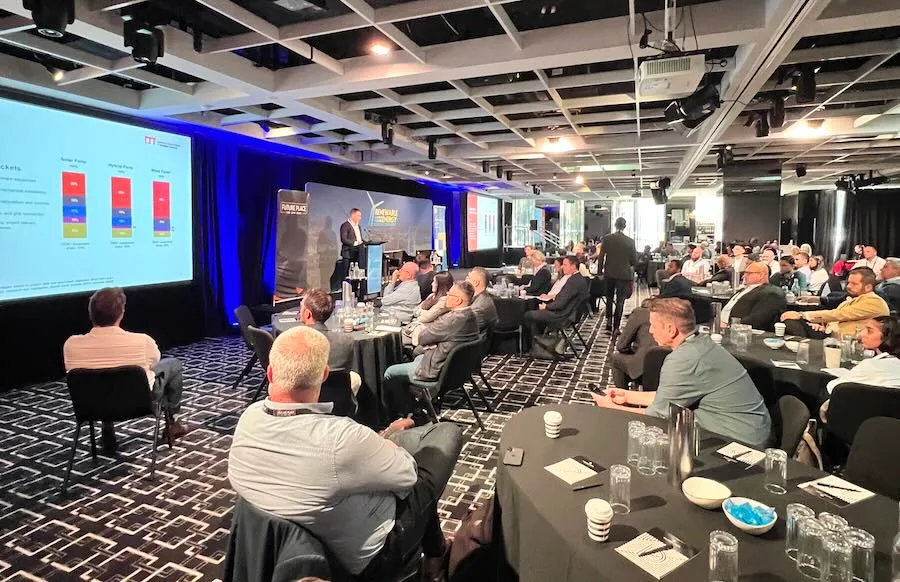
WinDC argued the latency rule predates the workload
Andrew Sjoquist founded WinDC and runs it as chief executive. The company sites containerised compute at renewable generation rather than in city data halls, and Certified Strategic's ecosystem map places it in the neocloud tier, among operators that develop the facilities they sell compute from. He followed Buckley, on rethinking where Australia builds data centres.
As he put it to the summit, the dominant component of the delay a user experiences is the model generating the answer, and the network carrying the request contributes little beside it. Ten milliseconds or so between Sydney and a regional site is immaterial against that. The preference for metropolitan siting rests on a rule of thumb about latency formed roughly twenty years ago, for workloads that no longer describe most AI infrastructure. Training is less sensitive still.
WinDC has made a version of this case publicly since May 2026, separating urban facilities serving latency-sensitive applications from regional capacity serving the high-throughput AI work that defines an AI data centre, where response times under 150 milliseconds are rarely a requirement.
The build is closed-loop liquid-cooled and containerised. In March 2026 WinDC announced a partnership with United States edge computing firm Armada covering 11MW of modular capacity across New South Wales, other National Electricity Market sites and Western Australia, with each unit deployable in about 90 days.
By WinDC's account, 7.2TWh of renewable generation was curtailed across regional Australia during 2025, roughly a year's supply for two million homes. Certified Strategic has covered the same problem from the network side in AEMO's treatment of data centres as a flexible load. Sjoquist's proposal is a policy one: designate digital economic zones alongside the renewable energy zones, so approvals and community participation are handled together.
The national expectations make the operator carry the firming bill
The Australian Government's national expectations require a large data centre to bring new energy, cover its network costs and operate as a flexible load. Operators have largely accepted that trade. What several have asked for since, in consultation responses and in public, is a durable legislated route to bring and firm their own supply instead of negotiating each project on its merits.
Money drives that as much as reputation. Energy an operator adds and firms itself stays out of the argument about shared infrastructure, which is where the sector's consent problem has sat through the moratorium debate and the grid queue arguments alike.
A large operator meeting those conditions has to buy firming, and GenCost has that cost falling by up to 16% in a year. Buckley's presentation describes the supply chain those cells come out of. Sjoquist adds the siting question, and answers it with the renewable energy zone.
Three constraints sit against that. The announced 11MW with Armada is a demonstration, while the campuses being financed today are measured in hundreds of megawatts. Regional siting moves the consent question to a community already hosting the generation, and asks it to take the load as well. And the compute has to be sellable, because a regional AI factory needs customers who will accept a regional address, which Australia's two-tier compute market has yet to settle.
What to watch
Where the A$150 billion comes from. Buckley's slide and Commonwealth Bank's published estimate carry the same number. Establishing whether that is one estimate or two changes how much weight the figure can take, and it is one question to Climate Energy Finance.
Chinese capital, not only Chinese equipment. Buckley's argument runs past supply chains to construction and investment. Chinese foreign direct investment into Australia at a two-decade low, against A$300 billion of annual trade, is the number to track if the sector takes his point.
Digital economic zones. Sjoquist's proposal needs a state sponsor. New South Wales, building the Central-West Orana renewable energy zone through EnergyCo, is the first place to look.
Connection conditions. Transgrid's capacity allocation policy and the NSW connection and cost recovery consultation are drafting the route by which an operator brings and firms its own energy. That drafting decides whether the legislated certainty operators want exists.