
US pushes ahead with ban on new Chinese optical transceivers
By Winston Su, Editor · · Add us as a preferred source on Google
At a glance
The US administration plans to press ahead with blocking imports of new Chinese optical transceiver models, sources told Reuters on 17 November, despite lobbying by Amazon, Google, Meta and Microsoft.
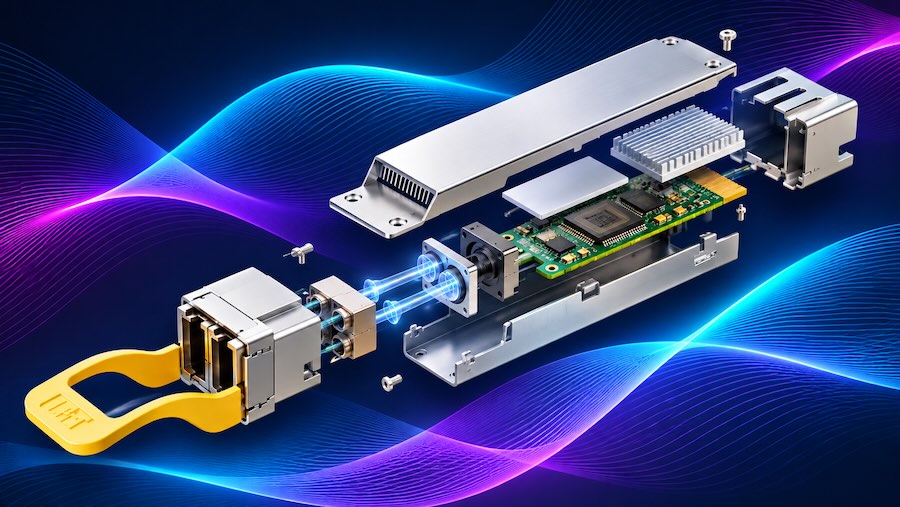
Optical transceivers turn electrical signals into light so GPUs and switches can exchange data over fibre, and Chinese makers supply nearly two-thirds of the world's data centre units.
In Australia, the cloud companies and AI compute providers that rent data centre halls buy the same kinds of modules, including those behind the up to 2GW of capacity NVIDIA's Australian partners plan.
Sources told Reuters a cut-off of 3.2 terabits per second is under consideration, a speed Morgan Stanley does not expect to start ramping up until 2028.
Under a wider measure, Australian buyers could end up competing with US cloud companies for modules from non-Chinese makers such as Coherent and Lumentum.
The Trump administration plans to press ahead with blocking imports of new models of Chinese optical transceivers through the Federal Communications Commission (FCC), the US communications regulator. Transceivers are the small modules that carry data between servers inside AI data centres. People briefed on the matter told Reuters on 17 November, US time, that the plan is moving forward despite pushback from Amazon, Google, Meta and other companies at a meeting with White House officials earlier in 2026, where executives said US companies could need up to a decade to comply.
In Australia the same modules connect the GPU clusters going into AI data centres, including those planned under the up to 2GW of land, power and shell capacity NVIDIA's Australian partners plan by the end of 2027. Reuters reports some data centres need millions of them. The FCC measure would decide what can be imported into the United States, so any effect on Australian buyers would come through global supply and price.
The cut-off reported to be under consideration, 3.2 terabits per second, would apply to the next, faster generation of modules, which is not expected to start ramping up until 2028. NVIDIA's Australian partners plan their land, power and shell capacity by the end of 2027. If the FCC goes wider, Counterpoint expects cloud operators to pay higher premiums for non-Chinese supply, and Australian buyers could be among them.
Big Tech told the White House compliance could take up to a decade
The pushback followed a Reuters report on 4 August that the FCC was drafting the measure because officials feared the modules could be used to steal data, install malware or disrupt service. The FCC has used its Covered List, which blocks new equipment from approval for sale in the United States, against drones, routers, power inverters and robots.
Microsoft pressed the administration to drop the plan, and weeks after the August report it was among a handful of companies that met officials from the White House Office of Science and Technology Policy and the National Security Council to raise supply chain concerns. John Miller of the Information Technology Industry Council, a US tech industry group, said the AI chips cloud companies have bought for the buildout "could just sit there waiting around un-utilized" until the transceivers to connect them arrive.
On 17 November, Reuters' sources named US AI cloud company CoreWeave and network equipment maker Cisco among the other companies at that White House meeting, and said the measure is moving forward, although it could still be shelved if sentiment in the administration changes. Reuters said the momentum owes partly to the reports about Jensen Huang, which have fuelled calls in Washington for a tougher line on Chinese technology. Huang resigned as NVIDIA's chief executive on 12 November after the reports surfaced, and NVIDIA's board has said it has "no reason to believe that either national security or NVIDIA secrets were compromised". China's embassy in Washington said Beijing firmly opposes the US overstretching the concept of national security. The FCC measure sits alongside a Commerce Department rule, released on 16 November, that would require licences for AI chips in any data centre that gives Chinese companies more than a set amount of computing power.
Chinese makers lead the global market for data centre optics
Zhongji Innolight leads the market with about 27 per cent of global data centre transceiver revenue, research firm Counterpoint estimates, followed by US maker Coherent with about 17 per cent and China's Eoptolink in third place. US maker Lumentum holds about 6 per cent. Chinese makers together supply nearly two-thirds of the world's units and about 60 per cent of revenue, and the Pentagon added Innolight in June to its list of companies it says are linked to China's military.
The leading Chinese makers rely on overseas buyers, mainly US cloud companies, for more than 90 per cent of their revenue from modules that move 800 gigabits or 1.6 terabits per second, the speeds used in current AI clusters, according to Counterpoint. They build those modules with signal-processing chips from US firms Broadcom and Marvell and lasers from Lumentum, Coherent and Japan's Mitsubishi Electric, and Innolight and Eoptolink run high-volume lines in Thailand, and Counterpoint says assembly, testing and shipping for US customers frequently take place in Southeast Asia. Counterpoint says Western makers do not have the factory capacity to take on that volume in the next 12 to 24 months.
Australia's AI data centres run on the same parts
The US cloud companies that buy from those makers also run cloud regions in Sydney and Melbourne, where they own or lease data centre space. Operators such as NEXTDC, AirTrunk and CDC build the halls and supply power and cooling, and their tenants buy the servers, switches and transceivers that go inside.
Alongside hyperscalers such as AWS, Microsoft and Google, the tenants include Australian AI compute providers such as Firmus and Sharon AI, which own the GPUs they rent out. On NVIDIA's results call on 18 November AEDT, interim chief executive Colette Kress said its Australian partners plan up to 2GW of land, power and shell capacity by the end of calendar 2027.
A 3.2-terabit cut-off would hit the next generation of parts
Morgan Stanley said in an October client note that the administration was considering barring Chinese transceivers that handle 3.2 terabits per second, a speed not expected to start ramping up until 2028, with widespread installation in 2029. Two of Reuters' sources said that threshold is under consideration, and Reuters said it could give US makers time to expand production. Under that cut-off, the 800-gigabit and 1.6-terabit modules in current AI clusters would sit below the line.
The FCC could also decide who the measure covers. Counterpoint says a version targeting the Chinese parent company, rather than the place a module is made, could also catch modules Chinese makers produce in Thailand. More broadly, Counterpoint expects restricted supply to force cloud operators to pay higher premiums for non-Chinese allocations. Australian buyers of Coherent, Lumentum and other non-Chinese modules could then be competing with those US buyers, while Chinese makers, which sell most of their high-end modules to US customers, could be looking for other buyers.
Australian data centre owners manage supplier risk under SOCI
Australia handles supplier risk through the Security of Critical Infrastructure (SOCI) Act, under which the owners of critical data storage or processing assets must keep a risk management program. The 2023 rules require that program to deal with supply chain hazards, including risks from major suppliers, unauthorised access to the supply chain and misuse of privileged access by a provider. Tighter rules that commenced on 10 June 2026 add supply chain mapping and an assessment of each major supplier's foreign ownership, control or influence for nine other asset classes, including electricity, gas and water, with those obligations due by 10 June 2028. Industry body Data Centres Australia told Home Affairs in a 1 May 2026 submission on the tighter rules that it supports the principle of understanding and managing supply chain risk, and that "the government should bear the onus of identifying risky vendors."
Nyrstar is studying indium, a metal China restricts
China could also respond to a US measure through the raw materials. One of Reuters' sources said US companies raised the prospect of China banning exports of indium phosphide, a material used to make transceivers. China put indium under export restrictions in February 2025, and the US Geological Survey estimates it refined 760 of the world's 1,100 tonnes that year.
Indium is on Australia's Critical Minerals List, and smelting company Nyrstar said in August 2025 that its studies would examine what it needs to produce germanium and indium in Hobart. The Australian, South Australian and Tasmanian governments committed A$135 million that month and a further A$105 million in June 2026 to keep Nyrstar's Hobart and Port Pirie smelters running for the rest of the year while it completes those studies.
What to watch
The FCC's decision. The FCC will set whether the measure covers only 3.2-terabit modules or all new Chinese models, and whether it targets the maker or the factory location.
The Senate bill. The Securing National Security Systems from Chinese Optical Transceivers Act, referred to the Senate's homeland security committee on 24 September, would bar US agencies from buying Innolight and Eoptolink modules for national security systems after a five-year transition.
Home Affairs guidance. The department said in its consultation summary that best-practice guidance on supply chain mapping and supplier assessments for the asset classes under the tighter rules was being developed and was expected in August 2026.
NVIDIA's Australian buildout. The partners plan up to 2GW of land, power and shell capacity by the end of calendar 2027, with the computing equipment to follow.
Nyrstar's Hobart studies. The results will inform whether the smelter adds indium to the metals it produces.
Keep reading the market
Get The Strategic Brief in your inbox every Thursday.
The leading Australian data centre and AI infrastructure newsletter.
Your Next Read

AirTrunk names Google, Apple, Meta, Amazon and Microsoft as Australian prospects

Google and NVIDIA are writing the AI factory playbook
US acts to stop China renting AI chips in Asian data centres
Latest Headlines
Tasmania's lower house backs AI data centre moratorium
19 Nov 2026Ten days that changed Australian data centres in 2026
18 Nov 2026Chalmers' super test reset could reach AI's power supply
18 Nov 2026NVIDIA's US$115.8bn quarter names Australia's planned 2GW AI build
18 Nov 2026Dataspace launches with 14.5MW across five ex-Fujitsu sites
17 Nov 2026
Interested in reaching this audience? Advertise with us.