At a glance
Jensen Huang has resigned from NVIDIA after reports of an affair with a former Megaspeed executive. US intelligence officials believe she is a Chinese intelligence asset, The New York Times reported, and China denies it.
Interim chief executive Colette Kress now decides NVIDIA's investments in Australian AI builds.
NVIDIA's chips are planned to 2028, from Vera Rubin to Feynman, and Australia's AI builds are designed around them.
Unlike Mark Zuckerberg or Google's founders, Huang held no super-voting shares, only 3.6 per cent of NVIDIA's votes.
Megaspeed's Australian arm lists a Sydney virtual office as its address, and its director lists a newsagency in Seymour, Victoria.
Jensen Huang has resigned from NVIDIA, the company he co-founded and ran for 33 years, after reports of an affair with Alice Huang, no relation, a former executive of Singapore cloud company Megaspeed. US intelligence officials believe she is a Chinese intelligence asset, The New York Times reported. Attorney-General Todd Blanche said the Justice Department had not concluded whether she was a spy. NVIDIA announced on 12 November 2026, US time, that he had resigned as president, chief executive and director, effective immediately, and that chief financial officer Colette Kress would run the company in the interim.
Alice Huang could not be reached for comment, Reuters said, and Beijing has called the spying claim "a groundless accusation, slander and a smear".
NVIDIA supplies, invests in and buys capacity from Australia's AI builders. NVIDIA says its chip roadmap continues to 2028. Its next investments in Australian AI builds are now Kress's call.
The Financial Times says NVIDIA's board has approached Arm chief executive Rene Haas, who worked at NVIDIA for seven years, about the permanent job. The board told CNBC on 13 November that it had "not formally engaged any potential candidates". NVIDIA shares fell 2.01 per cent on 13 November, closing below US$4 trillion in market value.
Australia's AI builds run on NVIDIA chips and NVIDIA money
NVIDIA holds about 80 per cent of the world's AI chip market by revenue, Silicon Analysts estimates. The Australian neocloud builds at Firmus, Sharon AI and IREN run on its processors, and in September NVIDIA named eight Australian partners, including NEXTDC, AirTrunk and CDC, to ready up to 2GW of land, power and buildings for its AI factories by 2027.
Huang also made NVIDIA an investor in its own customers, including the neocloud providers in Australia. NVIDIA holds shares in Firmus, took part in its US$2 billion round fully committed on 7 August 2026, and is a Firmus customer. It takes a share of Sharon AI's cloud revenue under a six-year agreement worth up to US$4.88 billion for 72MW in Australia, and holds a five-year warrant over up to US$2.1 billion of IREN shares.
Company | NVIDIA's position | Status |
|---|---|---|
Firmus | Shareholder; customer for 14MW in Australia and 360MW in Indonesia | New investment in talks, reported October 2026 |
Sharon AI | Revenue share and credit support on 72MW in Australia, up to US$4.88bn over six years | Announced 12 June 2026 |
IREN | Five-year warrant over up to US$2.1bn of shares, vesting on deliveries of up to 600,000 NVIDIA GPUs | Announced 7 May 2026 |
Source: Firmus, Sharon AI, IREN, Australian Financial Review, The Information, as at 14 November 2026.
NVIDIA's investment decisions now pass to Kress, NVIDIA's chief financial officer since 2013, who keeps that role while she runs the company. The Information says she has at times pushed back on Huang's deals, including one to backstop US$250 billion of credit for an OpenAI data centre project. Meritz Securities analyst Hwang Soo-wook told the Korea Herald a more conservative approach to new financial support "could affect the pace of neocloud expansion and their financing conditions".
The first of those decisions concerns Firmus, which withdrew its ASX float on 9 October and, Bloomberg says, is talking to existing investors about a private round of US$2 billion to US$3 billion. The Information says NVIDIA was in talks to invest hundreds of millions of US dollars. Firmus has since signed Mira Murati's Thinking Machines Lab as a customer.
NVIDIA after Huang: no successor named, chips designed to 2028
Huang planned to stay. He told podcaster Lex Fridman in March that he hoped to "die on the job", and he has said he does not believe in succession plans. He ran NVIDIA with dozens of direct reports and few layers of management, and the company has named no successor. Santa Clara University management professor Jo-Ellen Pozner told Fortune the structure had suppressed "the emergence of potential successors". Analysts have named NVIDIA data centre executive Ian Buck as an internal option, alongside Haas.
Whoever takes the job inherits Huang's roadmap. He laid out three generations at GTC in San Jose on 16 March 2026:
Year | Platform | What it brings |
|---|---|---|
2026 | Vera Rubin | Vera CPU and Rubin GPU, ramping into full production since May |
2027 | Rubin Ultra | Kyber rack with vertical trays, liquid cooling as standard and about 600kW a rack |
2028 | Feynman | 3D-stacked chips, a new Rosa CPU and NVLink-8 interconnect |
Source: NVIDIA, TweakTown, DCD, March 2025 to May 2026.
Research firm SemiAnalysis reported in July that the Kyber rack had slipped to 2028.
NVIDIA said on 31 May that Vera Rubin was ramping into full production, with shipments starting in the US autumn, and claimed 10 times the agent throughput of its Grace Blackwell platform. Huang said at GTC in 2025 that the Kyber rack that follows will draw about 600kW, against about 120kW for a Blackwell rack. Its purchase order pipeline for Blackwell and Vera Rubin targets US$1 trillion through 2027. New board chair Harvey Jones said NVIDIA expects "operations, customer commitments and product roadmap to continue without interruption".
NVIDIA launched CUDA, the software that lets its chips run general calculations and that AI developers now build on, in 2006, and it was about a decade before Wall Street believed in it, research vice president Bryan Catanzaro told Yahoo Finance in 2023. The roadmap to Feynman carries his decisions into 2028, so the next chief executive's first years will ship chips he chose.
Australia's AI builds are being sized for those chips now. NVIDIA's eight Australian partners are readying up to 2GW of land, power and buildings by 2027, not all of it in Australia. IREN targets energisation of its 800MW Bundey campus from 2028. NVIDIA named Firmus and IREN among the cloud providers adopting Vera Rubin's confidential computing on 31 May. WinDC says NVIDIA's DSX POD, a container-built hall for AI data centres built around seven Vera Rubin racks, positions it to bring 230MW of modular capacity to regional Australia in 2027. Halls that open in 2027 and 2028 will be fitting Rubin Ultra and Feynman racks, and their power and liquid cooling have to be designed for them before the buildings go up.
Our view: the chips Australia receives to 2028 are the part of NVIDIA least exposed to Huang's exit. Vera Rubin is shipping and the next two generations are designed. NVIDIA's funding of the buildings that house them is less certain. Huang backed neoclouds with equity, warrants, revenue shares and credit support. An interim chief executive drawn from finance, who has questioned some of those deals, may write fewer of them. For Australian builders who raise capital on the strength of NVIDIA's backing, fewer such deals would make financing harder.
Huang held 3.6 per cent of NVIDIA and no super-voting shares to protect him
Huang built NVIDIA into what was the world's most valuable company without the voting power to protect his position. NVIDIA adopted one vote per share when it listed in 1999, so its co-founder held 3.6 per cent of the votes, the same as his share of the company, NVIDIA's 2026 proxy statement shows. Without a majority, he could not control the board's decisions.
Mark Zuckerberg, by contrast, holds 61 per cent of Meta's votes on 13 per cent of its shares. Larry Page and Sergey Brin hold 53 per cent of Alphabet's votes on at least 9 per cent of its shares, and Elon Musk holds 84 per cent of SpaceX's on 48 per cent. In 2004, 5 per cent of US technology companies listing on the market used extra-vote shares. Nearly half did last year.
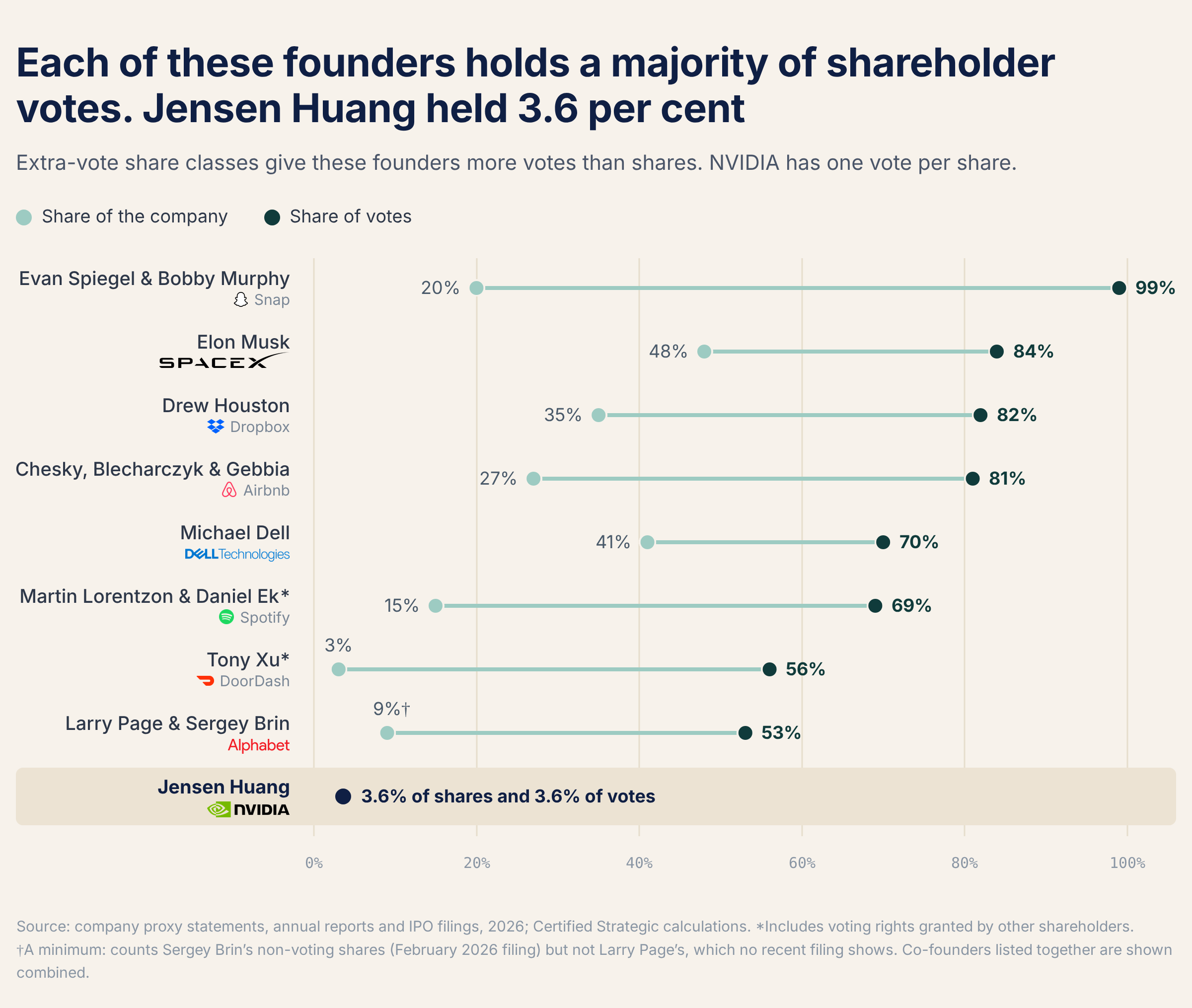
A simple majority of NVIDIA's board was enough to remove him. Huang's authority rested on his record and on a board he had worked with for decades: three of NVIDIA's 11 directors, including Huang, had served since its founding in 1993. On 8 November he told employees he had been "unfaithful to my wife", and the board began an independent investigation into reports that he had been the target of a foreign intelligence effort. It said it had "no reason to believe that either national security or NVIDIA secrets were compromised". Three days later it accepted his resignation. At Meta and Alphabet, founders with a voting majority can replace the directors who would decide their future.
Megaspeed's paper trail runs from Singapore to Seymour
The Information says Megaspeed moved at least US$7.5 billion of NVIDIA chips through Singapore and its Malaysian subsidiary. Bloomberg, counting Malaysian and Indonesian customs records, puts its NVIDIA imports at a minimum of US$4.6 billion. Megaspeed denies wrongdoing.
Megaspeed registered an Australian affiliate with ASIC in 2024. Its sole director, Kai Kang, listed his address as a newsagency in Seymour, an hour north of Melbourne, and its business address is a 10th-floor virtual office in Sydney's central business district. A woman who said she was his mother told Reuters he is based in Shanghai and has nothing to do with Megaspeed. Reuters could not reach Kang, and he has not been accused of wrongdoing.
Megaspeed's Singapore parent, Swiftdata, lists a registered office that an interior design firm told The Straits Times it has occupied for more than four years. The firm's co-founder said he did not know Swiftdata or Megaspeed. Singapore police confirmed in October 2025 that they were investigating Megaspeed.
US prosecutors have alleged chip diversion through Southeast Asia in other cases, including a separate case in which three men are charged with using a Southeast Asian company to divert at least US$510 million of AI servers to China, and with leaving non-working replicas relabelled with a hair dryer for inspectors. The charges are unproven.
NEXTDC says it has "no links whatsoever with Megaspeed or anyone at that company", it told the ABC, after footage circulated of chief executive Craig Scroggie standing next to Alice Huang. The ABC said there was no suggestion he had any link to the scandal.
What to watch
NVIDIA's third-quarter results. NVIDIA reports on 17 November, US time, with its results call at 9am AEDT on 18 November, Kress's first as interim chief executive and the first chance to say whether its roadmap, neocloud investments and revenue-share programme continue unchanged.
Firmus's private round. NVIDIA's reported investment is the first new Australian commitment Kress will decide. The Financial Review says investors in Firmus's August round receive more shares if it has not listed by 30 November.
Congress. Three House committee chairs have called Huang to a closed-door interview on 1 December, US time, and say they will subpoena him if he does not take part. A Senate committee has also asked him to testify.