
Australia's data centre construction spend to grow fastest
By Winston Su, Editor · · Add us as a preferred source on Google
At a glance
Australia will be the fastest-growing of 25 data centre construction markets through to 2028, economic consultancy Oxford Economics forecasts, with Ireland second.
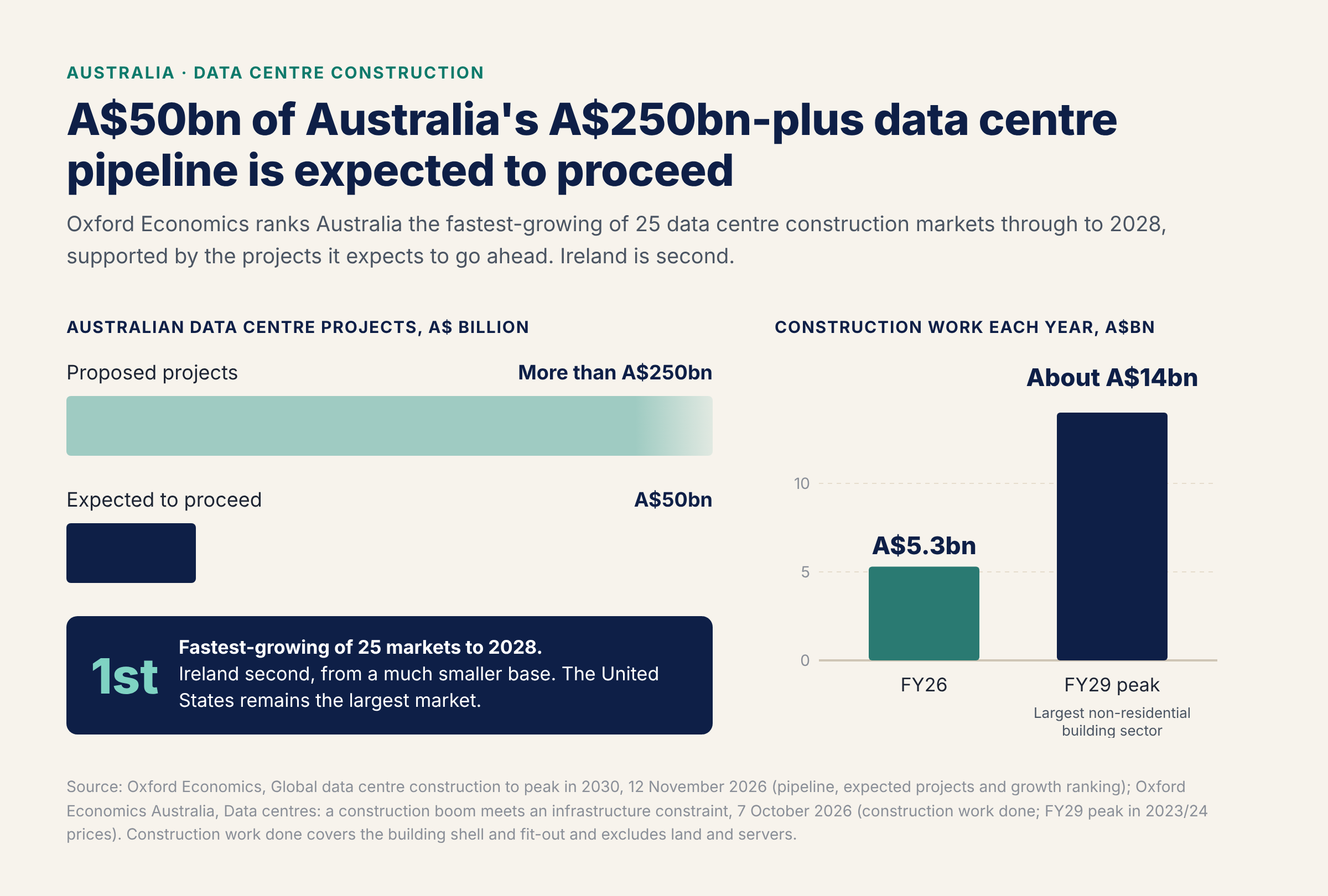
Oxford Economics counts more than A$250 billion in proposed Australian projects and expects A$50 billion of them to proceed.
Construction across all the markets peaks at US$212 billion in 2030, then falls 40 per cent by 2037 as growth in AI adoption slows.
The United States will account for more than 60 per cent of global growth over the next two years, while Asia peaks in 2029 and Europe in 2028.
Oxford Economics says tight construction labour markets limit how many projects can break ground and push up costs.
Australia will be the fastest-growing of 25 data centre construction markets through to 2028, economic consultancy Oxford Economics forecasts in a briefing dated 12 November 2026. Ireland is second, while the United States remains the largest market and carries global construction to a peak in 2030.
Oxford Economics counts more than A$250 billion in proposed Australian data centre projects and expects A$50 billion of them to proceed. Across all its markets, Oxford Economics bases the near-term forecasts on projects under construction and projects it judges highly likely to go ahead, because new data centre announcements far exceed what the construction industry can deliver.
Australia's growth is backed by A$50 billion of projects
The A$50 billion comes from Oxford Economics' project tracking, which draws on its global project tracker, desk research and partner organisations, and accounts for industry capacity limits such as the supply of construction workers and access to electricity infrastructure. Ireland is second for growth, slightly behind Australia and coming off a much smaller base, after the end of a four-year de facto moratorium on new data centre grid connections there.
The forecasts measure construction work done, which is the money paid to the lead contractor for the building shell and fit-out, including switchgear, generators and cooling. Land and the servers installed inside are excluded. Oxford Economics Australia put Australian data centre construction work at about A$5.3 billion in FY26, in an analysis published on 7 October 2026. It expects the work to peak in FY29 at about A$14 billion in 2023/24 prices, when data centres would become Australia's largest non-residential building sector.
A separate Oxford Economics estimate, published on 6 October 2026, puts about 35 per cent of Australian data centre capital spending to FY30 into the Australian economy. The building shell and site works are largely bought locally, while most of the IT hardware is imported.
Other forecasts point the same way on Australia
Oxford Economics' ranking sits alongside other recent forecasts for the Australian market. CBRE placed Australia among five Leading markets in its Asia Pacific data centre outlook, published in May, and forecasts that the part of the Australian market investors can buy into will be worth A$57 billion by 2030, almost double its 2026 value. The Australian Bureau of Statistics reported data centre construction rising for an eighth straight quarter in the June quarter 2026.
Oxford Economics' 2030 peak measures construction spending rather than capacity. Property adviser JLL expects nearly 100GW of new data centre capacity to be added worldwide between 2026 and 2030, doubling global capacity, and Oxford Economics still puts 2037 construction at three times its 2022 level.
The United States drives the global peak
Across all 25 markets, data centre construction grows 20 per cent in 2027 and 11 per cent in 2028. It peaks in 2030 at US$212 billion in 2023 prices, 45 per cent above the 2026 level.
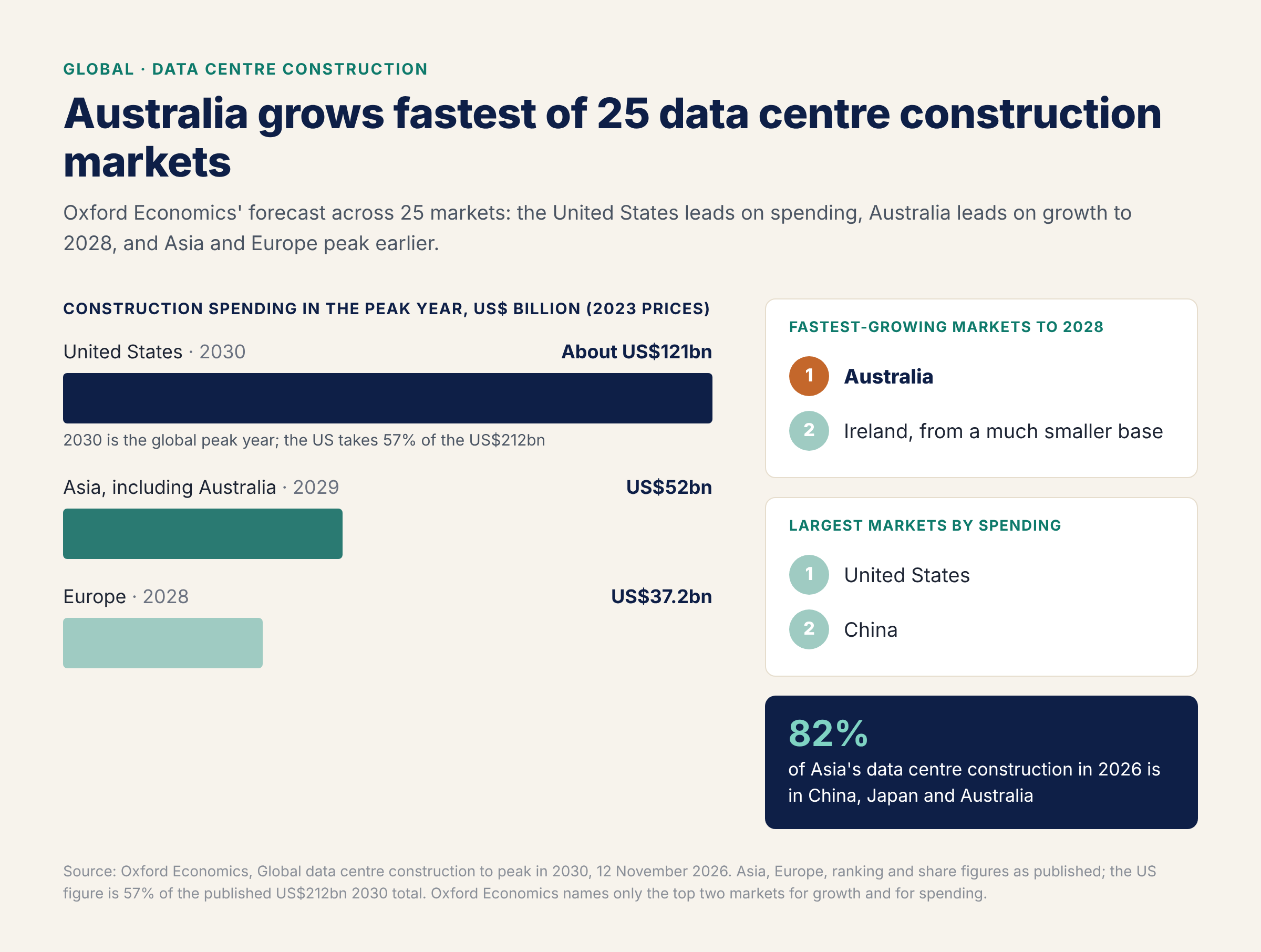
The United States accounts for more than 60 per cent of global spending growth over the next two years. Its share of activity rises from 47 per cent in 2026 to 57 per cent in 2030, and that activity is driven by Amazon, Meta, Microsoft, Google and OpenAI building data centres for their own use. China is the second-largest market by spending.
Market | Oxford Economics forecast | Timing |
|---|---|---|
Australia | Fastest-growing market, on A$50bn of projects expected to proceed | To 2028 |
Ireland | Second fastest-growing market, from a much smaller base | To 2028 |
United States | More than 60% of global spending growth to 2028; share of activity rises from 47% to 57% by 2030 | 2026 to 2030 |
Asia | Peaks at US$52bn | 2029 |
Europe | Peaks at US$37.2bn | 2028 |
All 25 markets | Peaks at US$212bn, then falls to US$127bn | 2030 to 2037 |
Source: Oxford Economics, Global data centre construction to peak in 2030, 12 November 2026. US dollar figures in 2023 constant prices.
Asia peaks in 2029 and Europe in 2028
Asia and Europe peak earlier than the global total. China, Japan and Australia together account for 82 per cent of Asian data centre construction work in 2026, and 22 per cent of the global total. Asian construction peaks at US$52 billion in 2029. Oxford Economics notes that building a data centre costs far less in China and India than in Australia, Japan and the United States, so China and India hold a larger share of the region's capacity than their spending suggests.
Europe plateaus at a peak of US$37.2 billion in 2028, with regulation and limits on supporting infrastructure restricting investment. Activity there is moving away from the financial hubs towards other cities with cheaper land and renewable power.
Construction eases after 2030 as AI adoption matures
The 2030 peak comes from how Oxford Economics models AI demand, on a technology adoption curve with slow early uptake, a period of strong growth as AI becomes mainstream and a flattening once late adopters arrive. It places global adoption at the start of the strong-growth stage in 2026, with that growth slowing by 2030, when construction peaks.
After the peak, construction work falls 40 per cent to US$127 billion in 2037. That is still three times the 2022 level, because demand for AI and cloud computing keeps growing, at a slower rate. Renovation and upgrades of existing facilities make up a growing share of the work over that period.
The construction peak does not necessarily coincide with the peak in AI capital spending. In the United States, spending on the computer equipment that fills a data centre runs six to eight quarters behind construction, and facilities built for GPUs carry a much higher IT cost, so construction is a smaller share of what an AI data centre costs to build.
Labour and power limit how fast projects start
Two constraints decide how fast the pipeline moves. Tightness in many construction labour markets limits how many projects can break ground, Oxford Economics says, and affects live projects by raising costs as workers are paid more and by delaying work. It flags a risk that projects take longer to move from breaking ground to completed work as a result. Oxford Economics Australia's October analysis adds that power availability will increasingly shape where data centres in Australia are built and how quickly they proceed.
Australian operators and builders compete for the same trades. Jobs and Skills Australia rates refrigeration mechanics, electricians, linesworkers and data cablers in shortage in every state and territory, and NEXTDC builder Kapitol expects a company record for data centre starts.
What to watch
Oxford Economics' December forecast update adds 15 markets, including Singapore, Malaysia, Saudi Arabia and the United Arab Emirates, taking its coverage to 90 per cent of the data centres in its project tracking. That brings Singapore and Malaysia into the same forecast set as Australia, and the update will also add commencement forecasts in floor area terms.
The Australian Bureau of Statistics publishes its private new capital expenditure survey for the September quarter on 26 November 2026, the next reading on data centre construction after eight straight quarterly rises.
Keep reading the market
Get The Strategic Brief in your inbox every Thursday.
The leading Australian data centre and AI infrastructure newsletter.
Your Next Read
IaaS is Australia's fastest-growing IT spend at A$9.1 billion

Data centre cities top LinkedIn's rankings in five countries
Data centres in eight of Australia's ten fastest-growing cities
Latest Headlines
Sydney's data centre pipeline sheds four early-stage plans
20 Nov 2026NEXTDC lifts FY27 guidance, weighs S4 joint venture
20 Nov 2026Stockland plans A$5bn Kemps Creek AI data centre with EdgeConneX
20 Nov 2026Greg Goodman makes case for A$15bn data centre builds
20 Nov 2026Anthropic IPO priced at US$83, valuing it at US$1.5 trillion
20 Nov 2026
Interested in reaching this audience? Advertise with us.