At a glance
Private new capital expenditure fell 3.6 per cent in the June quarter 2026 to A$50.95 billion, against a market forecast of a rise.
The fall came from a 53.0 per cent drop in information media and telecommunications equipment, the line that carries data centre servers.
Over the previous twelve months Australia spent a record A$24.3 billion on data centre equipment and buildings, against A$12.7 billion a year earlier.
Data centre construction reached a record A$3.33 billion, an eighth straight quarterly rise.
Companies now expect to spend A$200.7 billion in 2026-27, 15.5 per cent above their previous estimate.
Private new capital expenditure fell 3.6 per cent to A$50.95 billion
The Australian Bureau of Statistics published its June quarter capital expenditure survey on 27 August 2026, and the quarter's headline fall came out of the line that carries Australian data centre hardware. Private new capex fell 3.6 per cent in seasonally adjusted chain volume terms, to A$50.95 billion, against a market forecast of a 0.5 per cent rise. Reuters headlined the result as the data centre rush fading.
Tom Lay, the ABS head of business statistics, put the fall on one line in the media release. "June's fall in investment was the result of a 53.0 per cent drop in spending on information media and telecommunications equipment, after record investment in server racks and processing equipment for data centres saw an increase of 199.6 per cent last quarter."
Measured over the previous twelve months, the June quarter closed the biggest year for Australian data centre investment on record. A$13.5 billion went on servers and equipment and A$10.9 billion on buildings, A$24.3 billion combined, against A$12.7 billion in the twelve months to June 2025.
Two-thirds of a data centre's cost is imported hardware
Buildings and structures is Australian work. It covers concrete, steel, switchrooms, grid connection and the trades who do it, spent across a construction programme that runs for years.
Equipment is bought overseas. Treasury's advice to the Treasurer puts about two-thirds of what is spent on an Australian data centre on imports, and the processors and servers that fill an AI data centre are most of that. Reserve Bank Assistant Governor Sarah Hunter put it in plain words on 19 May 2026: "we import the computers, the servers, and all the other equipment largely that gets placed in the data centre."
The ABS measures this series in constant prices, so the movements show how much equipment was bought rather than what it cost. Imported hardware arrives in shipments against contracted delivery slots, so the line moves in steps. A quarter with a large delivery prints a record. The quarter after it prints a fall from a base far above where the series sat a year earlier, which is what A$2.79 billion is against A$1.44 billion in the June quarter of 2025. The construction work done through that quarter appears in the buildings line.
Data centre construction rose for an eighth straight quarter
Across the whole economy, equipment, plant and machinery fell 8.9 per cent to A$25.12 billion while buildings and structures rose 2.1 per cent to A$25.83 billion. Lay credited construction across the data centres in Australia that operators are expanding for the buildings rise. "Buildings and structures investment rose 2.1 per cent driven by continued activity on data centre construction to expand capacity, as well as commencement of new renewable energy projects this quarter." He added that investment in data centre construction and expansion "continues to grow, rising for an eighth straight quarter".
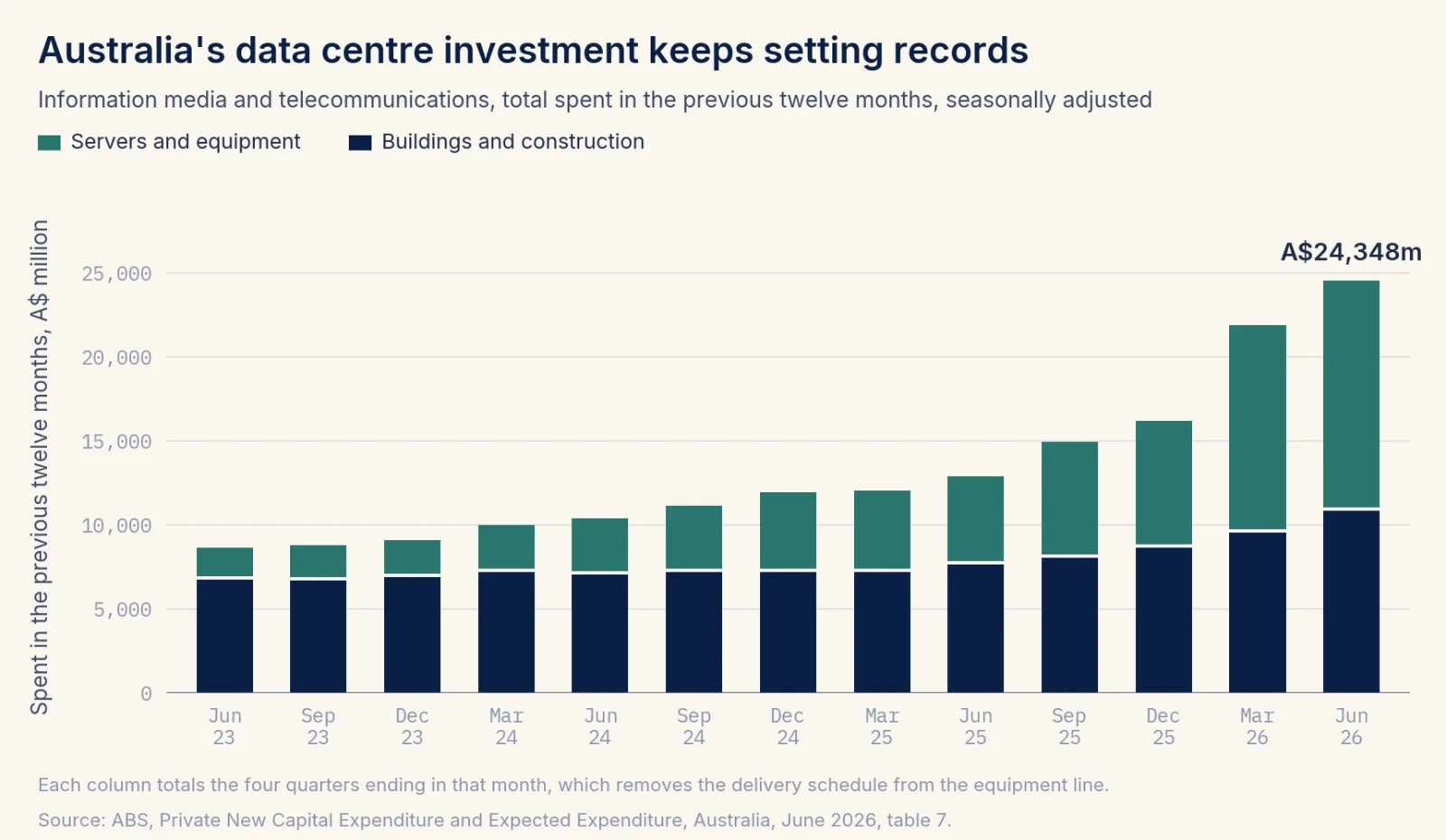
Totalling four quarters at a time takes the delivery schedule out of the equipment line. On that basis the equipment total reached A$13.5 billion in the twelve months to June 2026 and the buildings total A$10.9 billion, both the highest readings in a series the ABS has run since September 1987. The twelve-month equipment total has risen in every quarter since March 2023.
Data centre construction reached A$3.33 billion in the June quarter, the highest quarterly reading in the series, and it has risen in every quarter since September 2024. The March quarter release carried the seventh of those quarters at 12.6 per cent, and pointed to the buildings line flattening as shells completed while equipment kept climbing. Buildings accelerated instead.
New South Wales fell 2.8 per cent in the quarter and is 26.6 per cent higher over the year, the strongest annual result of any state.
State | June quarter 2026 | Year on year |
|---|---|---|
New South Wales | −2.8% | +26.6% |
Victoria | −13.9% | +4.2% |
Queensland | −0.4% | +3.9% |
South Australia | −1.9% | +14.8% |
Western Australia | +4.0% | +7.1% |
Tasmania | +9.3% | +4.3% |
Northern Territory | +6.8% | −37.4% |
ACT | +3.2% | −0.3% |
Source: ABS, Private New Capital Expenditure and Expected Expenditure, Australia, June 2026.
Companies expect to spend A$200.7 billion in 2026-27
The third estimate for 2026-27 expected capital expenditure is A$200.7 billion, 15.5 per cent above the second estimate published three months earlier. Non-mining expectations were revised up 17.7 per cent to A$144.3 billion. Buildings and structures expectations are A$116.0 billion and equipment A$84.7 billion. Lay attributed the revision to "continued investment in data centres and renewable energy projects".
Australia's listed operators guided the same way in August. NEXTDC told the market on 27 August 2026 that it will spend up to A$5.75 billion in FY27, and three of the four other ASX data centre companies that reported that month guided higher. Cushman & Wakefield counts 2.44GW of Australian capacity leased before it is built.
GDP grew 0.4 per cent in the June quarter
The June quarter national accounts, published on 2 September 2026, record GDP growth of 0.4 per cent in the quarter and 2.1 per cent over the year. Private business investment fell 0.5 per cent and is 10.4 per cent higher than a year ago.
The accounts carry the same machinery fall for data centre fit-outs after the March quarter rise, and state that investment in data centres "remains at elevated levels". On the building side the ABS is more specific: "Business investment remained elevated with an increase in new building construction associated with data centres."
Imports of goods and services still rose 0.5 per cent in the quarter, with motor vehicles bought to meet household demand for electric vehicles, and fuels and fertilisers bought for domestic use and reserves. Exports rose 0.8 per cent on a coal rebound, and net trade added 0.1 percentage points to growth.
What to watch
The September quarter capex release, due at 11.30am on 26 November 2026, is the next reading on the equipment line. Two consecutive quarters below the March peak would indicate the delivery schedule has slowed. A single low quarter between two high ones is a shipping calendar.
Buildings and structures is the portion of the spend bought in Australia, so a ninth consecutive rise would show the construction programme running on its own schedule.
The fourth estimate for 2026-27 expected capital expenditure, in the same 26 November release, tests whether the 15.5 per cent revision holds. It is the survey equivalent of the FY27 guidance the ASX operators gave in August.
Whether New South Wales holds its lead on the annual measure in the September release. It is the closest national statistic to the Sydney pipeline.