At a glance
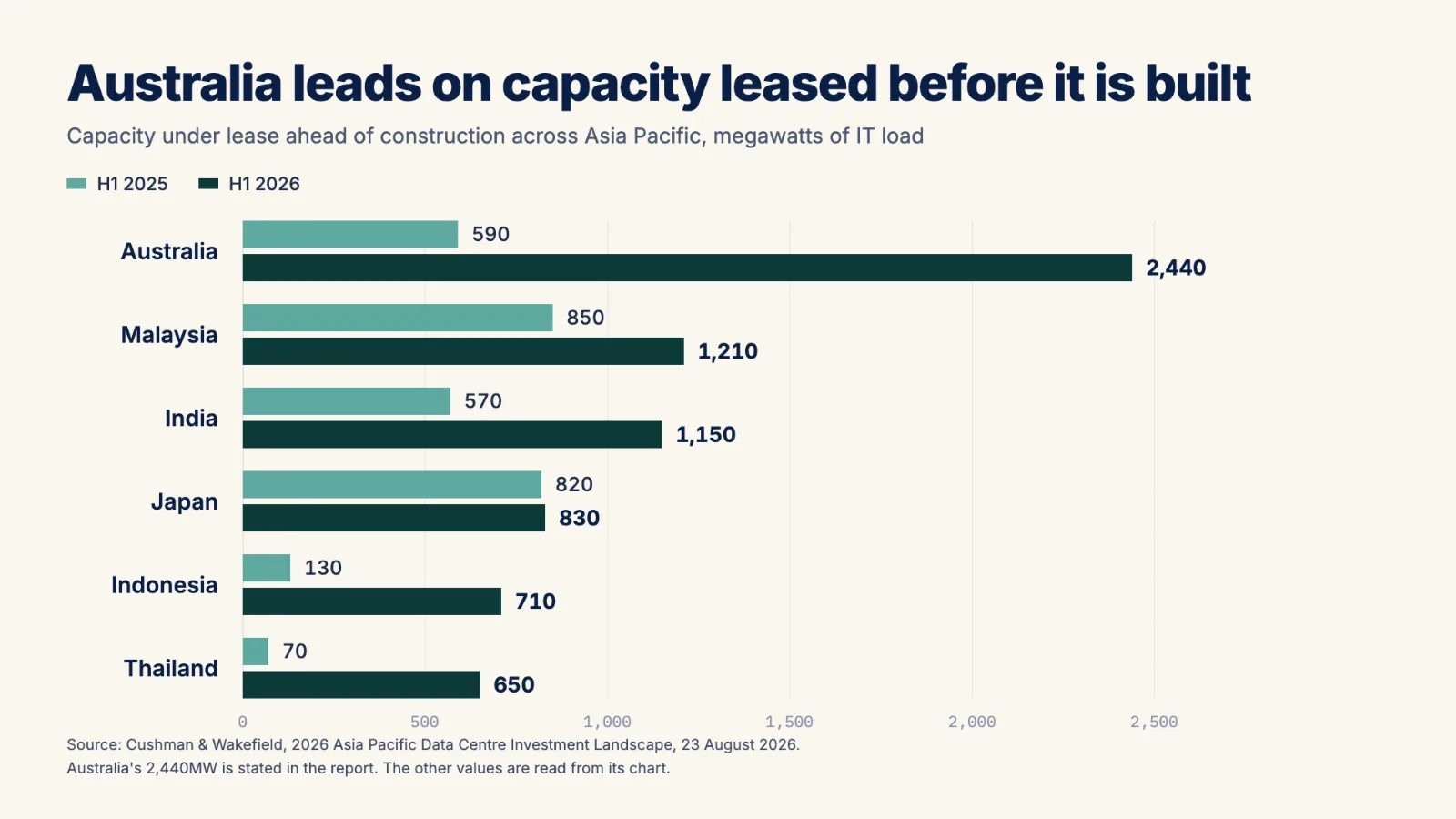
Customers have signed leases on 2.44GW of Australian data centres that have not been built, 61 per cent of everything the country has planned, on Cushman & Wakefield's count. No other Asia Pacific market has as much signed in advance.
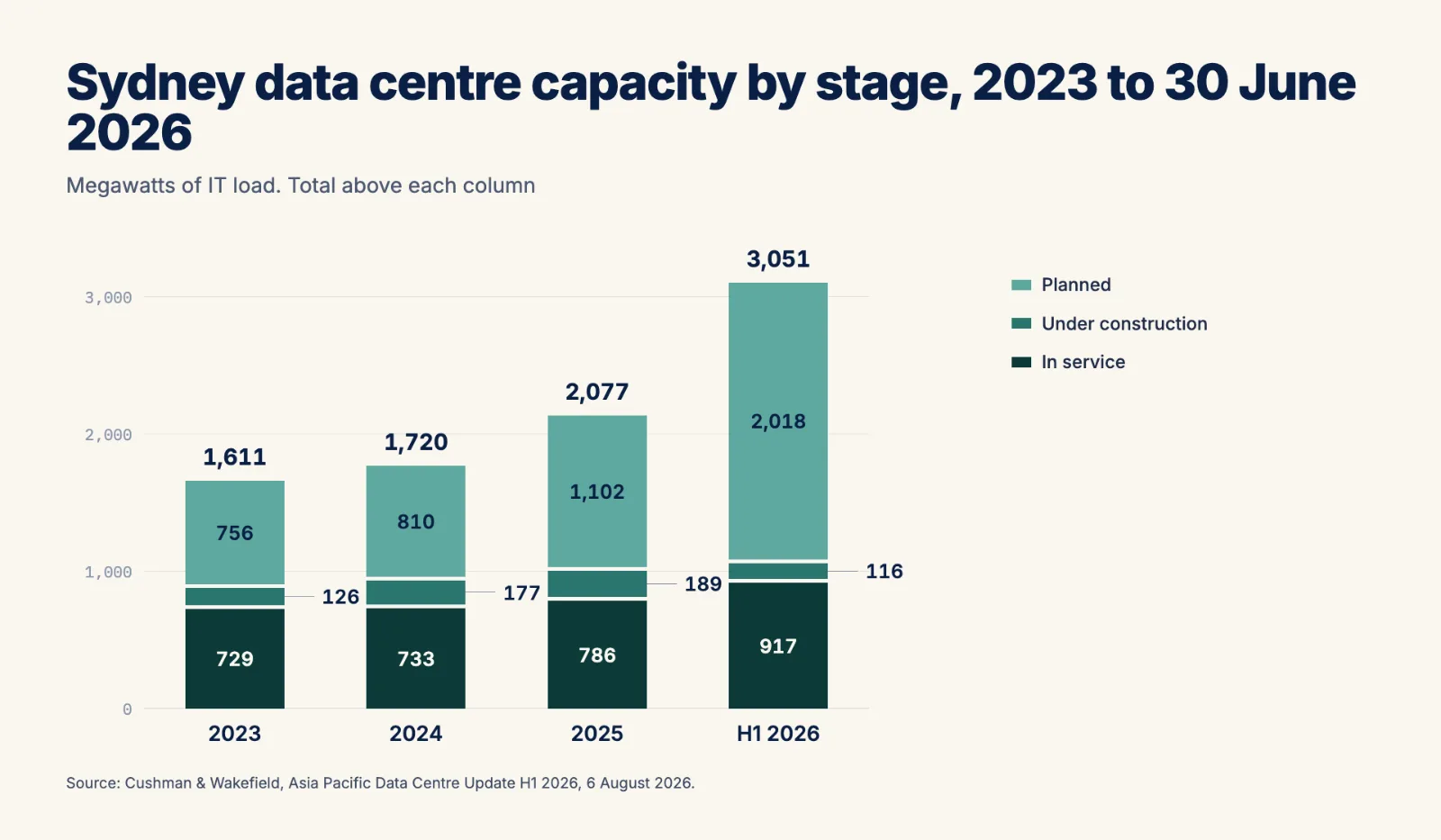
Cushman puts Sydney at 917MW in service, 116MW under construction and 2,018MW in planning at 30 June 2026, leaving it 83MW short of the 1GW Cushman forecast for year end.
Sydney's vacancy was 2.2 per cent, tighter than Tokyo, Singapore, Mumbai and Hong Kong, and looser than Johor and Seoul.
Cushman values the region's operating data centres above US$950 billion by 2030 and puts Australia second to Japan on projected 2030 rental income.
Perth's pipeline grew nearly fivefold to 253MW while its operating capacity held flat, and a 120MW campus was withdrawn after community opposition.
Cushman published two Asia Pacific reports this month
Cushman & Wakefield, the property firm that publishes a half-yearly count of Asia Pacific's data centre markets and an annual investment study, released both within three weeks. The market update of 6 August 2026 records what is built, building and planned in each city. The investment report of 23 August 2026 puts a price on the region and ranks its fourteen markets. The first put the regional pipeline at a record 26.5GW.
Australia's capacity figures have pointed in two directions all year. The network businesses told AEMO they are handling 67GW of proposed connections against 2.2GW already connected. Cushman itself wrote in its June note on Australian land values that grid applications here are in some cases "being used strategically by landowners and developers to inflate land values, rather than as part of genuinely executable projects". Neither figure says how much of the build has a paying customer.
Customers have already signed leases on 2.44GW of Australian data centres that have not been built. That is 61 per cent of everything Australia has planned, and more than any other market in the region. Malaysia is next at about 1.21GW and India at about 1.15GW. Across Asia Pacific the total signed ahead of construction rose 115 per cent in a year, to more than 7.8GW. The figures are Cushman's, published on 23 August 2026, and this is the first edition to carry them for Australia.
It is the first published figure that sizes the contracted part of the Australian build. Dividing 2.44GW by 61 per cent puts Australia's total pipeline near 4GW.
The chart shows the six largest of the nine groups Cushman plots.
Sydney gained 131MW and ended June with 116MW building
Cushman puts Sydney at 917MW of operating capacity across 51 facilities run by 21 operators at 30 June 2026, with 116MW under construction and 2,018MW in planning. That is 57 per cent of all operating data centre capacity in Australia on its count. Its account of the half is that the city gained 131MW of new capacity while vacancy compressed to 2.2 per cent, which it reads as demand keeping pace with incoming supply.
Cushman puts large campus development at the centre of the half, naming NEXTDC and Goodman pushing hyperscale-ready projects and Macquarie Data Centres acquiring a 34,200 square metre site for a future 200MW development.
Sydney | 2025 | H1 2026 |
|---|---|---|
In operation | 786MW | 917MW |
Under construction | 189MW | 116MW |
Planned | 1,102MW | 2,018MW |
Colocation vacancy | 3.0% | 2.2% |
Source: Cushman & Wakefield, Asia Pacific Data Centre Update H1 2026 and the H2 2025 edition released 27 March 2026.
Capacity leaves the under construction column when a facility opens.
Capacity under construction in Sydney fell from 189MW to 116MW, the first decline in the four annual figures Cushman shows: 126MW in 2023, 177MW in 2024, 189MW in 2025 and 116MW at 30 June 2026. Capacity leaves that column when it opens, and 131MW opened over the same six months. Cushman publishes completions but not new construction starts. The report records the fall and leaves its cause open.
The 917MW also tests a forecast. Cushman named Sydney, Mumbai and Johor in May 2026 as the three markets set to cross 1GW of operating capacity by the end of 2026. Johor has since passed it at 1,110MW. Sydney is 83MW short with six months to run, and Mumbai sits at 890MW.
Sydney sits in Cushman's top tier of regional markets, which it labels powerhouse, on 3,051MW of operating, building and planned capacity combined, and its planned column almost doubled in six months. Cushman defines planned capacity as capacity an operator has committed to and announced, where construction on site may not have started. That is a different test from a signed customer.
What the investment report says about lending
Cushman's investment report draws on feedback from what it calls a cross-section of senior lenders active in Asia Pacific data centre financing. It reports that long-term contracted cash flow "remains one of the most important credit considerations, with many lenders requiring substantial pre-leasing before providing development financing". Its summary of the position is blunt: "Banks are unlikely to support speculative developments."
Nine of the fourteen markets Cushman covers now have more than a quarter of their pipeline leased ahead of construction, and Australia sits at 61 per cent. Cushman's stated reasons are power scarcity and longer build times, which push customers to commit years before a building opens.
The two August reports name different constraints. In the market update, Andrew Green, who heads Cushman's Asia Pacific data centre group, says AI and cloud investment has entered "a phase of rapid, power-constrained execution, with hyperscale capex accelerating even as electricity availability becomes the industry's binding bottleneck". In the investment report, Kevin Tham, managing director for Asia credit at Värde Partners, writes that "financing is rapidly becoming the primary constraint on growth, surpassing power, land, hardware, and talent".
What each Australian capacity figure counts
Australia's build is quoted at three different sizes, and the difference is in what each figure counts.
The figure | What it counts | Source |
|---|---|---|
2.44GW | Capacity leased to a customer before construction, colocation only | Cushman & Wakefield, 23 August 2026 |
3,051MW | Sydney capacity in service, building and planned combined | Cushman & Wakefield, 6 August 2026 |
67GW | Proposed grid connection capacity, all stages, reported by the network businesses | AEMO 2026 Electricity Statement of Opportunities |
Source: Cushman & Wakefield Asia Pacific Data Centre Update H1 2026 and Asia Pacific Data Centre Investment Landscape 2026; AEMO 2026 Electricity Statement of Opportunities, 25 August 2026.
Cushman measures IT load, the electricity that reaches the servers inside a building. AEMO's figure measures grid connection, the size of the supply a network business is asked to build, which runs larger than the load behind it. AEMO expects a mature fleet to draw 45 to 51 per cent of its connection.
Cushman's investment figures also count colocation only, meaning space leased to other companies. A facility a hyperscaler builds and runs for itself is excluded from the 2.44GW and from the valuation below. AEMO counts both. So the two sets differ in what they cover as well as in what they measure, and the 2.44GW is a floor on contracted Australian demand.
One caution runs under all of it. These are Cushman's counts on Cushman's definitions, compiled by a private firm rather than a regulator, and rival research houses reach different totals from the same market. A DC Byte count of Australia's share of regional capacity sat on a different basis again. Read the figures here as one well-sourced view of the leasing layer. The register of what exists in Australia still comes from the operators and the network businesses.
That is also how Cushman's June warning and its August count sit together. Grid applications can be used to hold land while a separate 2.44GW of capacity is under contract. The phantom-demand argument describes the applications layer. The pre-leasing figure describes the leasing layer. Cushman has now published a number for each layer.
Cushman puts US$950 billion on the region by 2030
The investment report projects the value of operating data centre assets across its fourteen Asia Pacific markets to surpass US$950 billion by 2030. It also projects US$66 billion of annual colocation rent by then. Development capital needed between 2026 and 2030 comes to US$280 billion, of which Australia and New Zealand account for US$52.3 billion, or 19 per cent.
Australia moved to second on projected 2030 colocation rental income, behind Japan and ahead of Malaysia, and is one of two markets Cushman expects to generate more than US$10 billion a year. Australia's own capital requirement is US$48.7 billion, third in the region after Japan and Malaysia.
Cushman models a 50MW liquid-cooled facility built for a single customer and finds every market except Japan, Mainland China and Hong Kong has the potential to return more than 10 per cent a year against build cost, before borrowing. It also puts a 25 to 35 per cent capital cost premium on AI-capable facilities with liquid cooling against traditional air-cooled ones, so the modelled return is earned on a larger build cost.
The report also lists disclosed debt raisings since January 2025, more than US$43 billion across eighteen deals. The Australian entries are Firmus, one of the neocloud companies in Australia, at US$10 billion from Blackstone and Coatue, and NEXTDC three times for a combined US$5.03 billion.
Perth's pipeline grew nearly fivefold to 253MW
Cushman puts Perth at 27MW in service across 16 facilities, unchanged over the half, with 4MW under construction. Its pipeline grew from 53MW to 253MW, almost all of it in planning. Vacancy fell from 39.4 per cent to 34.3 per cent with no new facility opening, so existing space filled.
Cushman puts the withdrawal of GreenSquareDC's 120MW Hazelmere campus in the same half, and gives its reasons as strong community opposition over environmental impacts, generator noise, and the site's proximity to a school and culturally sensitive areas. The application was withdrawn in May 2026 after about 1,900 public submissions, the first community-driven withdrawal of this cycle. Cushman also records Singapore-based AsiaPhos proposing a controlling stake in Perth-based DC Alliance and an expansion from 2MW to 8MW; AsiaPhos signed a non-binding bid for 51 per cent of Perth's Pier DC in June 2026. Cushman's reading is that capital keeps flowing into Australia's digital infrastructure sector while developers face mounting pressure to balance capacity growth with environmental and community expectations.
Perth carries 249MW of plans against 27MW in service. Sydney's constraint sits in power and approvals. Perth's sits in community consent, which is what the 120MW Hazelmere proposal ran into.
What to watch
The NSW instruments. The Data Centre Guidelines of 17 August 2026 trade conditions for a 75-day assessment, and the bill putting 5MW connections under grid access schemes leaves the coverage of data centres to regulations still to be written. Both act on the step between Sydney's planned capacity and its construction sites.
Cushman's next count. The market update runs twice a year, so the H2 2026 edition is due in the first half of 2027. Sydney's construction figure has fallen once, and 83MW stands between it and the 1GW Cushman forecast for the end of this year. Cushman also lists Australia, India, Japan and Malaysia as each on track to pass 2GW of operating capacity by 2028.
Melbourne. Cushman places Melbourne one tier below Sydney, in the group it calls established, on 2,271MW of combined operating, building and planned capacity against Sydney's 3,051MW. The city has four campuses in its own pipeline.