At a glance
New South Wales approved Microsoft's A$1.26 billion, 96MW Honeman Close data centre at Huntingwood, in Sydney's west, on 1 October 2026.
Before the site operates, Microsoft has to show its whole electricity demand is matched at all times with additional renewable supply based in NSW.
On 1 September Microsoft asked a Senate inquiry to count earlier renewable deals, to accept supply from any state, and to let new generation follow a data centre's opening.
Microsoft's 868MW of Australian renewable contracts includes a NSW solar farm, and the head of the NSW planning department judges whether earlier deals count for Huntingwood.
Goodman's and Stockland's Macquarie Park consents carry the same power condition, and National Cabinet intends to legislate national standards in early 2027.
The New South Wales planning department approved Microsoft's Honeman Close data centre at Huntingwood, in Sydney's west, on 1 October 2026. The consent, for a A$1.26 billion, 96MW building on the industrial estate beside the M4 Motorway, requires Microsoft to show before the site operates that its electricity demand is matched at all times with additional, firmed renewable supply based in NSW, under signed contracts.
A month earlier, Microsoft told a Senate inquiry it supports new large loads adding renewable generation, and asked for room in how that works: that supply from any state count, that earlier renewable deals count, and that new generation be allowed to come online after a data centre opens.
On location and timing, the Huntingwood consent asks for NSW-based supply, with the contracts signed and the matching shown before the building operates. On earlier deals, the head of the NSW planning department will judge what counts as additional, and the national definition is still being written.
The consent ties operation to signed NSW power contracts
Condition B30 of the development consent requires Microsoft, before the data centre operates, to show the Planning Secretary, who heads the NSW planning department, that "all operational electricity demand is matched with a portfolio of additional, firmed renewable energy supply at all times". That demand includes the servers and the cooling and other plant that support them. Firmed supply is renewable generation backed by storage or other generation so it is available when the site needs it.
Microsoft must have signed power purchase agreements, long-term contracts to buy a generator's output, and a firming agreement "for NSW-based supply within the National Electricity Market". It also needs a framework for any shortfalls in renewable supply, "including through demand flexibility and firming". Condition B31 requires written evidence within six months of construction starting that the contracting has begun, and an update every six months after that.
The same wording sits in Goodman's Project Apollo consent of 2 September and Stockland's Road 1 consent, determined on the same day as Huntingwood. The assessment report says the department treated the NSW data centre guidelines of 17 August as a relevant consideration, and set the power conditions "to address community concerns regarding GHG [greenhouse gas] emissions".
Microsoft asked senators for flexibility on place and timing
Microsoft's submission supports the principle that "new large loads should contribute to additional renewable generation", and asks for flexibility in how it is applied. Policy settings, it says, "should recognise prior investments in renewable generation that were made to offset future data centre developments, rather than resetting the clock to the day any new rules commence". Investments that support the grid "should be recognised regardless of the specific state or territory in which a data centre is located".
On timing, Microsoft wants flexibility "rather than requiring renewable projects to be operational before data centre facilities commence operation", and names the NSW guidelines as "a reasonable model for this". The guidelines set a volume test: contracted supply equal to a site's annual average demand, from its fourth year of operation. The Huntingwood consent asks for matching at all times, shown before the site operates.
Setting | Microsoft's Senate submission | Huntingwood consent |
|---|---|---|
Where the supply sits | Any state or territory | NSW-based supply |
When it must be in place | New generation can follow the data centre opening | Contracts signed and matching shown before operation |
Deals signed before the rules | Should count | Left to the Planning Secretary |
Source: Microsoft submission to the Senate Environment and Communications References Committee, 1 September 2026; development consent SSD-58601963, conditions B30 and B31, 1 October 2026.
NSW will judge whether Microsoft's 300MW Riverina solar deal counts
Microsoft puts its contracted Australian renewable capacity at 868MW, of which 478MW is supplying the grid. Its submission says its first Australian power purchase agreement backs the 300MW Walla Walla Solar Farm in the NSW Riverina, inside the state the consent names. The assessment report records Microsoft's intention to source all of the Huntingwood site's electricity from renewables by 2030 through power purchase agreements.
The Planning Secretary decides whether a contract such as Walla Walla counts as additional supply for Huntingwood, "with regard to applicable government policy". That policy is still being set. Energy ministers agreed on 28 July to progress rules requiring data centres to fund new renewables in their own state, and National Cabinet intends to legislate national standards in early 2027. Microsoft's submission sits among the Senate submissions on how those rules should treat earlier renewable deals.
Huntingwood is capped at 140MW of total power
The consent caps the site's total power consumption at 140MW, which covers the 96MW for computing equipment plus cooling and other plant. Its backup generators are capped at 133.4MW of installed capacity and, outside unplanned outages, at 187 hours of running a year, with one tested at a time. The building has 40 data halls over five storeys. It is designed for a power usage effectiveness of 1.28, so total power runs 28% above what the computing equipment draws.
The department puts employment at up to 250 construction jobs and 74 operational roles. The building's evaporative cooling is forecast to use about 3.9 megalitres of water a day, and Microsoft has an agreement with Sydney Water to determine whether network upgrades are needed before operation.
The decision came 32 months after public exhibition closed on 1 February 2024. One member of the public objected over the air quality and health effects of the site's greenhouse gas emissions. Blacktown City Council objected over clearing in a conservation area of Cumberland Plain woodland that is swift parrot habitat, and later withdrew its objection. With fewer than 15 unique public objections and no reportable political donation, the Acting Director, Industry Assessments decided the application under the delegation the planning minister issued on 18 August.
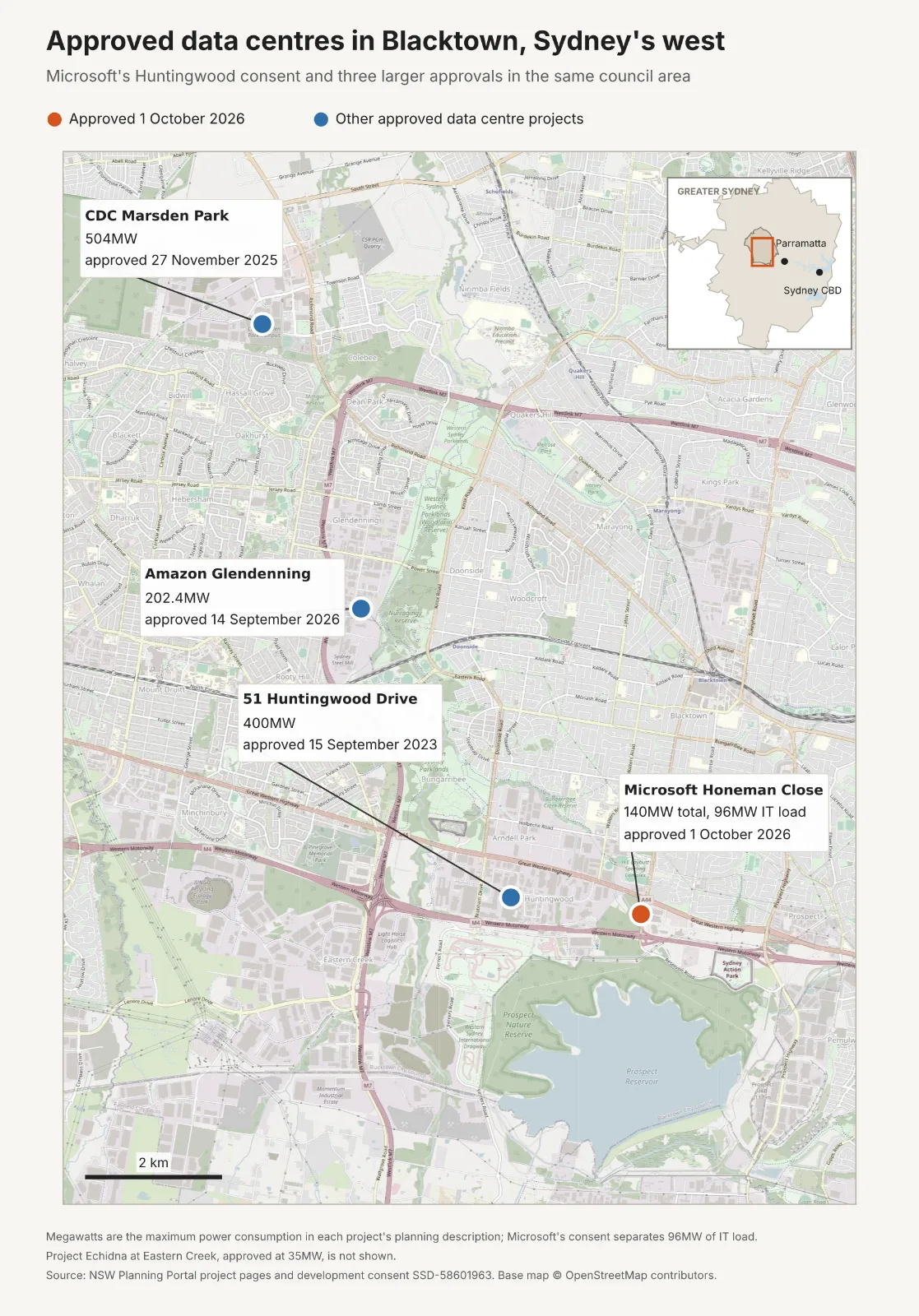
Huntingwood sits in the Blacktown cluster mapped in data centres in Western Sydney, where Amazon won approval at Glendenning on 14 September and CDC at Marsden Park in November 2025. Microsoft has committed A$25 billion in Australia to the end of 2029, and Honeman Close joins the directory of data centres in Australia as an approved project.
What to watch
The first contracting update. Microsoft's first evidence under condition B31 is due six months after construction starts. The department then receives an update every six months.
The Senate report. The committee reports on 16 November. Its recommendations arrive before the national standards are legislated.
The national definition of additional. The national standards may settle whether renewable contracts signed before the rules count. Microsoft, Google and Amazon each hold Australian renewable contracts signed before the rules were set.
The federal environment approval. W.Media reported that the project is also being assessed under the federal environment law, the EPBC Act. The federal decision is a separate approval from the NSW consent.