
Melbourne leads Asia Pacific data centre leasing as approvals slow
By Winston Su, Editor · · Add us as a preferred source on Google

At a glance
Melbourne overtook Johor to lead Asia Pacific for data centre leasing, with 1,546MW leased to 30 September 2026, according to market researcher datacenterHawk. Its 1,370MW in the September quarter was more than every European market combined.
It did so despite an apparent pause on Victorian approvals before the state election, noted by industry body Data Centres Australia and researcher DC Byte, and the suspension of power works for NEXTDC's M3 campus in September.
Nine Victorian data centre applications, Stockland's 250MVA Brooklyn campus among them, have been held over until after the 28 November election.
Monash City Council refused Centuria's 38MW Clayton data centre, and NEXTDC has kept M4 and M5 on hold until they have customer contracts. None of these plans has been withdrawn.
AirTrunk at Mickleham and HyperDC at Moorabool are moving their plans forward.
Melbourne leased more data centre capacity than any other Asia Pacific market in the first nine months of 2026, according to market researcher datacenterHawk's third-quarter Asia Pacific report. Customers took 1,546MW in Melbourne to 30 September, ahead of 1,279MW in Malaysia's Johor, and 1,370MW of that was leased in the September quarter alone.
Melbourne built that lead while Victorian approvals slowed. Industry body Data Centres Australia and data centre researcher DC Byte noted an apparent pause on approvals ahead of the November state election, Hume and Melton councils called for a moratorium in August, and electricity distributor Jemena suspended the power works for NEXTDC's M3 campus in September. Since late September, Monash City Council has refused a Melbourne data centre, NEXTDC has kept M4 and M5 on hold until they have customer contracts, and nine data centre applications worth about A$5 billion have been held over since Victoria entered the caretaker period on 3 November.
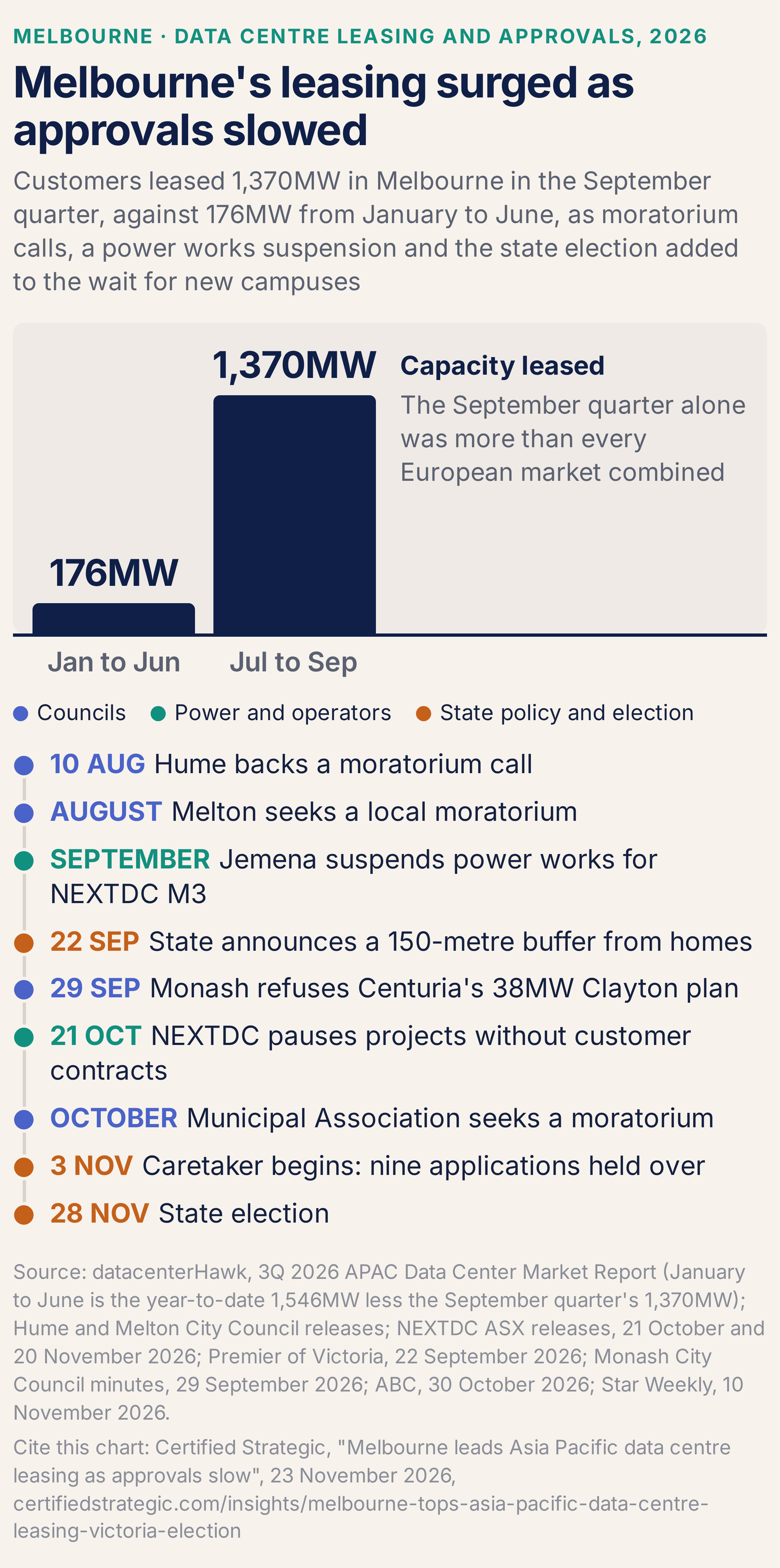
Melbourne leads the region on demand in spite of slower approvals, and none of its stalled plans has been withdrawn. Centuria can ask the state tribunal to review its refusal, M4 keeps the approval it won in January, and the nine held-over applications wait for the planning minister in the government formed after the 28 November vote.
Plan and developer | Site and size | What happened |
|---|---|---|
Clayton data centre, Centuria Industrial REIT | 1816-1832 Dandenong Road, Clayton. 38MW, A$137 million | Refused by Monash City Council on 29 September, against its officers' recommendation |
M4, NEXTDC | 127 Todd Road, Port Melbourne. 150MW of IT capacity, approved January 2026 | On hold from 21 October, no customer contract |
M5, NEXTDC | Melbourne, location not named. 1,200MW of IT load | On hold from 21 October, no customer contract |
M3 Stages 6 and 7, NEXTDC | West Footscray. Final stages of a 225MW campus | Planning decision not expected until 2027. Jemena's power works not expected to restart before February 2027 |
Nine held-over applications, including Stockland at Brooklyn | Brooklyn application 250MVA, lodged 21 May | Held over until after the 28 November election |
Source: Monash City Council minutes, 29 September 2026; W.Media; NEXTDC ASX releases, 21 October and 20 November 2026; NEXTDC FY26 results, August 2026; NEXTDC; Victorian ministerial permits register; The Australian Financial Review; Star Weekly, 10 November 2026.
Melbourne leads Asia Pacific for data centre leasing so far in 2026
Melbourne was second to Johor for leasing in Asia Pacific in 2025. In the first nine months of 2026 it moved to first, ahead of Johor at 1,279MW, Jakarta at 973MW and Sydney at 710MW. Its 1,370MW in the September quarter alone was more than twice its total for all of 2025 and more than every European market combined. datacenterHawk's Melbourne market page also ranks the city first in Asia Pacific for planned colocation capacity that has not yet broken ground.
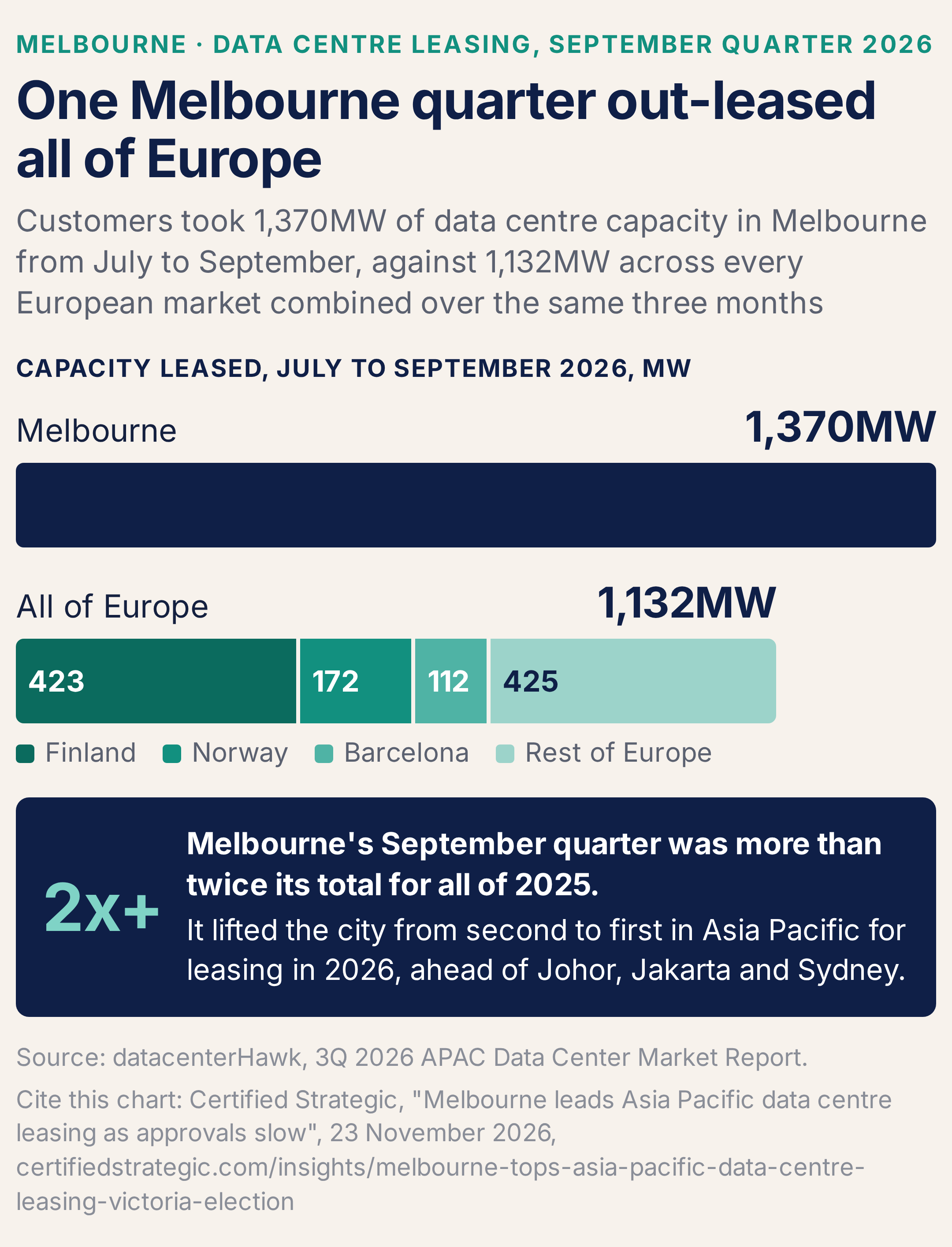
Across Asia Pacific, 94 per cent of leasing to 30 September was preleased, signed before the capacity was built. The midpoint of Melbourne's hyperscale rate range rose 32 per cent from 2025 to 2026, against 16 per cent in Sydney, and datacenterHawk puts rising hyperscale rates across the region down to scarcity. Donny Gunadi, datacenterHawk's senior insight analyst for Asia Pacific, told trade publication W.Media that Australian capacity is generally not being developed without firm customer commitments, and that "we are not seeing signs of speculative over-ordering in Australia". He expects regional New South Wales and Victoria to become dominant themes in Australian development in 2027, and said the projects that progress will be those that engage early with communities and show clear local benefits.
Nine applications wait for the next planning minister
Planning Minister Sonya Kilkenny did not decide nine outstanding data centre proposals before caretaker began. Melbourne local newspaper Star Weekly reported on 10 November that a spokesperson for the minister had confirmed decisions on applications in the Development Facilitation Program were deferred until after the 28 November poll. The program is an accelerated state pathway for significant economic projects, with the planning minister as decision-maker. Stockland's 250MVA Brooklyn campus, lodged on 21 May, is among the nine, and its entry on the ministerial permits register records no decision.
A Victorian government spokesperson told the ABC on 30 October that data centres "can't be built near homes" and must bring their own power supply. An opposition spokesperson said that under a Liberal and Nationals government data centres would not be built in or next to residential areas or green wedges, and would be placed in "Data Centre Precincts". The Greens have called for a moratorium on new AI data centres.
Monash refuses Centuria's Clayton data centre
Centuria Industrial REIT applied to replace two buildings on the Telstra-occupied data centre campus at 1816-1832 Dandenong Road, Clayton, in Melbourne's south-east, with a four-storey data centre. W.Media reported the plan at 38MW and A$137 million. The council minutes record that at Monash City Council's meeting on 29 September a motion to grant the permit with conditions was lost, and councillors carried an alternative motion to refuse it.
The council's written grounds rely on the existing Monash Planning Scheme. The first says the development "would result in an unacceptable intensification of the data centre use on the land that is not in the net community benefit". The second cites the proposal's energy demands and wider infrastructure footprint, including 66kV powerlines, and the third cites the scheme's general decision guidelines on environmental effects.
Centuria lodged the application with the council, so it can ask the Victorian Civil and Administrative Tribunal to review the refusal, an option not open to applications on the state's fast-track pathway. Centuria also has a separate application for a second data centre of up to 40MW on the same site, which the Clayton refusal does not cover.
NEXTDC keeps M4 and M5 on hold and may sell sites near homes
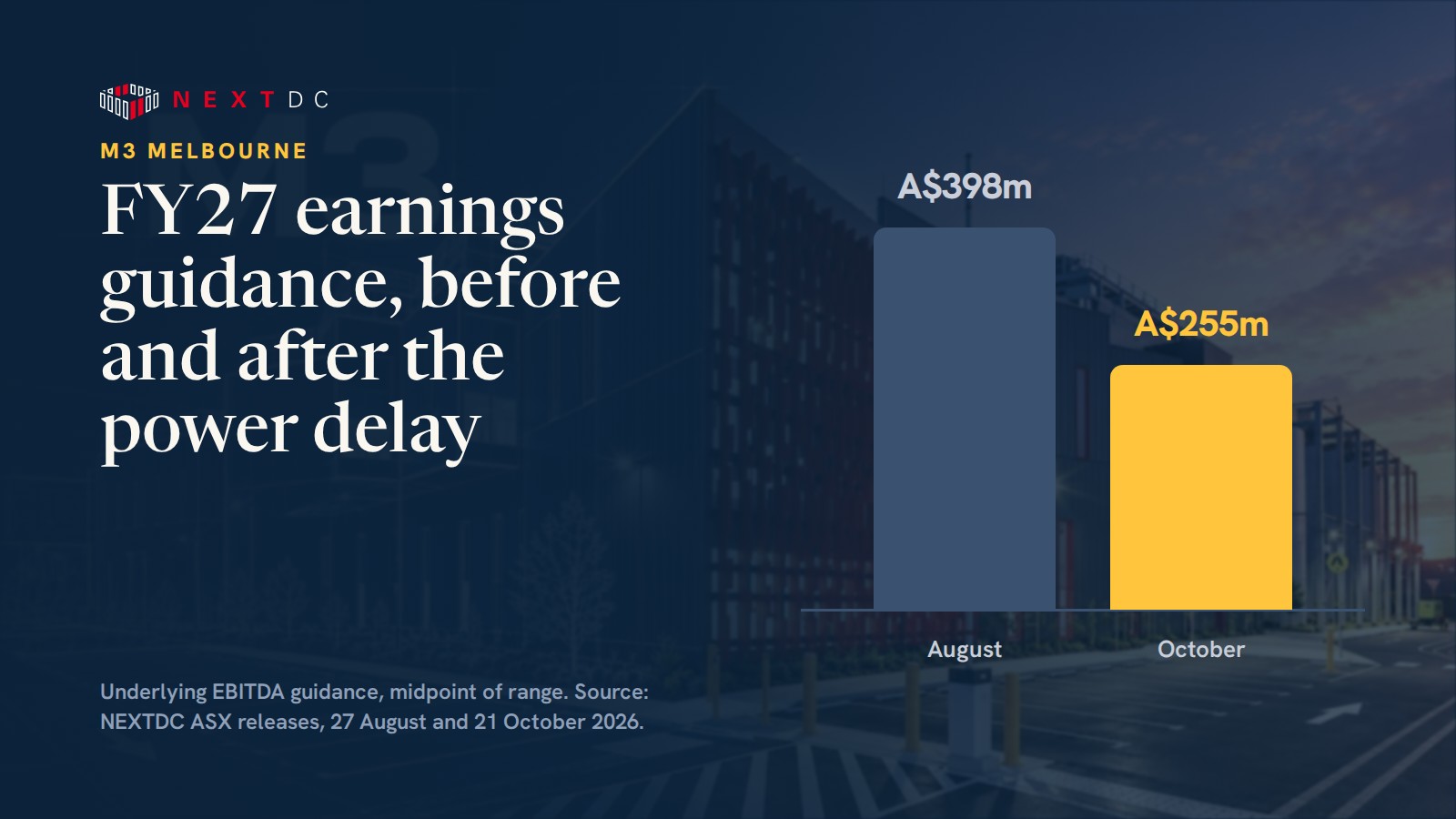
NEXTDC put new development projects and land purchases on hold on 21 October, after a delay to power at M3 forced it to cut its FY27 guidance. Its ASX release of 20 November, after a project-by-project review of its spending, said uncontracted projects "including M4, M5, S5, S7, GC1 and AK1" remain on hold, along with new land purchases, while capital goes first to contracted capacity, mainly at S4 Sydney, M2 Melbourne, M3 Melbourne and KL1 Kuala Lumpur. NEXTDC will commit new capital to a project only when it has customer contracts, expected returns above its cost of capital, sufficiently advanced power and planning, and funding in place.
M4 at Port Melbourne won Victorian approval in January 2026, and NEXTDC has put 1,200MW of IT load on M5 without naming its location. The same release said NEXTDC is evaluating the sale of some development sites, that no decision has been made, and that sales are not expected soon except for "development sites near residential properties that NEXTDC no longer intends to develop".
In their AGM address, NEXTDC's chairman and chief executive said the company builds only on land zoned industrial, and that community views on industrial areas have changed as opposition to data centres and AI has grown. NEXTDC does "not intend to pursue new development opportunities that are near residential properties", and it is setting up a community consultative committee for M3 and a community engagement plan for every site in Australia and Asia.
Jemena does not expect to restart M3's power works before February 2027
M3 has been under development in an industrial precinct in West Footscray since 2021, and is planned at 225MW. Its next increase in power needs Jemena to install new 66kV lines, and Jemena suspended parts of those works in September 2026, citing safety concerns and a lack of access to work sites. Jemena does not expect to restart them before February 2027, NEXTDC told the ASX on 21 October, when it took the affected M3 contracts out of its FY27 guidance. Construction continues on the approved, contracted capacity at M3.
NEXTDC and Jemena are working on alternative routes through industrial streets and underground, alternative substations and upgrades to existing feeders, and Jemena will lead consultation and approvals once its technical solution is finalised. The planning decision for M3 Stages 6 and 7, the final stages of the campus, sits with the Victorian Government. NEXTDC said on 21 October that it did not expect that decision until 2027, and on 20 November that it expects the process to resume after the election.
AirTrunk, HyperDC and GreenSquareDC keep their plans moving
HyperDC's application for a data centre campus at Moorabool, north-west of Geelong and beside AusNet's Moorabool Terminal Station, was received on 22 September. AirTrunk set out its plans on 9 November for a campus at 45 Donnybrook Road, Mickleham, where an application for seven data centre parcels went into the state pathway on 1 July, and it proposes an A$26.5 million community package subject to approvals.
GreenSquareDC's 240MW Spotswood application, on a former fuel depot in Melbourne's inner west, is also with the state. Victoria's new rules, including a 150-metre buffer from homes, do not apply to applications under assessment when they were released, and the Mickleham and Brooklyn sites both sit more than 150 metres from homes. AirTrunk says the Mickleham site is more than 400 metres from the nearest home, and the noise assessment that acoustic consultant Marshall Day Acoustics prepared for Stockland puts the nearest homes about 170 metres from the Brooklyn site.
Councils call for a pause as Victoria sets a 150-metre buffer
Victoria's Sustainable Data Centre Action Plan, released on 22 September, says new data centres will keep a 150-metre buffer between a home and a data centre building, and will be prohibited on residential and Green Wedge Zone land. The rules are not retrospective for applications under assessment, the Premier's office said on 22 September.
The ABC reported on 30 October that the Municipal Association of Victoria, the peak body for all 79 of the state's councils, had resolved at its October state council to seek a moratorium on approvals for all new or expanded data centres until a comprehensive planning and environmental framework is in place. MAV president Jennifer Anderson said the resolutions "added weight" to councils' concerns and called for "a proper partnership" with the state government. Hume City Council, whose area takes in Mickleham, endorsed a call for a statewide moratorium on 10 August, and Melton City Council has sought one in its own area.
Melbourne's pipeline reaches 10.7GW, ahead of Sydney's 7.8GW
Data Centres Australia and DC Byte put Melbourne's total pipeline at 10.7GW at 30 September 2026, up 1.7GW from April and larger than Sydney's 7.8GW, in their Australian Data Centre Forecast Report. Melbourne moved 1.2GW of capacity from early stage into committed over the six months, against 0.7GW in Sydney, which the report says "may indicate the impact of faster approval processes through the Victorian Government's Development Facilitation Program".
The report's charts show 1.4GW of capacity running in Melbourne by 2030 and 2.0GW in Sydney. The national forecast for 2030 rose to 3.9GW, from 3.2GW in April. Its data runs to 30 September, before NEXTDC's pause and the caretaker period. Melbourne's operating campuses cluster west of the city, and the two-year wait for planning and grid connection limits how much of the pipeline can be running by 2030.
What to watch
The 28 November election. The planning minister in the government formed after the vote decides the state-pathway applications, including Brooklyn and Mickleham, and the M3 Stages 6 and 7 decision also sits with the Victorian Government.
Centuria's next step. Centuria can seek a tribunal review of the Clayton refusal, and its second application on the site, for up to 40MW, is still to be decided.
Jemena's solution for M3. Jemena will lead community consultation and approvals once its technical solution is finalised, and it does not expect to restart the suspended works before February 2027.
NEXTDC's site sales. NEXTDC has made no decision on selling development sites, and has said the sites near homes it no longer intends to develop are the exception.
Keep reading the market
Get The Strategic Brief in your inbox every Thursday.
The leading Australian data centre and AI infrastructure newsletter.
Your Next Read


Latest Headlines
Hydro Tasmania says gas would bridge AI data centre supply
23 Nov 2026Southeast Asia steps up data centre oversight under US curbs
22 Nov 2026Australia pitches digital infrastructure to UK pension funds
21 Nov 2026Australia's data centre construction spend to grow fastest
20 Nov 2026Sydney's data centre pipeline sheds four early-stage plans
20 Nov 2026
Interested in reaching this audience? Advertise with us.