
Japan's data centre market: hyperscalers and the Australian firms
By Winston Su, Editor · · Add us as a preferred source on Google

Greater Tokyo had 1,397MW of operating data centre capacity at mid-2026, the most of any primary market in Cushman & Wakefield's latest Asia Pacific update. Johor follows at 1,110MW, then Singapore at 1,068MW and Sydney at 917MW.
Microsoft, Amazon Web Services and Oracle have each pledged billions of dollars for cloud and AI infrastructure in Japan since 2024, and Australian companies AirTrunk, Goodman and NEXTDC are building there too. We launched our Japan data centre map on 14 November 2026. It has 41 campuses, with their status and the cable routes to Australia.
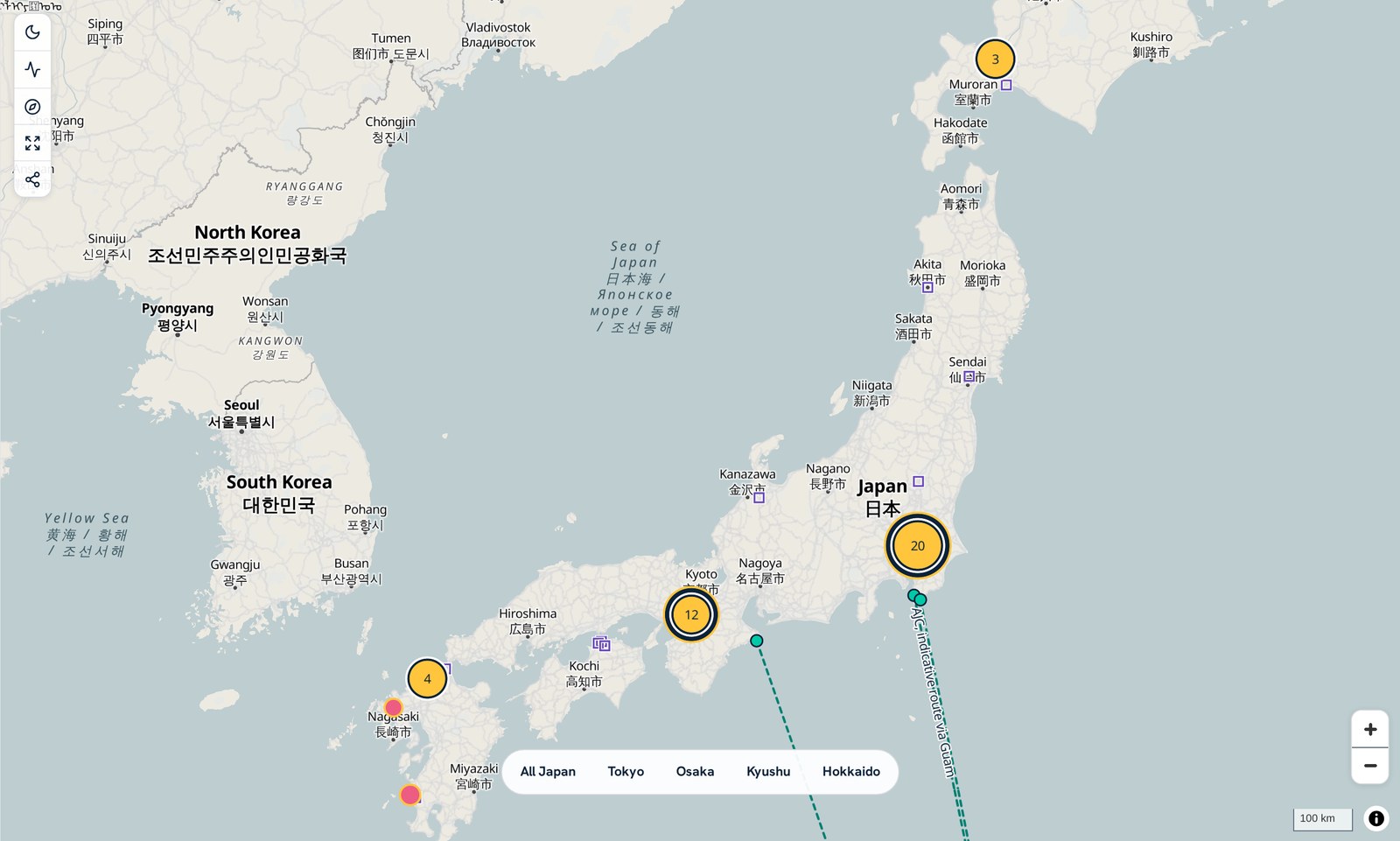
Tap any campus on our Japan data centre map for its status, capacity and operator, or jump straight to Tokyo, Osaka, Kyushu or Hokkaido.
Cushman's primary-market pages leave out mainland Chinese cities. In its 2026 global comparison, the adviser calls Beijing "the region's dominant market" and the only Asia Pacific market with more than 2GW in operation. CBRE puts Japan in the top tier of its Asia Pacific outlook, alongside mainland China, India, Malaysia and Australia.
Japan's subsea cable hub has two links to Australia
Japan is "the telecommunications hub responsible for nearly all of the U.S.-Asia bandwidth", the Center for Strategic and International Studies wrote in August 2025, counting more than 20 international cable landing stations and about 30 active or announced international cable systems.
The Australia-Japan Cable has been in service since December 2001, landing at Shima and Maruyama in Japan and running through Guam to Sydney. The Japan-Guam-Australia system came into service in 2020, with its northern and southern cables joined at Piti in Guam. Our Japan map draws both routes to Australia as indicative lines.
Brisbane company SUBCO plans a third link, APX North, announced on 22 September. The 9,500km cable would run from Sydney to Japan via Guam, with some fibre pairs bypassing Guam, and is targeted for 2029.
Japanese companies build and fund data centres across the region
NTT DATA describes itself as the world's third-largest data centre provider, with more than 2,000MW of IT load in over 20 countries, and in March 2025 it opened a campus in India that can hold more than 500MW when fully built.
Japanese banks lend to AirTrunk in Japan and Australia. Sumitomo Mitsui Banking Corporation and MUFG Bank led a JP¥191.6 billion (US$1.24 billion) green loan for AirTrunk's Tokyo campus in March 2026, and in October Mizuho, MUFG and Sumitomo Mitsui were among the 14 lead banks on an A$4.25 billion green loan for AirTrunk's SYD3 campus in Western Sydney.
The government plans more than ¥10 trillion of support for AI and chips
The government has set out more than ¥10 trillion of support for AI and semiconductors over the seven years to the 2030 financial year, and METI, the industry ministry, says the money aims to draw more than ¥50 trillion of public and private investment over ten years.
In April 2024, METI offered subsidies of up to ¥72.5 billion for Japanese GPU cloud computing, with about ¥50.1 billion of it for Sakura Internet.
To plan for power, METI and the communications ministry set up a "watt-bit" council in March 2025, where power, telecommunications and data centre companies discuss building grid and network capacity together. In September 2026, the Cabinet Secretariat set up a council on where data centres should go and how they fit with local communities, and it plans to compile an action plan by the end of the year.
The world's cloud companies have pledged billions
Microsoft committed US$2.9 billion over two years in April 2024, and in April 2026 announced a further US$10 billion from 2026 to 2029 for AI infrastructure, cybersecurity and training.
Amazon Web Services said in January 2024 that it plans to invest ¥2.26 trillion in its Tokyo and Osaka cloud regions by 2027. Oracle said in April 2024 it would invest more than US$8 billion in Japan over ten years.
Among Japan's own telecommunications groups, NTT plans to lift its Japanese data centre capacity from about 300MW to about 1GW by the 2033 financial year. KDDI opened its Osaka Sakai data centre on the former Sharp LCD plant in January 2026, and SoftBank is turning its own part of the site into an AI data centre.
Among global operators, MC Digital Realty is building KIX15, a 24MW data centre in Osaka. The venture of Digital Realty and Mitsubishi Corporation will then have about 220MW across ten data centres, Digital Realty said in October.
Tokyo and Osaka hold 32 of the map's 41 campuses
Most of those projects sit around the two biggest cities. Our map places 20 campuses in the Kanto region around Tokyo and 12 in the Kansai region around Osaka, with 6 in Kyushu and 3 in Hokkaido.
JLL, citing government figures, says more than 80 per cent of Japan's capacity sits in Greater Tokyo and Greater Osaka. In September 2025 JLL put the wait for a grid connection at eight to ten years in Tokyo, against three to five in Osaka.
AirTrunk has four campuses in Tokyo and Osaka
Of the Australian companies on the map, AirTrunk has the most campuses in Japan. Robin Khuda founded the company in 2015, and Blackstone and CPP Investments completed their purchase of it in December 2024, at an implied enterprise value of more than A$24 billion.
AirTrunk announced its move into Japan in September 2020 and opened TOK1 at Inzai, east of Tokyo, in November 2021, a campus planned at more than 300MW at full build-out. TOK2 in west Tokyo opened in May 2024 and is planned at more than 110MW.
In Osaka, AirTrunk described its 20MW OSK1 as its existing West Osaka facility in December 2025, though its website still lists OSK1 as coming soon. It announced OSK2 in East Osaka on 17 December 2025, at up to 100MW, and says its four Japan campuses will deliver about 530MW at full build-out.
In October, Khuda told Nikkei Asia that AirTrunk plans to lift its Japan investment to as much as US$30 billion within five years. It has US$9 billion committed so far, including the US$1 billion it is putting into TOK1 to expand the campus and install liquid cooling for AI workloads. Its owner gave a similar figure in June, when Blackstone president Jonathan Gray told Nikkei the firm plans to invest US$30 billion in Japanese AI data centres over three to five years.
Khuda wrote in October that 224 Japanese suppliers earned more than A$1.5 billion from their work with AirTrunk in the 2026 financial year. On 5 October, Treasurer Jim Chalmers and Japanese Finance Minister Satsuki Katayama signed a memorandum in Tokyo, which names digital infrastructure among five sectors where the two governments will consider using their state-owned lenders.
AirTrunk campus | Place | Stage |
|---|---|---|
Inzai, Chiba | Opened November 2021, more than 300MW at full build-out | |
West Tokyo | Opened May 2024, more than 110MW at full build-out | |
West Osaka | 20MW; AirTrunk's own pages differ on whether it is open | |
OSK2 Osaka Downtown East | East Osaka | Announced December 2025, up to 100MW (not pinned) |
Source: AirTrunk releases, via the Certified Strategic Japan map, read 15 November 2026.
Goodman is building a 1GW campus at Tsukuba
Goodman Group says it entered Japan in 2007, and it set up its first Japanese data centre partnership in 2023. Its global power bank, the power it holds or is securing for data centres, stood at 6.6GW at 30 September 2026.
Tsukuba Tech Central in Ibaraki, north-east of Tokyo, is its largest Japanese project, and Goodman calls it a 1GW campus. In August a global hyperscale customer signed a 20-year lease for the first 50MW building, with service due in early 2028.
Closer to the city, Goodman has more than 300MW of data centre projects at Goodman Business Park in Inzai, where STT GDC's Tokyo campus sits. In May it became lead development partner for a possible campus at Sagamihara in Kanagawa, south-west of Tokyo.
NEXTDC is building TK1 next to Tokyo Tower
NEXTDC has broken ground on TK1, its first Japanese data centre, in Tokyo's Minato ward next to Tokyo Tower, and is building it with CBRE Investment Management. The company calls TK1 "a new AI-ready landing zone at the centre of Japan's connectivity ecosystem".
Its December 2025 release gives 28MW of planned IT capacity and targets completion in late 2030. Its August 2026 results give about 30MW of total planned power, with completion in the 2030 financial year, which ends in June 2030. The company's Malaysian data centre, KL1 in Kuala Lumpur, opened to its first customer in May 2026.
Lendlease built PDG's campus in Saitama
Australian property group Lendlease has built for the Japanese market too. It developed and built the structure and outer shell of Princeton Digital Group's TY1 campus in Saitama, north of Tokyo, on a long-term lease to PDG. The two companies broke ground in June 2022, and Lendlease finished that work on the first 48MW phase in March 2024.
PDG opened TY1 in April 2025 as a US$1 billion campus with 96MW of IT capacity, and the map lists it under PDG.
Kyushu and Hokkaido are among the places the government wants new campuses
Away from Tokyo and Osaka, the government is steering new data centres to regional sites, including two each on Kyushu and Hokkaido. On 11 September, METI certified the first round of its GX strategic regions. GX stands for green transformation, and the regions are meant to build new industry around renewable and nuclear power.
Its data centre cluster towns include Kitakyushu and Satsumasendai in Kyushu, Ishikari and Tomakomai in Hokkaido, and Tsukuba, the city where Goodman is building.
Of the two islands, Kyushu has more new projects, with five under construction or planned against one in Hokkaido. Researcher DC Byte counted about 21MW of live capacity on Kyushu in June 2026 and about 3GW planned, up from about 101MW of plans in 2023.
Kyushu campus | Developer | Capacity | Stage |
|---|---|---|---|
SoftBank | Not published | Operating since 2008 | |
Asia Pacific Land and Global Compute Infrastructure | 120MW | Site works started 2026 | |
Asia Pacific Land | 300MW | Planned | |
NTT West | 5MW | Planned, due by March 2030 | |
DayOne | 200MW | Planned, first phase 2030 | |
Kai Shin Digital Infrastructure | 350MW (sources differ on whether this is the first stage or the total) | Planned |
Source: company releases and city records, via the Certified Strategic Japan map. Capacity is as each source states it, and the measures differ.
Hokkaido's biggest project is SoftBank's AI data centre at Tomakomai, where the first 50MW building is due to open in the year to March 2027. SoftBank chose Hokkaido for its cool climate, its renewable power and its distance from Tokyo and Osaka.
Hokkaido campus | Developer | Capacity | Stage |
|---|---|---|---|
SoftBank | 50MW first building | Under construction, due in the year to March 2027 | |
Sakura Internet | Not published | Operating since 2011 | |
A company formed by Tokyu Land, Flower Communications and Agility Asset Advisers | 15MW | Operating since August 2026 |
Source: SoftBank, Sakura Internet, Impress Cloud Watch and ASCII, read 15 November 2026.
Further north in Ishikari, the city set up a data centre consortium with Sakura Internet and other operators in July 2026, aiming to make it Japan's next data centre hub after the Kanto and Kansai regions.
In July 2025 SoftBank said it would build landing stations on both islands, at Tomakomai in Hokkaido and Itoshima in Fukuoka, for the E2A cable linking Japan, Taiwan, South Korea and the US.
We expect both islands to draw more campuses over the next two years, because METI has named data centre clusters on each, SoftBank has sites on both, and DayOne and NTT West have chosen Kyushu.
What to watch
Japan's data centre siting plan. The Cabinet Secretariat's new council plans to compile its action plan on data centre locations and local communities by the end of 2026.
SoftBank's Tomakomai opening. The first 50MW building of SoftBank's Hokkaido AI data centre is due to open in the year to March 2027.
Hibikino's building start. Asia Pacific Land has told residents that building works on the 120MW Kitakyushu campus will start before the end of March 2027, a reporter said at the city's October briefing.
NTT DATA's TKY11. The first 24MW building of NTT DATA's 50MW campus at Shiroi, in Chiba, is due in April 2027.
Goodman's Tsukuba handover. The first 50MW building is due to start service in early 2028.
Keep reading the market
Get The Strategic Brief in your inbox every Thursday.
The leading Australian data centre and AI infrastructure newsletter.
Your Next Read
AirTrunk plans up to US$30bn for Japan
AirTrunk raises A$4.25 billion and plans A$75 billion more in Australia

Goodman and Digital Realty raid NEXTDC shares at A$9.50
Latest Headlines
Dataspace launches with 14.5MW across five ex-Fujitsu sites
17 Nov 2026US acts to stop China renting AI chips in Asian data centres
17 Nov 2026Firmus seeks upfront payments from NVIDIA and Meta in A$4.4bn raise
17 Nov 2026Sharon AI misses on revenue as its price per megawatt climbs
17 Nov 2026IREN starts NSW approval for 900MW Wagga Wagga data centre
17 Nov 2026
Interested in reaching this audience? Advertise with us.