At a glance
AirTrunk is investing a further US$1 billion in TOK1, its 300MW-plus campus at Inzai, east of Tokyo, to expand capacity and install liquid cooling for AI workloads.
A US$1 billion green loan led by Sumitomo Mitsui Banking Corp, MUFG Bank and United Overseas Bank funds the work and takes AirTrunk's Japan investment to US$9 billion.
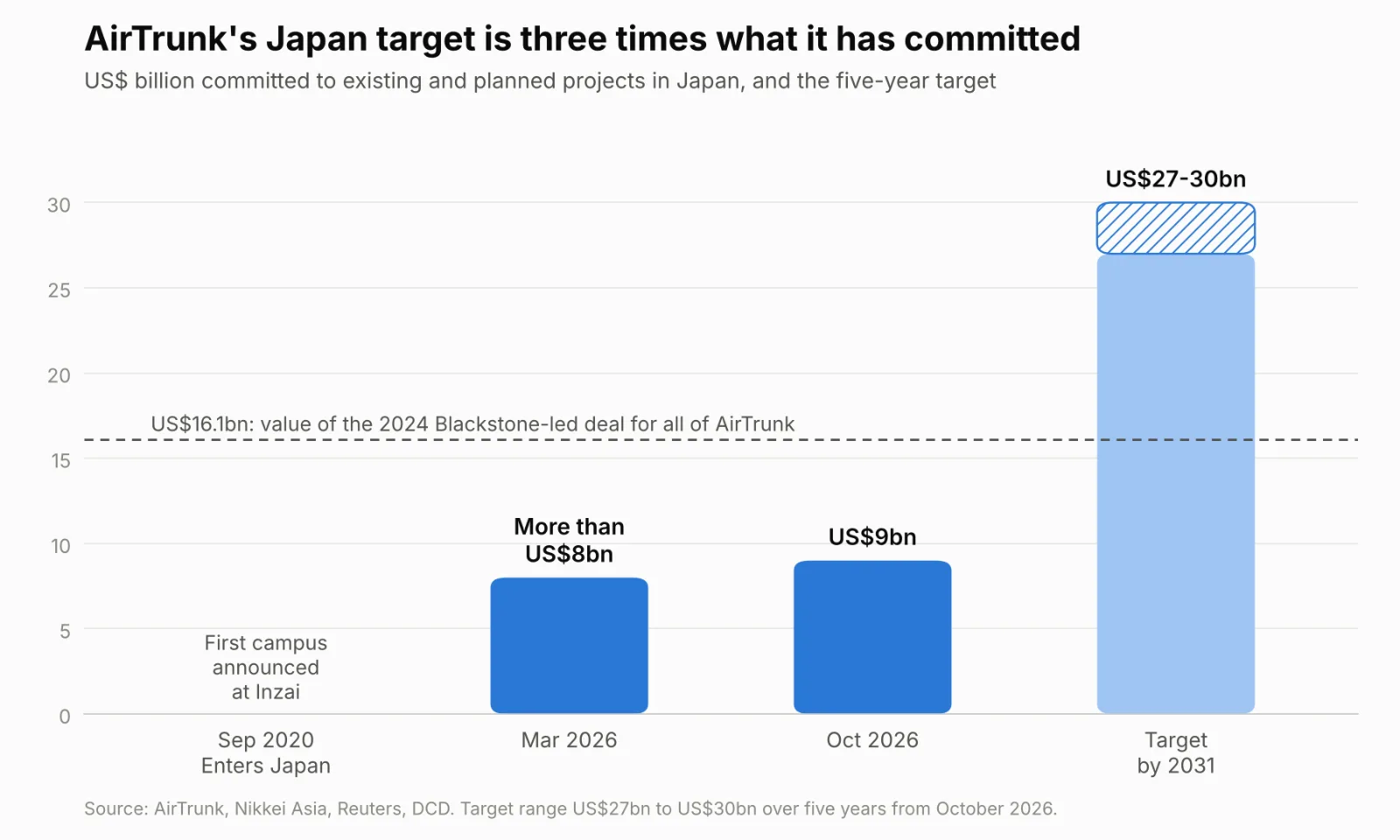
AirTrunk entered Japan in 2020 with one Inzai campus. Founder and chief executive Robin Khuda told Nikkei Asia it plans to lift its Japan investment to between US$27 billion and US$30 billion over the next five years, and its Japan capacity past 1GW.
The target mirrors the US$30 billion, 1GW-plus Japan plan Blackstone president Jonathan Gray set out in June 2026.
Khuda counts Australia among the four Asia-Pacific markets that will carry the region's AI build, and the Australian Financial Review has reported Anthropic in advanced talks for AirTrunk's 540MW Kurri Kurri campus.
From one Inzai campus in 2020 to a US$30bn Japan target
AirTrunk entered Japan in September 2020 with a single plan: a hyperscale campus at Inzai in Chiba Prefecture, east of Tokyo, scalable past 300MW, which the Sydney-founded operator said at the time would be among the largest independent data centres in Asia. Six years on it has four Japanese campuses, TOK1 and TOK2 in the Tokyo area and OSK1 and OSK2 in Osaka, designed for about 530MW at full build-out, and US$9 billion committed to existing and planned projects in the country.
AirTrunk founder and chief executive Robin Khuda now plans to lift that to as much as US$30 billion within five years, he told Nikkei Asia on 7 October 2026. US$9 billion over six years averages about US$1.5 billion a year. Reaching US$27 billion to US$30 billion by 2031 takes between US$3.6 billion and US$4.2 billion a year, more than double the rate of commitment so far. The top of the range is almost twice the roughly US$16.1 billion at which a Blackstone-led consortium valued the whole of AirTrunk when it agreed to buy the company in 2024.
US$1bn turns TOK1 toward AI workloads
The first step is at Inzai. AirTrunk is putting a further US$1 billion into TOK1, Nikkei Asia reported, and the company confirmed the investment to Reuters the same day. The money expands the campus and installs liquid cooling, which carries heat away from the chips in fluid and lets a site run the dense racks that AI data centres depend on. TOK1 was built for cloud workloads, and Khuda said it is likely to be the first campus in Japan to host AI deployments at large scale.
The work is funded by a US$1 billion green loan led by Sumitomo Mitsui Banking Corp, MUFG Bank and United Overseas Bank, DCD reported. It follows a ¥191.6 billion (US$1.24 billion) green loan for the same campus in March, which AirTrunk described as the largest data centre financing completed in Japan. That facility refinanced TOK1 and funded its next phases, including more than 100MW of IT load then under construction.
Measure | March 2026 | October 2026 |
|---|---|---|
TOK1 green loan | ¥191.6bn (US$1.24bn) | US$1bn |
Lead banks | SMBC, MUFG, Crédit Agricole CIB, Société Générale | SMBC, MUFG, United Overseas Bank and others |
Japan investment | More than US$8bn | US$9bn, with US$27-30bn targeted within five years |
Japan capacity | About 530MW at full build-out of four campuses | Target of more than 1GW |
Source: AirTrunk, Nikkei Asia, Reuters, DCD, W.Media, March and October 2026.
Customers, power and lenders point AirTrunk to Japan
AirTrunk has not set out its reasons beyond Khuda's comments, but the public record points to three conditions that suit a build of this size.
The first is customer demand. AirTrunk builds for the large cloud and AI companies, and they are spending heavily in Japan. Amazon Web Services has earmarked about ¥2.26 trillion through 2027 and Oracle US$8 billion over ten years, and Microsoft committed about US$10 billion for 2026 to 2029 in April 2026, on top of the US$2.9 billion it pledged in 2024.
The second is power. A new grid connection in Tokyo can take eight to ten years, on JLL's figures, against three to five in Osaka. AirTrunk secured high-voltage power for Inzai, with dedicated 66kV substations, when it announced the campus in 2020. A campus with its grid connection in place can add capacity years ahead of a new site, which fits Khuda's remark to Nikkei Asia that customers are "happy to pay a premium" for capacity in Japan.
The third is finance. Japanese lenders Sumitomo Mitsui Banking Corp and MUFG Bank co-led both of AirTrunk's TOK1 green loans in 2026, putting more than US$2 billion of green debt behind a single campus in seven months.
Khuda also told Reuters that geopolitics has "more and more customers looking to Japan from a North Asian perspective", and that AI infrastructure will become harder to deploy in the United States and is difficult in Europe, leaving Asia to gain.
The target mirrors Blackstone's June plan
Blackstone and Canada Pension Plan Investment Board own AirTrunk. In June 2026, Blackstone president and chief operating officer Jonathan Gray told Nikkei the firm plans to invest US$30 billion in Japanese AI data centres over three to five years, with more than 500MW developed in the country and discussions under way on facilities totalling more than 1GW. Blackstone is building its Japan data centres with AirTrunk, and the operator's new five-year target carries the same dollar figure and the same gigawatt threshold.
What it means for Australia
Khuda counts Australia in the same Asia-Pacific build. In a July 2026 interview with the Kyodo-group wire NNA, he named Japan, Australia, the Singapore-Malaysia zone and India as the four markets that will carry the region's cloud and AI build. If AI capacity that is hard to build in the United States and Europe moves to Asia-Pacific, as Khuda expects, Australia is one of the four markets he names to receive it.
At home, AirTrunk has proposed a 540MW campus at Kurri Kurri in the NSW Hunter, where Anthropic is in advanced talks to be the anchor tenant, the Australian Financial Review reported on 22 September 2026.
What to watch
TOK1's liquid-cooled capacity. A completion date for the AI-ready halls will show when the campus can host the deployments Khuda describes.
New Japanese sites. Passing 1GW means adding about 470MW to the 530MW planned across the four campuses, and AirTrunk has not said where that capacity will sit. The Japanese government has offered subsidies for data centres in Hokkaido and Kyushu, away from Tokyo and Osaka.
Kurri Kurri. The NSW Government's assessment of the 540MW campus and any signed Anthropic agreement are the next public steps for AirTrunk's Hunter project.